St Ann’s Church, Manchester: An 18th-Century Parish Church
Site at a Glance
- Rating
- 4.6
- Popularity
- High
- Country
- United Kingdom
- Primary era
- Early Modern
- Eras represented
- Early Modern, Modern
- Civilizations
- British
- Site type
- Religious
- Remains
- Church
On this page8 sections
History
St Ann’s Church is an 18th-century parish church in Manchester, United Kingdom, built in a neoclassical style inspired by ancient Greek and Roman architecture. Ann, Lady Bland, founded it as Manchester’s population grew. Its foundation stone was laid in 1709, and it was consecrated in 1712. The church remains an active parish of the Church of England, the Anglican church in England, and follows the Broad Church tradition, which allows a wide range of theological views.
Foundation and the growth of St Ann’s Square
Lady Bland inherited the manor of Manchester in 1693. After Henry Newcome, the town’s incumbent priest, died in 1695, she decided to establish a church of her own. A prominent member of Manchester society, she belonged to the Low Church Party, an Anglican movement that emphasized Protestant theology and relatively plain worship. Before founding St Ann’s, she worshipped at the town’s Presbyterian church. In 1708, a petition was made to Parliament for permission to build a new church, in response to the town’s growing population. Lady Bland laid its foundation stone at Acres Field on 18 May 1709. The Bishop of Chester consecrated the church on 17 July 1712, dedicating it to Saint Anne, traditionally regarded as the mother of the Virgin Mary, and to the reigning Queen Anne, who ruled from 1702 to 1714.
When St Ann’s was founded, Manchester was still a small town of fields and timber-framed houses. Acres Field had hosted an annual fair since the 13th century; in 1823, the fair moved to Knott Mill. St Ann’s Square was laid out and planted with trees by 1720, following the fashion for squares in London and Bath. By 1735, buildings were rising on its south side, and King Street and Ridgefield had been established.
Religious and civic life
St Ann’s stood near Manchester’s collegiate church, a church served by a chapter of clergy rather than a monastic community. It became fashionable for people to attend one church in the morning and the other in the afternoon. John Byrom, prominent at St Ann’s under its first two rectors, was among them despite his Jacobite sympathies. Jacobites supported the restoration of the Stuart dynasty to the British throne.
Manchester’s rapid expansion during the Industrial Revolution brought new churches, while later population shifts to the suburbs left many older churches unused and eventually demolished. St Ann’s also had a civic role: its rectors sometimes served as chaplains to the Lord Mayor, county council chairmen, and the police. In 1975, businesses in the parish formed the Friends of St Ann’s Church to help maintain the building. St Ann’s is a Grade I listed building, the highest category of listed-building status in England.
Remains
Exterior and construction
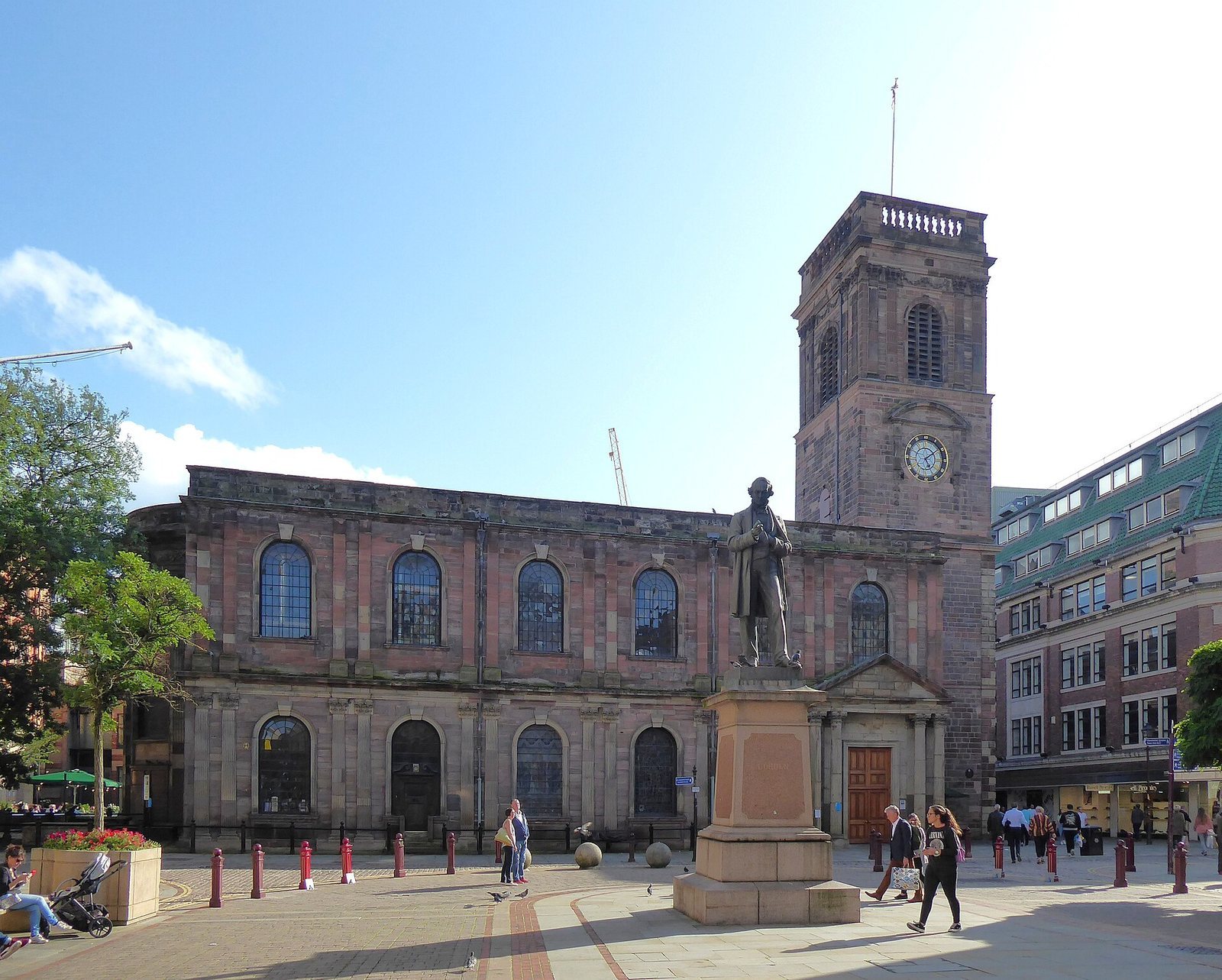
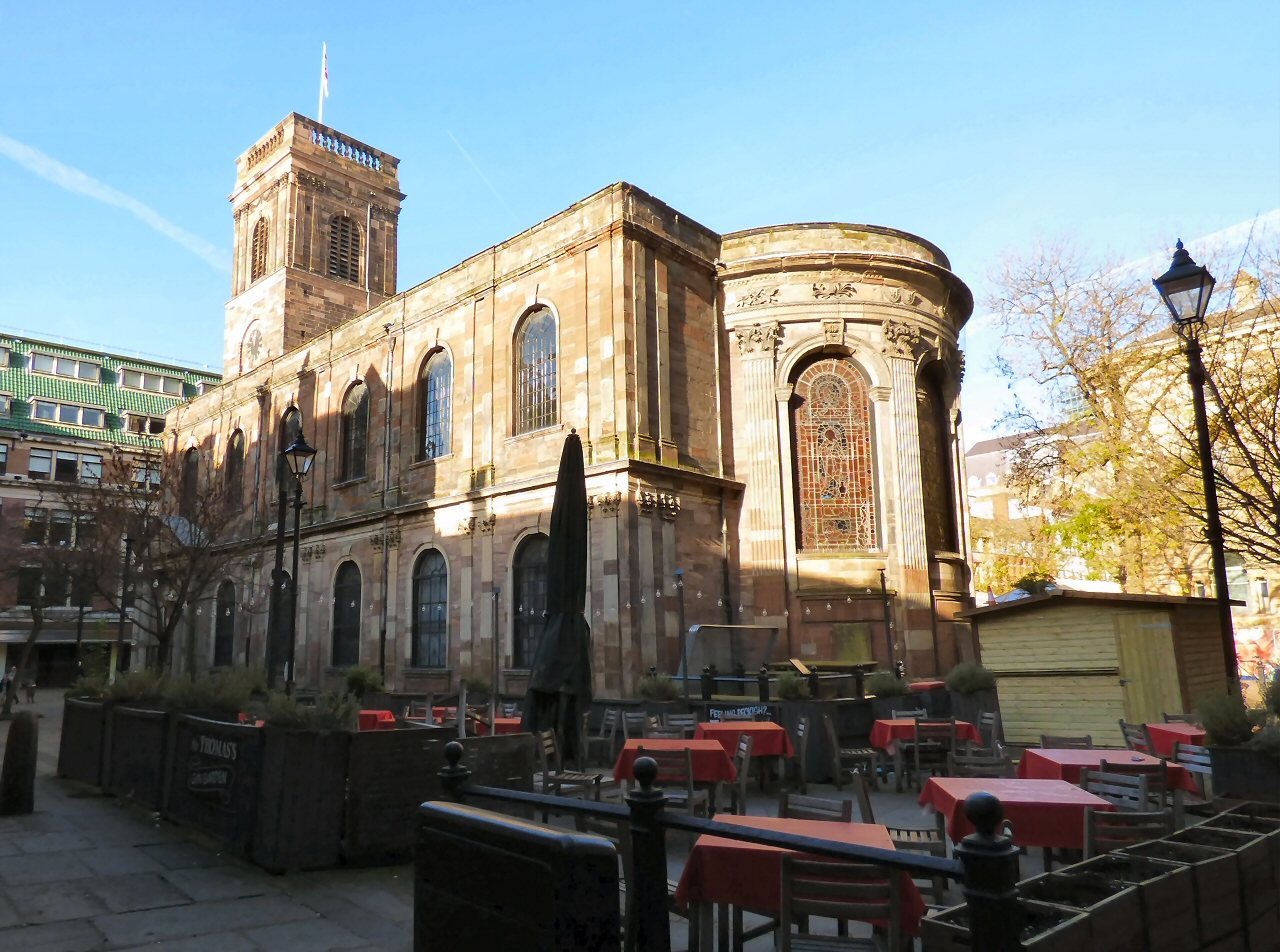
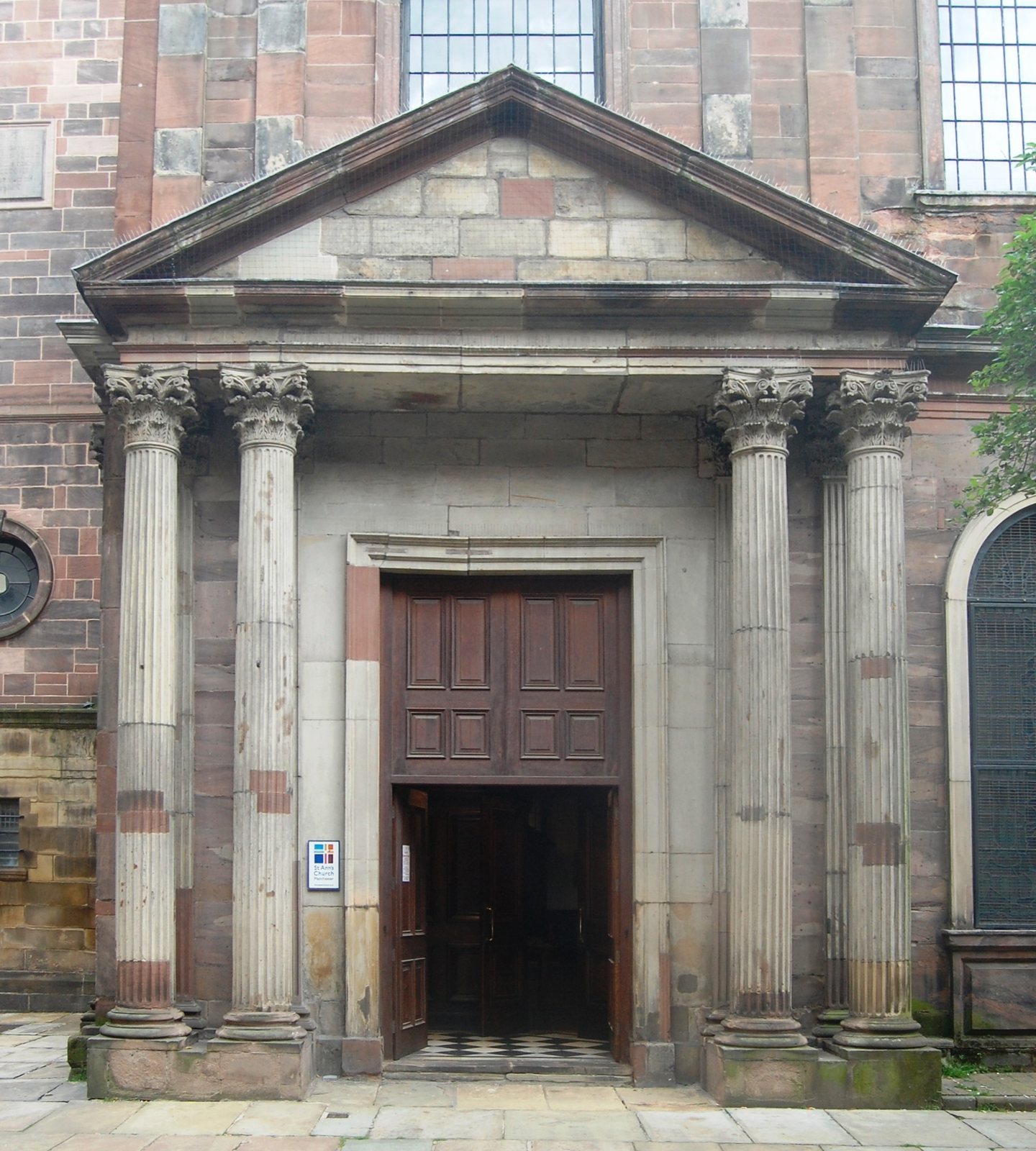
The church stands on the former Acres Field, now St Ann’s Square. Its neoclassical structure was first built from locally quarried red Collyhurst sandstone. Because that stone is soft, much of it has since been replaced with sandstone from several areas: Parbold in Lancashire, Hollington in Staffordshire, Darley Dale in Derbyshire, and Runcorn in Cheshire. The replacement stone varies in colour. During renovation in 2011, repairs were made to the building’s stonework and roof, as well as to its clock and bell.
Tower and surveying marker
The tower marked the centre of Manchester and served surveyors as a place from which to measure distances to other locations. A benchmark, a fixed point used for surveying, remains visible at the tower door.
Windows
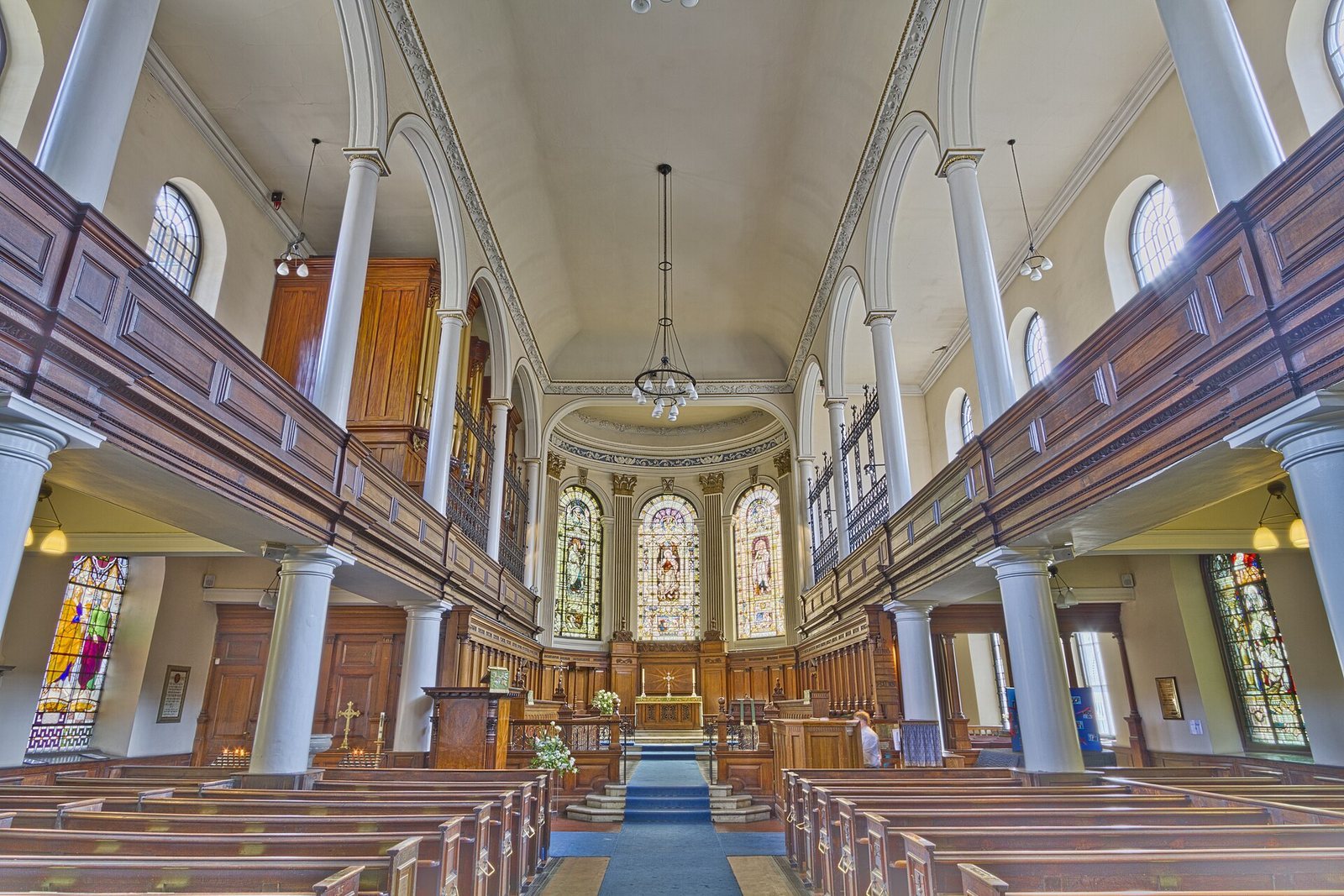
The interior originally had a simple appearance, with plain-glass windows. Many changes followed in the 19th century, including the addition of stained glass. Some windows were made for St Ann’s, while others were adapted from different churches. William Peckitt, an English stained-glass artist, designed and made a window on the north side.
Furnishings and memorials
The church contains a Queen Anne altar table, thought to be the only surviving example of its kind, and Annibale Carracci’s painting The Descent from the Cross. The painting had previously hung in nearby St Peter’s Church, demolished in 1907. St Ann’s also holds memorials from several demolished churches, including St Matthew’s, Campfield. Associated with architect Sir Charles Barry, St Matthew’s was built in 1823–25 and demolished in 1950. The church’s organ, built by George Sixsmith, has four manuals, or hand-played keyboards.