John Rylands Library: A Manchester Library for Rare Books and Manuscripts
Site at a Glance
- Popularity
- Very High
- Country
- United Kingdom
- Primary era
- Modern
- Eras represented
- Modern
- Civilizations
- British
- Site type
- Civic
- Remains
- Library
On this page15 sections
History
The John Rylands Library is a neo-Gothic library in Manchester, United Kingdom, commissioned by Enriqueta Augustina Rylands in 1889 in memory of her husband, the Manchester industrialist John Rylands. Designed by Basil Champneys and built from 1890 to 1899, it incorporates Arts and Crafts details, an approach that valued skilled workmanship and traditional making. Conceived on the scale of an Oxford college library, it was intended chiefly for theological collections and developed into a major home for rare books, manuscripts, and archives.
Foundation and opening
Enriqueta Rylands began acquiring books in 1889, the year she purchased the Deansgate site. In 1892 she bought the library of George Spencer, 2nd Earl Spencer, for £210,000. Its roughly 40,000 books formed the core of the new institution, and Rylands continued to build the collection throughout her life. She and Champneys disagreed about some aspects of the building’s decoration. Rylands chose certain decorative details, window glass, and statues despite the architect’s objections.
The library was inaugurated on 6 October 1899, the wedding anniversary of John Rylands and Enriqueta Tennant, and opened to readers on 1 January 1900. At its opening, it held 70,000 books and fewer than 100 manuscripts. In 1901, Enriqueta Rylands purchased more than 6,000 manuscripts from James Lindsay, 26th Earl of Crawford. They came from the Bibliotheca Lindesiana, one of Britain’s notable private collections for its size and the rarity of some of its contents.
Growth and archival collecting
Other major additions broadened the library’s holdings. Richard Copley Christie’s collection of more than 8,000 volumes, including many rare Renaissance books, passed to Owens College Library in 1901 and later moved into the Deansgate building. In 1908, Enriqueta Rylands left her private collections and an endowment of £200,000 for the library’s development. Later bequests brought 80,000 works and 3,000 manuscripts, while the endowment helped fund the purchase of 180,000 books and a further 3,000 manuscripts. These additions led to an annex behind the main building and further building work.
Champneys designed the first extension in 1920, after the First World War had delayed the project. In 1921, librarian Henry Guppy invited people to entrust their archives to the library for safekeeping. It became one of the early institutions to collect family records from Lancashire and Cheshire. In 1924, the library acquired much of the Bibliotheca Lindesiana’s French Revolutionary collection, and the 27th Earl of Crawford donated related broadsides. Walter Llewellyn Bullock bequeathed 5,000 items, especially early Italian imprints, during the 1930s. Sections of the Crawford library were deposited between 1946 and 1988; all but one were withdrawn in 1988.
University library and later development
The Lady Wolfson Building opened on the library’s west side in 1962, and another extension was built south of the first in 1969. The John Rylands Library and Manchester University Library merged in July 1972 to form the John Rylands University Library of Manchester. The Christie collection, previously held by Owens College Library, was transferred to Deansgate after the merger. Special collections from both institutions were gradually brought together there. The library is now part of the University of Manchester and houses most of the university’s Special Collections.
The building was listed in 1952 and upgraded to Grade I in 1994, the highest category for listed buildings in England, reserved for structures of exceptional architectural or historic interest. Its collections are also included among those recognized as nationally and internationally important under England’s Designation Scheme. A renovation begun in 2003 refurbished parts of the older building, removed the 1969 extension, and added a pitched roof over the reinforced-concrete roof. The work was completed in 2007.
The John Rylands Research Institute was established in 1987 to support research on collections held at Deansgate. It was relaunched in 2013 as a collaboration between the University of Manchester’s Faculty of Humanities and the library, and the two formed a new partnership in 2021. The British Pop Archive, a national collection focused on popular culture, opened with an exhibition at the library in May 2022. In 2025, Dr Williams’s Library moved from London to the Institute.
Remains
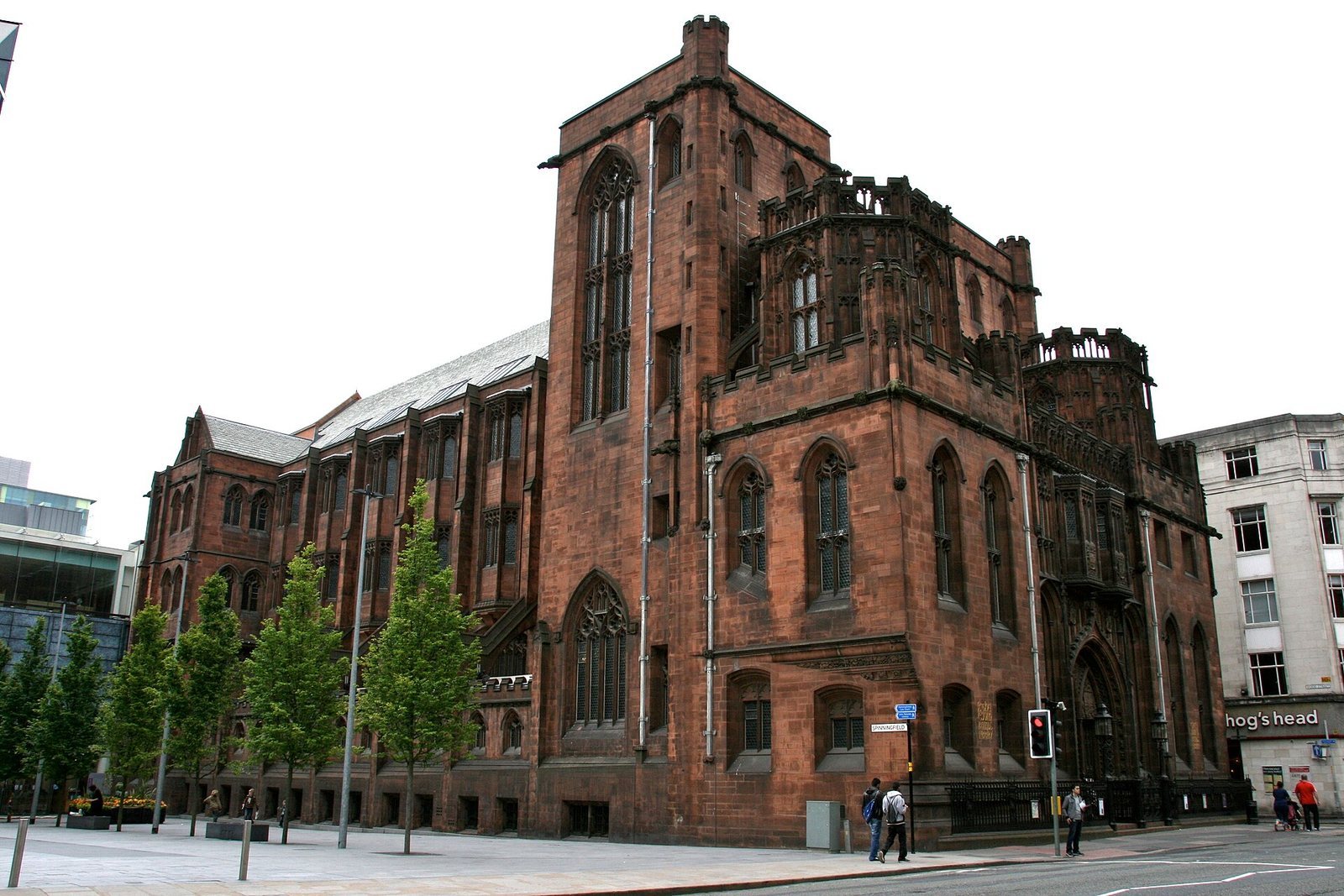
The library has a rectangular main block with later additions to the rear. A lower-level chamber, or crypt, and two unequal storeys above it give the building the appearance of three floors. Its exterior is dark-red Barbary sandstone from Penrith, while the interior uses Shawk stone from Dalston, with shades ranging from sand to pink. An internal steel frame supports floors built with brick arches. The building’s position on a cramped, irregular site shaped its form. At the time, warehouses, derelict cottages, and narrow streets surrounded it, while industrial smoke and chemical pollution threatened books and stonework.
Architecture
Site and exterior
Agreements with neighbouring property owners limited the height of future adjacent buildings to just over 34 feet. Champneys set the two façade towers 12 feet back from the boundary, kept the entrance block low, and arranged the building in stepped levels beneath a nearly flat roof. The design allowed light into the library while respecting neighbours’ access to it. When Champneys inspected the exterior in 1900, he found little softening of the stone from Manchester’s polluted air, although repairs were needed by 1909.
Deansgate façade
The ornate front has a roofline with alternating raised sections and gaps, above open decorative arches. Its central entrance spans three façade bays, or divisions. A pointed, two-centred arch frames the portal, where a central support separates the doorways. Tall windows flank the entrance, with two small projecting oriel windows above. Decorative tracery on solid wall surfaces and detailed carving include John Rylands’s initials, the Rylands and St Helens arms, and the arms of five English, two Scottish, and two Irish universities, as well as Owens College.
Square towers flank the entrance, and square wings on either side are each two storeys high and two bays wide. Their plain walls have a horizontal carved band featuring grotesque figures and a large octagonal lantern. Behind the entrance, the reading hall’s east window has reticulated tracery, a net-like pattern, and stone shafts. Art Nouveau bronze railings, a central pair of gates, and lamp standards stand in front of the building.
Reading room and interior
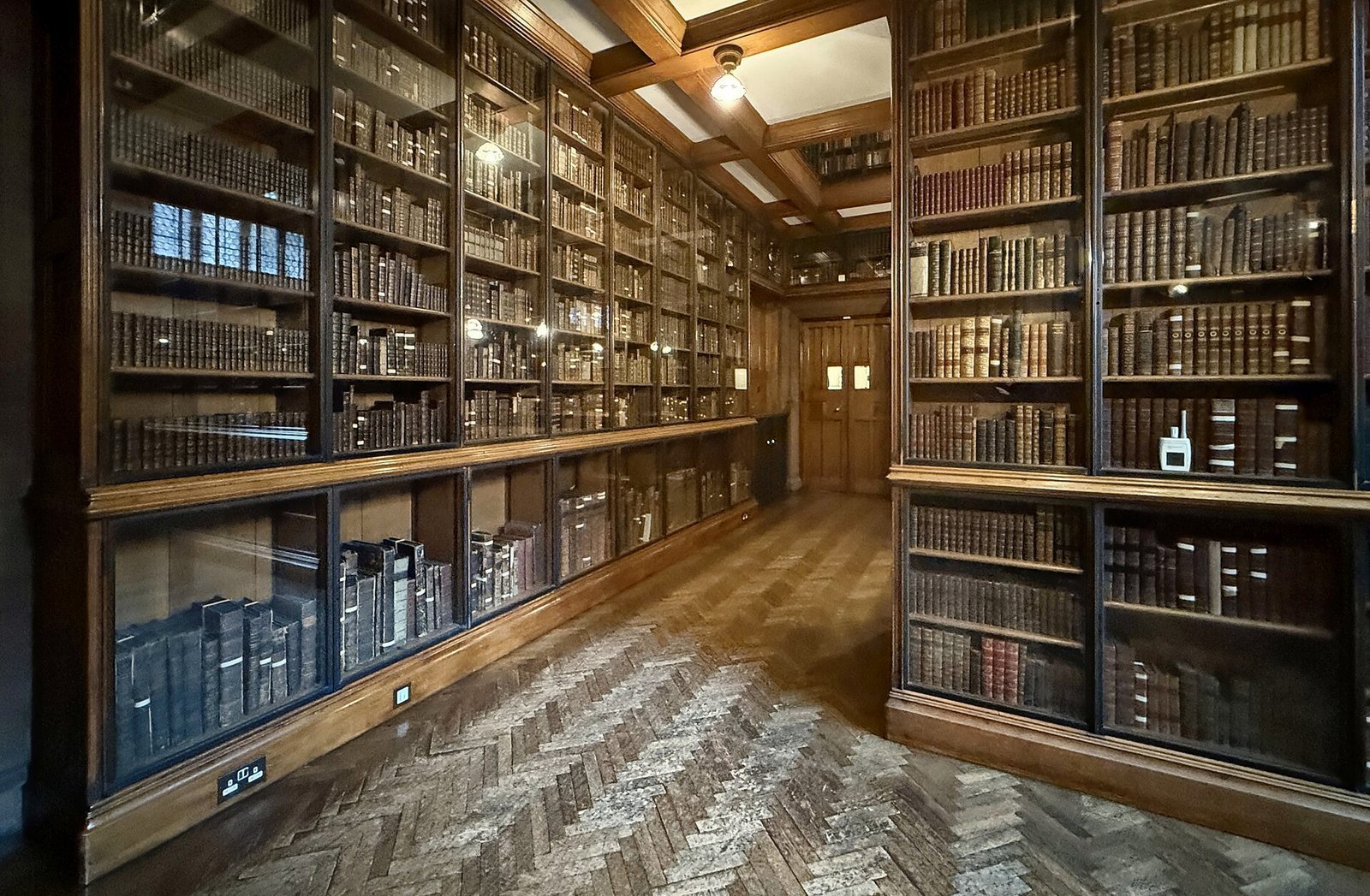
The main reading room occupies the first floor, 30 feet above ground and set 12 feet in from each of the building’s four boundaries. Projecting windows in the reading alcoves are supplemented by high rows of windows along both sides. Two large stained-glass windows designed by C. E. Kempe accompany statues by Robert Bridgeman and Sons of Lichfield and Art Nouveau bronze work by Singer of Frome. Twenty portrait sculptures and 40 stained-glass portraits depict figures from intellectual and artistic history. The west window presents theology, from Moses to Friedrich Schleiermacher; the east represents literature and art, including philosophy.
White-marble portrait statues of John and Enriqueta Rylands in the reading room were made by John Cassidy, who also sculpted a group in the vestibule representing Theology, Science, and Art. The plan included a gallery above the reading room, Bible and map rooms on the first floor, and conference or lecture rooms and committee rooms on the ground floor. The principal rooms have Dantzig oak woodwork. A caretaker’s house was once incorporated into the building and was demolished for the 1969 extension.
Lighting and air protection
Electric light was chosen as a cleaner, safer alternative to gas. Because electricity was still at an early stage of development, the library produced its own 110-volt direct-current supply on site. It was among Manchester’s first public buildings lit by electricity and generated its own power until 1950. To protect books and manuscripts from pollution, the building used numerous ground-floor air inlets, jute or hessian screens to catch soot, and water sprays to capture sulphur and other chemicals. Screen doors at the entrance and swing doors between circulation areas and the main library helped control air movement. By 1900, electric fans drew pavement-level air through coke screens sprayed with water.
Collections
Printed books
The library holds medieval illuminated manuscripts and early European printed books. Its Spencer collection included about 3,000 incunabula, books printed in Europe before 1501, among them a few block books printed from carved blocks rather than movable type. One is a southern German block print of St Christopher dated 1423, the earliest dated block print with an undisputed date. More than 1,000 additional incunabula came from other collections. The library also holds a fine-paper copy of the Gutenberg Bible, a large collection of William Caxton’s printing, and the most extensive collection of editions from the Aldine Press of Venice.
Manuscripts and papyri
Among the biblical manuscripts are the St John Fragment, believed to be the oldest surviving New Testament text, and Papyrus Rylands P52. P52 is the earliest surviving fragment of the canonical Gospel of John, one of the four New Testament Gospels, and may be the earliest surviving New Testament text. Other papyri include Papyrus Rylands 458, the earliest fragment of the Septuagint, an ancient Greek translation of Jewish scriptures, and Papyrus Rylands 463, a fragment of the apocryphal Gospel of Mary, a text outside the Christian biblical canon. The collection also contains an Oxyrhynchus homily about women, part of the Book of Tobit, and Papyrus Oxyrhynchus 73, a document concerning the transfer of a slave.
The Manchester Odyssey is among the oldest surviving texts on vellum, writing material made from animal skin, and is the oldest surviving codex of the Odyssey, an ancient Greek epic poem. The library also holds papyrus fragments and documents from North Africa. Its Arabic papyri include personal letters, accounts, tax documents, and other papers. Around 800 are held, most dating to the third century AH, the Islamic Hijri calendar, and many originating in an Egyptian town with a predominantly Coptic population.
Arabic and other Eastern manuscripts
The library’s approximately 900 Arabic manuscripts include material acquired through the Crawford collection. It also holds about 1,500 uncatalogued Judeo-Arabic papers from Rabbi Moses Gaster’s collection. Judeo-Arabic refers to forms of Arabic used by Jewish communities. Other holdings include about 1,000 Persian manuscripts and around 200 Turkish manuscripts, mostly in Ottoman Turkish, with a smaller number in Chagatai, a historical Turkic literary language.
Several Qur’ans in the collection use Kufic, an early Arabic script with angular letter forms, and date to the ninth and tenth centuries. One, the Qur’an of Kansuh al-Ghuri, dates to the late Mamluk period, when military elites ruled Egypt, and weighs 52 kilograms. It was once in the Sultan’s library in Cairo. Pages separated from it were found at the Chester Beatty in the 1970s; a new imaging method later brought the material together digitally in 944 images.
Personal papers and catalogues
Personal papers and letters in the collections include material associated with the novelist Elizabeth Gaskell, the scientist John Dalton, and the theologian John Wesley. David Samuel Margoliouth catalogued the Arabic papyri. Researchers including Alphonse Mingana and C. E. Bosworth prepared catalogues of Eastern manuscripts. Mingana’s main catalogue comprised three volumes and included some mistaken attributions of authorship. By 2012, the library’s holdings had grown to more than 250,000 printed volumes and over one million manuscripts and archival items.