St Stephen Walbrook in London: A Parish Church Designed by Christopher Wren
Site at a Glance
- Popularity
- High
- Country
- United Kingdom
- Primary era
- Early Modern
- Eras represented
- Early Modern, Modern
- Civilizations
- British, English
- Site type
- Religious
- Remains
- Church
On this page9 sections
History
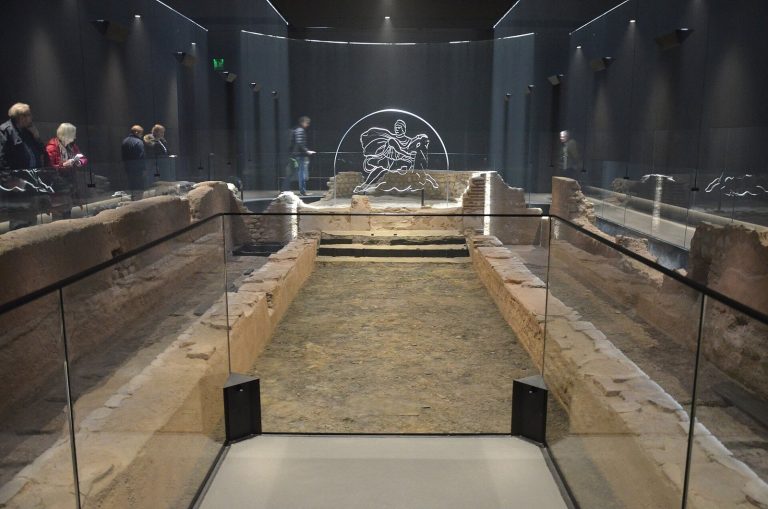
St Stephen Walbrook is a parish church of the Church of England, the Anglican church in England, in London, United Kingdom. Dedicated to Saint Stephen, traditionally regarded as Christianity’s first martyr, it belongs to the Diocese of London, a regional church administration. Its first church was founded sometime between AD 700 and 980 and is thought to have stood over the remains of a Roman temple to Mithras, a Roman religious cult. This location may reflect the Christian practice of consecrating places formerly used for pagan worship.
Early church and medieval rebuilding
The church was Roman Catholic and associated with the Knights Hospitaller, a Catholic religious order that also undertook military duties, until 1538. In 1090, the Norman royal steward Eudo Dapifer gave it to Clerkenwell Priory, a religious house governed by a prior. During the fifteenth century, the church moved to higher ground across Walbrook Street. In 1429, merchant and Lord Mayor Robert Chichele acquired land near Stocks Market as executor of former Lord Mayor William Standon’s will and gave it to the parish. The foundation stones were laid on 11 May that year, and the church was consecrated on 30 April 1439.
The medieval church was destroyed in the Great Fire of London in 1666. St Benet Sherehog, also destroyed in the fire, was not rebuilt, and its parish joined St Stephen’s. The medieval church had contained a memorial to the composer John Dunstaple. Its epitaph, recorded in the early seventeenth century, was reinstated in 1904. Other people buried at the church included diarist Elizabeth Jekyll, architect and playwright John Vanbrugh, and publisher Sir Rowland Hill, known as the “First Protestant Lord Mayor of London.” Hill’s monument was lost in the fire and later re-established at Hawkstone.
Wren’s church and later changes
The present church was built between 1672 and 1679 to the design of Sir Christopher Wren, a leading English architect. Thomas Strong, brother of mason Edward Strong the Elder, worked as mason, while Edward Strong the Younger was responsible for the spire. George England supplied a new organ in 1760. In 1776, the central east window was bricked up to accommodate Benjamin West’s painting of the removal of Saint Stephen’s body. The following year, rector Thomas Wilson installed a statue of the historian and political writer Catharine Macaulay, whom he admired for her political ideas. Protests led to its removal.
An extensive restoration in 1850 reopened the east window and moved West’s painting to the north wall. The parishes of St Mary Bothaw and St Swithin London Stone, which had merged in 1670, were united with St Stephen’s in 1954.
Modern parish and conservation
The church suffered slight damage during the London Blitz in 1941 and was later restored. It became a Grade I listed building on 4 January 1950, the highest English listing category for buildings of exceptional architectural or historic interest. In 1953, rector Chad Varah founded the Samaritans, a volunteer organization offering telephone support to people in emotional distress. Its first branch operated in a crypt beneath the church before moving to Marshall Street in Soho.
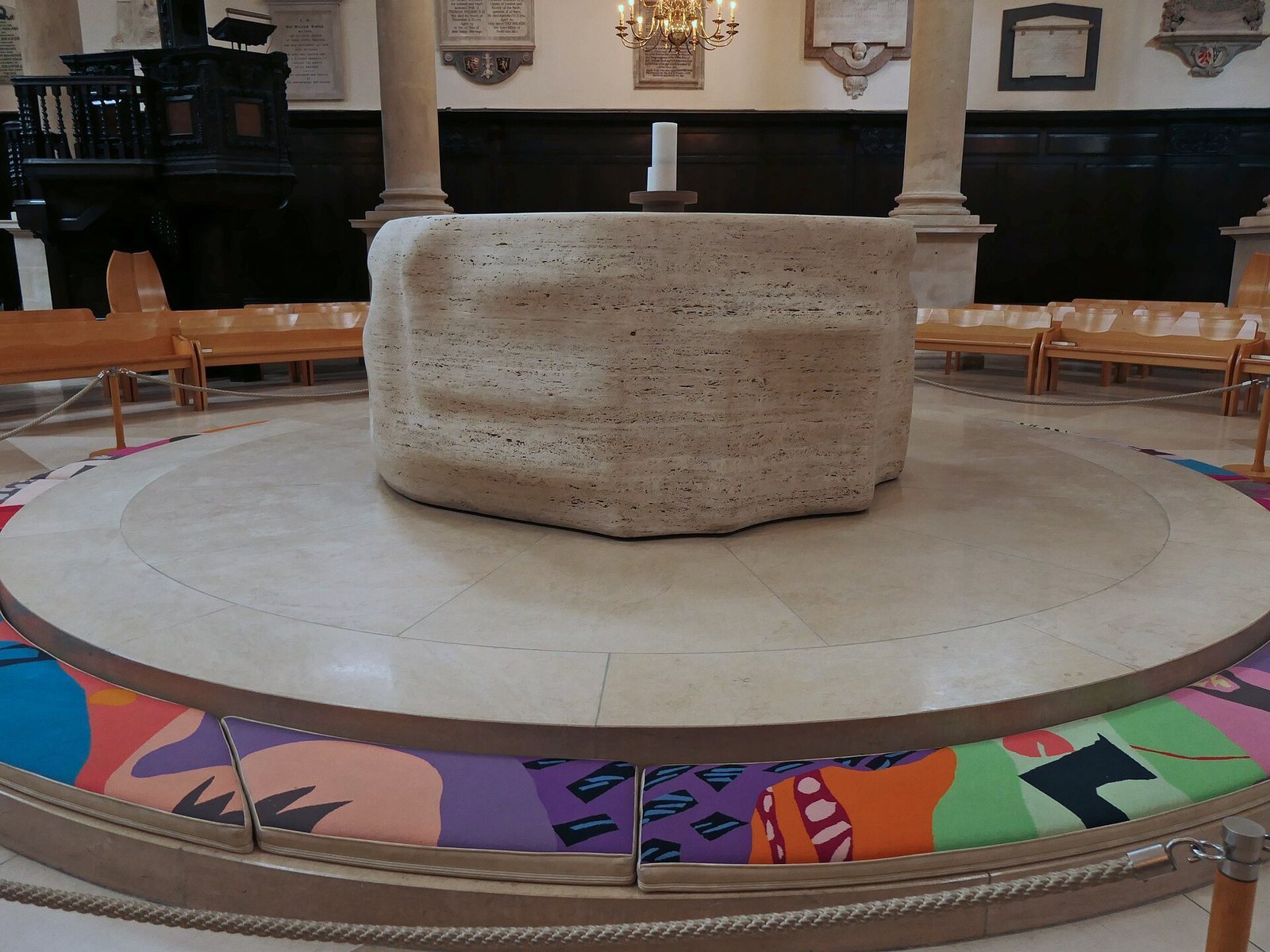
A major repair and reordering programme in 1987 included a new altar commissioned from sculptor Henry Moore. Its position required authorization from the Church of England’s Court of Ecclesiastical Causes Reserved, which deals with certain reserved church matters. After the reordering, West’s painting was put into storage; its initial removal was unlawful. In 2013, the church received permission to sell it despite opposition from church advisory bodies. A temporary export bar allowed time for the painting to remain in the United Kingdom. A foundation bought it and later loaned it to the Museum of Fine Arts, Boston, where it was restored.
Remains
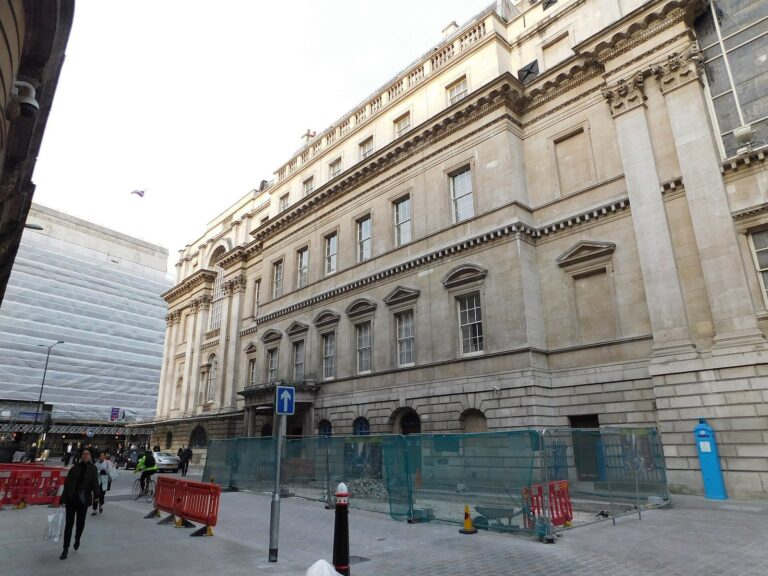
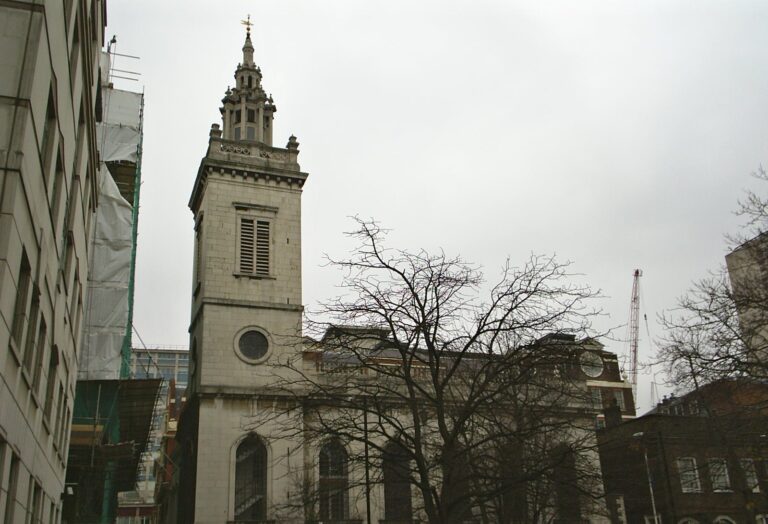
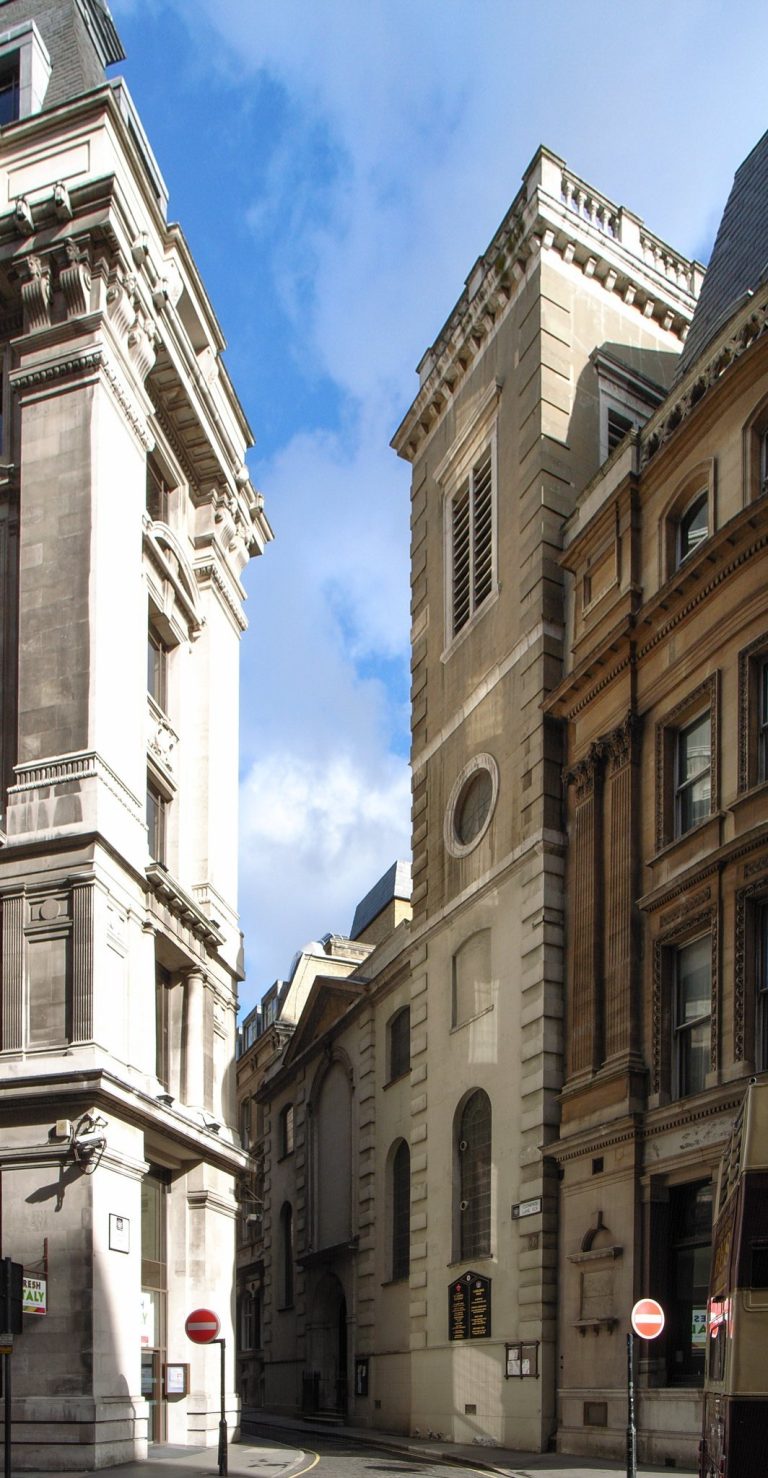
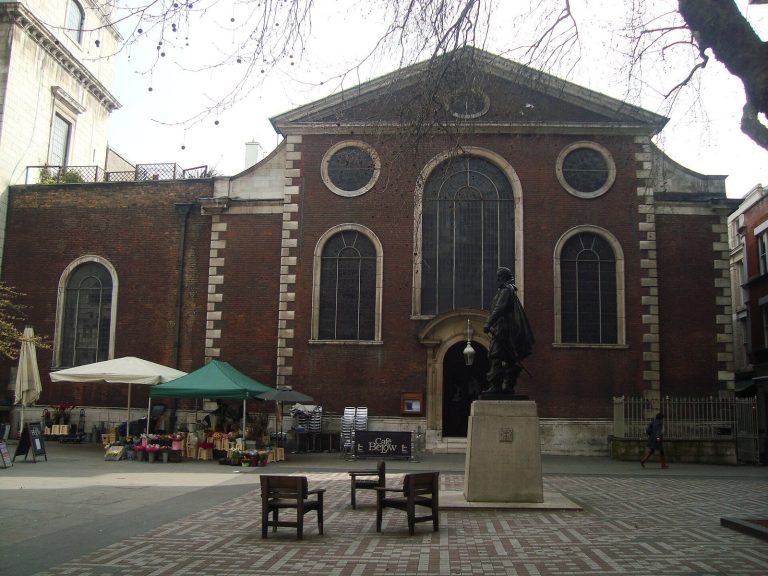
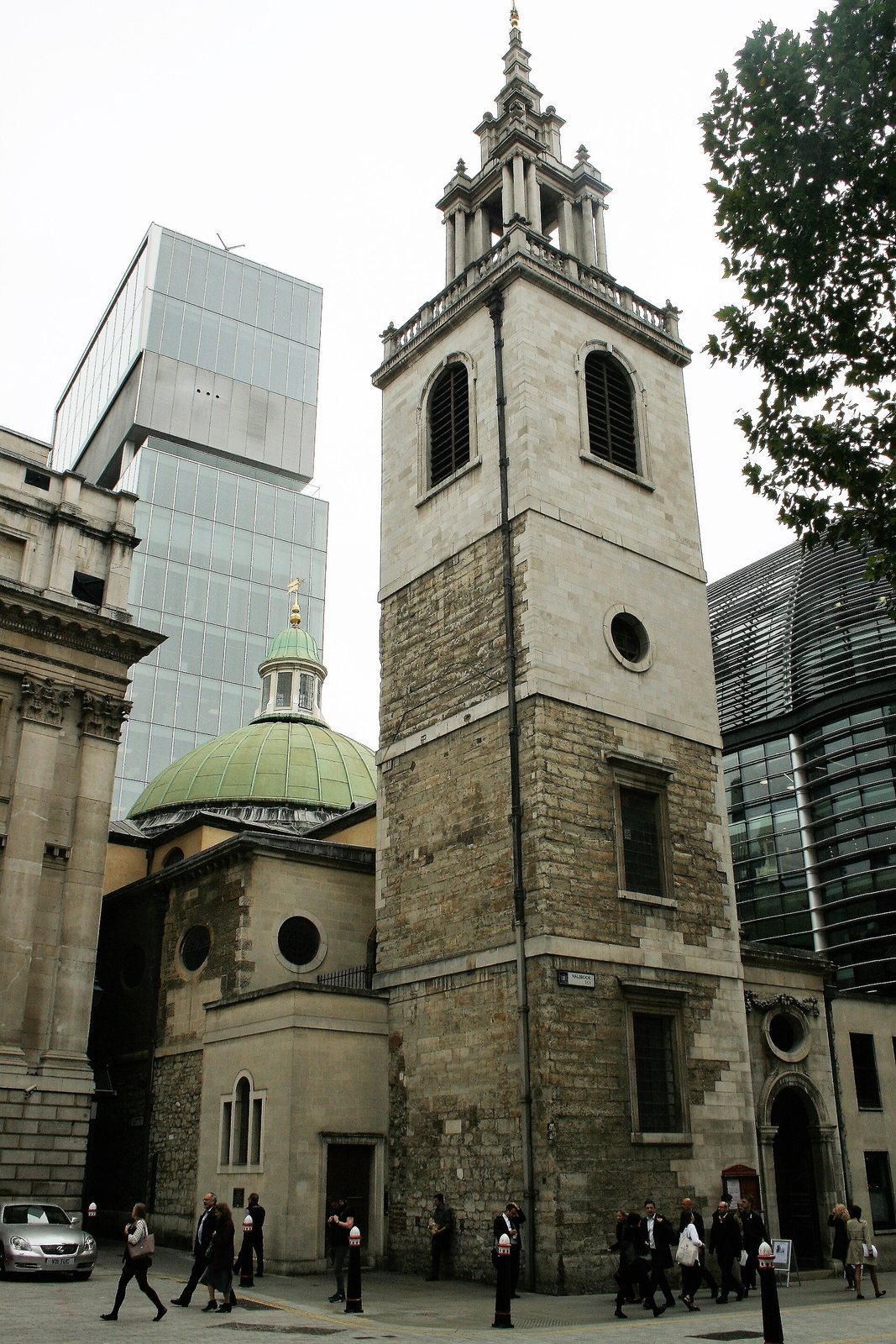
The present church has a rectangular plan, a dome, and a tower attached at the northwest. Its walls, tower, and interior columns are stone. The building stands next to Mansion House, the official residence of the Lord Mayor of the City of London.
The medieval site and the Walbrook
The medieval church stood west of what is now Walbrook Street, on the eastern bank of the Walbrook stream. It measured 125 feet (38 m) long and 67 feet (20 m) wide, making it considerably larger than the present church. The later church occupies higher ground across the street, still on the stream’s eastern side. The Walbrook once provided an important Roman source of fresh water and ran southwest from near Moorfields across the City to the Thames. It was later diverted into a brick culvert beneath Walbrook Street and Dowgate Hill, on a straighter course to the river.
Dome and interior
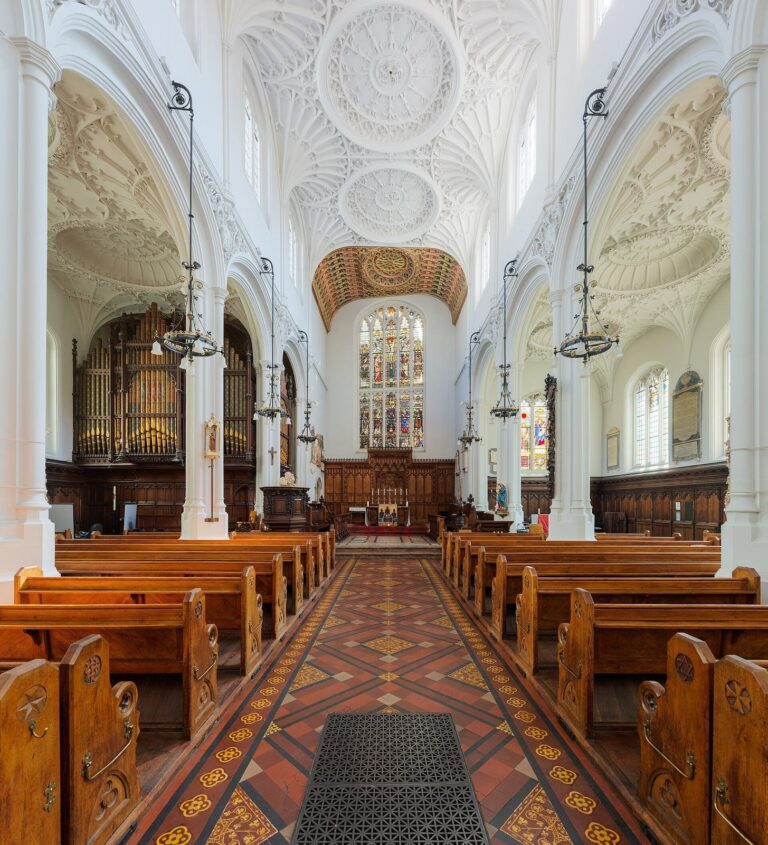
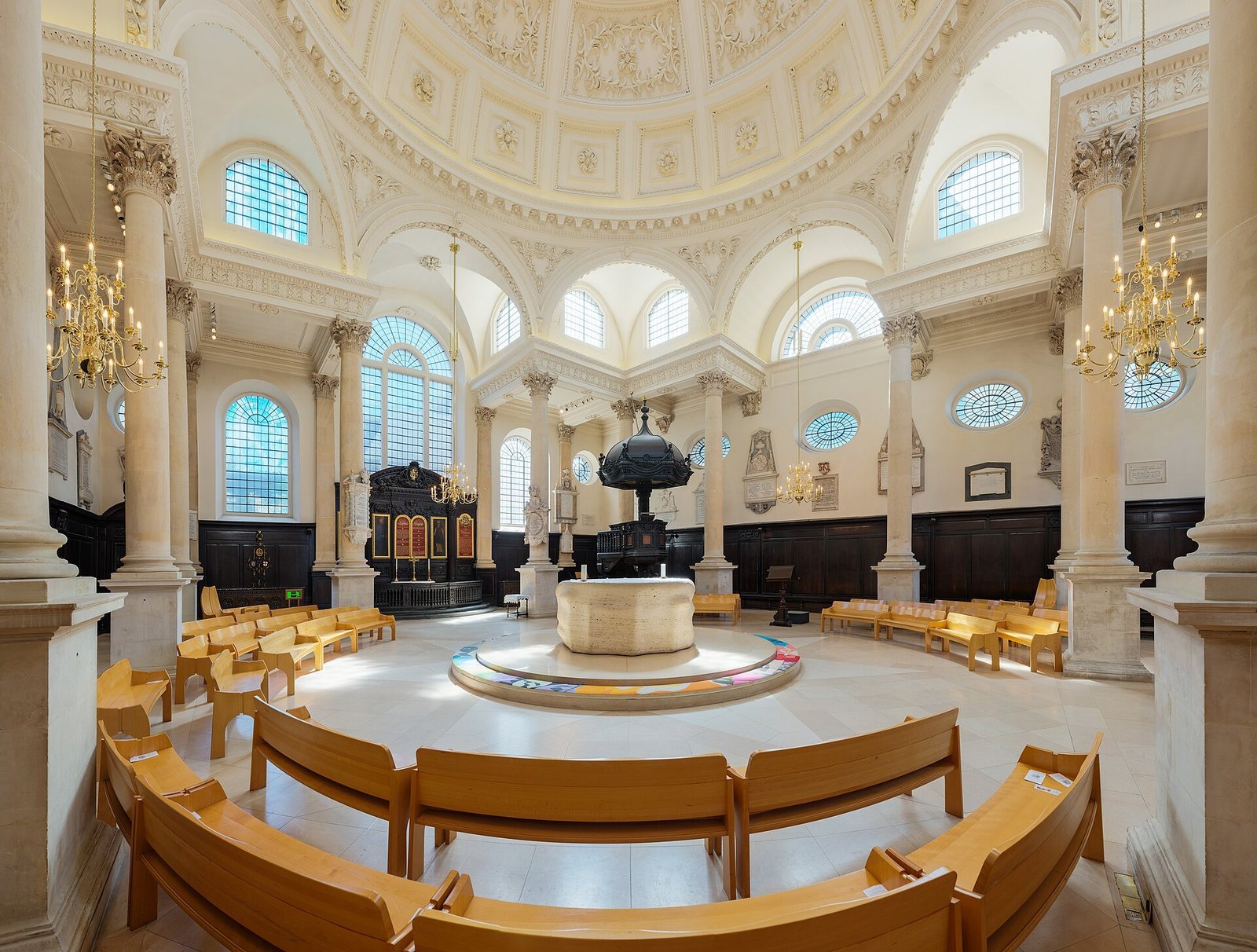
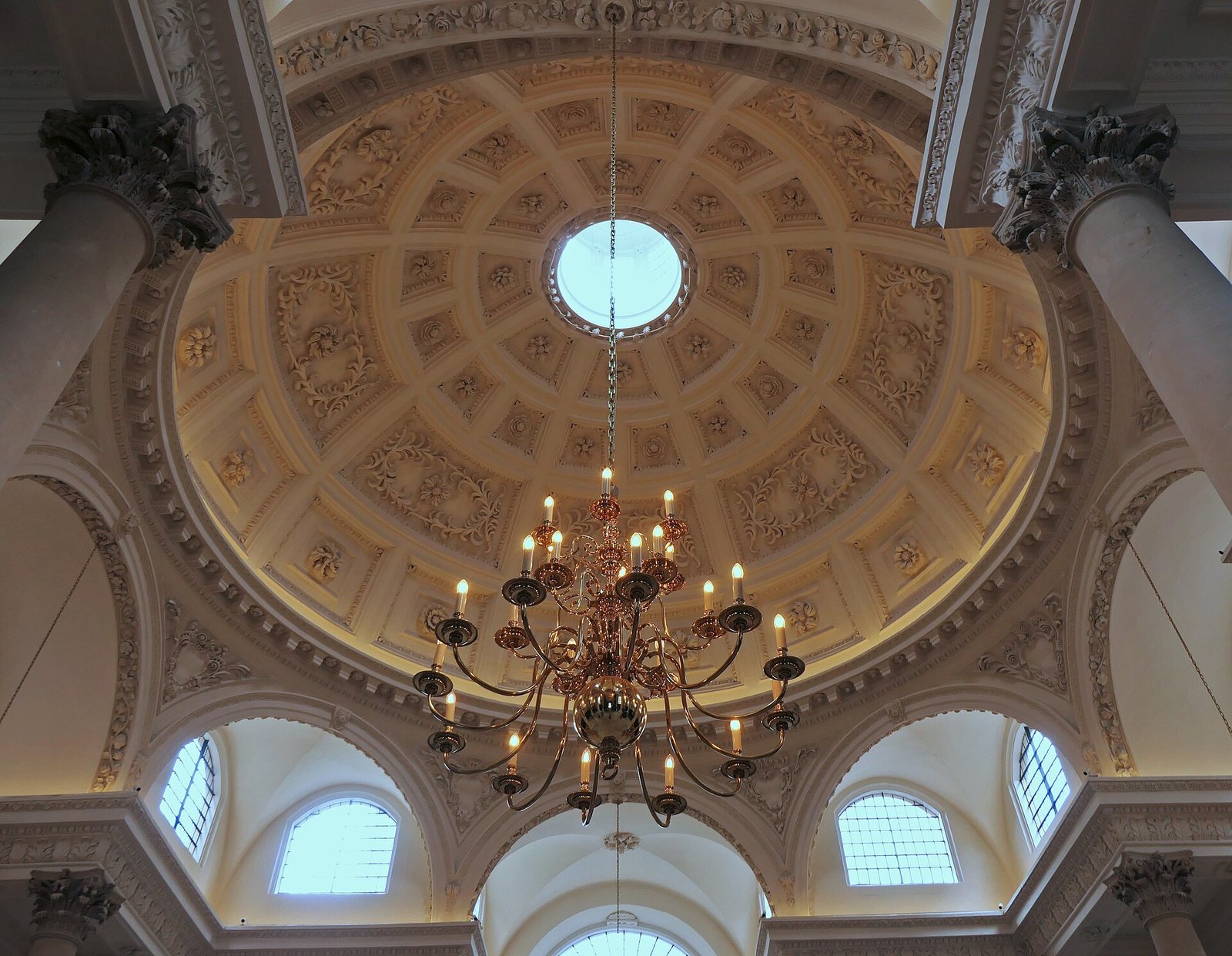
The dome is 19 m high, built of timber and plaster, and covered externally in copper. Its design draws on Wren’s original design for St Paul’s. It rises above a square surrounded by twelve Corinthian columns, a classical form with elaborately decorated capitals. Rather than using pendentives, curved surfaces that support a dome above a square, the circular base rests on eight arches springing from eight columns and crossing the square’s corners. This arrangement resembles squinches, structures that bridge corners to support a dome or its base. The interior has been judged by some to be among Wren’s finest church interiors, and architectural historian Nikolaus Pevsner included the church among England’s ten most important buildings.
Entrances and furnishings
The west entrance is reached by sixteen steps within a porch attached to the west front. Wren designed a porch for the north side, but it was never built. The north door was bricked up in 1685 after smells from slaughterhouses in nearby Stocks Market entered through it. Carved furnishings include an altarpiece, the Royal Arms, a pulpit, and a font cover, a lid or canopy over a baptismal font. The carvings are attributed to carpenters Thomas Creecher and Stephen Colledge and woodcarvers William Newman and Jonathan Maine.
Artworks and commemorative objects
West’s painting, Devout Men Taking Away the Body of St Stephen, depicts the removal of the saint’s body. At the church’s centre stands the large altar of white polished stone commissioned from Moore. A circle of brightly coloured kneelers designed by artist Patrick Heron surrounds it; they were added in 1993. A telephone associated with the early Samaritans is kept in a glass case in the church.