St Bertoline’s Church, Barthomley: An Anglican Parish Church
Site at a Glance
- Popularity
- Medium
- Country
- United Kingdom
- Primary era
- Medieval
- Eras represented
- Medieval, Early Modern, Modern
- Civilizations
- British, English
- Site type
- Religious
- Remains
- Church
On this page17 sections
History
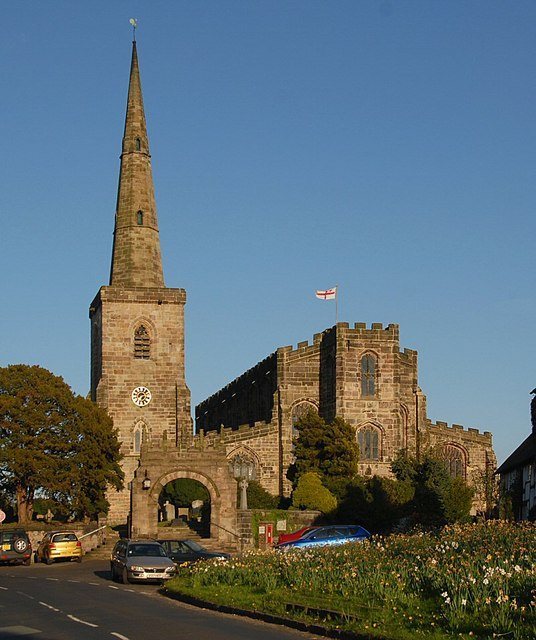
St Bertoline’s Church, Barthomley, is an Anglican parish church in the United Kingdom, founded in 1150 and dedicated to Saint Bertoline, a medieval Christian saint venerated in England. Its central worship space, the nave, and tower date from the late 15th century. The church combines Perpendicular architecture, a late English Gothic style marked by strong vertical divisions, with Gothic Revival, a later return to medieval forms. Its history is also linked to the killings of Parliamentarian supporters during the English Civil War.
Foundation and medieval development
For generations, the church served a large area of southeast Cheshire, whose scattered population had Barthomley at its centre. Alsager, Crewe, Haslington and other settlements later formed separate parishes. Barthomley remained a parish of about 400 people. Its parish registers begin in 1562, and the churchwardens’ accounts begin in 1660.
The late-15th-century nave and tower formed a major phase in the church’s development. The Crewe Chapel was added about 1528 at the east end of the south aisle. These building phases followed the church’s 1150 foundation.
The Civil War killings
On Christmas Eve 1643, during the mid-17th-century conflict between supporters of Parliament and the monarchy, about 20 Parliamentarian supporters took refuge inside the church. Royalist forces led by John Byron, 1st Baron Byron, set the building on fire. After the refugees surrendered, twelve were killed.
Restoration and later use
A restoration carried out from 1852 to 1854 resulted in the loss of many old fittings. In 1925–26, the eastern part around the altar, or chancel, was built to designs by Austin and Paley. The Marquess of Crewe, a high-ranking hereditary titleholder, built it as a memorial to members of his family.
The church remains an active Anglican parish within the Diocese of Chester and the Province of York, in the Archdeaconry of Macclesfield and Deanery of Congleton. It received Grade I listed status in 1967. Cheshire historian Raymond Richards regarded it as one of the county’s most beautiful churches and believed it was the only church in England dedicated to Saint Bertoline. It is also an important setting in Alan Garner’s novel Red Shift, which deals largely with the 1643 killings.
Remains
Setting and plan
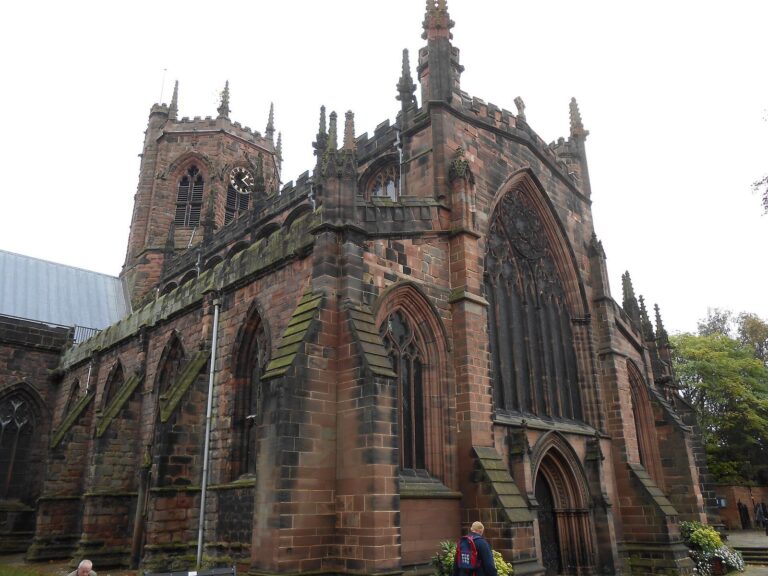
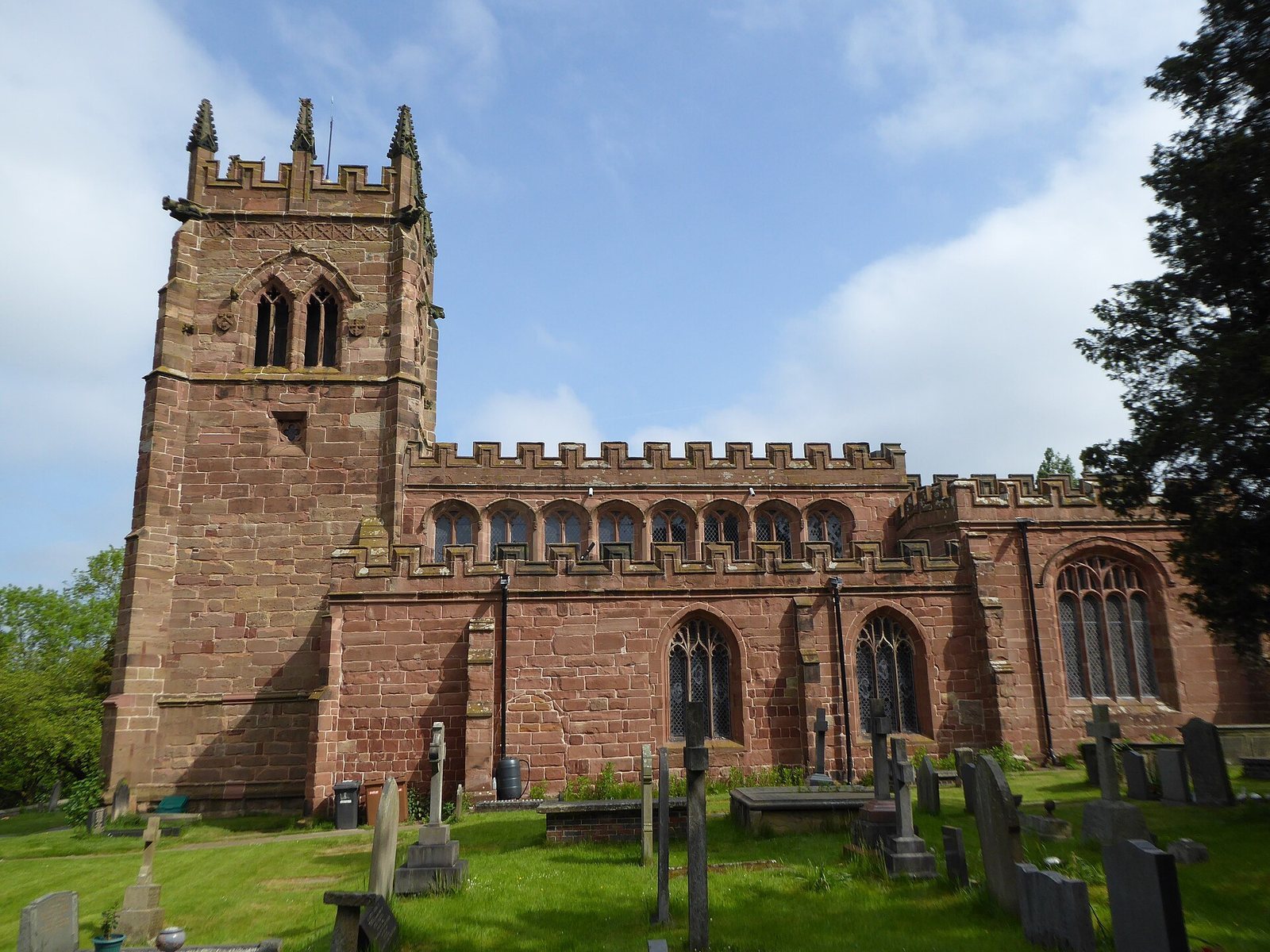
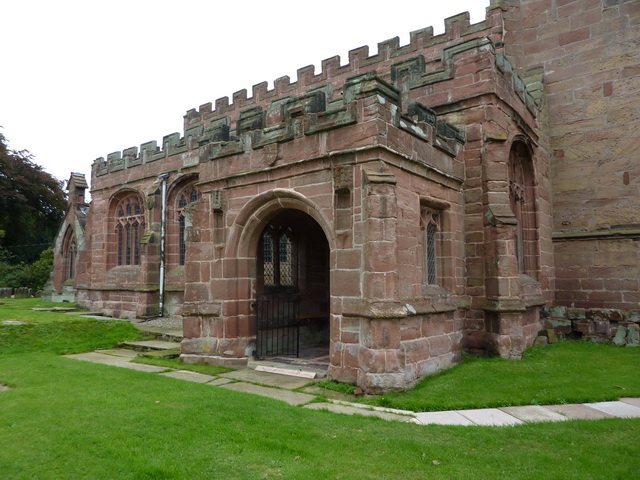
The church stands on elevated Barrow Hill, an ancient burial ground in the centre of Barthomley. It rises above the road and is reached by steps. Built of red sandstone beneath a lead roof, it has a west tower, a nave divided into four structural sections, north and south side aisles, a north porch and the chancel. A high band of windows, called a clerestory, lights the nave. A vestry adjoins the chancel on its north side, while the Crewe Chapel occupies the east end of the south aisle.
Exterior fabric
Tower and elevations
The tower has a west entrance with a four-part window above it. Each side has two-part openings for the bells, flanked by coats of arms belonging to local families, and a clock is set into its north face. Its top edge is battlemented, with eight pinnacles bearing carved projections and gargoyles at the four corners. The nave and aisles also have battlemented tops.
North doorway and porch
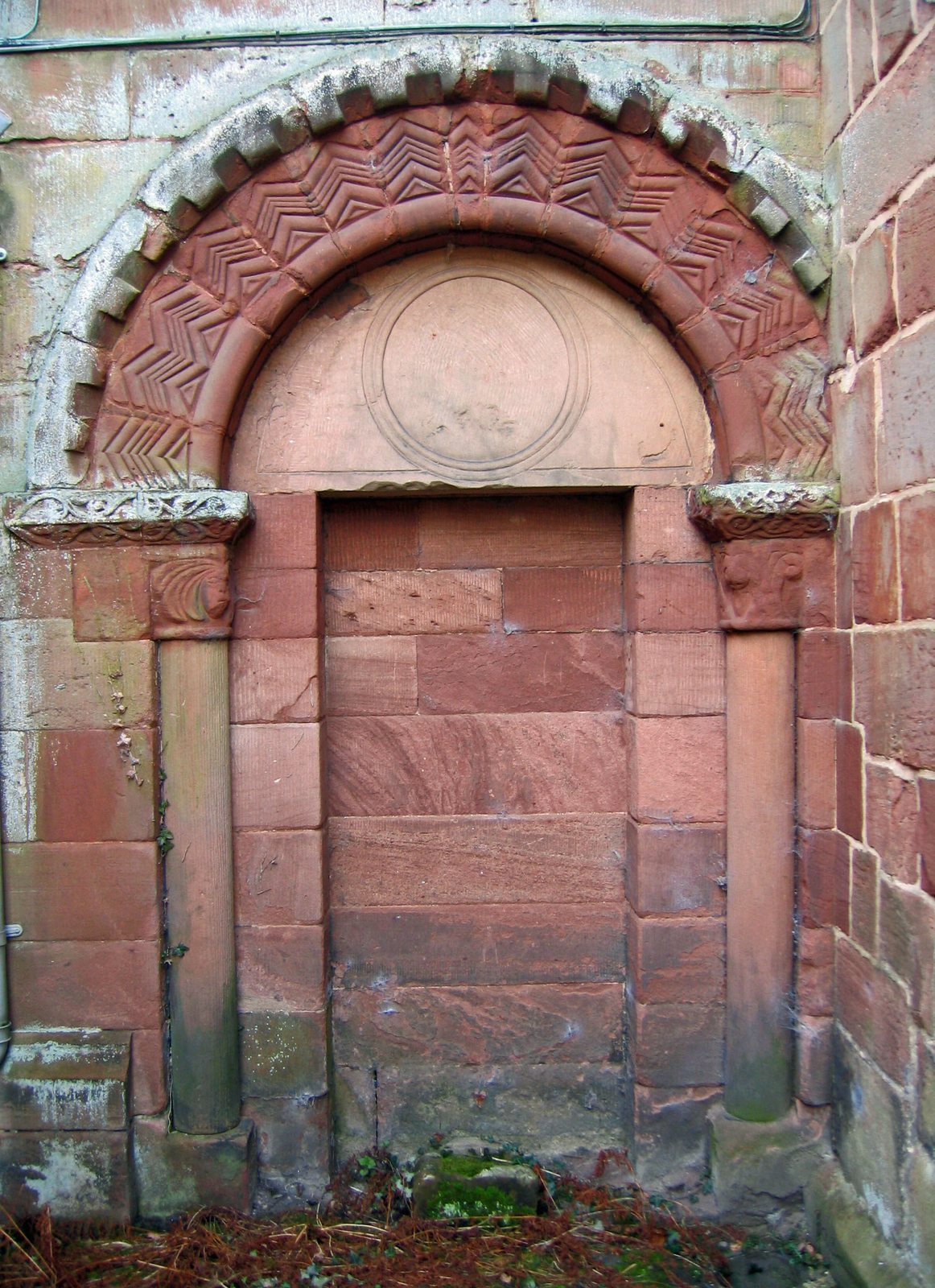
A blocked Norman doorway, in the Romanesque style associated with the Norman period in England, is set into the north wall between the end of the aisle and the vestry. It was moved there in the 19th century and is the oldest identified feature. The porch contains the church’s original stone holy-water font.
Interior and furnishings
Roofs and windows
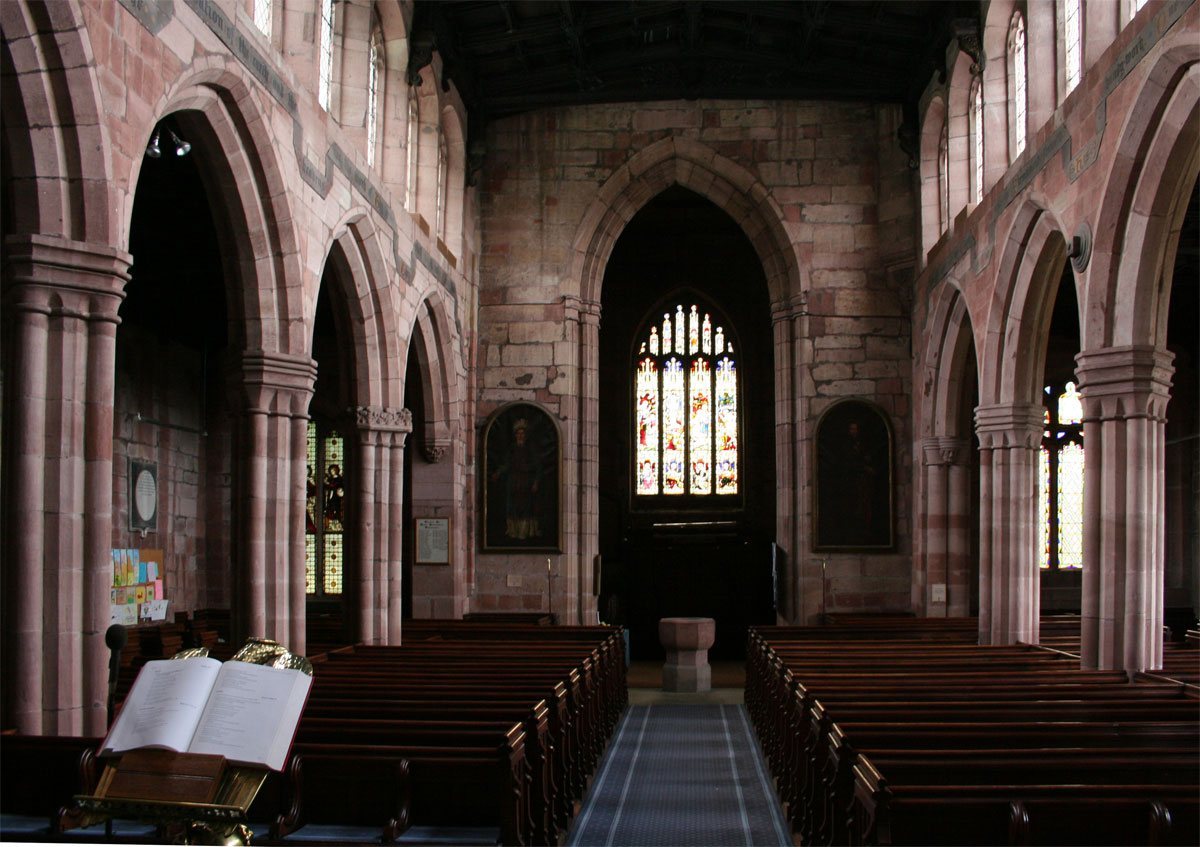
The nave and north aisle have 16th-century panelled timber roofs with curved beams. The east window has five sections. Stained glass in the west window was made by Clayton and Bell in 1873; the east-window glass was produced by Shrigley and Hunt in 1925.
Altar and chancel
The late-16th-century altar carries images that include the Nativity and the Flight into Egypt, as well as two men, each carrying a hare and a bird. A pair of arched seats for clergy is built into the south wall of the chancel. English oil paintings of Moses and Aaron are also in the church.
Screen, bells and organ
A partition screen that once separated the Crewe Chapel from the chancel now encloses the organ at the east end of the north aisle. Forster & Andrews built the organ in 1850. Ward & Shutt restored it in 1969 and 2003; a Makin digital organ replaced it in 2005. The church has eight bells. Six were cast by Rudhall of Gloucester, five in 1743 and one in 1747; later bells were cast by Taylor of Loughborough in 1908.
Crewe Chapel and memorials
Medieval tomb figures
The chapel contains an alabaster figure of Sir Robert de Foulshurst, dated to about 1390. Shown reclining in armour, he wears a mail neck guard, a conical helmet and a collar formed from repeated S-shaped links. Six male and six female figures stand beneath Gothic arches along the sides of the tomb chest. Another reclining figure represents a clergyman, probably Robert Foulshurst, rector of Barthomley, who died in 1529.
Later family memorials
Later monuments include a marble figure of Lady Houghton, who died in 1887, sculpted by J. Edgar Boehm. The chapel also contains a Victorian Gothic monument to the first Lord Crewe and two large wall monuments to other members of the Crewe family.
Churchyard memorials
Memorials in the churchyard commemorate brothers Joseph Edgar Ginders and George Percy Ginders, both soldiers in the New Zealand Expeditionary Force, New Zealand’s overseas military force during the First World War. Joseph, born in October 1884, was killed at Gallipoli on 14 August 1915, aged 30. Gallipoli was the site of the Allied campaign in the Ottoman Empire in 1915–16. George, born in April 1889, was killed on 15 March 1918, aged 28.