Deir el-Bersha: An Ancient Egyptian Necropolis in Middle Egypt
Site at a Glance
- Popularity
- Medium
- Country
- Egypt
- Primary era
- Bronze Age
- Eras represented
- Bronze Age
- Civilizations
- Egyptian
- Site type
- Burial
- Remains
- Necropolis
On this page16 sections
History
Deir el-Bersha is an ancient Egyptian necropolis beside a Coptic village on the east bank of Egypt’s Nile, in Middle Egypt. The village lies south of Antinopolis and almost opposite Mallawi; its cemetery is near Minya, about 225 km south of Cairo. The cemetery’s use extended from before the Middle Kingdom through the Second Intermediate Period and into the early New Kingdom. During the Eleventh and Twelfth Dynasties, it served as the burial ground of governors of the Hare nome, the fifteenth administrative district of Upper Egypt.
Early cemetery and Middle Kingdom governors
Stone-circle tombs from the Third Dynasty mark an early phase of burial at Deir el-Bersha. Human activity is also associated with the reign of the Fifth Dynasty pharaoh Neferefre, and tombs from the Sixth Dynasty survive. The cemetery remained in use through successive periods of ancient Egyptian history, including the Middle Kingdom and Second Intermediate Period, and into the early New Kingdom.
In the Middle Kingdom, the cemetery served the nomarchs, or district governors, of the Hare nome. Inscriptions from their tombs, considered alongside contemporary inscriptions at Hatnub, help trace a family line of these officials across much of the period. The name Barsha may preserve the ancient Egyptian place-name Pr-shs, meaning “House of Travertine,” a form of limestone, through Coptic tradition. The Greek names Alabastron Polis and Alabastrine may also refer to the same place.
Later use and archaeological investigation
Ancient quarrying and looting damaged or destroyed tombs, and some were quarried for building stone at Amarna. Later, Christian monks lived in tombs, particularly in the valley. Animal offerings and sacrificial remains were found mixed with food refuse.
In the winter of 1891–1892, Percy E. Newberry, George Willoughby Fraser, Howard Carter, and Marcus Worsley Blackden surveyed the site for the Egypt Exploration Fund. They recorded ten Middle Kingdom tombs in two volumes, one devoted to Djehutihotep’s tomb. Georges Daressy and Ahmed Kamal excavated burial shafts in 1897 and 1900, including shafts in that tomb’s forecourt. Kamal returned in 1902 with a sugar-factory owner from Mallawi; the calcite-alabaster offering table recovered during the work was the sole object from that season selected for publication.
In spring 1915, a Harvard University and Museum of Fine Arts, Boston expedition led by George Andrew Reisner excavated tomb 10A, belonging to the early Middle Kingdom governor Djehutynakht. The tomb had been looted, but its burial goods included wooden models and painted coffins, now held by the Museum of Fine Arts, Boston. The Egyptian Antiquities Organization excavated in the village during the 1970s. A wider archaeological project led by Harco Willems began in 1988 through Leiden University. It became a collaboration with the Boston museum and Penn State University in 1990, then continued under Leiden alone from 1992. Work paused from 1996 to 2001 and resumed after Willems, then at KU Leuven, secured grants. The project examined archaeology between al-Shaykh Sa’id to the south and Deir Abu Hinnis to the north.
In 2007, archaeologists discovered the burial chamber of Henu, an estate manager and high-ranking official of the First Intermediate Period (2181–2050 BCE). In 2014, physicists at the University of Amsterdam experimentally confirmed that wetting sand in front of a sledge made it easier to move a heavy load, as depicted in Djehutihotep’s tomb. In 2019, archaeologists identified a fragment of an early copy of The Book of Two Ways on the coffin of Ankh, a woman of the early Middle Kingdom.
Remains
Cemetery landscape
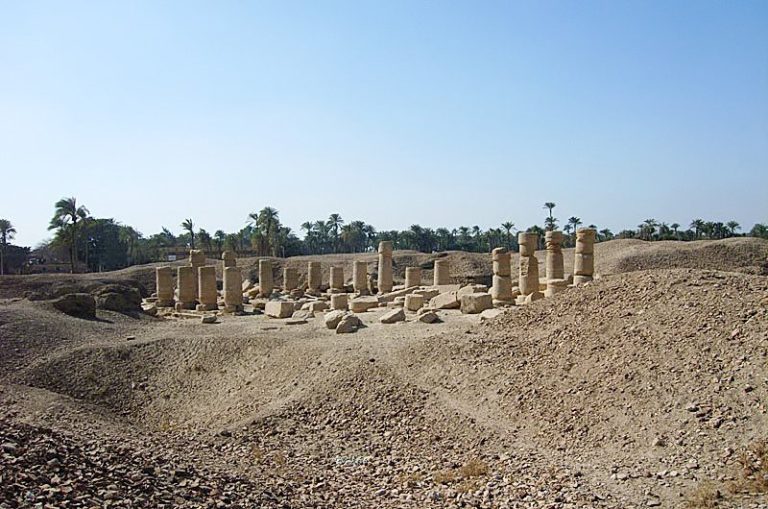
The best-known Middle Kingdom tombs lie along the north flank of Wadi Nakhla. The elite cemetery occupies the North Hill, designated Zone 2, while Third Dynasty stone-circle tombs lie west of it in Zone 8. The necropolis also includes ancient limestone and alabaster quarries, and surviving tombs retain important inscriptions.
Djehutihotep’s tomb
Portico and entrance
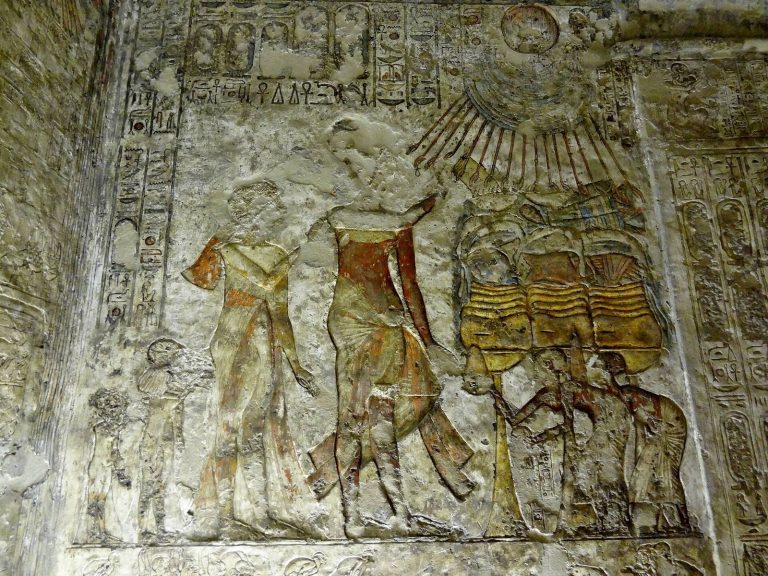
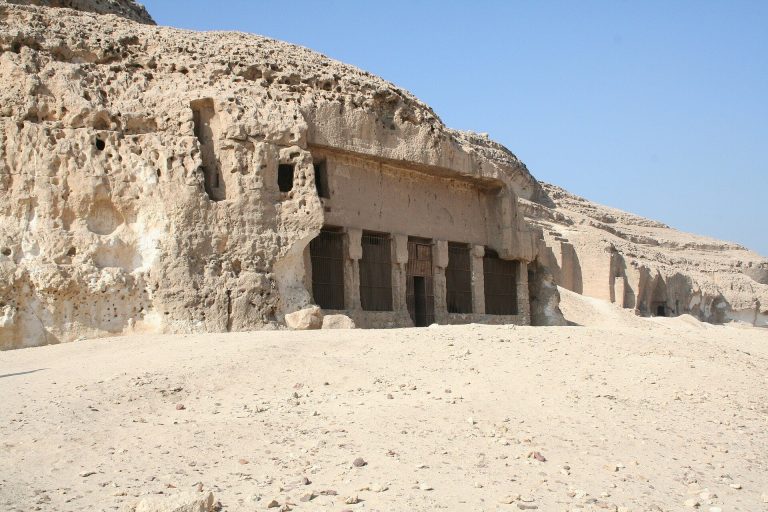
Tomb 2, belonging to Djehutihotep, was regarded as the most decorated of the ten Middle Kingdom tombs recorded by Newberry. Its entrance portico, a roofed space supported by columns, measures about 14 feet deep, 23 feet wide, and 15 feet high. Two columns with palm-leaf capitals, the sculpted tops of the columns, support the façade; the palm-leaf form was associated with Lower Egypt. Hieroglyphs, the ancient Egyptian writing system, and colorful designs cover the walls and ceiling. Among the designs are pink, blue, yellow, and green quatrefoils, or four-lobed patterns.
Newberry called the rear ten feet of the portico the “Outer Chamber.” A doorway centered in its back wall leads farther inside. The opening measures about 10.5 feet by 4 feet, and the wall around it is about 5 feet thick.
Inner chamber and shrine
The rectangular inner chamber is about 20 feet wide, 13 feet high, and 26 feet deep. A few steps at the rear lead to a shrine. Pivot holes in the stone show that the shrine was intended to close with a pair of doors.
Painted scenes
Paintings in the tomb’s upper chambers depict episodes from Djehutihotep’s life. On the left-hand wall, the scene known as the “Colossus on a Sledge” fills five of the seven rows of paintings. It shows workers hauling a colossal alabaster statue on a sledge toward a temple. One worker wets the sand, and the scene also includes sacrifices and a substantial inscription. The image contains 172 people.
Burial chambers and finds
Burial shafts
Excavated shafts, including those in Djehutihotep’s forecourt, yielded elaborately decorated and inscribed coffins belonging to Twelfth Dynasty officials, along with offering tables and wooden models. The calcite-alabaster offering table recovered in 1902 was singled out for publication.
Tomb 10A
Tomb 10A contained a large collection of wooden models depicting daily activities and boats, as well as painted coffins belonging to Djehutynakht and his wife. An ushabti, a funerary figurine intended to serve the deceased in the afterlife, was also found in the tomb. The grave goods are now in the Museum of Fine Arts, Boston.
Henu’s burial chamber
Henu’s burial chamber held his linen-wrapped mummy in a large wooden coffin inscribed with offering formulae, funerary texts expressing or requesting gifts for the dead. A large ka-statue, an image intended as a focus for the deceased’s vital essence, was among the finds. Wooden models show brickmaking, grain grinding, beer preparation, and a boat with rowers. The burial also included full-size wooden sandals painted white and a hieroglyphically decorated sarcophagus bearing appeals to Anubis, associated with embalming and protection of the dead, and Osiris, associated with the afterlife and resurrection.
Ankh’s coffin
Ankh’s early Middle Kingdom coffin belonged to a woman. The fragment identified in 2019 contains Coffin Text spells 1128 and 1130. These funerary writings also occur in later examples of The Book of Two Ways, an ancient Egyptian composition about the afterlife.
Mummy and genetic analysis
Mitochondrial DNA analysis of a 4,000-year-old mummy from Deir el-Bersha identified haplogroup U5b2b5 with one additional mutation. A haplogroup is a branch of mitochondrial genetic variation inherited through the maternal line.
Coptic church
An eighth-century Coptic church stands in a palm grove north of the necropolis. Remnants of paintings survive in its niches.