Church of los Santos Juanes, Bilbao: A Seventeenth-Century Jesuit and Parish Church
Site at a Glance
- Popularity
- Medium
- Country
- Spain
- Primary era
- Early Modern
- Eras represented
- Early Modern, Modern
- Civilizations
- Crown of Castile, Habsburg, Habsburg Spain, Spanish
- Site type
- Religious
- Remains
- Church
On this page27 sections
History
Atxuri and Jesuit construction
The Church of los Santos Juanes is a Catholic church in Bilbao, Spain, built for the Jesuits in the seventeenth century in the classicist phase of the Baroque, a restrained and ordered form of that early modern style. It first stood in Atxuri, opposite a hospital. A small church erected there in the early seventeenth century was intended as a burial place for patients who died at the hospital, reflecting the contemporary custom of burying the dead near churches. The church later moved to its present site.
The Jesuits promoted construction of the present church, supported by a donation from Domingo de la Gorgolla. Work began in 1622 to plans by the Jesuit Father Ramírez. By about 1642, the rear portion, divided into three bays, was complete, though the transept remained unfinished.
After a thirty-year pause, work on the transept and chancel resumed in 1672 under stonemasons Manuel Ceballos and Mateo del Río. In 1675, Francisco de Elorriaga began work on the roofs, vaulted ceilings, and dome. The church served the Jesuit College of Saint Andrew until the Jesuits were expelled in 1767.
Parish church and later history
After the expulsion, Bilbao’s municipal government took over the college premises at Portal de Zamudio. The college residence and cloister were assigned to welfare functions. In 1769, the historic parish of Saints John the Baptist and John the Evangelist was transferred from Ibeni to the former Jesuit church. It became a public church and the seat of the True Cross Confraternity, a religious association devoted to the cross traditionally identified as the one on which Jesus was crucified.
The Church of los Santos Juanes belongs to the Diocese of Bilbao and is served by secular clergy, priests who do not belong to a religious order. It was designated a Historic-Artistic Monument on 17 July 1984.
The catastrophic floods of 1983 damaged the church, which was subsequently restored. The floods also caused the loss of a statue of Saint Joseph and the Child from one of its chapels; a modern statue now takes its place.
Remains
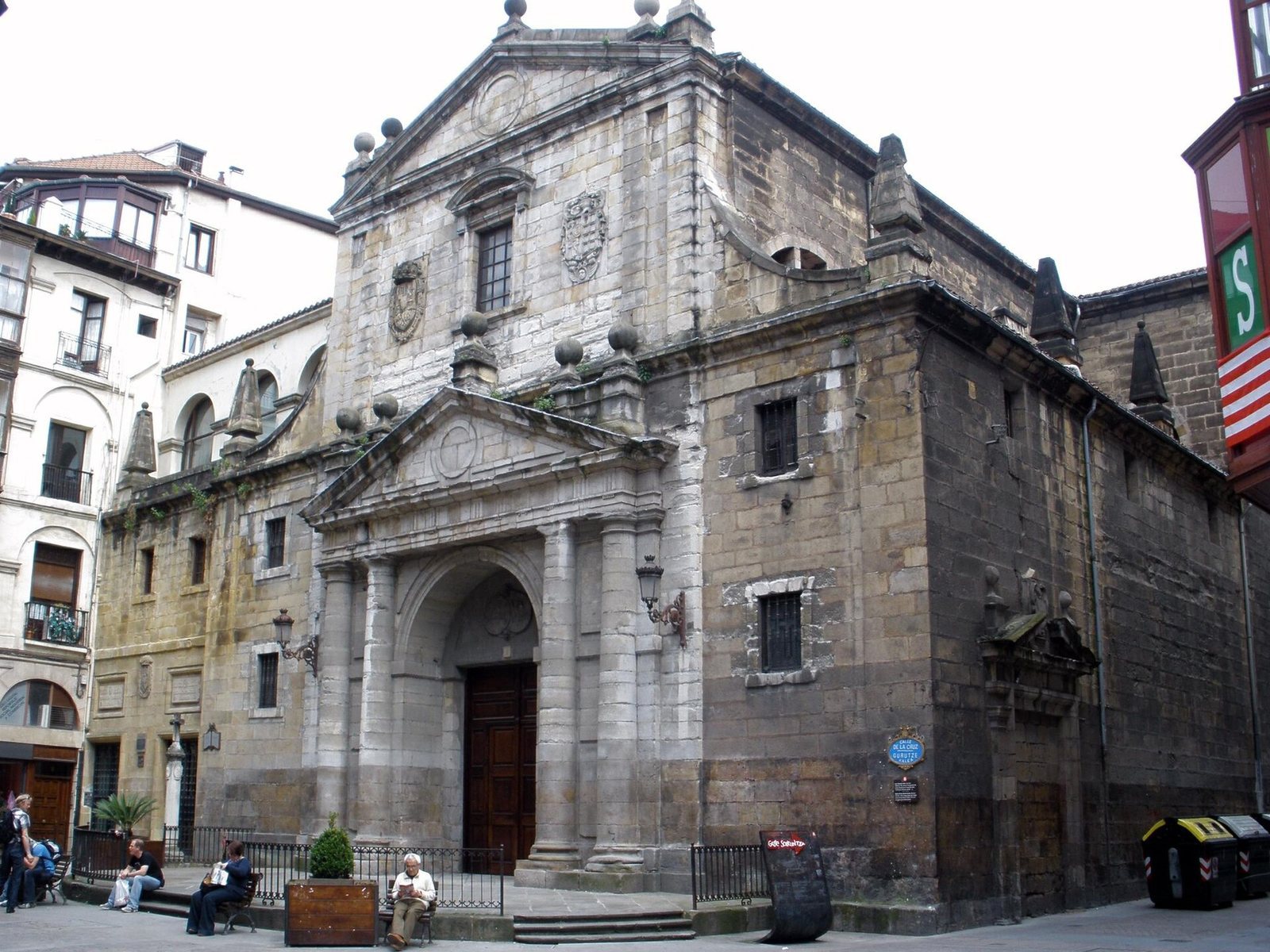
The church brings together a three-part façade and a rectangular interior organized around a nave, side aisles, and a short transept. Baroque decoration appears in its vaulted ceilings and richly furnished chapels, while the façade and interior arrangement reflect more ordered architectural forms.
Exterior and plan
Façade
The façade is arranged in three vertical sections, with a central section twice as wide as it is high. Concave connecting walls link it to the narrower side sections. The composition probably takes inspiration from the Church of the Gesù in Rome, the mother church of the Jesuits.
A semicircular entrance occupies the centre of the ground floor, framed by two pairs of Tuscan columns set against the wall. Above them is a horizontal structure with a frieze alternating grooved blocks and panels, and a triangular pediment crowned with five block-and-ball ornaments. A window with a flat lintel and semicircular pediment sits above the entrance. On either side are the original arms of benefactor Domingo de la Gorgolla and the arms of the Bourbons. The uppermost part of the central section repeats the forms of the entrance pediment.
The plainer side sections have two tiers of flat-topped windows. These align with the rear bays of the lower chapels and the galleries. Pyramidal ornaments mark the outer ends of the façade.
Plan, galleries, and cloister
The church has a rectangular plan. Its nave and short transept, which extends no farther than the side chapels, form a cross-shaped arrangement within that outline. The 1693 remodeling removed the walls between the lower chapels, creating two side aisles. The interior organization also draws on the Church of the Gesù, particularly the design associated with the Italian Renaissance architect Jacopo Vignola.
A gallery with horizontal lintels runs above the chapels. It links the choir with the transept, where it opens into a balcony, and continues to the chancel. Semicircular windows divided by vertical supports light the south side of the transept and the spaces above the galleries. A cloister formerly joined the north side of the church. It is now detached and has formed part of the Basque Archaeological, Ethnographic and Historical Museum since 1921.
Nave and crossing
Nave and ceiling
A barrel vault, a continuous arched ceiling, covers the nave. Curved recesses known as lunettes interrupt its surface, which is decorated with angled and other geometric patterns. Monograms and recessed panels add restrained Baroque decoration to the arches.
Crossing and dome
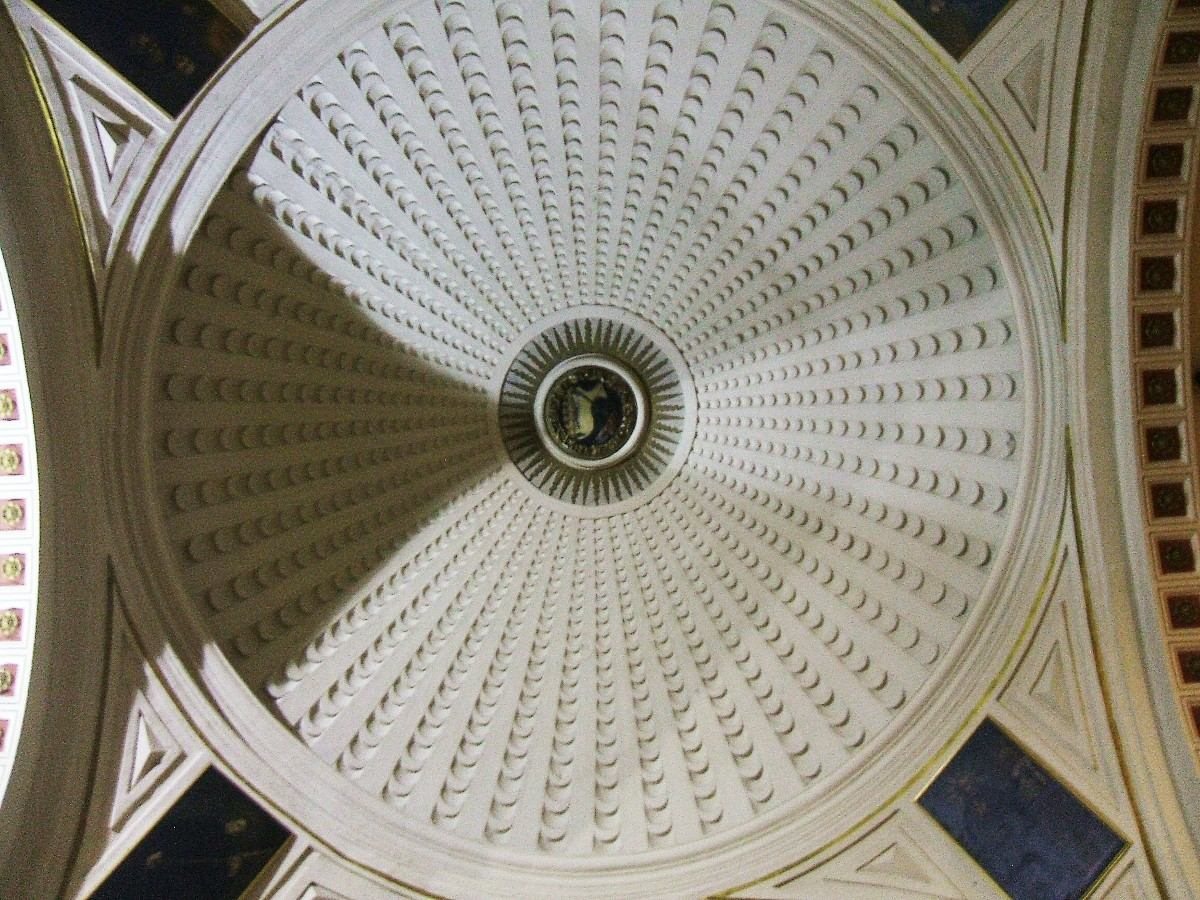
A very shallow dome covers the crossing, the space where the nave and transept meet. Its surface carries a radiating pattern of scale-like forms. Curved supports called pendentives carry the dome over the corners of the crossing, with the structural arches helping to shape them. Four seventeenth-century oil paintings set into the pendentives portray Jesuit saints Ignatius of Loyola, Francis Xavier, Francis Borgia, and Aloysius Gonzaga.
Main altar and transept chapels
Main chapel
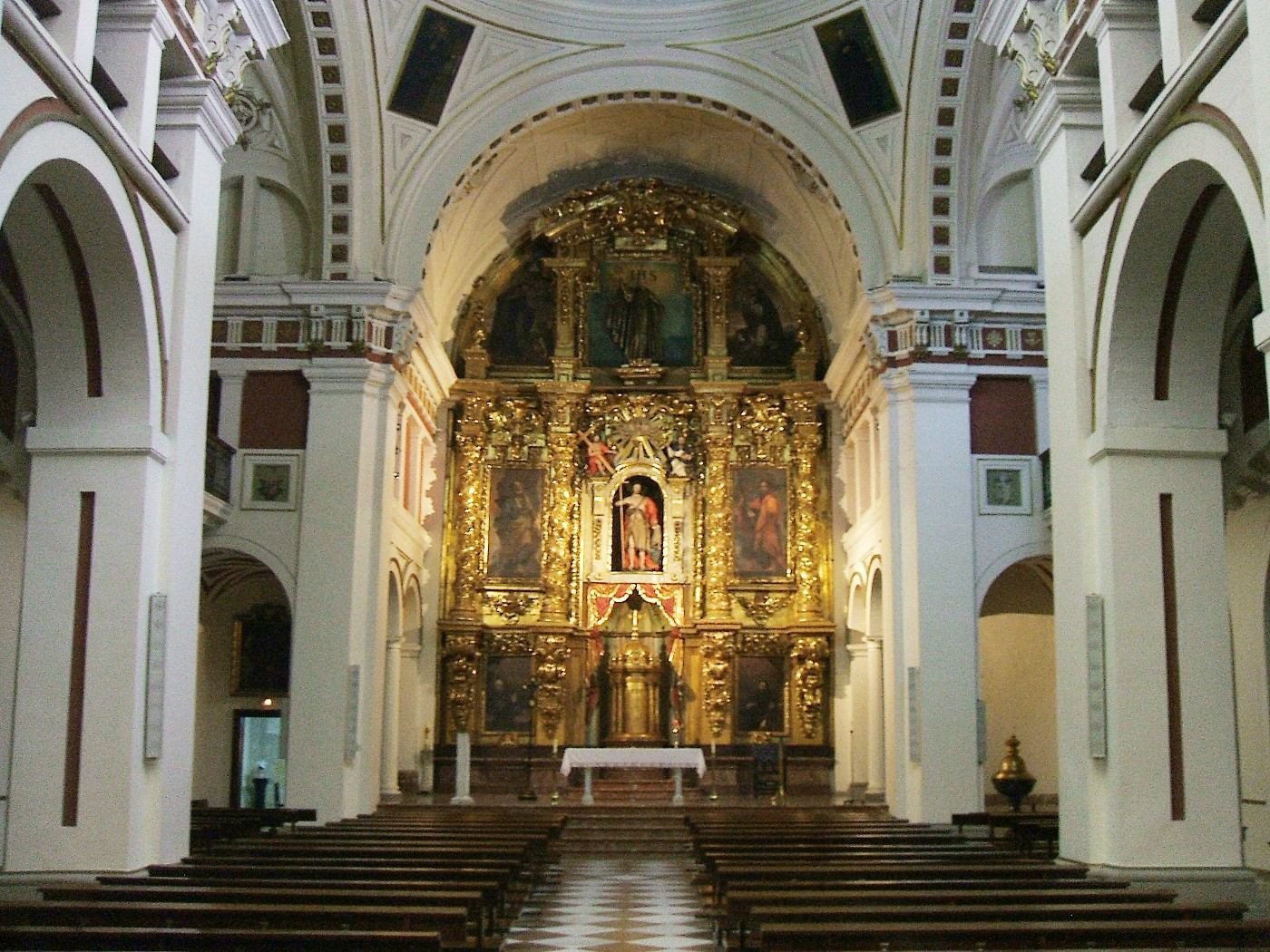
The main chapel contains a large altarpiece built between 1683 and 1689. An altarpiece is a decorated structure behind an altar. This one has a gilded, carved frame in two tiers, crowned by a semicircular upper section. Four vine-covered columns divide it into three vertical parts. The two columns beside the central part continue above as tapering supports.
Six paintings made in the same period as the altarpiece depict Saints Ignatius of Loyola, Francis Xavier, Peter, Paul, Augustine, and Dominic. Four sculptures include a large Saint John the Baptist in the central tier, carved in 1780 and associated with the style of Cantabrian sculptor Manuel de Acebo. Above him are figures of the Father and the Son, representing the Trinity. A statue of Saint Francis Borgia crowns the upper section and probably dates to the altarpiece’s original period. The tabernacle, which holds the Eucharist, is a nineteenth-century work in the Neoclassical revival style.
Our Lady of Mount Carmel
On the left side of the transept, the Chapel of Our Lady of Mount Carmel has an altarpiece made in 1693 by Santiago de Castaños. It contains a statue of the Virgin of Mount Carmel, paintings of Saints Joachim and Anne at the sides, and an image of Our Lady of Perpetual Help above. The chapel was originally dedicated to Saint Ignatius.
True Cross
A separate Chapel of the True Cross also stands on the left side of the transept. Its altarpiece holds the statue of the Holy Christ of the Town, a Mannerist work from the mid-sixteenth century, in the late-Renaissance style. The sculpture probably came from the Franco-Flemish artist Juan de Beaugrant and belonged to the True Cross Confraternity. A painting of the penitent Mary Magdalene hangs above it. The altarpiece’s carved frame and painted finish date to 1690, later than the statue.
Our Lady of Sorrows
On the right side of the transept, the Chapel of Our Lady of Sorrows has an altarpiece made by José de Egusquiza in 1695. Its central statue of the Virgin of Sorrows was carved around 1690 by Raimundo Capuz, a sculptor from eastern Spain. In the upper section, a 1694 painting by Martín Amigo shows the Ecce Homo, the presentation of Jesus before his crucifixion. The painting follows the style of Flemish Baroque artist Van Dyck.
Saint John the Evangelist
Opposite the Chapel of Our Lady of Mount Carmel is the Chapel of Saint John the Evangelist. Santiago de Castaños made its altarpiece around 1693. It includes paintings of Saints Francis of Assisi and Francis of Paola, as well as the Virgin of Begoña. The central statue of Saint John is a nineteenth-century copy. The chapel was originally dedicated to Saint Francis Xavier.
Side-aisle chapels
The devotional chapels in the side aisles have Baroque altarpieces of broadly related proportions and style. Most are medium-sized and have rounded tops. Among them is an altarpiece dedicated to Saint Michael the Archangel.
Saint Raphael
The Chapel of Saint Raphael the Archangel occupies the second bay of the north aisle. Its altarpiece, made in the lighter Rococo style of the mid-eighteenth century, was donated by Antonio Mazarredo, a prominent figure in Bilbao society.
Saint Aloysius Gonzaga
The Chapel of Saint Aloysius Gonzaga is in the third bay of the north aisle. Its altarpiece dates to around 1700 and is topped by a statue of the saint attributed to Spanish sculptor Luis Salvador Carmona. Nearby canvases show Saints Lucy and Agatha, while another depicts Saint Francis Xavier receiving the Martyrs of Nagasaki, executed in 1597.
Saint Joseph
The Chapel of Saint Joseph occupies the third bay of the south aisle. Its altarpiece is contemporary with that of the Chapel of Saint John the Evangelist. A modern statue of Joseph with the Child replaced the one lost in the 1983 floods. Baroque canvases portray Saints John Berchmans, Stanislaus Kostka, and Bruno; the first two were young Jesuit saints.
Sacred Heart of Jesus
The Chapel of the Sacred Heart of Jesus fills the second bay of the south aisle. Its 1740 altarpiece has an unusual design centered on a large radiating circle.
Christ of the Wayside Shrine
In the first bay of the south aisle, beside the entrance, the altarpiece of Christ of the Wayside Shrine has a modern frame dating to 1917. It holds a statue of Christ from around 1500, in the Hispano-Flemish style associated with artistic influences from Spain and Flanders. The oldest sculpture in the church, it stood for centuries in a wayside shrine in Bilbao that no longer survives.
Other chapels and furnishings
Baptistery
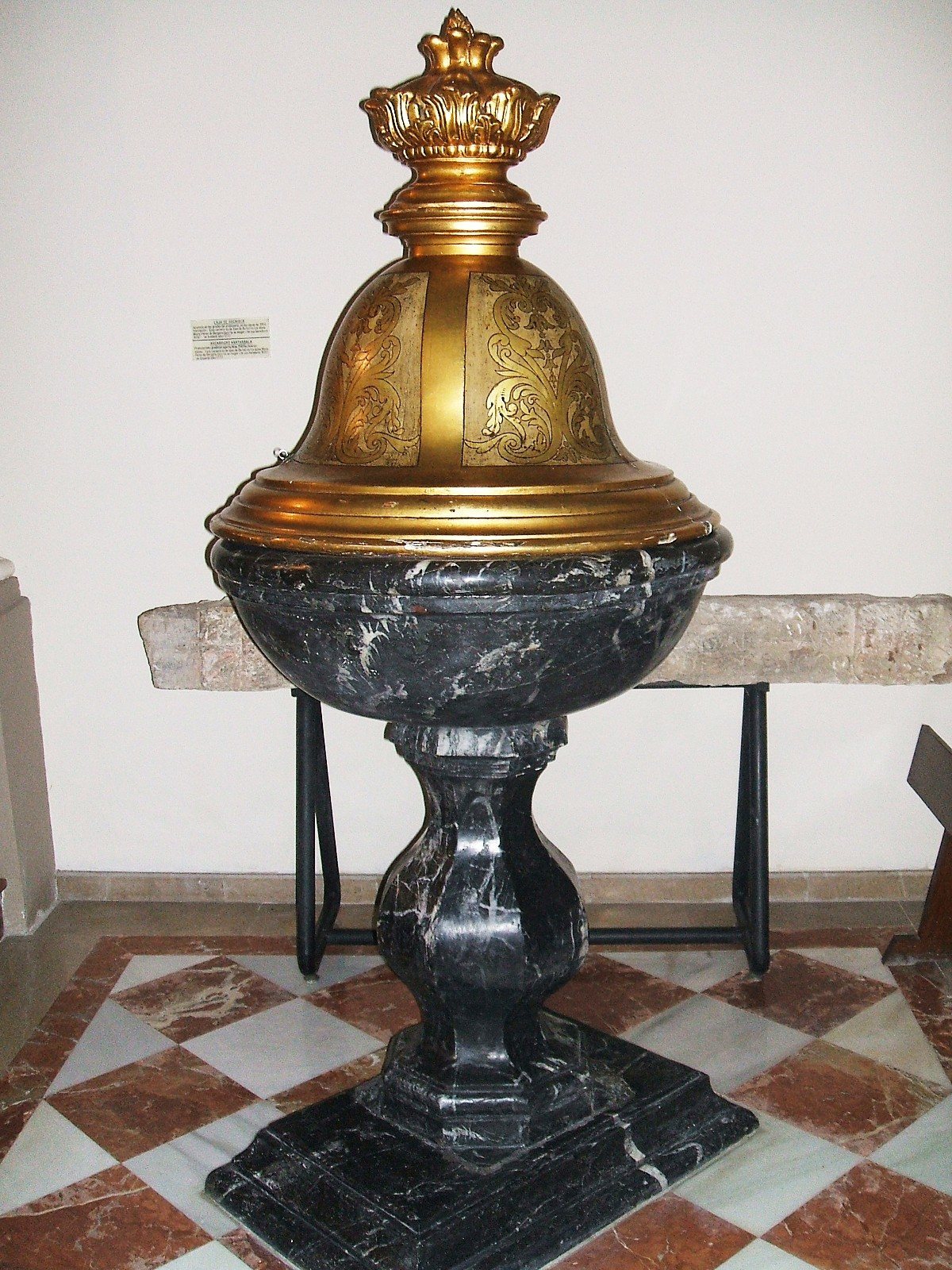
The baptistery lies on the right side of the altar area. Its eighteenth-century Baroque font is made of black Mañaria marble and has a bell-shaped gilded cover. A wall-mounted oil painting of the Baptism of Jesus dates to the first half of the seventeenth century.
Works beside the main altar
On the left side of the altar area is a small eighteenth-century Pietà, a depiction of Mary mourning over the dead Christ. It copies a work in the parish church of Saint Nicholas of Bari. Nearby, a cross made in 1940 by the Talleres Granda workshops combines silver, white metal, and enamel. Its Neo-Renaissance design revives Renaissance forms and incorporates a nineteenth-century container for a relic of the True Cross.
Above the passage to the sacristy hangs a late-sixteenth-century painting of the Visitation of the Virgin Mary to Saint Elizabeth. It was brought from the earlier Church of los Santos Juanes at Ibeni.
Chapel of Communion
The Chapel of Communion contains an oval relief depicting the Incarnation of Christ, made in the mid-eighteenth century.
Choir and organ
An elevated choir occupies the west end of the church. It houses an organ made in 1885 by the German company Walker.