Pool of Bethesda: Jerusalem’s Ancient Water and Religious Complex
Site at a Glance
- Popularity
- Very High
- Country
- Israel
- Primary era
- Classical
- Eras represented
- Iron Age, Classical, Medieval
- Civilizations
- Crusader, Israelite, Kingdom of Jerusalem, Roman, Seleucid
- Site type
- Religious
- Remains
- Sanctuary
On this page12 sections
History
The Pool of Bethesda is an ancient water and religious complex in Jerusalem, Israel, near the city’s former Sheep Gate. Its water system may have begun in the eighth century BCE, and the site later became a Roman sanctuary and a place of Christian religious visitation.
Water system and ritual use
The early reservoir lay in the Beth Zeta Valley, beside a market for animals intended for sacrifice. A dam held rainwater, while a channel carried water toward the Temple. Around 200 BCE, during the high priesthood of Simon II, a second pool was constructed south of the dam. The channel was then enclosed as a tunnel.
The pools have been linked with ritual purification in the Second Temple period, the era when Jerusalem’s rebuilt Temple stood until its destruction in 70 CE. The southern pool may have served as a mikveh, a Jewish bath for ritual immersion, although that interpretation remains debated. Washing sheep in the pools has also been proposed, but is considered unlikely given the water system’s supply function and the southern pool’s depth.
Roman sanctuary
In the first century BCE, natural caves east of the pools were adapted as small baths with religious or medical uses. At least one was associated with Fortuna, a Roman goddess. A Roman garrison may have established the baths, though this remains uncertain. In the mid-first century CE, Herod Agrippa, king of Judea, extended Jerusalem’s walls to include them. Under Emperor Hadrian, a temple to Asclepius, a Greek god of healing, and Serapis, a Greco-Egyptian deity, was built at the site. A roadway crossed the dam, and the complex served as a Roman sanctuary.
The Pool of Bethesda is also mentioned in the Copper Scroll, a copper-inscribed manuscript among the Dead Sea Scrolls, dated to AD 35–65.
Christian traditions and churches
John’s Gospel, one of the New Testament accounts of Jesus, places the pool near the Sheep Gate. It recounts that Jesus healed a man who had been ill for 38 years and told him to carry his mat. Because the healing took place on the Sabbath, the man’s action prompted a dispute. The story made the pool a destination for Christian religious visitation. The name appears in forms including Bethesda, Bethzatha, and Bezatha; Bethsaida in some manuscripts is generally regarded as a copying error. Proposed meanings include “house of mercy” and “house of grace,” while other interpretations connect the name with sheep pools or a colonnade.
A church associated with the pool was built in late antiquity, the period broadly spanning the third to eighth centuries CE. It was known as the Church of the Sheep Pool or the Church of the Paralytic. First associated with the healing story, it was linked with Mary, the mother of Jesus, from the sixth century. Empress Eudocia has been proposed as its founder, but an association with Juvenal, bishop of Jerusalem, is considered more likely. Persian forces destroyed the church in 614.
After Crusader forces captured Jerusalem in 1099, a smaller church, known as the Church of the Paralytic or the Monastery, was built among the Byzantine ruins. A larger Church of St Anne nearby was completed in 1138 on the site of a destroyed Basilica of St Mary. A grotto beneath it had been regarded since the fifth or sixth century as the birthplace of Mary.
Following Saladin’s conquest of Jerusalem in 1187, the Church of St Anne became a Shafi‘i school of Islamic law, one of the major Sunni legal traditions. The buildings later fell into ruin, and the complex became a waste dump.
Modern restoration and archaeological investigation
In 1856, Ottoman Sultan Abdülmecid I presented the area encompassing St Anne’s Church and the pool site to Napoleon III, emperor of France. French authorities renovated and rededicated St Anne’s under the administration of the White Fathers, a Catholic missionary order, while leaving the other ruins untouched. The church later returned to Catholic religious use.
Before excavation supported the identification of the site as the biblical pool, proposed locations included the Fountain of the Virgin, Birket Isra’il, and twin pools beneath the Sisters of Zion convent, now identified as the Struthion Pool. In the nineteenth century, Conrad Schick found a large tank about 30 metres northwest of St Anne’s and proposed that it was Bethesda. Excavations in 1964 revealed remains of Byzantine and Crusader churches, Hadrian’s temple, small healing pools, the southern large pool, and the dividing dam.
Remains
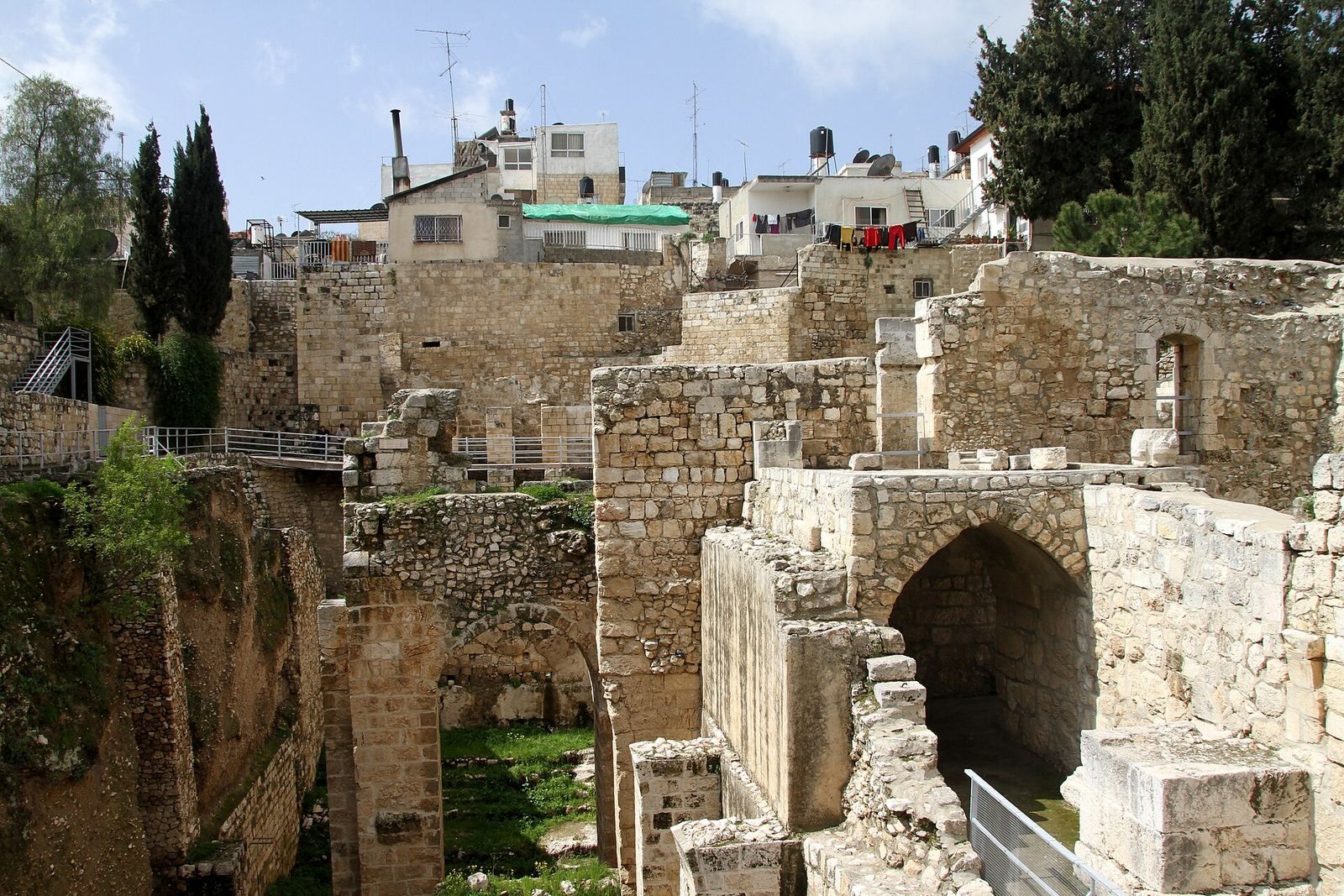
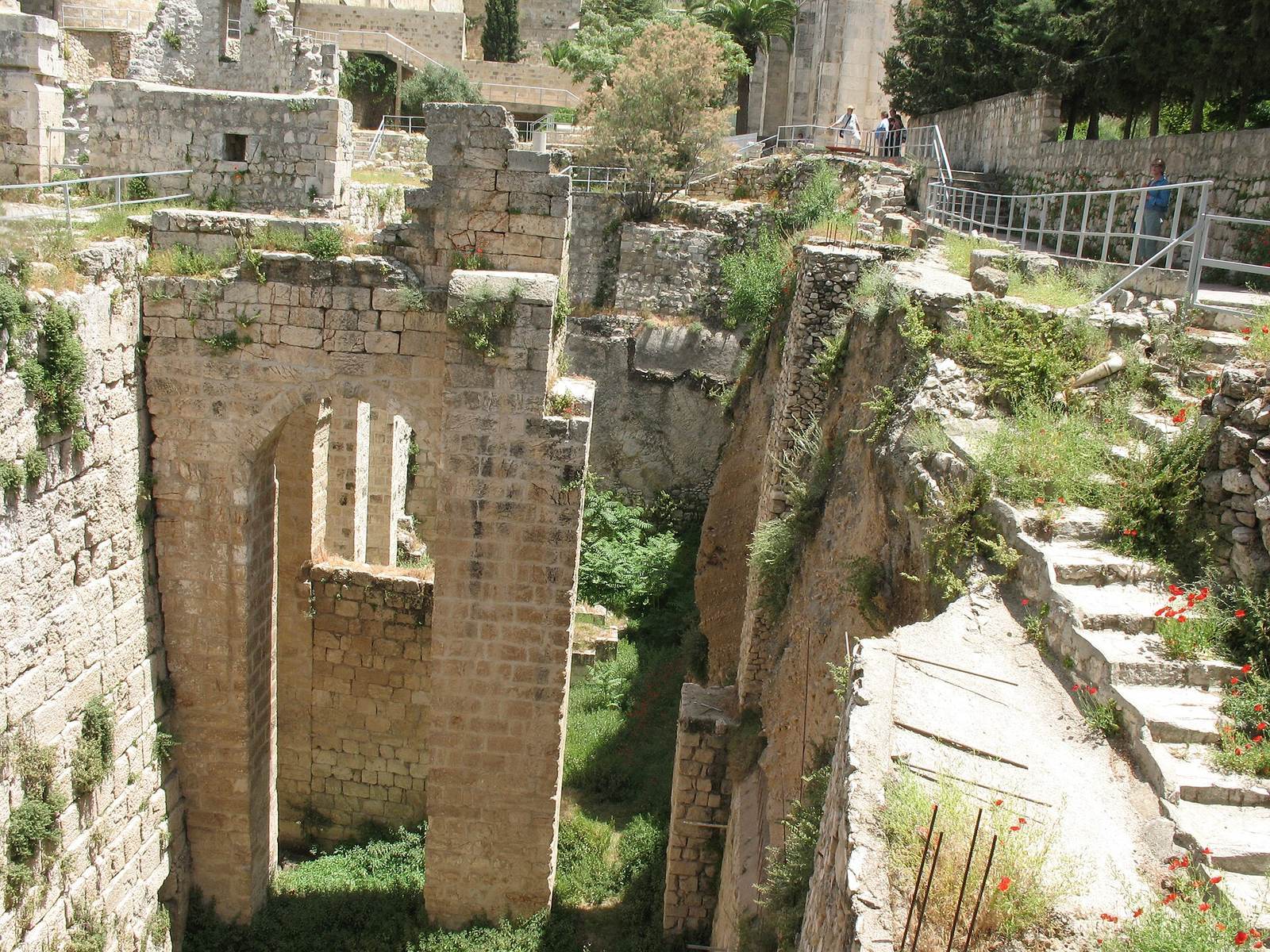
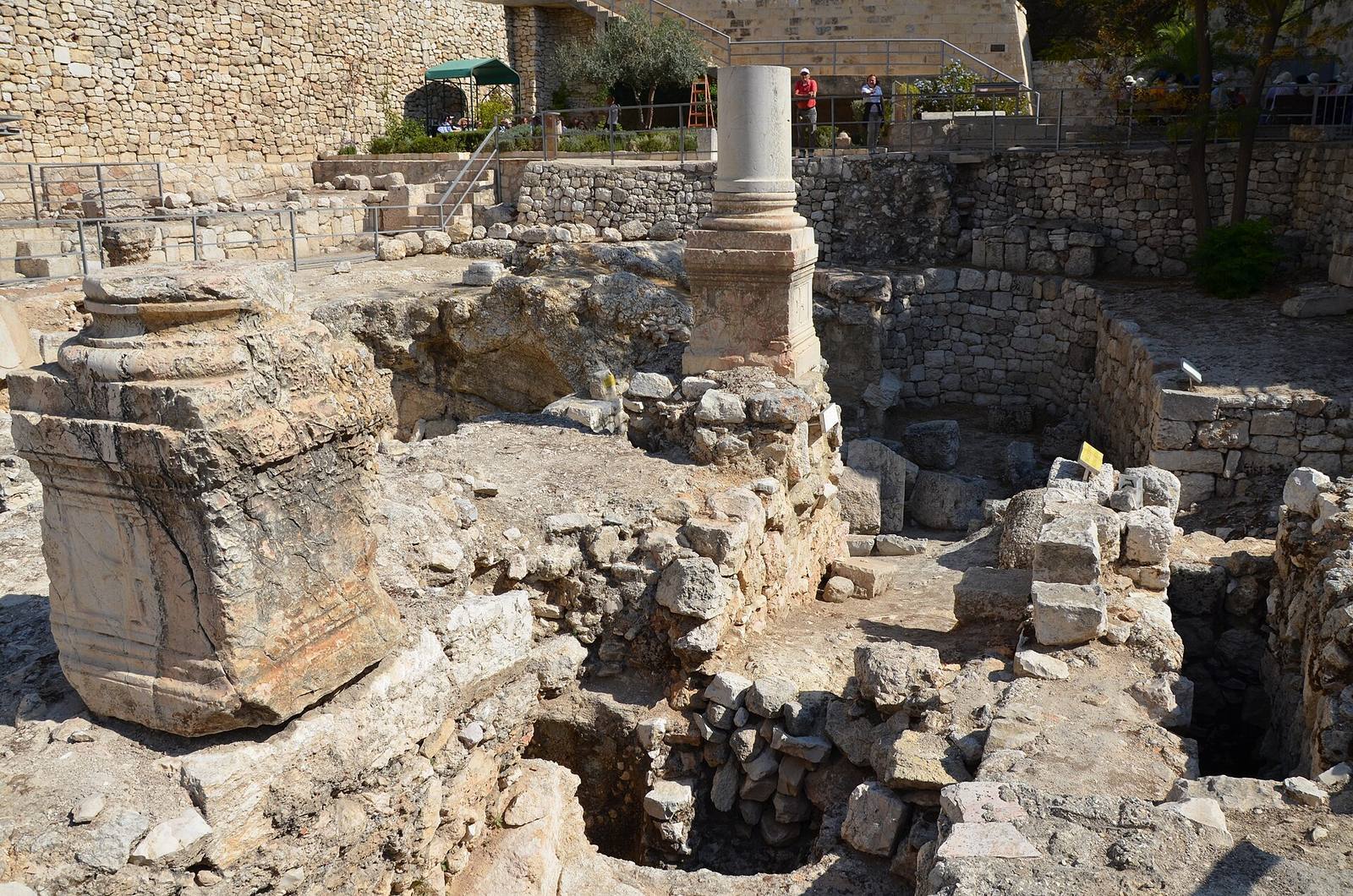
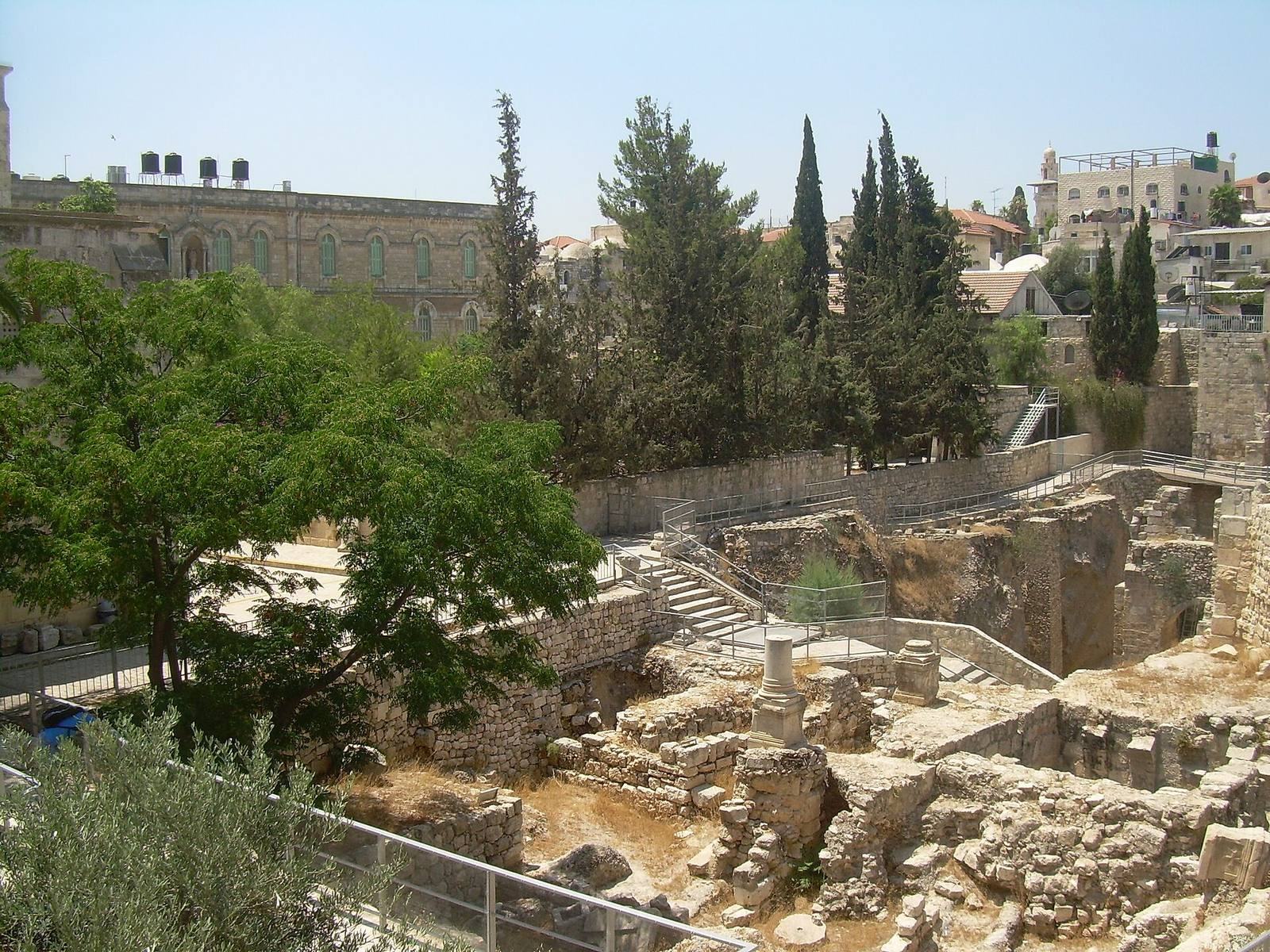
The archaeological complex occupies the Beth Zeta Valley. Some parts are cut into bedrock, while much of the site lies beneath the inhabited urban area. Its principal features are two large pools divided by a stone dam, with adapted caves and smaller pools to their east and church remains extending over parts of the water system.
Pools and waterworks
The northern pool measured about 40 by 50 metres, and the dam between the pools was about 6 metres wide. The southern pool reached a depth of about 13 metres. A sluice gate in the dam controlled the reservoir’s water level. The northern basin collected rainwater, while the southern one has been associated with bathing, ritual use, and healing. A channel carried water toward the city; it was first open and later roofed to form a tunnel. The paired pools have also been proposed as an explanation for the five porticoes, or covered walkways, in John’s Gospel. On this interpretation, four ran along the pools’ outer sides and a fifth crossed above the dividing dam.
Roman-period baths and healing pools
Natural caves east of the large pools were adapted as small baths. The archaeological complex also includes small healing pools associated with the Roman temple precinct.
Church remains
Byzantine church
The church associated with the pool extended over parts of the water spaces. Piers and other supports carried sections of the building above them, and its remains form part of the visible archaeological complex.
Crusader church
The smaller Crusader church stood on the stone dam separating the pools.
Church of St Anne
The surviving Church of St Anne is a Crusader building with solid stone construction and Romanesque design, a medieval style characterized by rounded arches and substantial masonry. It stands over the grotto associated with the tradition about Mary’s birthplace.