Saint Nicetas, Banjane: The Medieval Church of Gornjane Monastery
Site at a Glance
- Popularity
- Medium
- Country
- North Macedonia
- Primary era
- Medieval
- Eras represented
- Medieval, Modern
- Civilizations
- Byzantine, Ottoman, Serbian
- Site type
- Religious
- Remains
- Church
On this page17 sections
History
Saint Nicetas, Banjane, is the principal and only church of the medieval Gornjane Monastery, within the cadastral territory of Gornjane in North Macedonia. Its medieval form dates to a rebuilding under Serbian King Milutin in the early fourteenth century, although its precise construction date is uncertain.
Early church and monastery
The church stands on an older sacred site, above the remains of a predecessor building that may have been a Byzantine church of the twelfth century. Soon after the rebuilding, Milutin gave the monastery to Hilandar, a Serbian Orthodox monastery on Mount Athos. He also built a nearby chapel dedicated to Saint John the Forerunner, also known as John the Baptist. The chapel was destroyed in the late seventeenth century.
Repairs and later painting
The church underwent repeated repairs and additions. A complete renovation in 1484 is associated with the good preservation of its paintings. In the nineteenth century, painter and iconographer Dicho Zograf contributed a further phase of decoration.
Continuing religious use
Saint Nicetas remains an active Orthodox church in the Skopje Diocese of the Macedonian Orthodox Church – Ohrid Archbishopric and is recognized as a cultural monument in Macedonia. It has served people from Gornjane, Banjane, and Chucher. Although its cadastral location is in Gornjane, its village affiliation is uncertain.
Remains
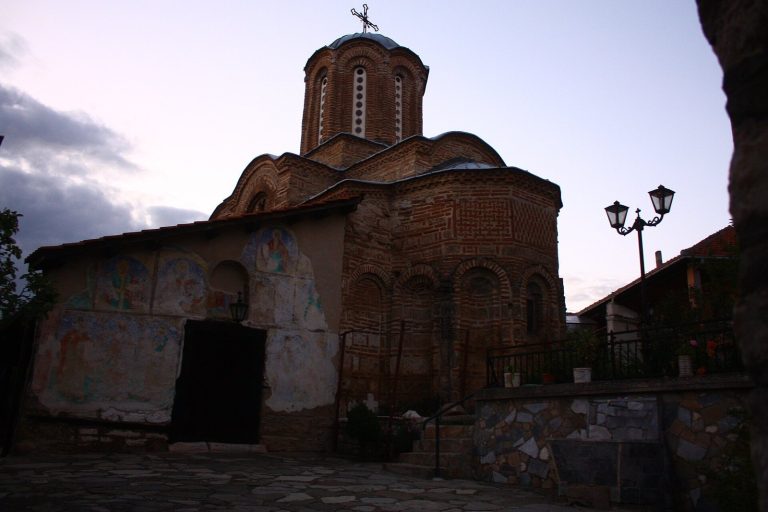
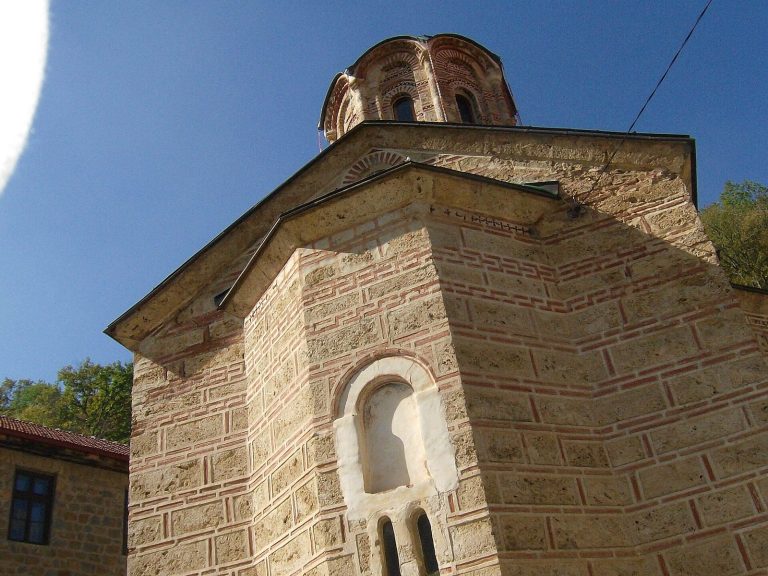
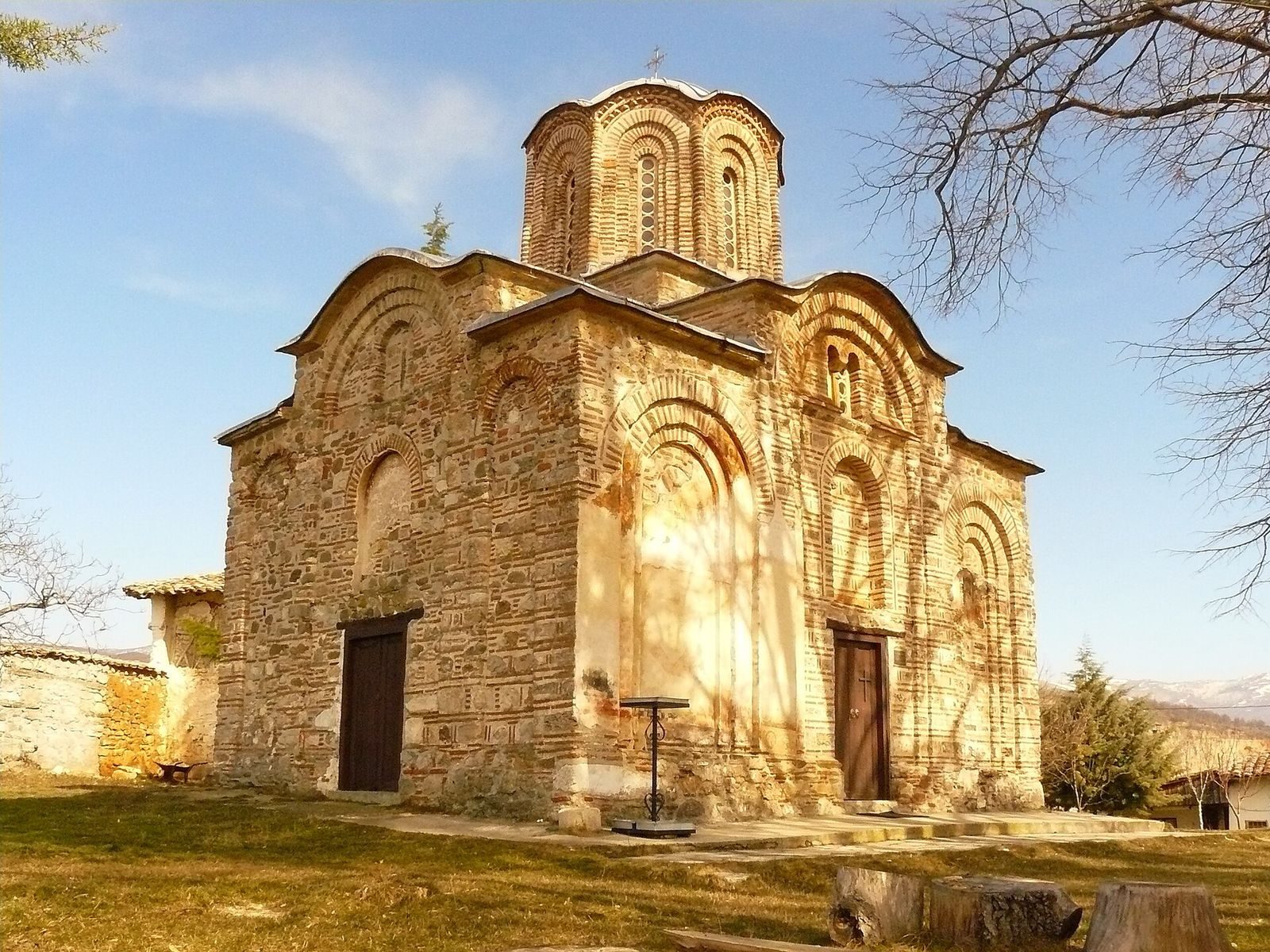
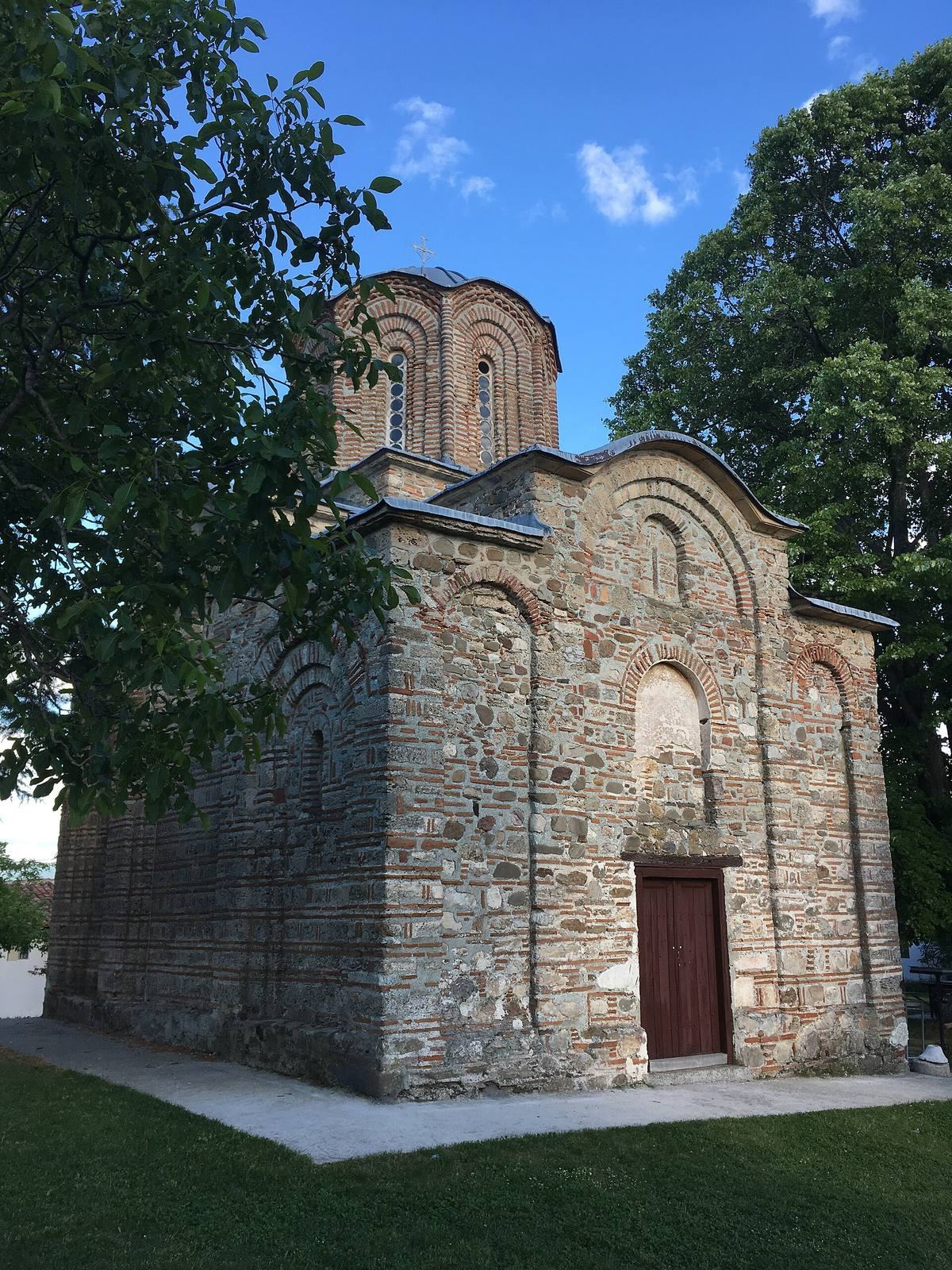
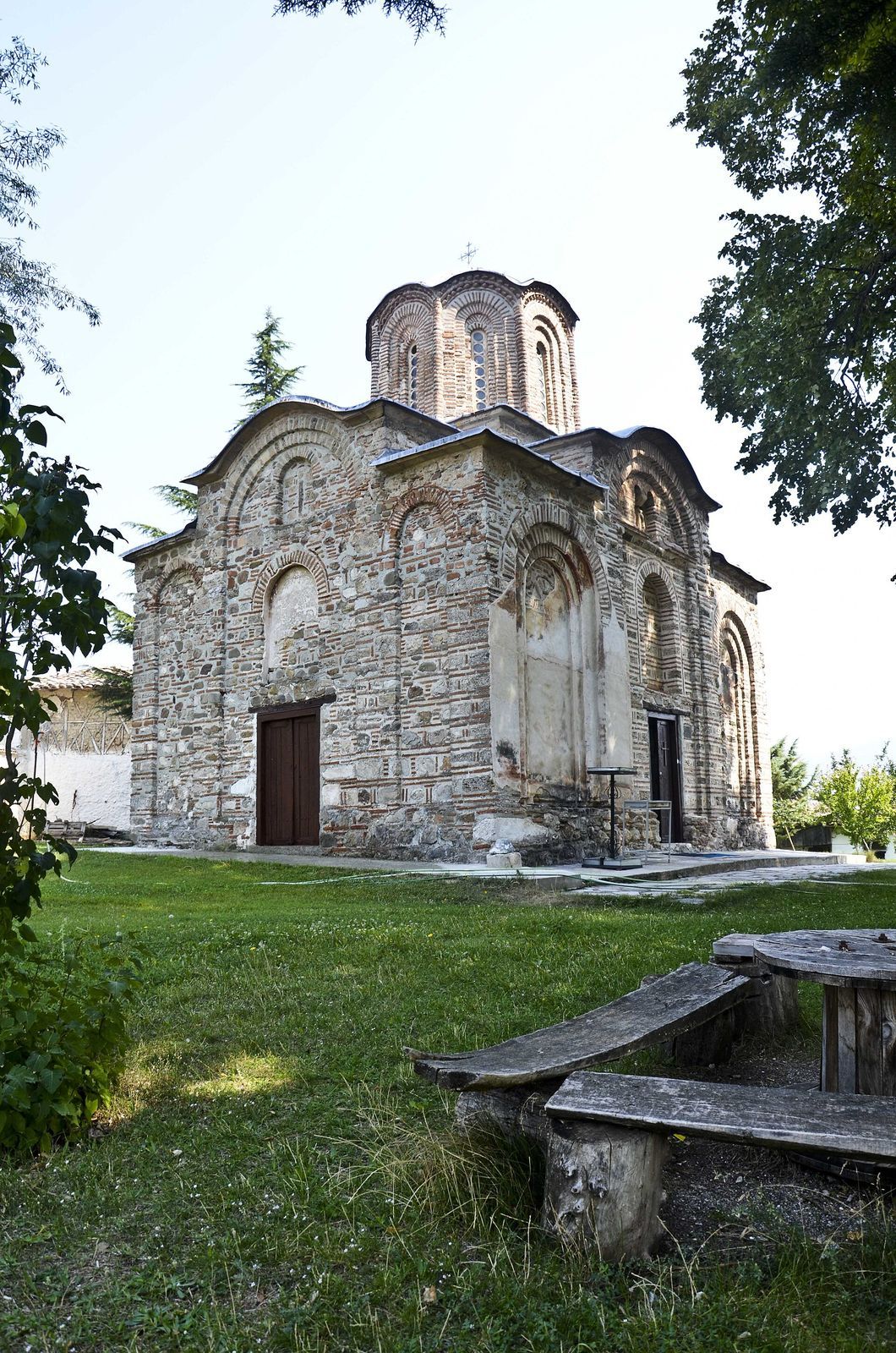
The church combines a cross-shaped interior within a rectangular footprint with a dome above its main space. Dressed stone, red brick, and mortar form the building, while its surviving decoration includes medieval frescoes and nineteenth-century painting.
Church fabric and earlier building
Structure and exterior
Four square pillars and curved pendentives, supports that carry a dome over a square space, hold up the dome, which rises on a high drum, or raised supporting wall. Blind arcades with varied geometric patterns decorate the exterior. Ceramic ornament is especially prominent around the apse, the curved end containing the altar.
Predecessor church
A fragment of painted decoration from the earlier church survives within the present building, linking its fabric to the older sacred site beneath it.
Medieval frescoes
Cycle and subjects
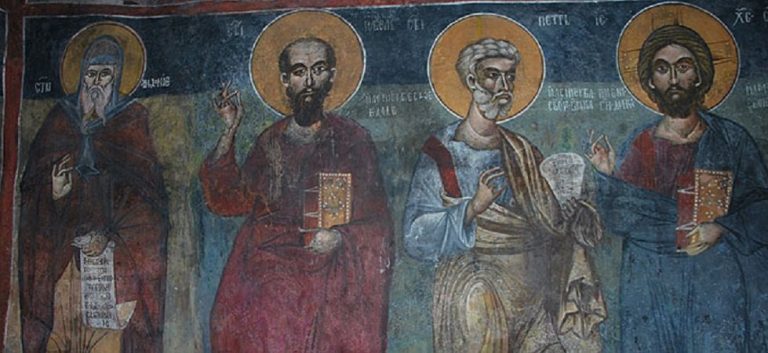
Most of the frescoes belong to the church’s medieval painting campaign. Their exact date is uncertain, though they are generally assigned to the early fourteenth century; parts were painted in 1483–84 by a leading workshop in the regional tradition associated with Kastoria. The paintings, which are well preserved, are arranged in three horizontal bands. Full-length, front-facing saints occupy the lowest band. The middle one includes Christ’s miracles, including the Expulsion of the Merchants from the Temple and the Wedding at Cana. The upper band depicts Christ’s Passion, the events of his suffering.
Saints, painters, and inscriptions
The church’s patron saint appears in armor, holding a spear in the right hand and a bow in the left. Saint George, also armored, stands to the patron’s right, while Saint Stephen, traditionally regarded as the first Christian martyr, is on the left. An image of Saint Theodore Tiron, an early Christian soldier and martyr, carries an inscription naming the painters Michael and Eutychius and describing Michael as Eutychius’s son. Inscriptions are in Greek and in the Serbian form of Church Slavonic, a regional form used in Serbian Orthodox contexts. The cycle is noted for its rich iconography and artistic quality. Compared with the paintings at the Church of the Virgin Peribleptos in Ohrid, its figures and compositions are more narrative and less monumental.
Nineteenth-century painted decoration
Dicho Zograf’s paintings
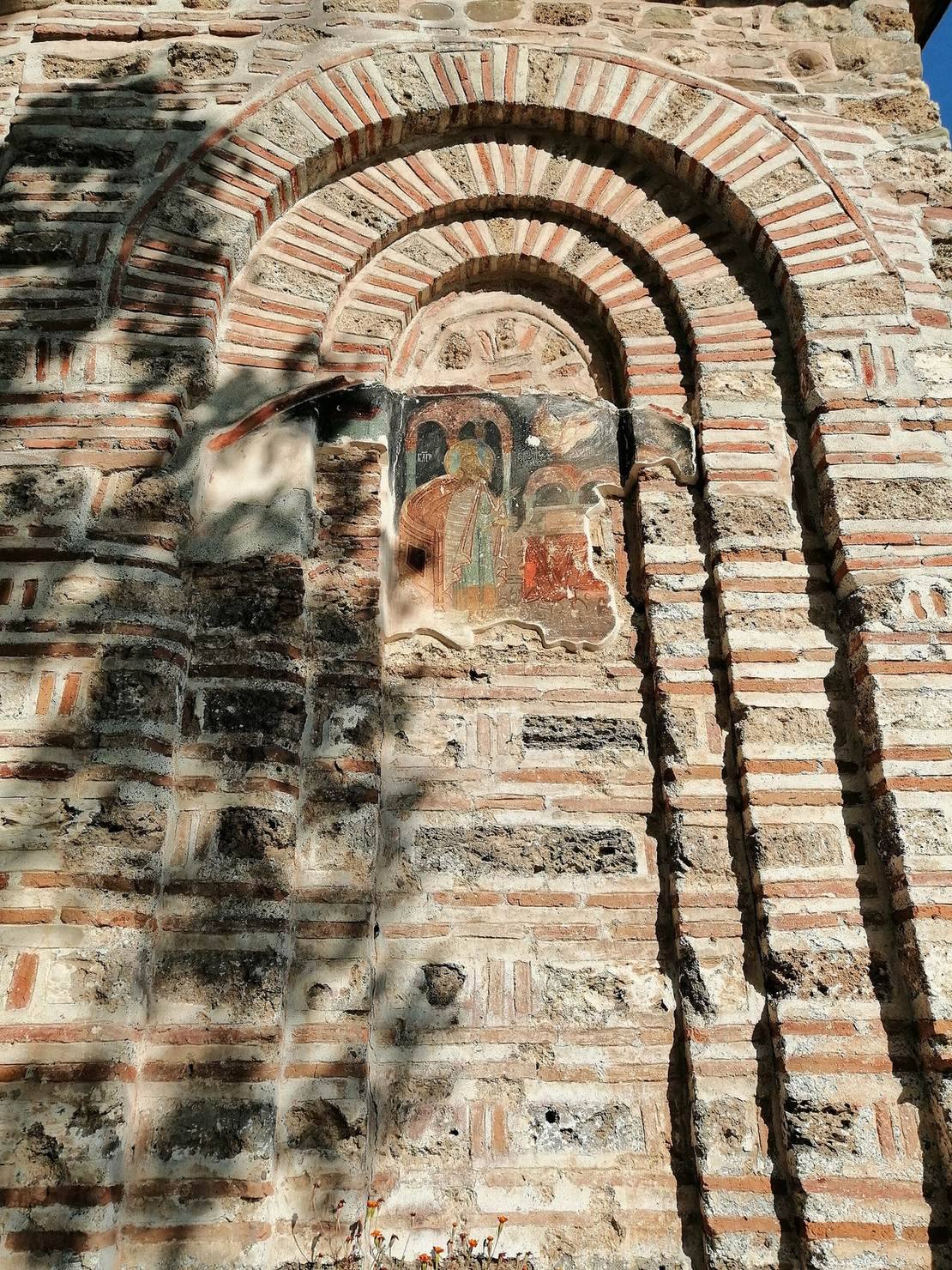
In the dome above the nave, the main body of the church, Dicho Zograf repainted a scene of worship centered on Christ Pantocrator, meaning Christ portrayed as ruler of all. The repainting retains the flesh tones and contours used by the earlier painters. Its attribution to Dicho rests on its style and comparison with his other paintings of the subject. A niche on the south façade, to the left of the entrance, preserves damaged sections of his mural of a mounted saint.
Interior furnishings and devotional features
Iconostasis and icons
The iconostasis, the screen of icons separating the sanctuary from the main body of an Orthodox church, includes works by Dicho Zograf. They comprise the royal doors, icons of the apostles, Jesus’s principal disciples and messengers, and feast days, a cross above the screen, and a small image of Mary and Jesus with saints. Other named subjects include Christ Pantocrator, the Virgin and Child, Saint John the Baptist, Saint Nicetas, the Archangel Michael, the Coronation of the Virgin, the Apostle James, and the Beheading of Saint John the Baptist.
The icons of Christ Pantocrator and the Virgin and Child are signed and dated 20 December 1846. Those of Saint John the Baptist and Saint Nicetas bear signatures and the date 15 February 1847. The Archangel Michael icon is unsigned, includes the patrons’ names, and is dated 1847. Dicho is credited with the unfinished Coronation of the Virgin.
Saints George and Demetrius icon
A signed icon of Saints George and Demetrius, dated 13 April 1856, rests against the lower part of the iconostasis. It may originally have belonged to the iconostasis of the Church of the Holy Trinity in Chucher.
Stone associated with Saint Nicetas
A stone beneath a carpet inside the church is believed to cover Saint Nicetas’s relics. A person seeking relief from hardship or making a wish lights a candle, faces the altar, crosses themselves, then circles and bows toward the stone three times. They then recite the Lord’s Prayer and state their hardship or wish.