Church of St Michael the Archangel, Framlingham: A Parish Church and Howard Mausoleum
Site at a Glance
- Popularity
- Medium
- Country
- United Kingdom
- Primary era
- Medieval
- Eras represented
- Medieval, Early Modern, Modern
- Civilizations
- British, English
- Site type
- Religious
- Remains
- Church
On this page18 sections
History
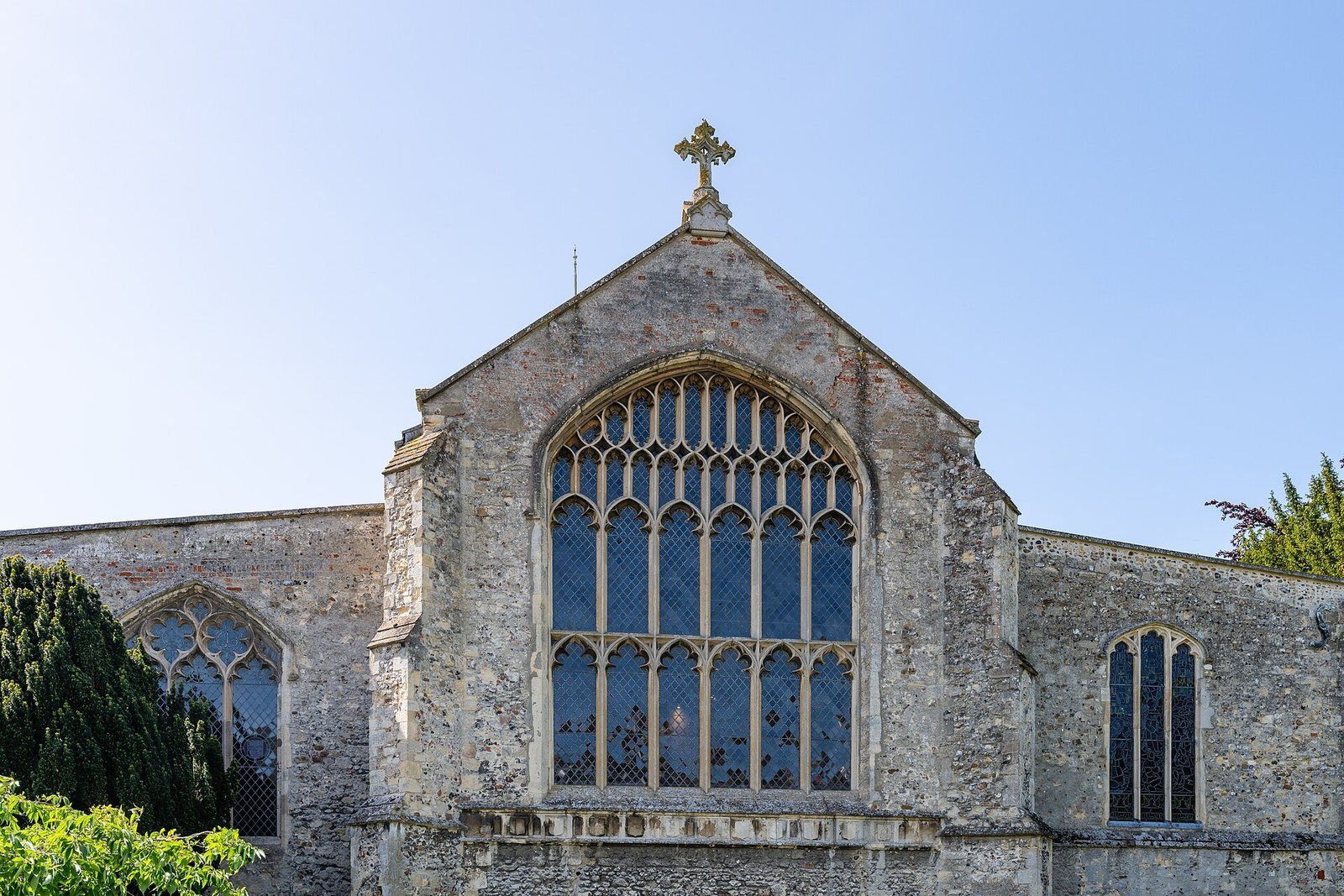
The Church of St Michael the Archangel is a parish church in Framlingham, United Kingdom, with origins in the 12th century. Most of its fabric was built between about 1350 and 1555 in the Perpendicular style, a late phase of English Gothic marked by strong vertical lines. Dedicated to Saint Michael, an archangel in Christian tradition, the church is now part of the Church of England and follows its relatively inclusive Broad Church tradition. It was formerly Roman Catholic and belongs to the Diocese of St Edmundsbury and Ipswich, within the Province of Canterbury.
Medieval origins and local lordship
The church was built, rebuilt and extended over several centuries. Its development took place in a town that served as a major seat of the Earls and Dukes of Norfolk. The estates of the Norman Bigod family were forfeited to Edward I, and Framlingham passed to his son Thomas of Brotherton. After later changes of inheritance, Sir Robert Hitcham bequeathed the estate to Pembroke College, Cambridge, around 1635. The college remains lord of the manor.
The Howard family and Tudor burials
After the Dissolution of the Monasteries, Henry VIII’s suppression and appropriation of England’s monastic institutions, the Howards lost their earlier burial place at Thetford Priory, a religious house governed by a prior. Many family burials were transferred to Framlingham, establishing the church as a Howard mausoleum. In 1540, Thomas Howard, 3rd Duke of Norfolk, petitioned Henry VIII to save Thetford’s church, referring to the graves of his first wife, Anne of York, and Henry FitzRoy. The appeal failed, but the king temporarily delayed the priory’s closure to allow families to rebury their dead.
FitzRoy, Duke of Richmond and Somerset, was Henry VIII’s illegitimate son by Elizabeth Blount. The king had raised him to high titles and honours while he was his only surviving son. FitzRoy died of consumption in 1536, aged 17. Thomas Howard had arranged his marriage to his daughter Mary Howard, later known as Mary FitzRoy, but the couple did not live together and the marriage was not consummated. Henry VIII assigned FitzRoy’s burial to Norfolk, apparently taking little further interest in the arrangements. FitzRoy was first buried at Thetford; after the priory’s dissolution, his tomb and remains were moved to Framlingham. Mary FitzRoy was also buried there after her death in December 1557.
Thomas Howard, 3rd Duke of Norfolk, and his wife Anne of York are commemorated in the church. His tomb was commissioned on behalf of a leading nobleman rather than by the Crown. Its religious imagery was regarded as the last major display of its kind in England before the theology of the English Reformation made such imagery untenable.
Later Howard burials and commemoration
Thomas Howard, 4th Duke of Norfolk, was executed for his involvement in the Ridolfi Plot, an attempt to overthrow Elizabeth I and arrange his marriage to Mary, Queen of Scots. He was buried at the Tower of London. His wives, Mary FitzAlan and Margaret Audley, are represented at Framlingham, although only Margaret was buried there.
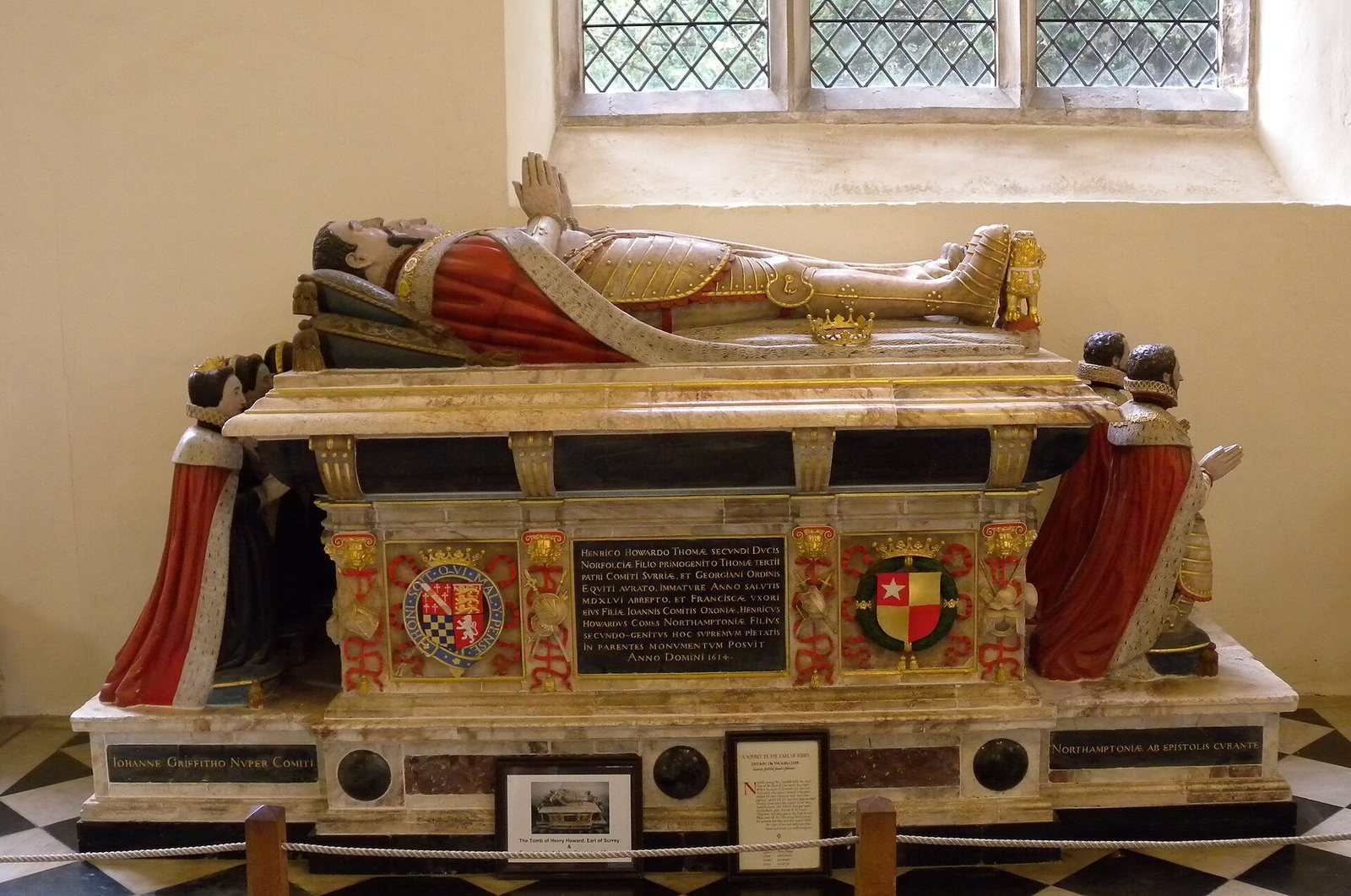
Before his death, Henry Howard, 1st Earl of Northampton, arranged for the remains of his parents, Henry Howard, Earl of Surrey, and Surrey’s wife, to be brought to Framlingham. Their monument was erected in 1614. Its inscription describes Surrey as the son of the second Duke of Norfolk. The dukedom had lapsed after Richard III died at the Battle of Bosworth, and the second Duke later became the first duke of a new creation. Robert Hitcham’s monument followed in 1638. The church was designated a Grade I listed building in 1966.
Framlingham also has a musical association with Felix Mendelssohn, who is believed to have taught Caroline Attwood during a visit to her brother George, then the rector. Mendelssohn knew Caroline’s father, Thomas Attwood, a composer and organist at St Paul’s Cathedral who had studied with Mozart.
Remains
Church fabric and plan
Nave and chancel
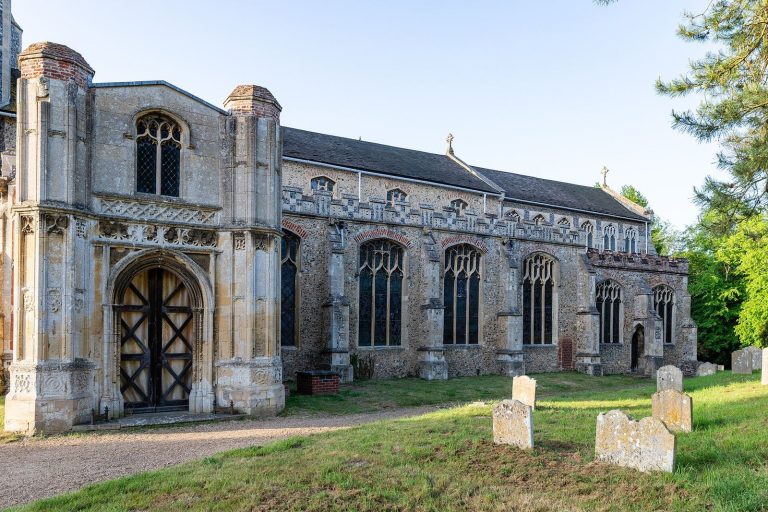
The church is arranged around a three-aisled nave and a chancel, the area around the high altar, that is both longer and wider than the nave. The present chancel dates to the 16th century and was built for the Howard mausoleum. Rows of arches forming the nave arcades date from the 14th century. The chancel arch retains capitals from the 12th century, while the roof and the clerestory, a high band of windows above the main interior, date from the 15th century.
Roof and tower
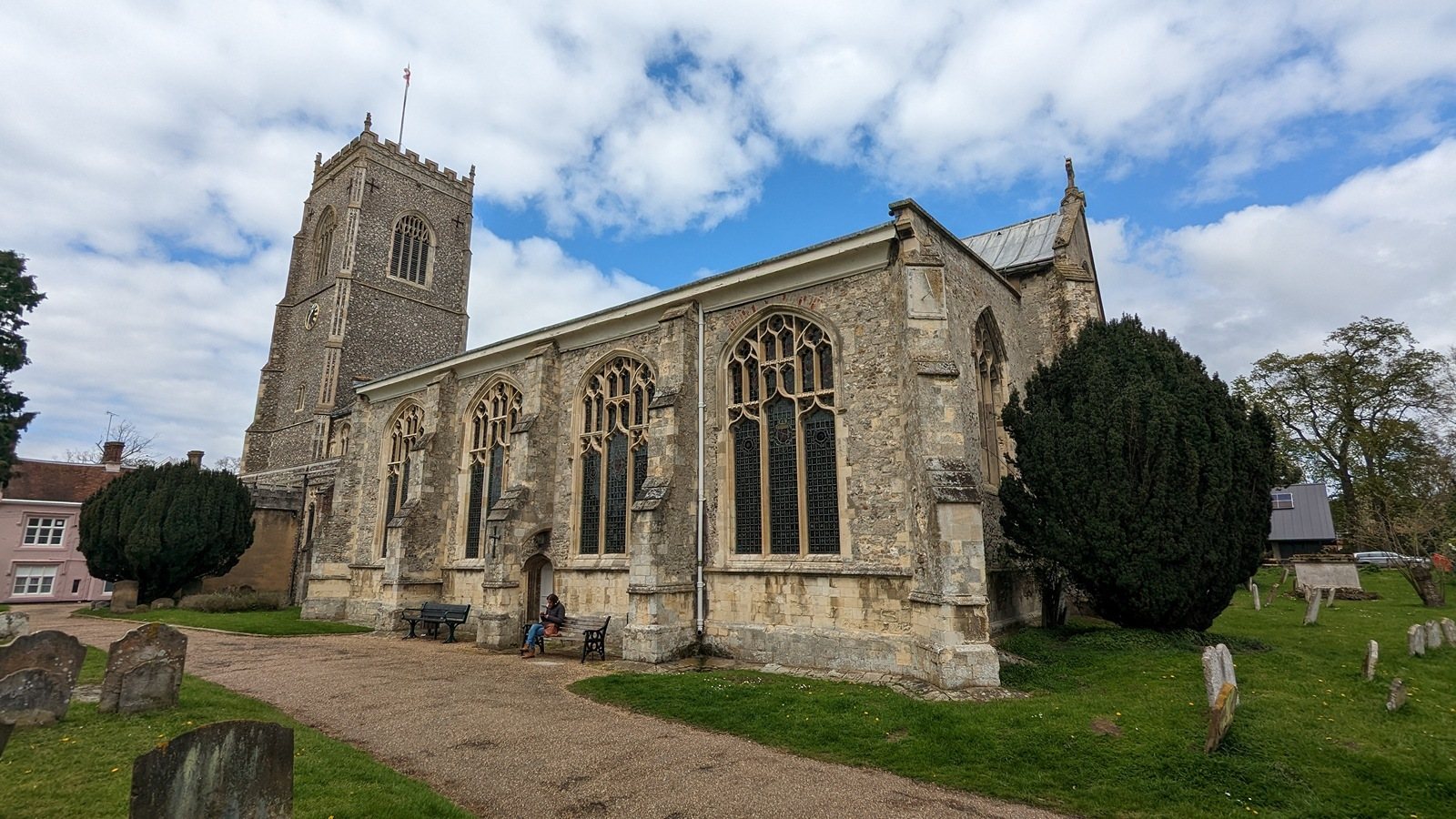
The roof, dating to about 1521, has intricate fan tracery, ornamental stonework with radiating fan-shaped patterns, that conceals hammer beams. The nave also has an open timber roof built with projecting hammerbeams that span the interior. At the west end, a square tower dating from the 15th century has a crenellated top, with alternating raised sections and gaps, and distinctive windows at bell-chamber level.
Interior fittings and bells
Font and wall paintings
An octagonal font bears symbols of the Evangelists and the Trinity. It stands on a base supported by four lions and has an oak cover. Among the surviving 14th-century wall paintings is a Throne of Mercy, a Christian image of the Trinity.
Bells
Eight bells hang in an oak frame made by George Day of Eye, Suffolk, in 1892. Their casting dates range from the 15th to the 20th century. The ring was increased to eight in 1718 with two new treble bells cast by John Stephens of Norwich, and the bells were overhauled in 1990.
Howard and other monuments
Henry FitzRoy’s tomb
FitzRoy’s ornate tomb combines royal and Christian imagery. His coat of arms is enclosed by the collar of the Order of the Garter, an English order of chivalry, and its motto, Honi soit qui mal pense, meaning “Shame on him who thinks evil of it.” The Howard arms also appear on the monument. Carved biblical scenes cover its four sides. They include the creation of Eve, life in Eden, the Temptation and the Expulsion; the story of Cain and Abel; scenes from the Flood and the lives of Abraham and Lot; and Abraham and Isaac, Moses with the tablets of the Law, and the Israelites worshipping the Golden Calf. A small doorway outlined in one carving has been interpreted as the private entrance used by noblemen arriving from the castle.
Tomb of Thomas Howard, 3rd Duke of Norfolk
The Duke’s tomb stands immediately south of the high altar and combines French and English design elements. Figures of Apostles and other religious figures appear on each side. Matthew, James the Great, James the Less and Andrew are on the south; Peter, Aaron and Paul on the west; Matthias, Jude Thaddeus, Simon the Zealot and Philip on the north; and John the Evangelist, Simeon of Jerusalem and Thomas on the east. Parts of the monument may have been reused from a tomb made at Thetford for Thomas Howard, 2nd Duke of Norfolk. Two other men’s remains lie in the tomb; their proposed identification as the 3rd Duke’s father and grandfather, transferred from Thetford, remains unproven.
Monument to the wives of the 4th Duke
The monument shows Mary FitzAlan and Margaret Audley in effigy, with heraldic quarterings, arms combining different family lines, on its sides. The space between the two figures is unusually wide. Columns that may once have supported a canopy suggest that the monument could have had a more elaborate form. A vault associated with it was opened in 1842, revealing a skull and some ashes. Local tradition says that townspeople hid valuables in the monument during the Jacobite rising of 1745, an attempt to restore the Stuart dynasty to the British throne, and later retrieved them.
Monument to Henry Howard, Earl of Surrey, and his wife
The 1614 monument takes the form of a tomb chest and was designed to honour the couple’s virtues. Their two sons kneel at its foot, while their three daughters appear at its head. Jane wears a small crown marking her noble rank; Katherine and Margaret are shown beside her. Katherine married Henry Berkeley, 7th Baron Berkeley, and Margaret married Henry Scrope, 9th Baron Scrope of Bolton. By about 1976 the monument was sinking in the middle and its ends were collapsing. During the restoration, John Green found holes beside Surrey’s calf where a crown had once been. A replacement was cast in lead, fitted with large fish weights as ornaments, painted, gilded and installed.
Other monuments
A monument to Elizabeth, daughter of the 4th Duke of Norfolk, is also among the church’s memorials. Robert Hitcham’s 1638 monument stands in the north chapel.
The Thamar organ
Thomas Thamar built the organ in 1674 for Pembroke College. The college chose a larger, more modern instrument for its Wren chapel in 1707, and the Thamar organ and its case were brought to Framlingham the following year. The case is thought to predate 1630 and may be as early as about 1580; some pipework may also predate the Commonwealth, the republican period in England during the mid-17th century. The painted front pipes are associated with Thamar’s instrument, and the only other pipes of this painted style are at Gloucester Cathedral. An uncertain tradition holds that organ builder John Byfield worked on the instrument around 1740.
The organ stood on a gallery until 1898, when Hunter rebuilt it, using most of Thamar’s pipes in the Great, the principal pipe division. It was later moved first to the north aisle and then to the chancel. In 1970, under Michael Gillingham’s leadership, the gallery was recovered from the castle and reunited with the organ, with help from the Pilgrim Trust. Bishop and Son of Ipswich carried out restoration work that year.
In 1898 the cornet, a group of organ pipes producing a distinctive combination of tones, and the trumpet pipes were replaced. The cornet disappeared and the trumpet pipes were lost, but the cornet was later found in the rectory attic and repaired and reconstructed. An old set of trumpet pipes was also found to replace the lost set. The restoration retained the historic arrangement apart from a board for bottom C-sharp, while adding a Cromorne, a reed stop, and a pedal reed. The Swell, an enclosed division whose shutters control volume, was adjusted to complement the Great, and the foot-operated pedal division was treated in a similar way.