Roman Shipyard of Stifone: An Archaeological Site of Uncertain Date
Site at a Glance
- Popularity
- Medium
- Country
- Italy
- Primary era
- Unclassified
- Eras represented
- Unclassified
- Civilizations
- Unclassified
- Site type
- Economic
- Remains
- Production Complex
On this page12 sections
History
The site known as the Roman shipyard of Stifone is an archaeological site at Le Mole, beside the Nera River in Narni, Italy, about 900 metres downstream from Stifone. Its date and original builders remain unresolved. One proposal places its beginnings around the thirteenth century BCE and attributes them to the Etruscans, an ancient people of central Italy who lived before Roman rule there. Roman-period use has also been suggested, possibly in connection with the Punic Wars, conflicts between Rome and Carthage fought mainly in the third and second centuries BCE.
Ancient river transport and proposed origins
Narni came under Roman rule in 299 BCE. The Nera provided a route for travel and transport toward Rome, with passage continuing by the Tiber near Orte. The navigable stretch generally ran from Stifone to the Nera’s meeting with the Tiber, while gorges below Narni hindered travel farther upstream. The Greek geographer Strabo described boats on the river as relatively small. The Roman historian Tacitus relates that Roman consul Gnaeus Calpurnius Piso, one of the state’s chief magistrates, and his wife Plancina travelled by river from Narni in 19 CE as they returned from Syria. Finds in nearby fields also indicate a Roman-period settlement in the surrounding area.
The site’s inland position, river access toward the Tyrrhenian Sea, and nearby timber resources have been proposed as reasons for building vessels there. Alvaro Caponi argued that the port and shipyard might have originated with the Etruscans and later been reused or renovated by the Romans. A possible role in Rome’s naval effort against Carthage in 261 BCE remains conjectural. The facility might have been one of several, while Rome’s principal naval dockyards are generally placed in the city itself.
Caponi also speculated that the site might be linked to Virgil’s account in The Aeneid of a fleet from Orte, proposing that ships could have been assembled there to support Turnus, the legendary Latin king who opposed Aeneas. This literary connection does not establish the site’s date or purpose.
Livy describes Roman forces blocking a passage near Narni in 207 BCE after intercepting correspondence between the Carthaginian commanders Hasdrubal Barca and Hannibal Barca. Identifying that passage with the area near the shipyard is an interpretation based on the geography in Livy’s account.
Local traditions and archaeological discovery
Local explanations for the name Stifone associated it with the building of wooden boats and rafts for transport toward Rome. In 1924, former Narni mayor Rutilio Robusti linked the place-name to this activity. Local writers Italo Ciaurro and Guerriero Bolli later repeated the tradition. Bolli assigned the shipyard to the Byzantine period, the history of the eastern Roman Empire, and specifically to the fifth or sixth century CE, but that date is unsupported. Raft-building was an early interpretation of the site; after substantial remains came to light, a connection with the Punic Wars was also proposed.
The ancient river port associated with Narnia, the ancient name of Narni, was described by the Jesuit Fulvio Cardoli in the sixteenth century, when traces could still be seen. Later dams raised the river level, including a major intervention in 1939, and the port was thought to have been submerged. Its remains were instead still in their earlier location, hidden by vegetation.
The archaeological site at Le Mole was discovered in 1969, when a winter flood exposed a large stone structure that Caponi photographed. Local archaeologist and speleologist Roberto Nini then explored the area and identified a second archaeological zone that he interpreted as a shipyard. Local research returned to the port and shipyard in 1992. Regional archaeological superintendent Daniela Monacchi later visited the port, but stagnant water prevented access to the shipyard.
Later alteration and research
Watermills built during the Middle Ages substantially changed the site and its surroundings. Christian Armadori’s research, developed with volunteers and published in 2012, aimed to encourage further study and recovery of the area.
Remains
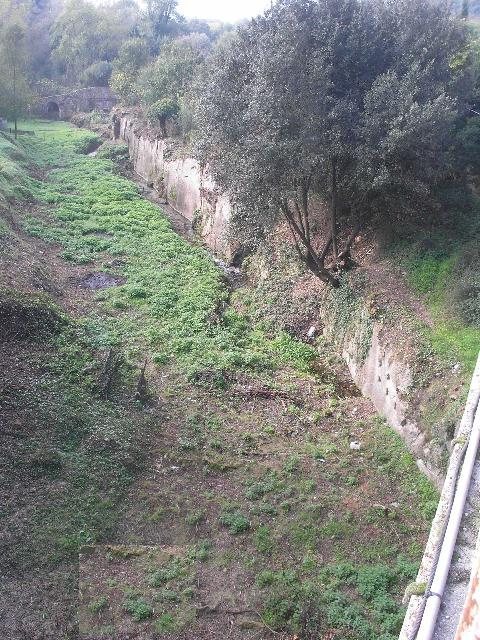
The remains center on a long, rock-cut artificial channel beside the Nera, with port features and other archaeological finds nearby. Its cut walls and openings form the main physical basis for interpreting the channel as a place where vessels may have been assembled.
Channel architecture
Cut walls and openings
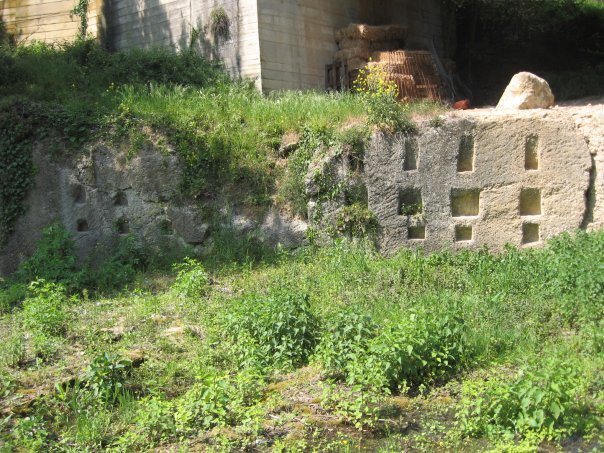
The channel measures about 280 metres long. Maps of property boundaries indicate that it once connected with the Nera at both ends. Two opposing walls cut into the rock stand about 16.5 metres apart. Square openings run in three rows along each wall for roughly 13 metres. A reconstruction counted 30 cuts, 27 of which remain visible. They have been interpreted as sockets for side props that steadied a vessel during assembly, although their exact purpose is uncertain.
Stonework and anchors
The argument for Etruscan origins has pointed to large, irregular stones with flattened faces, laid with little mortar and without Roman concrete. Heavy stone anchors found in the area have also featured in that interpretation. A quarry and workshop for producing stone anchors lay on the opposite riverbank. The channel’s dimensions have been considered too large for simple rafts, but they do not identify the intended vessels as Roman warships. Vessels needing relatively little depth of water have instead been proposed as more suitable for this stretch of the Nera.
Port and nearby archaeological features
Mooring features
A description made in 1879 noted two large stone posts used for mooring at the port. Cardoli also described iron rings fixed into the bedrock with lead, where boats could be secured.
Nearby structures and finds
The surrounding archaeological area includes an ancient bathing pool identified in 1914, two inscribed stones found nearby in 1850 and 1970, and a cistern about 25 metres long discovered close to the shipyard in 2007. Some shipyard remains are visible in the riverbed.
Water setting and condition
Streams and springs, together with underground watercourses of unknown origin, contribute to the Nera’s flow in this area. The shipyard is abandoned and at risk of further damage. Sudden flooding is also a concern because of dams upstream.