Tintagel Parish Church: An Anglican Church with Medieval Origins
Site at a Glance
- Popularity
- Medium
- Country
- United Kingdom
- Primary era
- Medieval
- Eras represented
- Medieval, Early Modern, Modern
- Civilizations
- British, English, Norman
- Site type
- Religious
- Remains
- Church
On this page15 sections
History
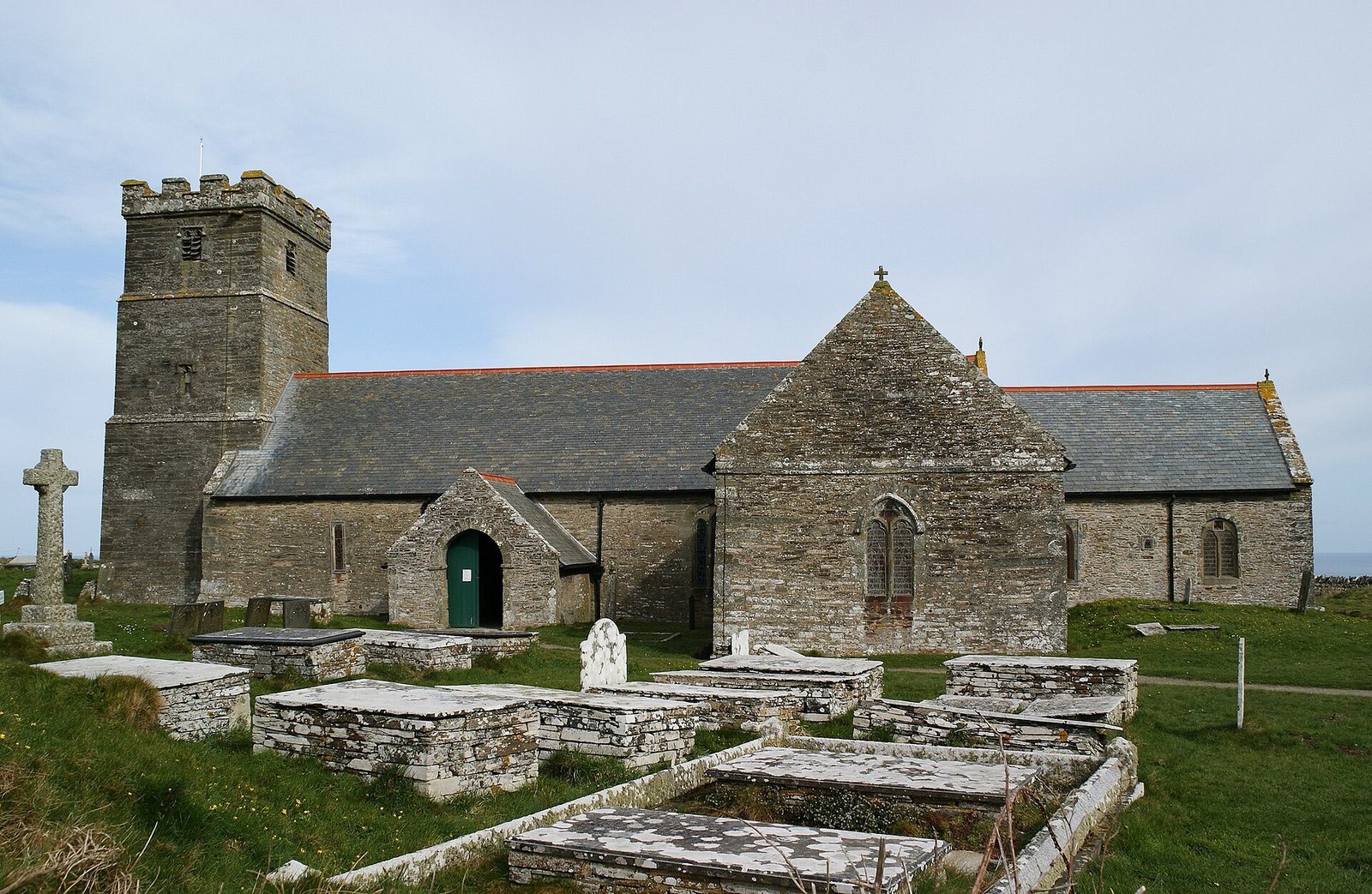
Tintagel Parish Church is an Anglican parish church on the cliffs between Trevena and Tintagel Castle in the United Kingdom, about 500 metres from the castle. A church or oratory probably occupied the site in the sixth century, while the present building may have been erected in the late eleventh or early twelfth century.
Early church and dedication
The early church was founded as a daughter church of Minster, meaning it was established as a dependent church, and dedicated to Saint Materiana. Tintagel and Minster are identified as the only churches dedicated to her. Her identity remains uncertain. She is often associated with Madryn, a princess of Gwent, a Brittonic kingdom, while another suggestion connects the dedication with Saint Marcellina, sister of Saint Ambrose, a fourth-century bishop of Milan. A separate tradition describes Materiana as a Brittonic queen of Gwent who brought Christianity to Cornwall in the fifth century.
Medieval parish and administration
The earliest vicar, or parish priest, named in the records was Gervase de Truueru, in 1259. In the thirteenth and fourteenth centuries, the French Abbey of Fontevrault held the right to nominate the parish priest. Since 1534, that right has belonged to the Dean and Canons of Windsor.
Parish registers begin with burials in 1546, baptisms in 1569 and marriages in 1588. A single scribe copied entries through 1668 from earlier records. Gerance Davye served as vicar from 1581 to 1629, the longest tenure recorded; Richard Byrn Kinsman, vicar from 1851 to 1894, had the second-longest tenure.
The parish was first within the deanery of Trigg Minor, an administrative district of the church, and later within Trigg Minor and Bodmin. It is now in the deanery of Stratton and belongs to the Boscastle and Tintagel group of parishes. The group also includes churches at Forrabury, Minster, Lesnewth, Otterham, St Juliot, Treknow, Trethevy and Trevalga.
Reformation and later parish life
The church is part of the Church of England, in the Diocese of Truro and the parish of Tintagel. Its High Church tradition places emphasis on formal worship and the sacraments. The building received Grade I listing on 17 December 1962.
On 20 December 1893, the barque Iota, a sailing vessel, was driven onto the cliff at Lye Rock. The crew reached the rock, but 14-year-old Domenico Catanese died. He was buried in the churchyard.
Restoration and archaeological work
In 1870, architect James Piers St Aubyn restored the church and provided a new roof. The pipe organ was subsequently moved twice, and by 2016 an electric organ was being used instead. Excavations took place northwest of the church in 1990 and 1991.
Remains
Church building
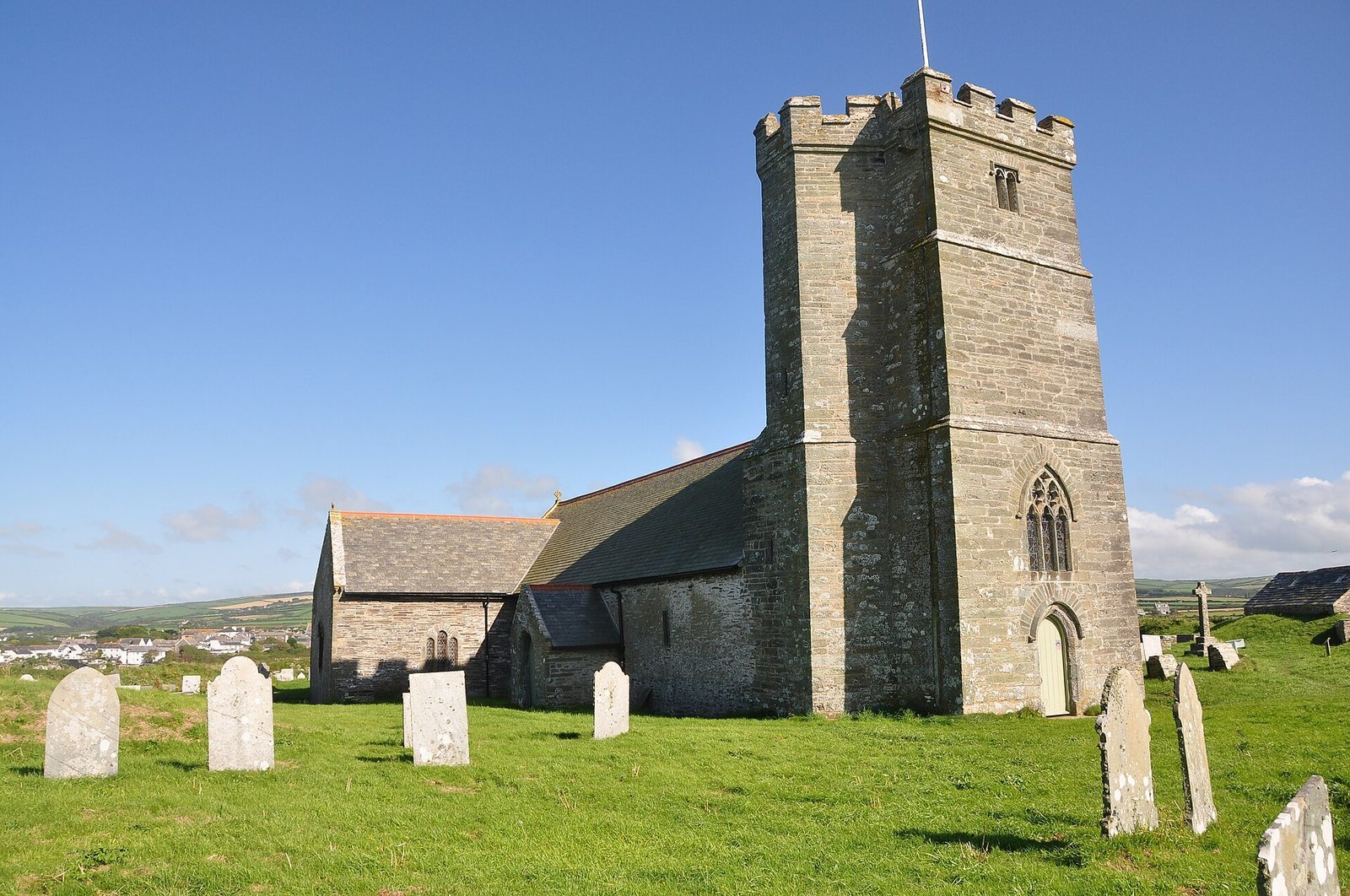
The church has a nave, the main body of the building, a chancel around the principal altar, transepts forming its crosswise arms, and a tower at the west end. The central space between the transepts has walls designed to carry a tower. The building is principally Norman, the English form of Romanesque architecture that developed after the Norman Conquest. Architectural historian Nikolaus Pevsner suggested that some work may be Saxon, from before the conquest. The walls are built mainly of local granite ashlar, finely dressed blocks laid in regular courses. A slate roof covers an exposed timber structure with pointed-arch ceiling forms.
Doorways and porches
Both the north and south doorways are Norman. The north doorway is more roughly worked and may be earlier than the south one. The north porch probably dates to the fourteenth century. The south porch is a later rebuilding of a porch dating to the thirteenth century.
Chancel and north chapel
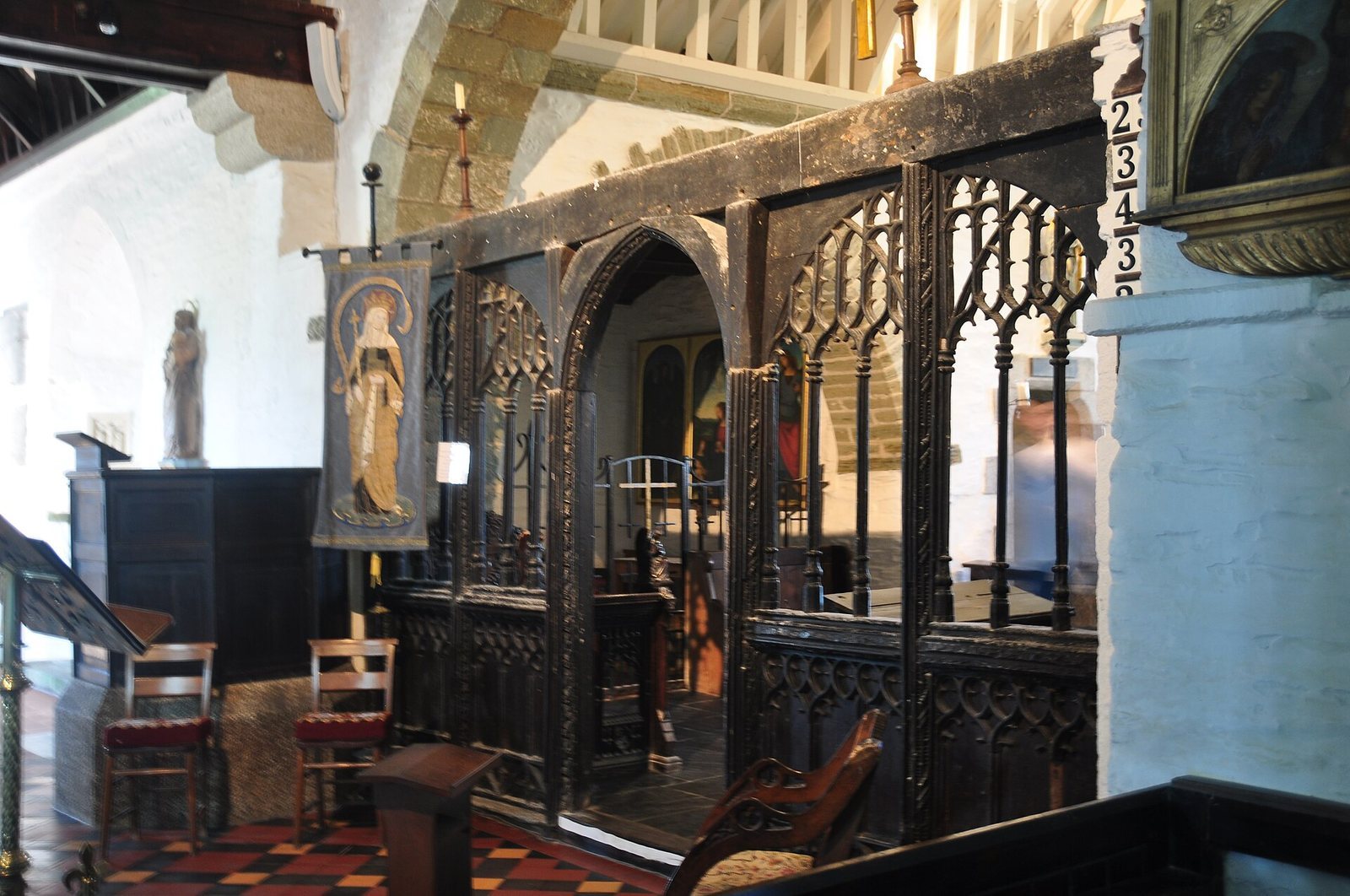
A fifteenth-century rood screen, a partition separating the chancel from the nave, once provided access to a loft on its south side. Its canopy was probably removed during the Reformation. In the chancel’s south wall, a recess probably dating to the fourteenth century is known as the Founder’s Tomb. A late-thirteenth-century stone coffin lid may commemorate a priest.
The chapel north of the chancel, formerly the Lady Chapel, a chapel dedicated to the Virgin Mary, was added after the chancel, though its date is uncertain. It contains a medieval stone altar. A recess on its north side held the organ and has more recently been used as a vestry.
The east window is a later memorial to Fr Canner, vicar from 1950 to 1976. A statue of Saint Materiana on the north wall commemorates Parson Chapman, vicar from 1894 to 1916. The church also contains a statue and banner of Materiana and three modern copies of Old Master paintings.
Font and stained glass
The Norman font is carved from elvan, a hard, fine-grained Cornish rock. Each of its four faces bears a snake, and a head is carved at each corner. Three windows are Norman; the largest of the other windows depicts Saint George. Later stained glass portrays Materiana, George, Piran and Christ.
Transepts and memorials
The north transept’s modern altar was first dedicated to All Saints and is now generally called the Saint Symphorian altar, after the window behind it. The window shows Symphorian as a bishop, contrary to tradition. The area’s claimed connection with the saint may stem from a mistake by the sixteenth-century antiquary John Leland in writing about the churches at Forrabury and Tintagel. The transept’s north window commemorates John Douglas Cook, founding editor of the Saturday Review, whose grave lies nearby.
The south transept is somewhat longer than the north and may have been extended to make room for a tomb. A stone bench runs along part of its walls, dating from a time when churches had no other seating. A memorial brass, an engraved metal memorial, commemorates Joan, who died around 1430. It identifies her as the mother of John Kelly, vicar from 1407 to 1427 and later dean of Crantock. The brass was once beneath the altar and was moved to the end of the transept in 1871.
West tower and bells
The date of the west tower is uncertain, and its battlements were added in the fifteenth century. It holds six bells. Five date from 1735, 1785, 1828 and 1868, with two from the last year; the sixth was added in 1945. The tenor, the largest and lowest-pitched bell, weighs 7-0-10. Modern armorial stained glass in the west window displays coats of arms associated with the parish’s history.
Churchyard
Ground, graves and stone finds
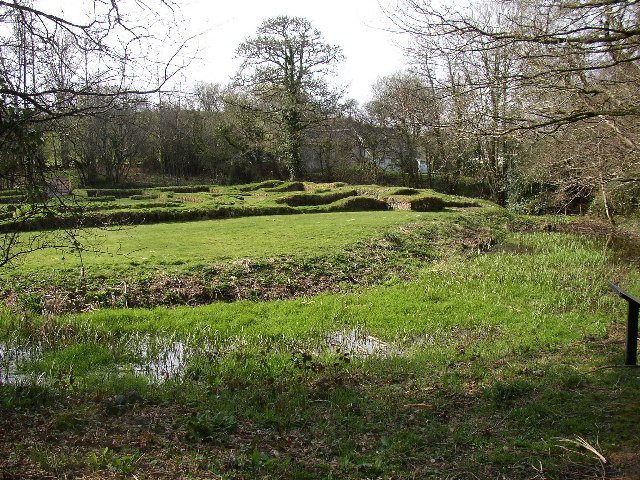
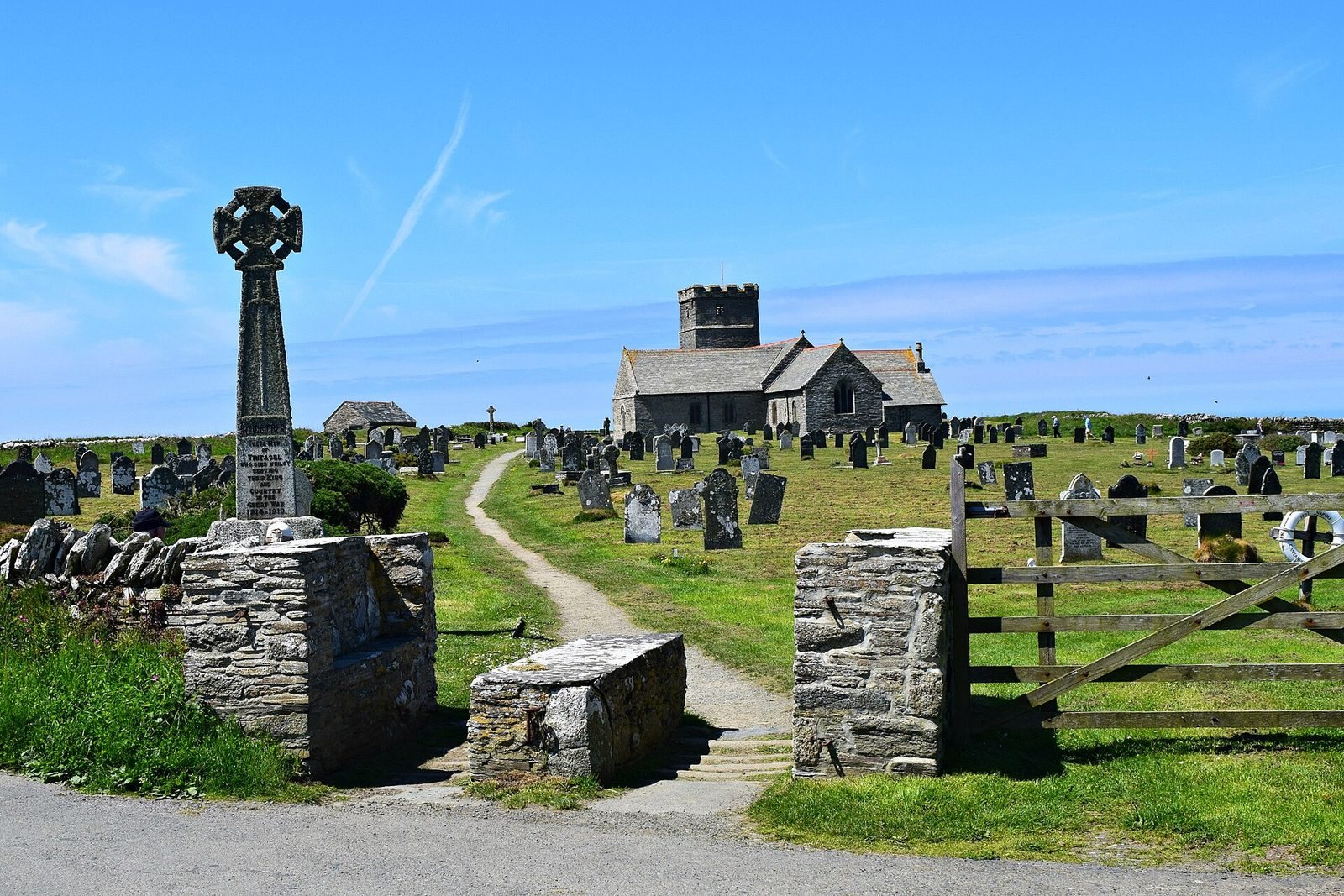
The churchyard is unusually large for Cornwall and appears to have been enlarged three times. Its older area is approximately circular. Sections to the east probably came into use in the early nineteenth and mid-twentieth centuries; the northeastern part was formerly within Trecarne Lands. Several early graves found there during ploughing were excavated in 1956 and probably date from AD 500 to 1000.
Pre-Victorian gravestones are made of local slate, with the earliest dating to around 1690–1710. John Douglas Cook’s tomb is northwest of the church, while a wooden cross marks Catanese’s grave to the east. An inscribed Roman milestone, a marker associated with a Roman road, was built into the western gateway and found there in 1889. The stone dates to the early fourth century and bears the name of Emperor Licinius, whose reign ended in 324.
Cross and war memorial
The churchyard cross and war memorial are modern structures made of granite. The memorial commemorates service personnel who died in the First and Second World Wars. Its First World War names include four officers and four non-commissioned officers; the west face is dedicated to those lost in the Second World War.