Tegea: An Ancient Arcadian City-State
Site at a Glance
- Popularity
- High
- Country
- Greece
- Primary era
- Classical
- Eras represented
- Iron Age, Classical
- Civilizations
- Ancient Greek
- Site type
- Religious
- Remains
- Temple
On this page23 sections
History
Tegea was an ancient Greek city-state in Arcadia, in the southeastern Peloponnese of Greece, centered on the site of the modern village of Alea. One of Arcadia’s oldest and most powerful communities, it occupied a broad territory bounded by Cynuria and Argolis to the east, Laconia to the south, Maenalia to the west, and Mantineia to the north. Mount Parthenium separated Tegea from the eastern districts.
Origins and early traditions
Legend traced Tegea’s name to Tegeates, a son of the mythical Arcadian king Lycaon. The city’s beginnings were also associated with Aleus, another legendary king, who was said to have united separate settlements into one community. This synoecism, or the joining of settlements into a single city, has no certain date; proposed dates range from the Archaic period, the era before Classical Greece, to about 478 to 473 BC.
Tradition first counted eight townships and later nine, after Apheidantes was added during the reign of Apheidas. The communities were Gareatae, Phylaceis, Caryatae, Corytheis, Potachidae, Oeatae, Manthyreis, Echeuetheis, and Apheidantes. Tegeans were also divided into four tribes, Clareotis, Hippothoitis, Apolloneatis, and Athoneatis, each including resident aliens. Tegea was present by the Greek Dark Ages, the period following the collapse of Mycenaean civilization and preceding the Archaic period, although occupation in the earlier Mycenaean era remains uncertain.
Tegea appears in the Catalogue of Ships in Homer’s Iliad, with its troops led by Agapenor. Other traditions connected the city to the wider heroic past. King Echemus was said to have killed Hyllus, son of Heracles, in single combat. In another story, Agapenor led Tegean colonists to Cyprus in the mid-eleventh century BC, where he founded Paphos and built a temple to Aphrodite. Pausanias also linked Tegeans to the Argonauts, the legendary companions of Jason, and to the Trojan War.
The cult of Athena Alea
The sanctuary of Athena Alea became a major religious center for Tegea and the surrounding region. Bronze offerings point to worship there from the eighth century BC, while a Mycenaean-period origin remains uncertain. Athena Alea has been understood as a combination of the Greek city-protecting Athena and the local goddess Alea. The proposed connection between Alea’s name and a word meaning refuge is uncertain, as are theories that the cult began at Alea and spread through Arcadia, possibly with refugees from Argos.
Contests were held in honor of Alea. Pausanias associated the Halotia contests with a Tegean victory over the Laconians at Dipaea. Local legend also placed Tegeans among the hunters who killed the Calydonian boar, with the huntress Atalanta among them. The sanctuary’s influence was at its height when its earlier temple burned in 394 BC.
Conflict with Sparta and the Persian Wars
Tegea resisted Spartan efforts to dominate Arcadia over an extended period. Spartan king Charilaus invaded after receiving what appeared to be a favorable oracle, but the Tegeans defeated him and captured the survivors. Later Spartan kings Leon and Agesicles also failed to subdue the city. Around 560 BC, during the reign of Anaxandridas II, the Spartans obtained the bones of Orestes in accordance with an oracle, defeated Tegea, and compelled it to accept Spartan supremacy. Tegea retained some independence but had to cooperate with Sparta, probably as an early member of the Sparta-led Peloponnesian League.
Despite this subordination, Tegea remained a substantial military power. During the Greco-Persian Wars, 500 Tegeans fought at Thermopylae and 3,000 at Plataea. At Plataea, half the contingent were heavily armed infantrymen called hoplites, and half were lightly armed troops. On the assumption that the force at Plataea was no more than three-quarters of Tegea’s total military strength, estimates place its military population at 4,000 and its free population at about 17,400.
Tegea fought Sparta twice between 479 and 464 BC and lost both encounters. It first fought alongside the Argives, then joined other Arcadians, apart from the Mantineians, at Dipaea. The city, especially the sanctuary of Athena Alea, also offered refuge to people who had fallen out with Sparta. Among them were the seer Hegesistratus and the Spartan kings Leotychides and Pausanias, son of Pleistoanax.
Alliances and the Arcadian League
During the Peloponnesian War, the prolonged conflict between Athens, Sparta, and their allies, Tegea remained firmly aligned with Sparta. Its aristocratic political system and rivalry with democratic Mantineia helped shape that choice. Tegea rejected the Argives’ proposal for an alliance against Sparta in 421 BC, joined a Spartan expedition against Argos in 418 BC, and fought on Sparta’s side in the Corinthian War in 394 BC.
After Sparta’s defeat at Leuctra in 371 BC, Tegea expelled its pro-Spartan faction and joined other Arcadian communities in founding Megalopolis and forming the Arcadian League, a confederation of Arcadian cities. It remained loyal to the league when Mantineia allied with Sparta, and fought beside the Theban general Epaminondas against Sparta at the Battle of Mantineia in 362 BC.
Hellenistic rule and conflict
Tegea later joined the Aetolian League, a regional Greek political and military confederation. After Cleomenes III became king of Sparta, Tegea allied with Sparta, Mantineia, and Orchomenus. During the Cleomenean War, Macedonian king Antigonus III Doson captured the city and forcibly incorporated it into the Achaean League in 222 BC.
In 218 BC, Spartan king Lycurgus seized Tegea but did not take its acropolis. The city later came under the control of the Spartan ruler Machanidas. After Philopoemen killed Machanidas at the Battle of Mantineia, the Achaeans recovered Tegea.
Roman and medieval Tegea
Tegea remained inhabited and prosperous under Roman rule. The geographer Strabo described it as the only Arcadian town still inhabited in his time, and it retained importance in the era of Pausanias. Goths sacked the city in AD 395 to 396.
By the tenth century, the medieval settlement associated with Tegea was known as Amyklion, a name later shortened to Amykli and Nikli. In 1082 it became the seat of the Diocese of Amyclae, a bishop’s district subordinate to the senior bishop overseeing Lacedaemon. Crusaders captured Nikli and the rest of Arcadia after a siege around 1206 to 1209, incorporating it into the Frankish Principality of Achaea. Nikli became the center of a secular barony and a Roman Catholic bishopric. It remained under Frankish control in 1280. By 1302, the Byzantines had recovered the settlement and restored the local church district to Orthodox clergy.
Excavation and identification
The ancient site lies within modern Alea, called Piali until 1915, near Episkopi and about 10 kilometers southeast of Tripoli. Arthur Milchhöfer excavated there in 1879, followed by Wilhelm Dörpfeld in 1882. The French School at Athens began work in 1900; Mendel uncovered most of the temple between 1900 and 1902, and Konstantinos Rhomaios continued the work in 1909. Charles Dugas excavated in 1910. The Norwegian Institute at Athens returned for excavations under E. Oestby from 1990 to 1994.
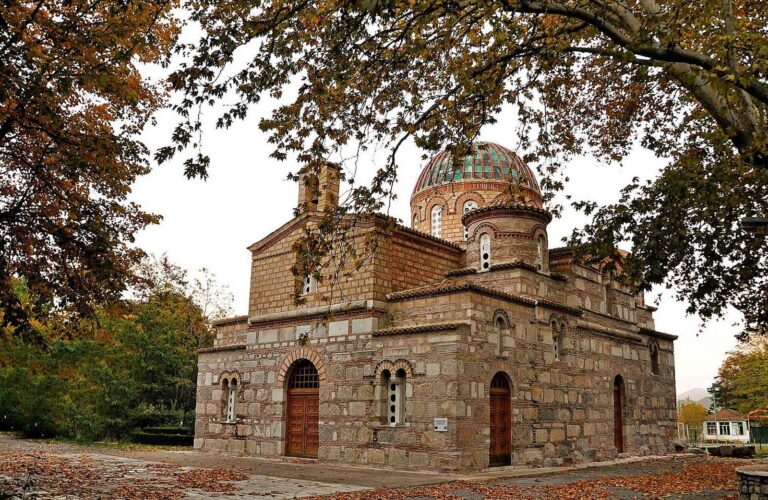
The sanctuary’s location had been sought using Pausanias’ description, while scattered Doric column drums indicated the presence of a substantial temple. Max Treu identified sculptures from the site as being in the style of Scopas and connected them with the temple’s pediments, supporting the sanctuary’s identification. The sanctuary partly overlapped the Church of Hagios Nikolaos.
Remains
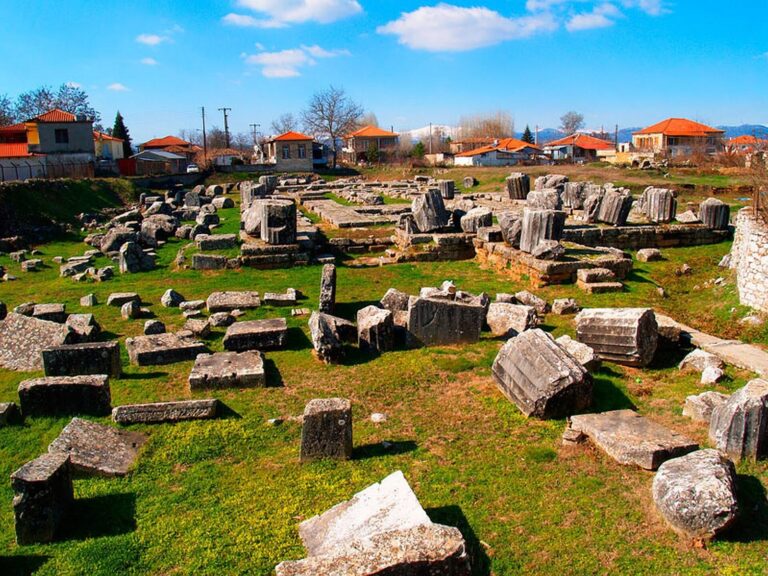
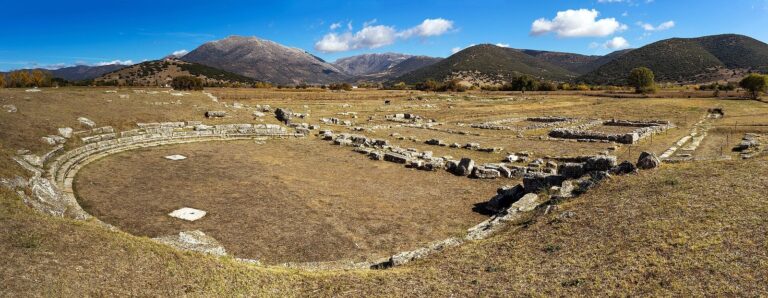
The ancient city occupied an open plain that was difficult to defend. Its first defensive walls were built around 370 BC. The remains include the foundations of the sanctuary of Athena Alea, civic and religious features within the city, and finds now held in the Tegea, Tripoli, and Athens archaeological museums.
City plan and civic center
Defensive walls
Tegea’s defensive enclosure dates from around 370 BC. The city’s position on a plain made it challenging to protect, and the walls formed its principal built defense.
Agora and theater
The agora, or civic marketplace, is thought to have occupied the center of the city. Pausanias compared its shape to a brick and described sanctuaries there dedicated to Aphrodite, Zeus Teleios, Eileithyia, and Gaia. A stele showed Ares Gynaikothoinas, whose title means honored with women’s banquets. Foundations of a theater beneath the Church of Palia Episkopi support the proposed location of the agora.
Temple of Athena Alea
Foundations and platform
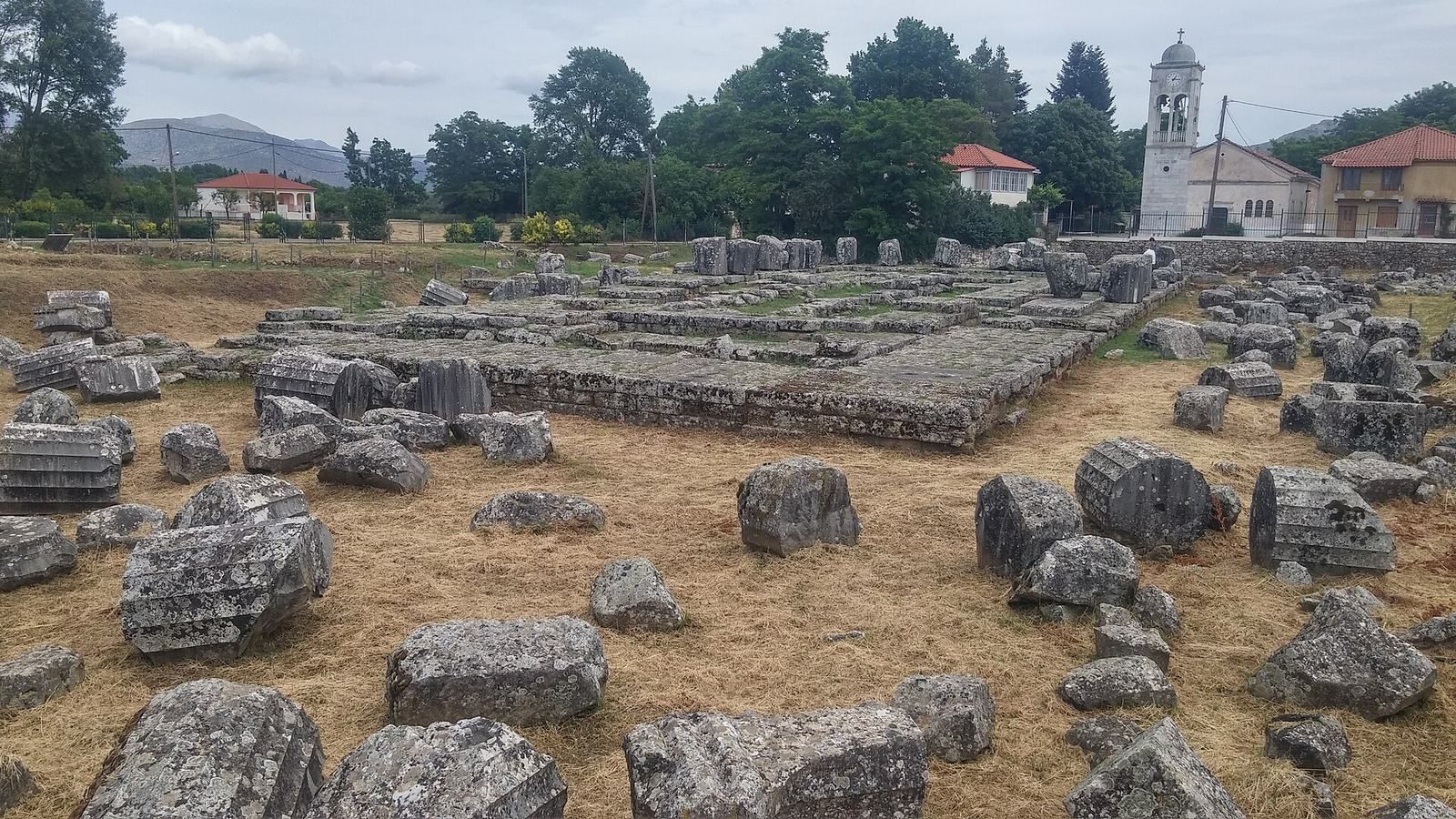
The temple was a Doric building, using one of the principal Greek architectural orders, with a single colonnade around its enclosed central chamber. It had six columns across each end and fourteen along each side, and its estimated height was 17 meters. Today, its remains consist mainly of heavily ruined foundations and some blocks from the upper foundation courses.
Two nested rectangular foundations define the plan. The outer rectangle, 49 meters long and 21 meters wide, carried the surrounding columns. The inner rectangle supported the chamber walls and the porch columns at the front and rear. Two crosswise foundations marked the divisions between these spaces. Smaller rectangular foundations near the middle of the north and east sides are interpreted as access ramps.
The stepped platform and other structural parts were made from white, coarse-grained Doliana marble quarried near Tegea. Most blocks were carefully fitted, while some irregular, unfitted blocks appear to be later than the fourth century BC. The upper foundation had three courses of blocks, some preserved in place. Their finished top surfaces and roughly worked undersides help establish the ancient ground level. A double step separated the column platform from the foundations, and the ramps sat slightly lower than the temple’s main base.
Columns and stonework above them
Marks on four slabs from the upper column platform, together with numerous column drums and several capitals, help establish the columns’ positions and dimensions. Each column had twenty vertical grooves. Its shaft measured 8.88 meters to the capital, or 9.47 meters including the capital. Thirteen capitals were recovered, including one designed for a corner; their upper profiles have sharply ending grooves and an almost straight cushion-shaped curve.
Parts of the horizontal stonework above the columns survive. The outer faces of the architrave beams were carefully polished, while their inner faces were roughly finished; the blocks fit closely together. Many blocks from the band around the colonnade preserve alternating grooved sections and intervening panels. Along the long sides, lion-shaped water spouts alternated with projecting scrollwork shaped like shoots or branches.
Roof and sculpture
Flat tiles covered the roof. The triangular end sections are reconstructed from Pausanias’ description and fragments found at the site. Their principal relief showed the Calydonian boar hunt. Fragments of the boar and the head of Atalanta are now in the National Archaeological Museum in Athens. Reconstructions of the roof ornaments place palmettes and scrolls at the peak, with standing winged figures at the corners.
Marble slabs formed the ceiling between the colonnade and the chamber walls; nine surviving fragments belong to this area. Fragments also indicate the form of the columns beside the inner porches. Three blocks from the porch decorations preserve their grooved sections, one from the front porch and two from the rear.
Interior and cult furnishings
Fragments found at the site allow the temple walls to be reconstructed. The floor of the front porch stood slightly above the paving beneath the outer columns, and a large doorway connected the porch with the main chamber. The north-side ramp suggests a possible side entrance directly into the chamber. Fourteen half-columns set against the interior walls stood in two rows of seven, with finely worked Corinthian capitals decorated with leaf forms.
An earlier building in the sanctuary dates to the late seventh century BC. Fragments survive at the site and in the Tegea museum, and some were reused in the later temple. The cult was associated with one altar. Its ivory statue of Athena Alea, attributed to the archaic sculptor Endoios, survived the fire of 394 BC and was placed in the rebuilt temple. Augustus later removed it to his forum in Rome. A replacement statue was supplied by one of Tegea’s nine townships.
Marble figures of Asclepius, associated with healing, and his daughter Hygieia stood behind the replacement statue. The altar was traditionally attributed to the legendary seer Melampus and represented Rhea and the nymph Oinoe holding the infant Zeus. An armed Athena found at the site may have been a copy of a work by Endoios.
Other sanctuaries and public features
Stadium and fountain
Pausanias described a stadium formed from an earth embankment. A fountain stood north of the temple of Athena Alea, while a temple of Hermes Ayptos lay three stadia from the fountain.
Other sanctuaries
A separate sanctuary honored Athena Poliatis, a city-protecting form of the goddess, and was called Eryma, meaning the Rampart. Other sanctuaries in the area were dedicated to Zeus Klarios, Demeter and Kore, Aphrodite, Dionysus, and Apollo. These shrines were described as less important than the sanctuary of Athena Alea.
Inscriptions and finds
Inscriptions
Numerous inscriptions came from within the city’s enclosure, although few remain in their original positions. A sacred-law inscription from the sanctuary of Athena Alea, setting out religious regulations, is held by the Tegea Archaeological Museum.
Small objects and sculptures
Excavations produced Geometric and Archaic bronze offerings shaped as horses and deer, as well as engraved sealstones and ancient garment fasteners. The Tegea museum holds sculptures associated with the sanctuary. A goddess’s head thought to represent Hygieia, dated about 350 to 325 BC, is in the National Archaeological Museum in Athens. Finds from the excavations are exhibited chiefly at the Tegea and Tripoli archaeological museums.