Schloss Freyenthurn: A Renaissance Castle in Austria
Site at a Glance
- Rating
- 4.6
- Popularity
- Low
- Country
- Austria
- Primary era
- Modern
- Eras represented
- Early Modern, Modern
- Civilizations
- Austria-Hungary, Habsburg, Habsburg Austria, Holy Roman Empire
- Site type
- Domestic
- Remains
- Castle
On this page5 sections
History
Construction and early ownership
Schloss Freyenthurn is a castle on the south-facing slope of Falkenberg in Austria, west of Klagenfurt. Hans Angerer built it around 1541 in a castle-like Renaissance style, reflecting the European cultural and artistic movement that shaped architecture from the fifteenth century onward. Angerer was a court paymaster, responsible for payments to the ruler’s household, serving Ferdinand I, the Habsburg ruler who later became Holy Roman Emperor in 1558 and was also king of Hungary and Bohemia. After the castle was built, Angerer received permission to add “zu Freyenthurn” to his name and thereafter called himself Hans Angerer zu Freyenthurn.
In the late sixteenth century, the castle passed to Sebaldus Feulner, lord of Drasing. From 1597, he used the name Sebald von Staudach. After Julius Neidhart von Staudach died, Imperial Count Johann Wilhelm Attems acquired the property in 1670; he also held the lordships of Tanzenberg and Oberfalkenstein. In 1686, it passed through Johann Andreas Sauer, Count of Ankenstein, to Michael von Thalheim. Andreas Lorenz von Vierengl acquired the lordship in 1694.
Eighteenth- and nineteenth-century owners
The Counts Grotta von Grottenegg owned Freyenthurn from 1743 to 1815 and made it part of a family entail, a legal arrangement that restricted the transfer or division of property to keep an estate within a family. Anton Medardus Kerschbaumer zu Treuenfeld acquired the lordship in 1815 and sold it two years later to Baron von Koller, a patron of Carinthia’s iron industry. Koller sold the castle in 1842 to industrialist Johann Rainer von Harbach.
Remodeling and modern use
In 1884, then-owner Wilhelm Count Westerholt commissioned a remodeling in the then-fashionable Tudor style, a revival of architectural forms associated with England’s Tudor period. His widow sold the property in 1923 to David Egger, a timber merchant and industrial entrepreneur from Villach. The castle suffered severe damage during the Second World War, especially in its ancillary buildings and rear section.
After Egger’s death, his daughter Marianne Haßlacher took over the property in 1950. It passed to her daughter Hertha Hoppe in 1954, and she established a castle hotel. Later efforts to revive the property foundered on its high maintenance costs; a proposed sanatorium did not proceed. Hoppe’s son Gotthardt later owned the castle. A Vienna-based investment company acquired it toward the end of the twentieth century and went bankrupt in 2001. Another Vienna-based company bought the property in 2003. It is leased to the operator of an upscale brothel.
Remains
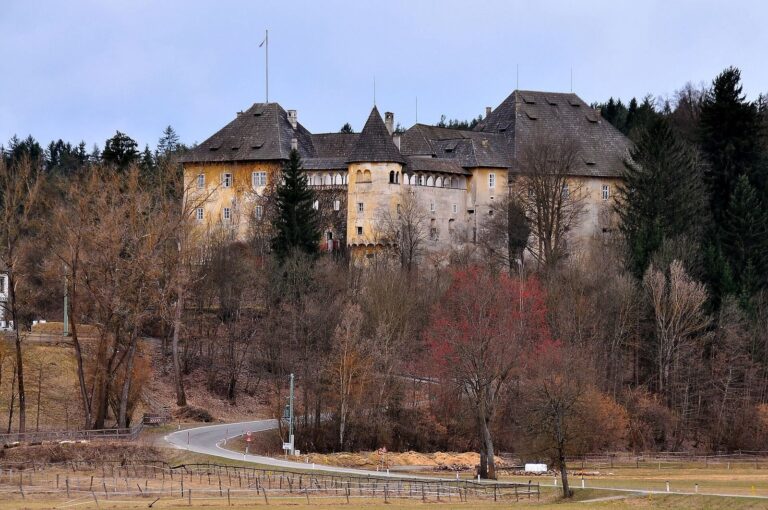
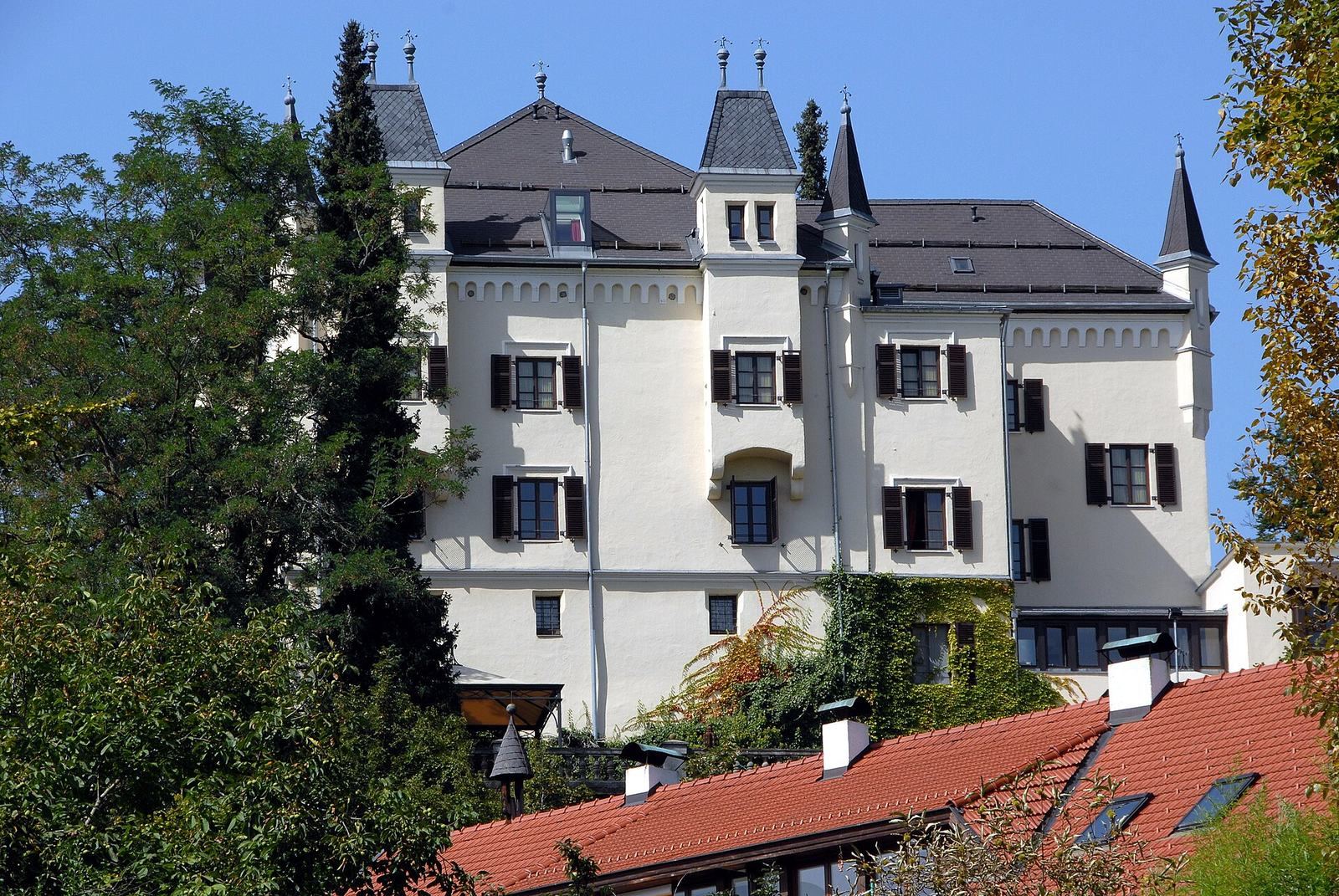
The castle stands above the eastern bay of Lake Wörthersee, where it is visible from a distance. Klagenfurt’s vineyard lies below it to the west. Its original form was a tower-like residence in a castle-like Renaissance style.
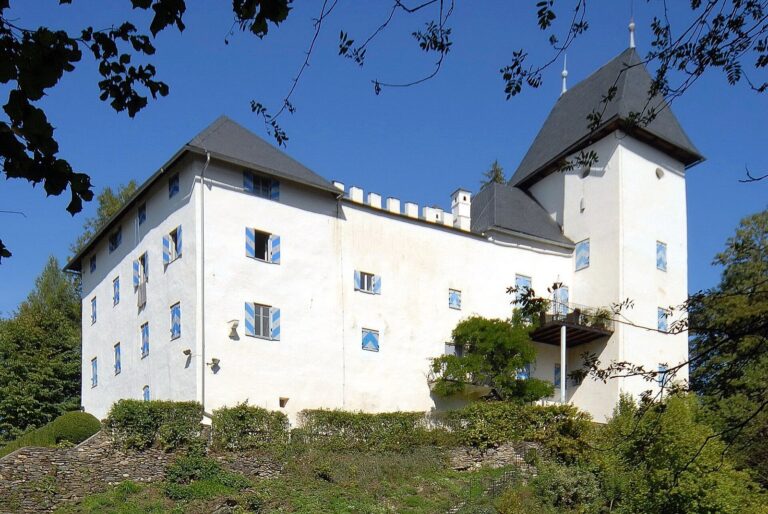
Numerous projecting bay windows and towers define the castle’s present appearance. Wartime damage is concentrated in the ancillary buildings and at the rear of the main structure.