Pfullingen Poor Clare Monastery: A Franciscan Convent in Germany
Site at a Glance
- Popularity
- Medium
- Country
- Germany
- Primary era
- Medieval
- Eras represented
- Medieval, Early Modern, Modern
- Civilizations
- Duchy of Württemberg, German, Holy Roman Empire
- Site type
- Religious
- Remains
- Monastery
On this page18 sections
History
The Pfullingen Poor Clare Monastery was a medieval convent of the Poor Clares, the women’s branch of the Franciscan movement founded by Clare of Assisi, in Pfullingen, Germany. Its foundation belongs to the mid-thirteenth century, but the precise sequence of its establishment remains uncertain. Dedicated to Saint Cecilia, an early Christian martyr, the monastery belonged to the Diocese of Constance, a Catholic ecclesiastical jurisdiction.
Foundation and formal establishment
A Franciscan chronicle places a small Franciscan settlement near Pfullingen in 1237, at or beside a chapel dedicated to Cecilia. A chronicle written by a Poor Clare in 1525 gives a fuller account, saying that Mechthild and Irmel of Pfullingen began building the monastery on 11 November 1250. It says they joined the order on 16 November 1252 while living at the chapel, then moved into the completed convent on 25 November 1278. Because this account was written nearly three centuries after the events, its chronology needs caution. Studies of the surviving buildings had supported the move in 1278, although a rescue excavation in 2022 cast doubt on the accepted interpretation of the building history.
The 1525 chronicle credits Mechthild and Irmel with founding the convent and associates them with the Rempen family. That family connection is disputed. An endowment by unnamed Lords of Pfullingen has been considered more likely, though the genealogy behind this proposal is unresolved and there are historical objections to it. The chronicler seems to have viewed the Rempen, whose family line ended in 1498, as an important local family in the thirteenth century. Irmel may have been Saint Irmingild of Pfullingen, a little-known figure.
On 21 October 1252, Pope Innocent IV accepted the women into the Poor Clares and gave them a religious rule. The community could formally be called a monastery from then on. Poor Clares from Söflingen arrived on 16 November to settle there. By 1260, the convent had its own spiritual attendant and received half of Pfullingen’s tithe, a levy on agricultural produce or income that commonly supported the church.
Religious life and the convent’s resources
The sisters first followed a rule issued in 1252 by Cardinal Hugolin, later Pope Gregory IX. In 1253, Pope Innocent IV allowed some adjustments because the rule’s requirements had developed in a milder climate than that of southern Germany, where winters could be severe. Pope Urban IV issued a further rule in 1263. Its use at Pfullingen is known from that year; it was less strict and established the order’s name in honor of Clare of Assisi.
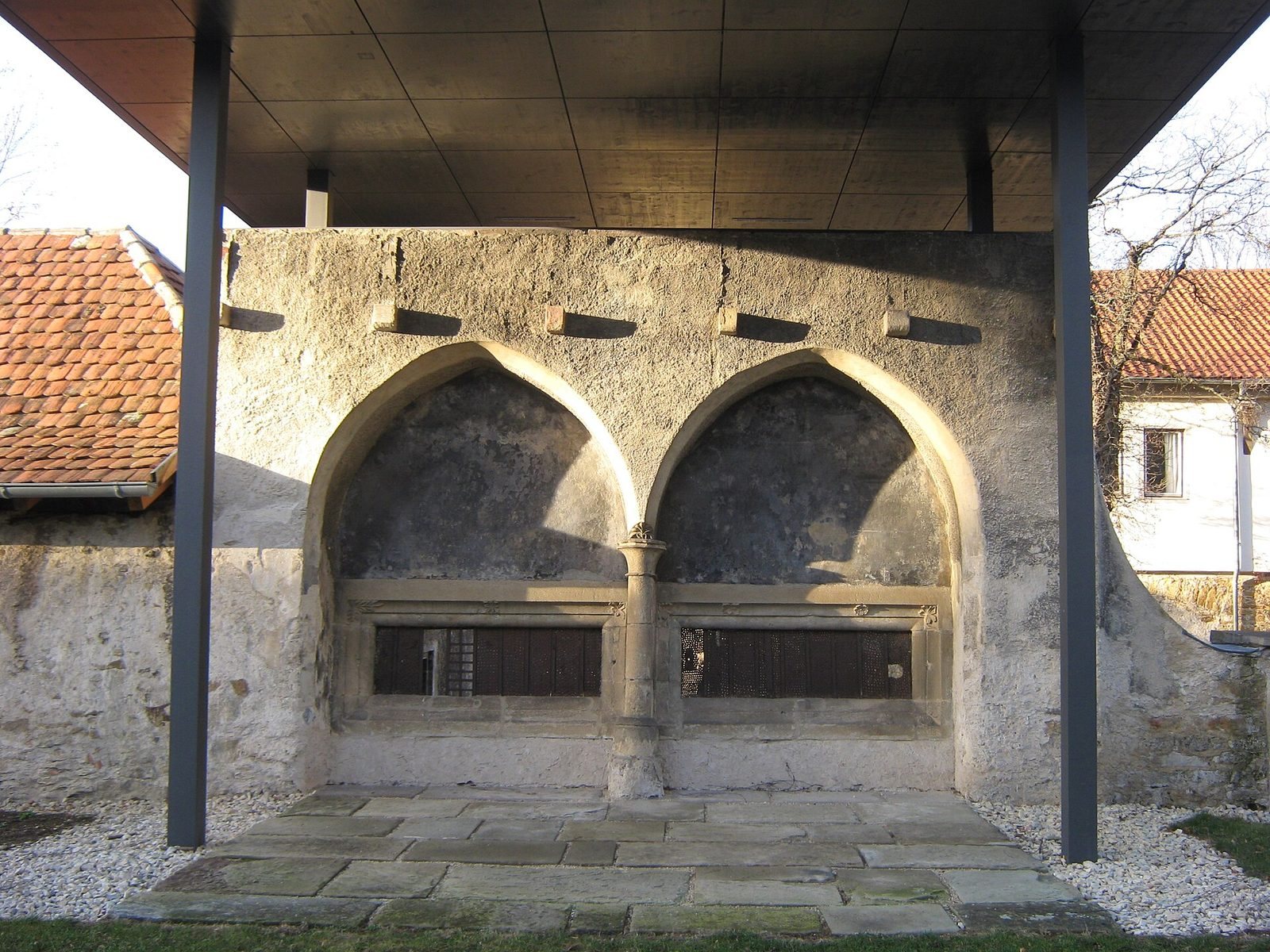
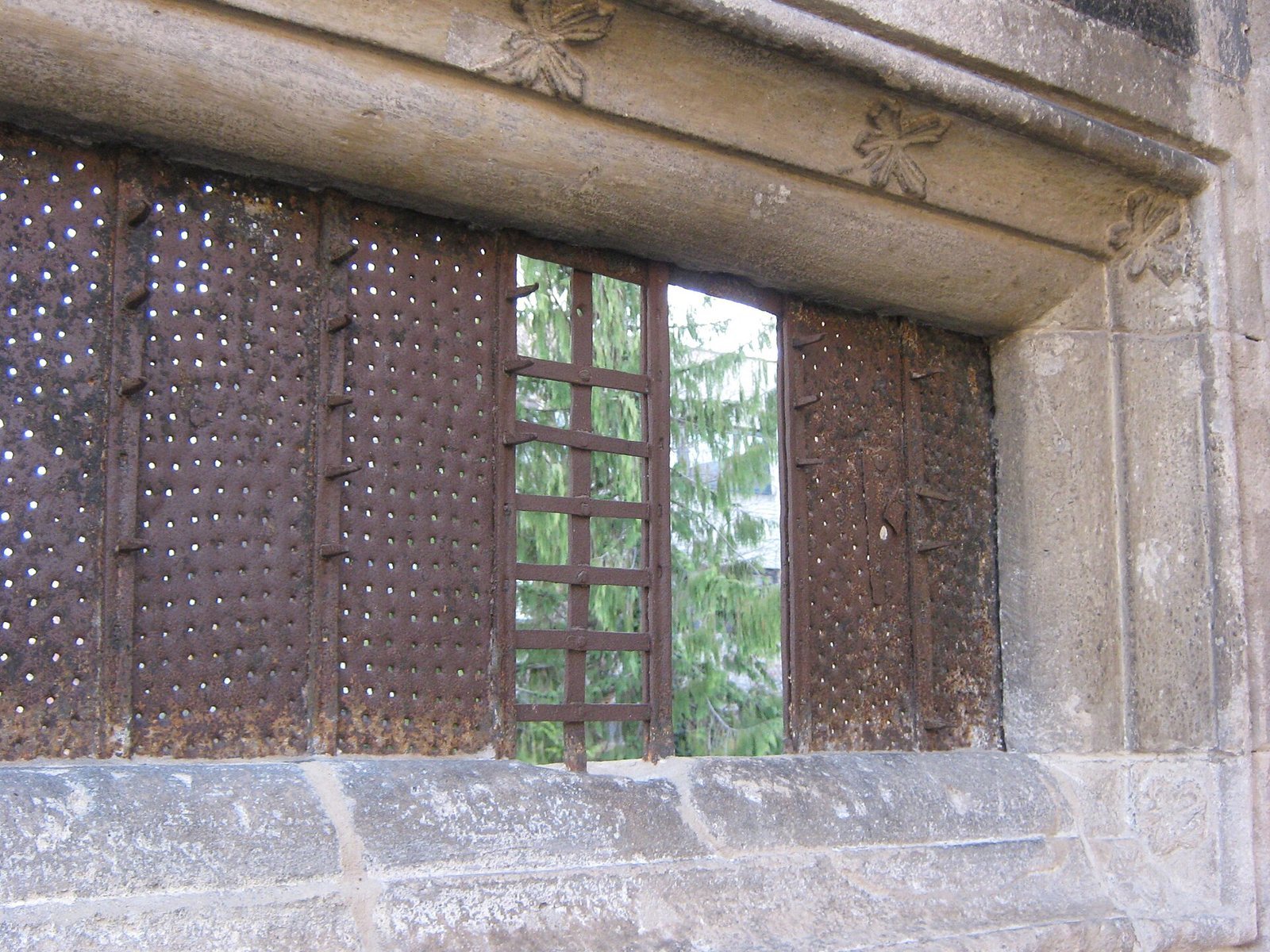
The nuns lived under enclosure, meaning separation from ordinary contact with the outside world. They were generally not permitted to leave, and outsiders were not allowed in; lay sisters could go out. The abbess, who headed the community, could approve conversations with outsiders, which two other sisters supervised. Sisters also received confession and communion at the speaking grille. A document from 1472 may indicate that the convent had another grille as well as the one that survives.
Individual ownership was forbidden, and the abbess managed the convent’s shared resources. During an unspecified period of hardship, sisters were allowed to seek help from friends and relatives. Donors later directed gifts to particular sisters, however, creating personal holdings that church rules prohibited; such holdings are recorded from 1307. The convent’s own wealth included about half the farmland in Pfullingen, nearly all of Genkingen and Reicheneck, and large estates in Mittelstadt, Hammetweil and Sondelfingen. It also held land and tithe rights in many other communities across the region. Its income came from estates, tithes, payments for care and maintenance, and, particularly in its early years, gifts and endowments. The convent also kept sheep, goats, cattle and pigs.
Rules governed the sisters’ diet, speech and dress, though how closely they followed every requirement is uncertain. Under Hugolin’s rule, they ate fasting food once a day. On Wednesdays and Fridays, their food was limited to raw fruit and vegetables, and during the fasts before Easter and Christmas they ate bread and water. Urban IV’s rule allowed a second meal in summer and, outside Fridays, Advent and Lent, dairy products and eggs. Meat remained forbidden, while elderly and infirm sisters were excused from fasting. The expected habit included a black cap, white veil and loose robe tied with a cord; the sisters were also expected to shave their hair. Only those who were weak wore shoes. The 1525 chronicle also mentions fur garments and clothing belonging to individual nuns.
Women could enter the convent as children or adults, bringing a dowry or inheritance. A novitiate, a period of preparation before taking vows, was customary but could last only a few days. Older sisters taught younger ones to read and write. The convent’s offices included abbess, prioress, scribe, guest mistress and gate mistress.
Late medieval reform and unrest
In 1413, the convent housed 64 nuns, most from prosperous urban families in the area between Tübingen, Nürtingen and Münsingen. After 1461, Poor Clares from Brixen, supported by Württemberg countess Mechthild of the Palatinate, introduced reforms associated with the Observance movement, which sought stricter adherence to an order’s original practices. Several devotional books written by nuns survive from the period that followed.
The convent experienced unrest and damage in the early sixteenth century. During an uprising in 1514, peasants passed it at night with pipes and drums. In 1519, the monastery’s estate in Reutlingen was damaged during Duke Ulrich’s siege of that imperial city. The monastery itself was plundered during the Peasants’ War in 1525.
Suppression, return and final departure
After recovering Württemberg, Duke Ulrich suppressed the monastery in 1534 as part of the Reformation. He barred the admission of novices, cut off the sisters’ access to Catholic clergy and customary worship, and required them to hear Protestant sermons. He also urged them to leave the order and abandon its habit, ended enclosure, installed a Protestant administrator and imposed heavy taxes. In 1539, he ordered the bell tower and part of the church demolished.
In 1540, Ulrich agreed to provide the sisters with money, food, accommodation and firewood. On 12 May, 27 Poor Clares were moved to an empty Franciscan monastery in Leonberg. After the Augsburg Interim of 1548, an imperial settlement concerning religious practice in the German lands, the sisters sought permission to return. Emperor Charles V ordered the monastery restored to them in 1550. Ulrich’s successor, Duke Christoph, allowed a return only under conditions, and 18 remaining sisters came back on 5 September 1551. Disputes between the convent and the duke continued despite imperial intervention.
The ban on taking novices gradually reduced the community. Three sisters remained in 1579. The last, Anna Reischin, died on 2 November 1595; an entry in the death register says she had converted to Protestantism around 1590.
In 1630, after Emperor Ferdinand II issued the Restitution Edict, which sought the return of church property secularized after 1552, Poor Clares from Söflingen were called to resettle Pfullingen and arrived in December. The Thirty Years’ War forced them to flee to their home monastery from 1632 to 1635, and again from 1638. On their final return, they lived at the former estate of Marchtal Abbey in Reutlingen. The Peace of Westphalia ended the war in 1648 and transferred the Pfullingen monastery to Württemberg. The sisters then returned permanently to Söflingen.
Changes to the site and its later history
After the transfer to Württemberg, a state finance office was built on the grounds in 1793. The property became privately owned in 1845, and the city of Pfullingen began acquiring it in 1953. Between 1785 and 1860, the cloister, all four convent wings and numerous service buildings were demolished. The former arsenal burned in 1920, and the monastery mill was demolished in 1968 to make way for the Friedrich-Schiller-Gymnasium, despite efforts to save it in the mid-1960s.
The surviving speaking grille also inspired the poet Paul Celan. In June 1957, publisher Günther Neske, whose publishing house stood opposite it, met Celan and soon sent him a postcard showing the grille. Celan wrote a poem titled Sprachgitter and later used the title for a poetry collection published by S. Fischer in 1959 rather than by Neske.
Remains
The monastery precinct had two boundaries. The inner enclosure contained the church, cloister walkway, convent building and nuns’ cemetery, while other structures, especially service buildings, stood beyond it. Surviving sections of both walls and several buildings preserve parts of this arrangement.
Enclosure and access
Walls and controlled entrances
A gate provided access through the enclosure and was walled up after each use. Another opening in the wall could be reached only by ladder. These arrangements controlled movement between the enclosed area and the outer precinct.
Windlass house
The windlass house used a revolving hatch to transfer objects across the enclosure without ordinary entry. In the seventeenth century, it was converted into a washhouse. The building is now used for exhibitions.
Monastery church
Exterior fabric
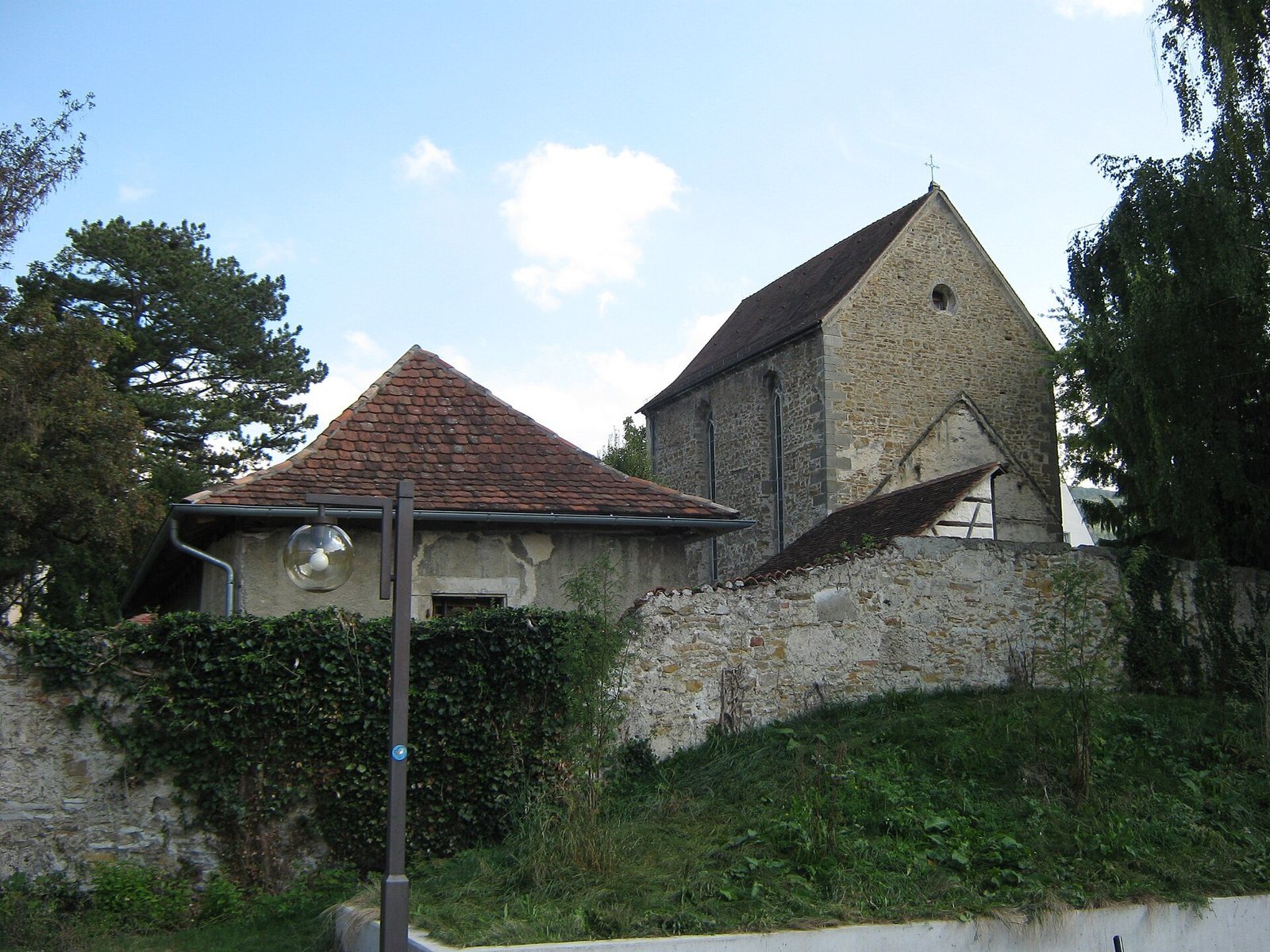
The church is among the monastery’s surviving buildings. Marks on its exterior show where the convent building and cloister walkway joined it, and traces of rooflines remain on the southwest and southeast sides. The southeast wall also retains a former entrance, now barred and glazed, and four projecting stone supports. The northeast facade dates to around 1579 rather than to the thirteenth century.
Interior and restoration
The church has five storeys. Its pointed-arch windows were once blocked, leaving small rectangular openings, and intermediate floors were inserted into the nave when the building was used as a granary. Before restoration, the structure had badly deteriorated and become overgrown. Work from 1978 to 1981 reopened the pointed windows, reconstructed the wooden ceiling and renewed the floors. Heating was also installed in the basement so the space could be used for events.
Wall paintings
Fourteenth-century wall paintings survive inside the church. They include painted lines that imitate masonry joints, false windows and Gothic ornament. The church restoration included measures to conserve these paintings.
Speaking grille
The grille is set into an exterior wall of the former speaking room. It comprises two openings fitted with perforated iron plates, one of which was later replaced by a serving hatch with a grid. The interior floor stands much higher than the exterior floor: the sisters knelt inside, while people outside had to reach upward. It is the only surviving medieval speaking grille in Europe, and a protective roof was installed over it in 2006.
Other buildings and the present grounds
Granary and church annexes
The former granary is now a residence. Two small annexes beside the church are connected to it by cellar vaults.
Present-day grounds
The former monastery grounds now include the Friedrich-Schiller-Gymnasium, the Neske Library, a hotel, a kindergarten and housing. A modern cultural building is connected to the church by a stair tower that provides barrier-free access to every storey.