Pentemont Abbey: A Cistercian Nunnery and Protestant Church in Paris
Site at a Glance
- Popularity
- Medium
- Country
- France
- Primary era
- Early Modern
- Eras represented
- Early Modern, Modern
- Civilizations
- French
- Site type
- Religious
- Remains
- Monastery
On this page11 sections
History
Pentemont Abbey, formally the Royal Abbey of Our Lady of Pentemont, is a former Cistercian nunnery in Paris, France. The Cistercians were a Catholic monastic order that developed from the Benedictine tradition. Bishop Philip of Dreux founded the abbey near Beauvais in 1217, and its present complex reflects an 18th-century Baroque rebuilding and later 19th-century changes.
Foundation near Beauvais
Philip set aside an orchard southwest of Beauvais, between Mont Saint-Symphorien and the Avelon River, along with seven arpents of vines. An arpent was an old French measure of land whose size varied. After Philip died, his successor as bishop, Milo of Nanteuil, provided the remaining funds, and the abbey was completed in 1218. Pope Gregory IX confirmed the foundation and safeguarded its endowment in a decree dated 8 June 1230. The name Pentemont refers to a mountain slope, recalling the abbey’s original position at the foot of Saint-Symphorien.
From Beauvais to Paris
In 1554, soldiers of King Henry II went to the neighboring Abbey of Saint-Paul to force its abbess, Charlotte I de Monceaux, to resign. She sought refuge at Pentemont, but the soldiers followed and compelled her to surrender her office there. The nuns moved into Beauvais itself in 1646. After flooding damaged their convent in 1670, Abbess Hélène de Tourville arranged their transfer to Paris in 1672. The move had the authorization of Louis XIV and the consent of the abbot of Cîteaux, the bishops of Beauvais, the archbishop of Paris and the abbot of Saint-Germain-des-Prés.
In Paris, the sisters settled in a recently suppressed convent of the Sisters of the Incarnate Word, described as an Augustinian convent. This community was distinct from Pentemont’s own Cistercian order. The Beauvais buildings were demolished, and their land returned to agricultural use. Hélène de Tourville died in 1715 and was buried in the abbey chapel.
Life and rebuilding in Paris
The Paris convent educated girls from wealthy families and provided rooms for women of high social standing seeking time away from family or marital difficulties. Residents could meet in the salons and, within limits on when they could leave, move around the abbey with relative freedom. Some brought children and servants. Among the pupils were Louise-Adélaïde de Bourbon-Condé, who later became the last abbess of Remiremont, and Louise d’Esparbès de Lussan, who later became the mistress of the Count of Artois, the future King Charles X.
Martha and Mary, daughters of American diplomat Thomas Jefferson, also attended the school while he was minister to France. The wife of the Marquis de Lafayette helped arrange their admission. Jefferson’s wife, Abigail Adams, objected to their attending a Catholic school, but Jefferson replied that Protestants were among the pupils. School rules were strict: fires were withheld until the water froze, and pupils could not speak outside lessons and recreation. Martha, known as Patsy, wrote that she wanted to become a nun, after which Jefferson removed both daughters.
Joséphine de Beauharnais stayed at the abbey during her separation from her first husband, Alexandre. A court order allowed her temporary independence but required her to live there with her children, with Alexandre charged for the expense. James Smithson, founder of the Smithsonian Institution, may also have been born at Pentemont. The proposed link rests on the abbey’s connections with the Duke of Northumberland, whose illegitimate daughters were educated there.
In 1743, Abbess Marie-Catherine de Béthisy de Mézières decided to replace cramped and deteriorating convent buildings. Construction began in 1747, supported by donations from the Dauphin, the French crown prince, and Cardinal Armand-Gaston de Rohan-Soubise, as well as contributions from the abbess. The funds proved insufficient. Pierre Contant d’Ivry’s design was chosen over a proposal by François II Franque. The architect and writer Jacques-François Blondel published Contant’s plan, and philosopher Denis Diderot praised its grandeur and simplicity. Work continued after Contant’s death in 1777 under an architect named Petit. The completed complex was more restrained than Contant’s published 1769 design.
Suppression and new uses
The abbey was suppressed in 1790 and its property seized. Its affairs were wound down in 1791–92, and the Beauvais properties were sold to meet state debts. At the time of suppression, the abbey’s revenue was 58,000 livres, an old French currency unit. The Paris buildings became state property and were used first by the National Guard, a citizen militia, and then by the Imperial Guard. Under Napoleon III, they housed the Cent-gardes, an elite mounted unit tasked with protecting the emperor and the Tuileries Palace.
In 1802, First Consul Napoleon Bonaparte granted the chapel to the Reformed Consistory of Paris, the governing council of a Protestant church. The chapel remained in military use until 1843, serving as a grain store during the Revolution and later as a hay store. The Reformed tradition, rooted in the Reformation, gained official recognition in France through the 1801 Concordat, which regulated relations between Napoleon’s government and the papacy, and the accompanying Organic Articles of 1802. The transfer of former Catholic churches to Reformed congregations marked a renewed period of public Protestant worship in Paris after earlier restrictions.
The chapel was consecrated for Reformed worship in 1843. Architect Victor Baltard began its conversion in 1844, following delays caused by administrative obstacles and opposition during the Bourbon Restoration, the return of the Bourbon monarchy from 1814 to 1830. The church was inaugurated on 8 November 1846. Parts of the abbey had already been demolished in 1805 to make way for Rue de Bellechasse, and further demolition accompanied an extension to that street in 1835. The congregation is now part of the United Protestant Church of France.
Government use and recent history
In 1915, the buildings were assigned to the War Ministry’s pensions service and later housed the Ministry of Veterans Affairs. A bunker was constructed beneath the Court of Honor in 1937. It contained two stationary bicycles intended to generate electricity if enemy bombardment caused a power failure. The former abbey received French historic-monument protections in 1983, 1992 and 2013, covering selected parts of the complex.
The French state sold the complex in 2014 to the property company Foncière des 6ème et 7ème Arrondissements, while government services continued to occupy the buildings temporarily. After three years of work, Yves Saint Laurent established its headquarters there in 2019.
Remains
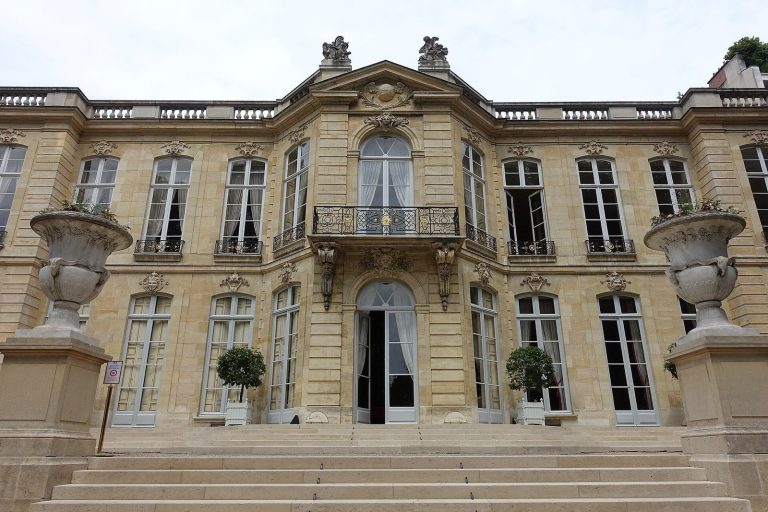
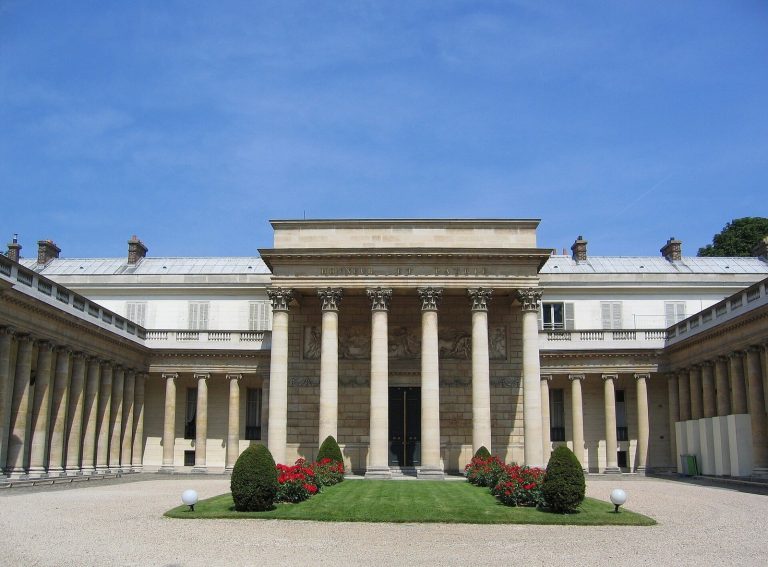
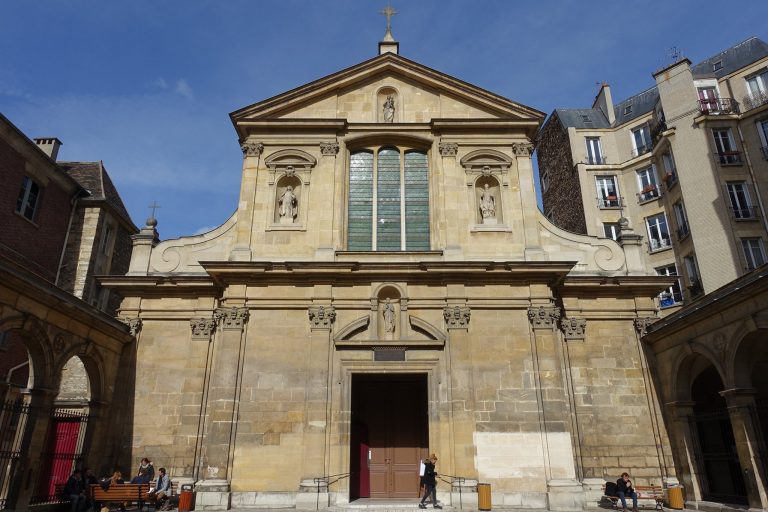
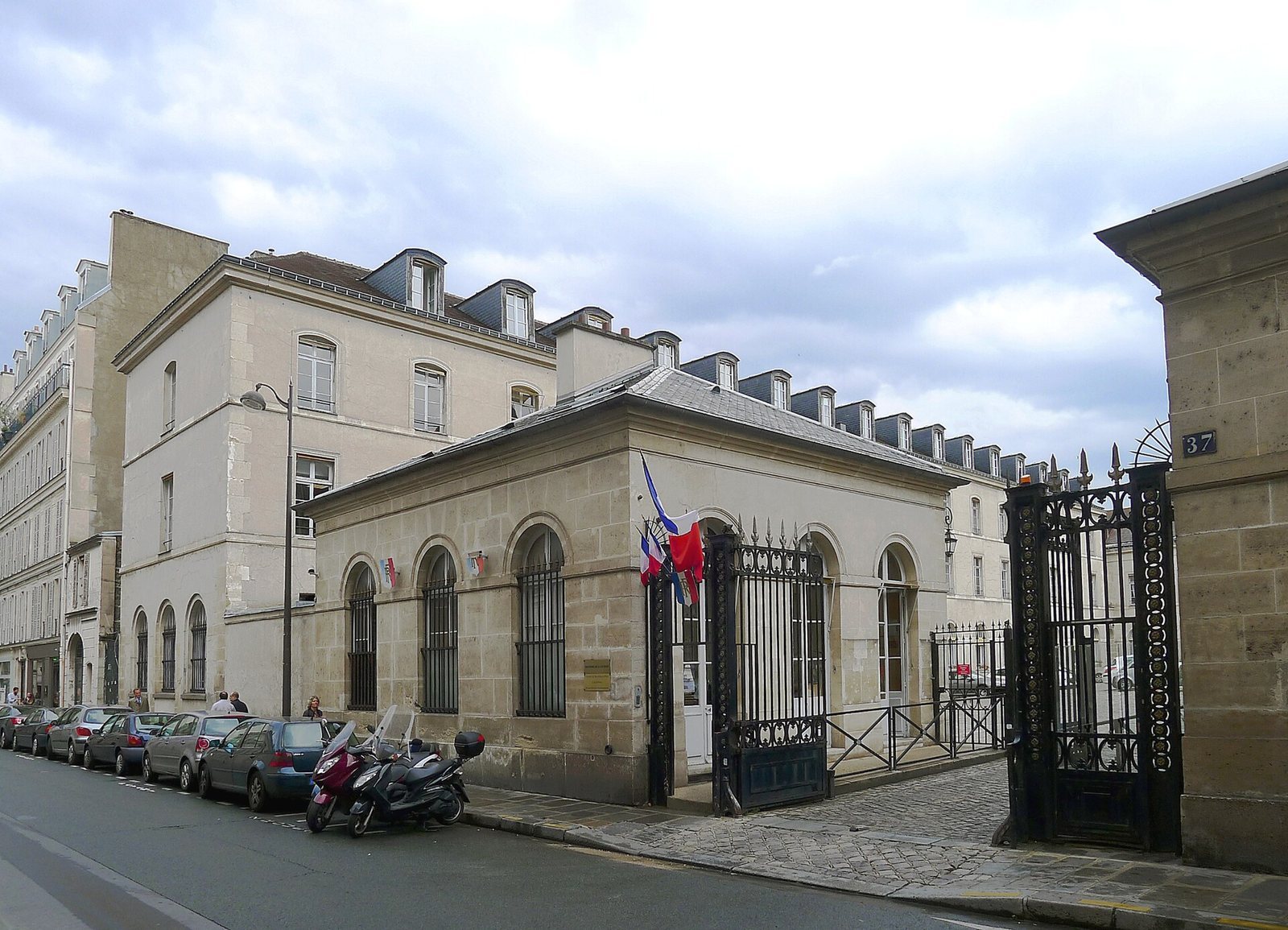
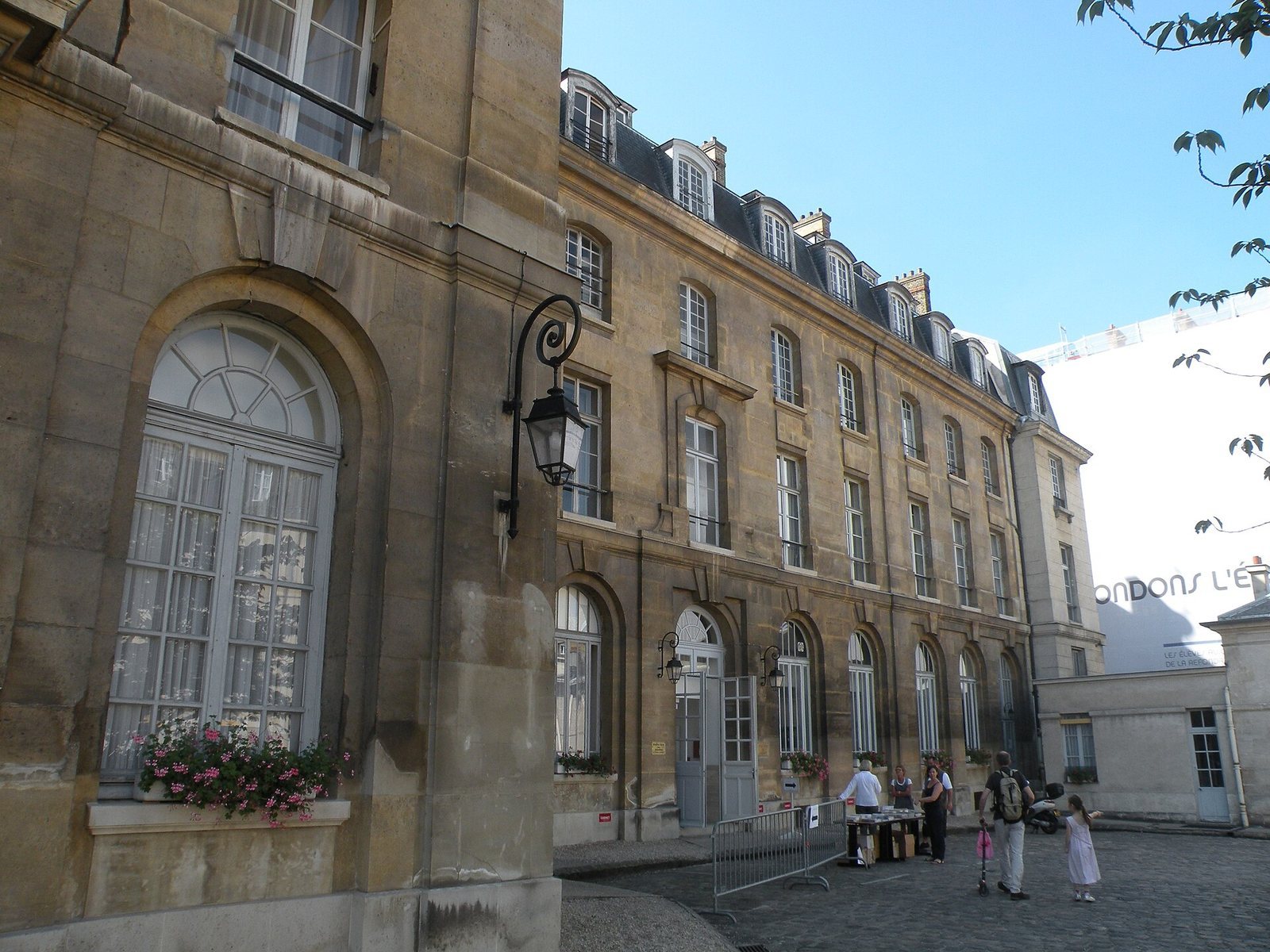
The surviving complex consists of 18th- and 19th-century buildings at the corner of Rue de Grenelle and Rue de Bellechasse. Its Baroque arrangement places the chapel facing Rue de Grenelle, with the larger abbey building behind it around a courtyard that opens onto Rue de Bellechasse from the side.
The chapel
Plan and construction
The Dauphin laid the chapel’s foundation stone in 1753. It was blessed in 1756 and completed in 1766. Its nave has a centered plan beneath a dome, followed by the elongated choir used by the nuns. A tower held a ground-floor retrochoir, the area behind the choir, and a first-floor oratory, a small place for prayer; a bell tower probably stood above. The dome uses Saracen vaulting, thin-brick construction generally built without conventional supporting frames. Contant d’Ivry introduced this technique to northern France.
Protestant adaptation and organ
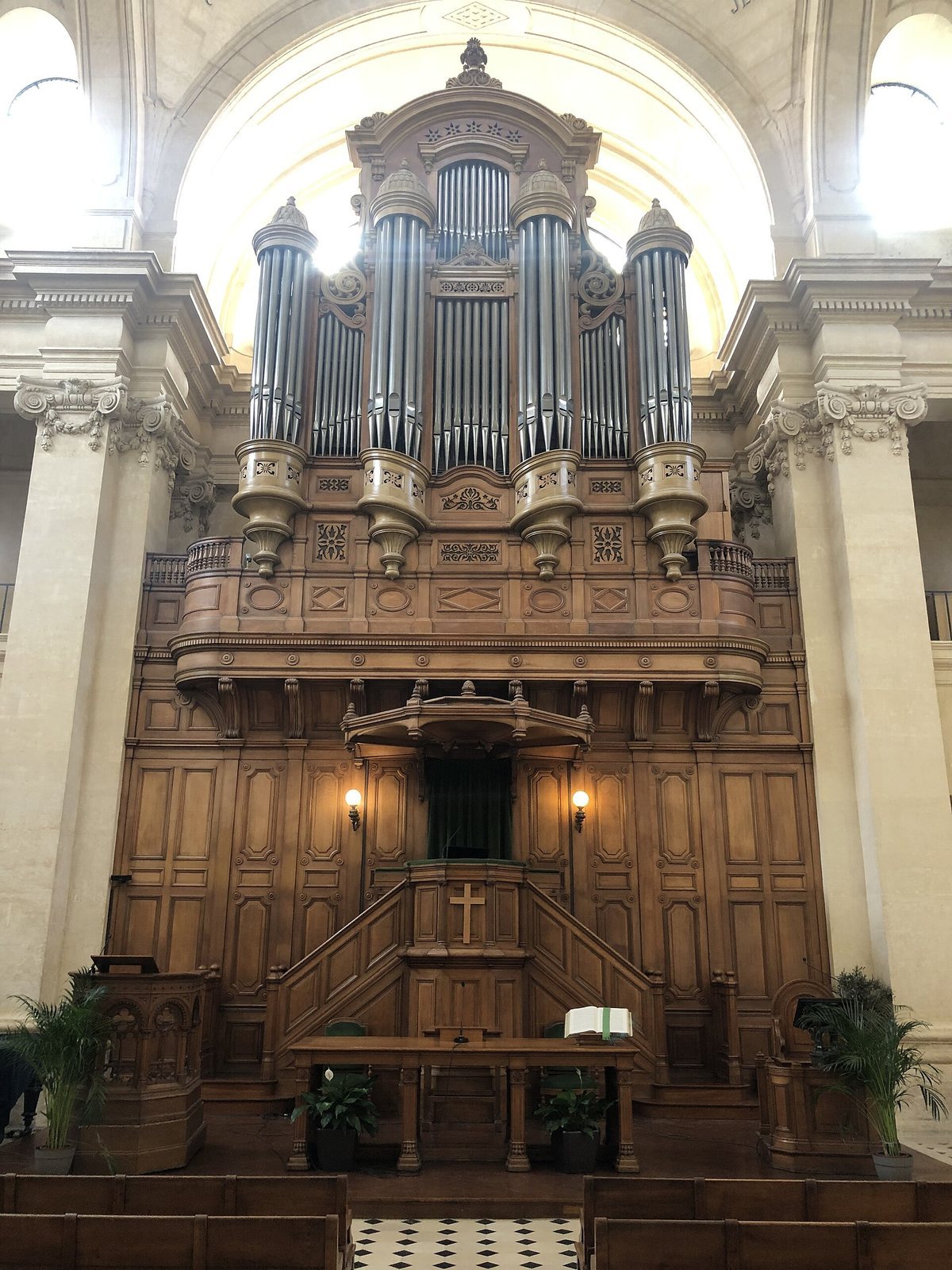
For Protestant worship, the former nuns’ choir became the nave. The entrance facing Rue de Grenelle was blocked, and two side windows were converted into doors. The chapel was separated from the rest of the abbey. Aristide Cavaillé-Coll’s organ was installed in 1846 and later modified; restoration work from 2011 to 2014 recovered its surviving original elements. The church itself was restored in 2005–07.
Abbey buildings and courtyard
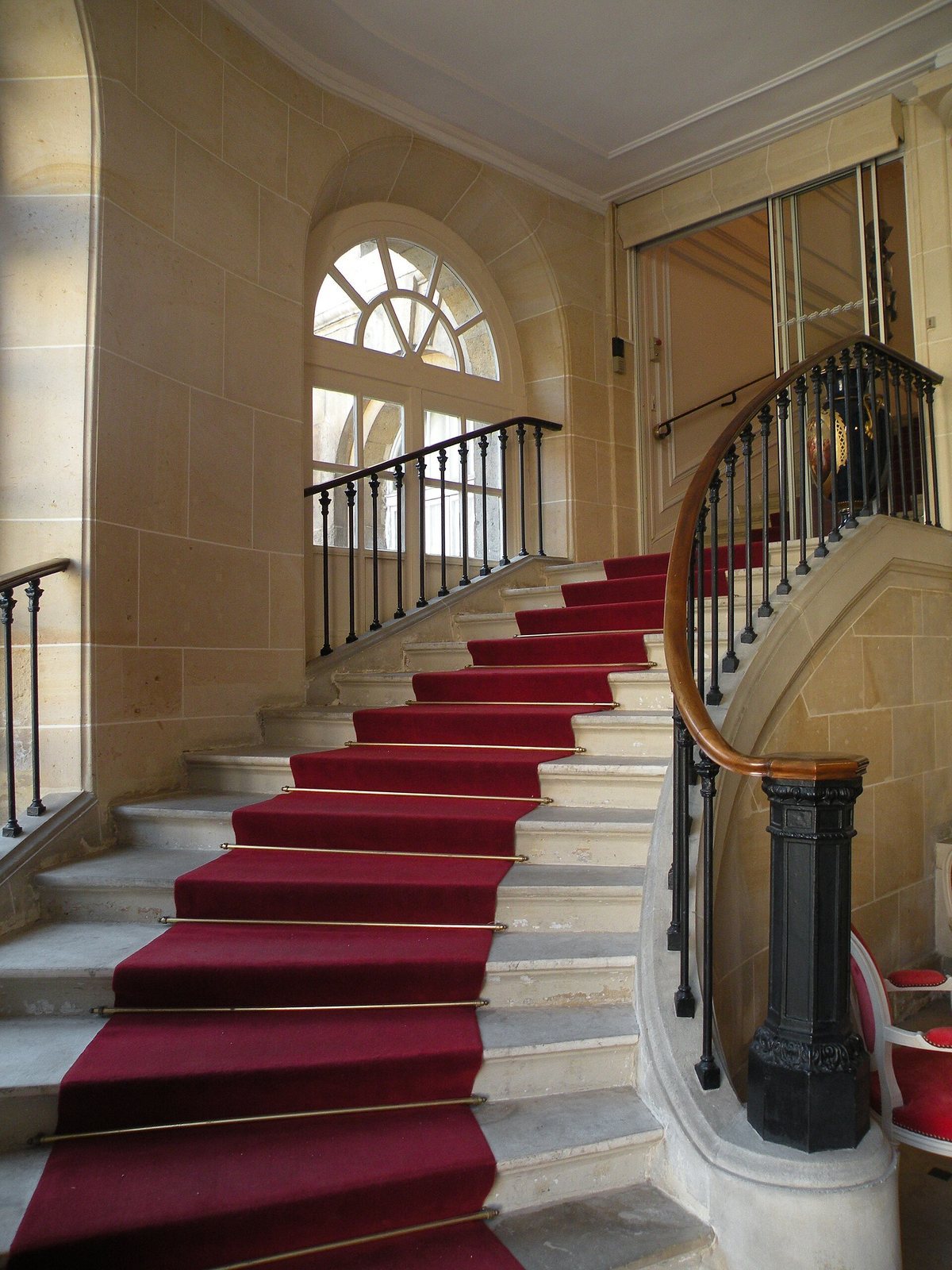
The Court of Honor contains a war memorial to veterans who died for their country. Its inscription dedicates it from veterans to their comrades who gave their lives, followed by the words In memoriam. Commemorative plaques honor André Maginot, a French politician, and Henri Frenay, a leader of the French Resistance during the Second World War. Among the surviving architectural features are the vestibule, the central projection on the garden side, and decorative details from the former abbess’s lodging.