Suben Abbey: An Augustinian Monastery and Baroque Complex in Austria
Site at a Glance
- Popularity
- Medium
- Country
- Austria
- Primary era
- Early Modern
- Eras represented
- Medieval, Early Modern
- Civilizations
- Duchy of Bavaria, Electorate of Bavaria, Holy Roman Empire
- Site type
- Religious
- Remains
- Monastery
On this page10 sections
History
Suben Abbey is a former monastery of Augustinian Canons in Suben, Austria. Its origins lie in a collegiate foundation made from a local fortress around 1050 or, possibly, 1084; the complex was later rebuilt in the Baroque style. The abbey became a religious center with extensive pastoral responsibilities in the Innviertel.
Foundation and medieval authority
Tuta, daughter of Heinrich of Formbach and wife of Béla I, king of Hungary, converted the Counts of Formbach’s fortress at Suben into a collegiate foundation for secular clergy. Unlike a monastery, such a foundation was a community of clergy not necessarily bound to monastic life. During the Investiture Controversy, a conflict between the papacy and secular rulers over the appointment of church leaders, the counts backed the pope. Supporters of Emperor Henry IV devastated Suben during the conflict.
Altmann, Bishop of Trent and a great-grandson of Tuta, re-established the community as a monastery in either 1126 or 1142. He made the canons follow the Rule of St Augustine, a guide to communal religious life, and gave the Prince-Archbishopric of Salzburg, the territory governed by Salzburg’s archbishop, the right to appoint the provost, or head of the community. In 1146, Pope Eugene III placed the monastery under his protection, confirmed its property, and granted it burial rights. Pope Gregory IX allowed the canons to elect their provost in 1236, but the first provost chosen from within the community was not elected until 1474.
From 1140, the Counts of Schaunberg held authority to protect and exercise legal oversight over the monastery. The community also formed agreements to pray for other religious houses. Provost Ulrich Saeldt made one with Reichersberg on 27 March 1416, and Provost Matthäus Meemoser made another with St Florian on 8 September 1426. Provost Johann IV Heiweckh agreed similar arrangements with Kremsmünster in 1497, Mondsee in 1500, Neustift near Brixen on 10 May 1501, and Göttweig in 1502.
Pastoral responsibilities and reform
Suben held lands in the Innviertel, Carinthia, Styria, and the Wachau, as well as important toll privileges. One estate, the Subenhof at Rossatz, later became an inn. Between 1500 and 1517, Passau Bishop Wiguleus Fröschl assigned the monastery pastoral work in numerous Innviertel parishes. The canons continued serving these parishes until the monastery’s closure.
When Count Wolfgang II, the last of the Schaunberg line, died in 1559, Suben gained its own court judge with lower jurisdiction, and the settlement became a manorial district with local authority. Church visitations in the later sixteenth century raised complaints about misconduct, weak discipline, use of the Protestant catechism, and concubinage. Secular authorities briefly installed Dean Johann Ponner, later Provost Johann VIII, as head of the community. A thorough reform followed under Provost Michael Hering, who led Suben from 1591 to 1599.
Baroque rebuilding and the final decades
Provost Ernest Theophil Scharrer, in office from 1679 to 1696, established the Archconfraternity of Our Lady of Help, a Catholic devotional association dedicated to the Virgin Mary. In 1684, Pope Innocent XI gave him the right to use a mitre, staff, ring, and pectoral cross, ceremonial signs of a prelate’s authority. Because the monastery buildings were in poor condition, a major Baroque rebuilding followed. Provost Asquilin Sattelberger commissioned a new residence for the provost, and Provost Gregor II Raiffauer continued the work. Most of the old monastery was demolished in 1696, and the foundation stone for the new complex was laid on 24 September. Construction continued through 1702–1703, when the upper storey of the east wing was completed.
During the War of the Spanish Succession, a European conflict fought from 1701 to 1714, refugees crowded into the monastery, while the warring sides demanded large payments. These pressures restricted further artistic work on the new complex. Baroque design also influenced churches in Suben’s parishes at Taufkirchen an der Pram, Zell an der Pram, and Raab.
The present church was built between 1766 and 1770 under Provost Ildefons Schalkhamer. On 6 October 1771, Cardinal Leopold Ernst Count of Firmian, Prince-Bishop of Passau, a bishop who also held the rank of territorial prince, consecrated it. In 1779, the Innviertel, including Suben, passed from Bavaria to Austria.
Dissolution and later uses
Emperor Joseph II dissolved the monastery on 6 March 1784 and placed it under the administration of Reichersberg Abbey. Suben’s pastoral district joined the parish district formerly served from St Marienkirchen to form an independent parish, supported by the Religious Fund, an Austrian state fund created from the assets of suppressed religious houses to support church institutions and parishes. The former abbey church became the parish church, and the monastery buildings passed into state ownership. Its 23 canons could take parish work as secular clergy or receive pensions. The last provost stayed in the emptied monastery until his death in 1789. Much of the property was sold, and the archive, library, and church treasury were dispersed.
In 1792, the remaining assets were assigned to the new Diocese of Linz as an endowment for its vicar general. After the vicar general died, the state took back the lordship. In 1809, the former monastery served as a hospital for French troops, and Napoleon gave the property to Bavarian field marshal Carl Philipp von Wrede. The buildings deteriorated under Wrede, and many artworks were sold or removed. The imperial-royal penitentiary fund bought the property back from the Wrede family in 1855. It became a penal institution in 1865, initially receiving the women’s prison transferred from Garsten. A men’s prison opened there in 1875 and remains in operation. Franciscan friars have provided pastoral care in the prison and parish.
The monastery’s arms displayed six gold lilies on a blue field. Suben’s municipal arms, granted in 1978, adopted the blue field and three gold lilies.
Remains
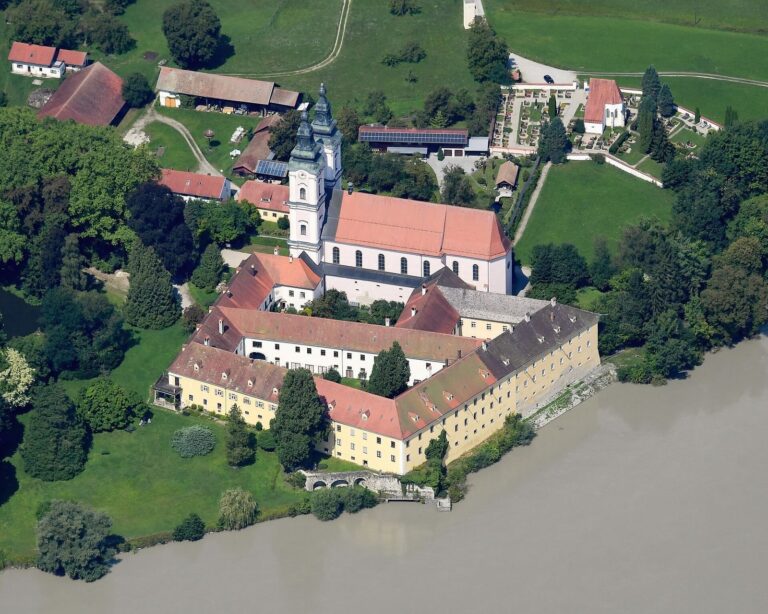
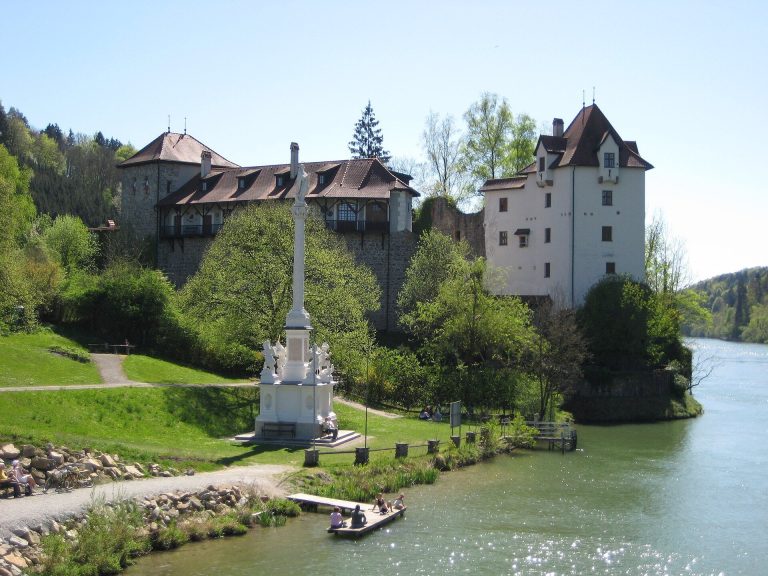
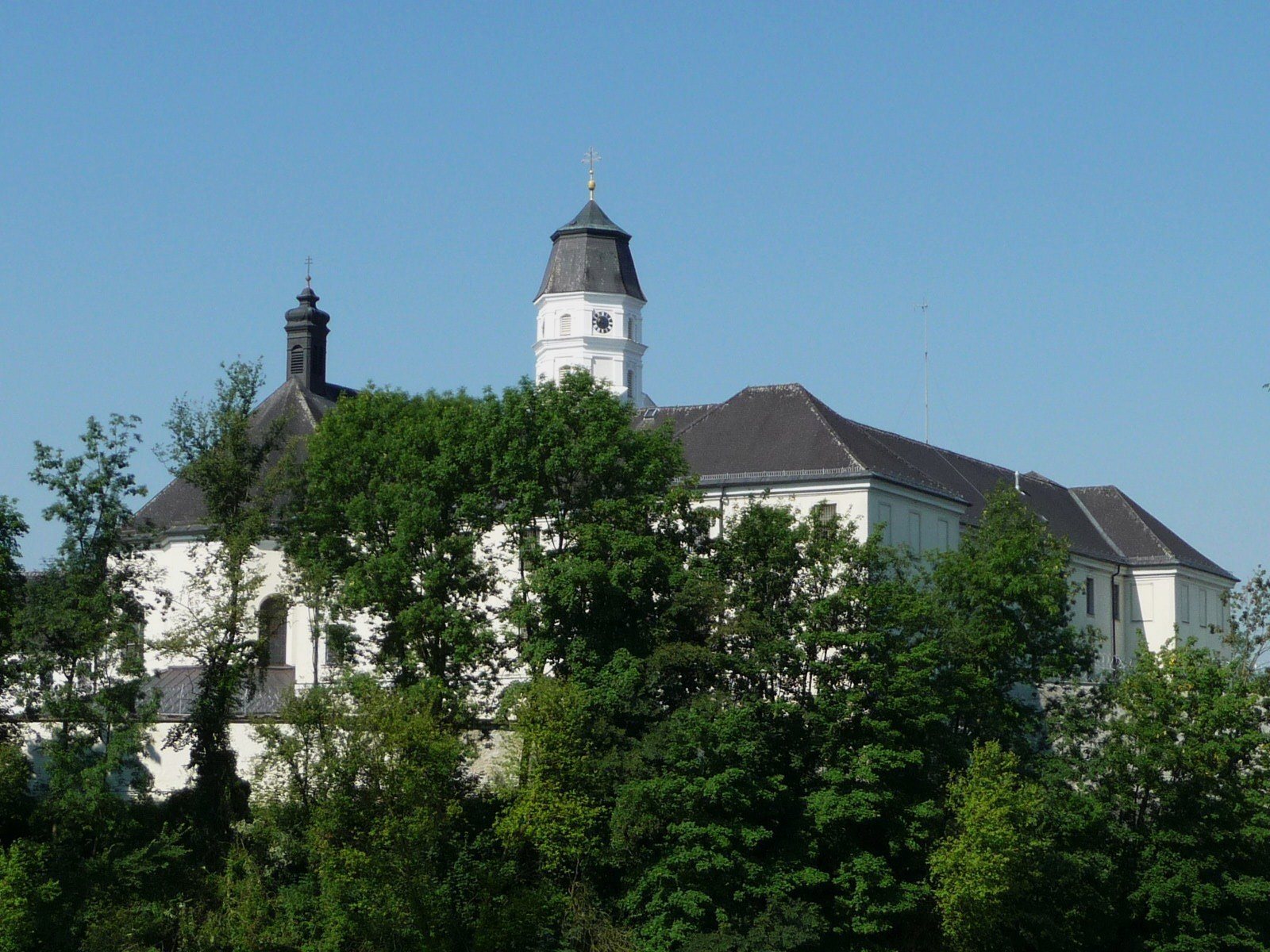
The Baroque monastery complex overlooks the Inn and Suben Bay. Its former monastic buildings now house Suben Prison, while the former abbey church continues to serve as the parish church.
Abbey church
Painted decoration and furnishings
Johann Jakob Zeiller painted the church’s frescoes. Those on the ceiling depict the conversion of St Augustine, with his glorification in the central panel. A fresco at the altar shows the Wedding of the Lamb. The altarpiece, also depicting St Augustine, was painted by Johann Georg Unruhe. Joseph Deutschmann made the pulpit, and Johann Baptist Modler produced the stucco work.
Earlier fabric and memorials
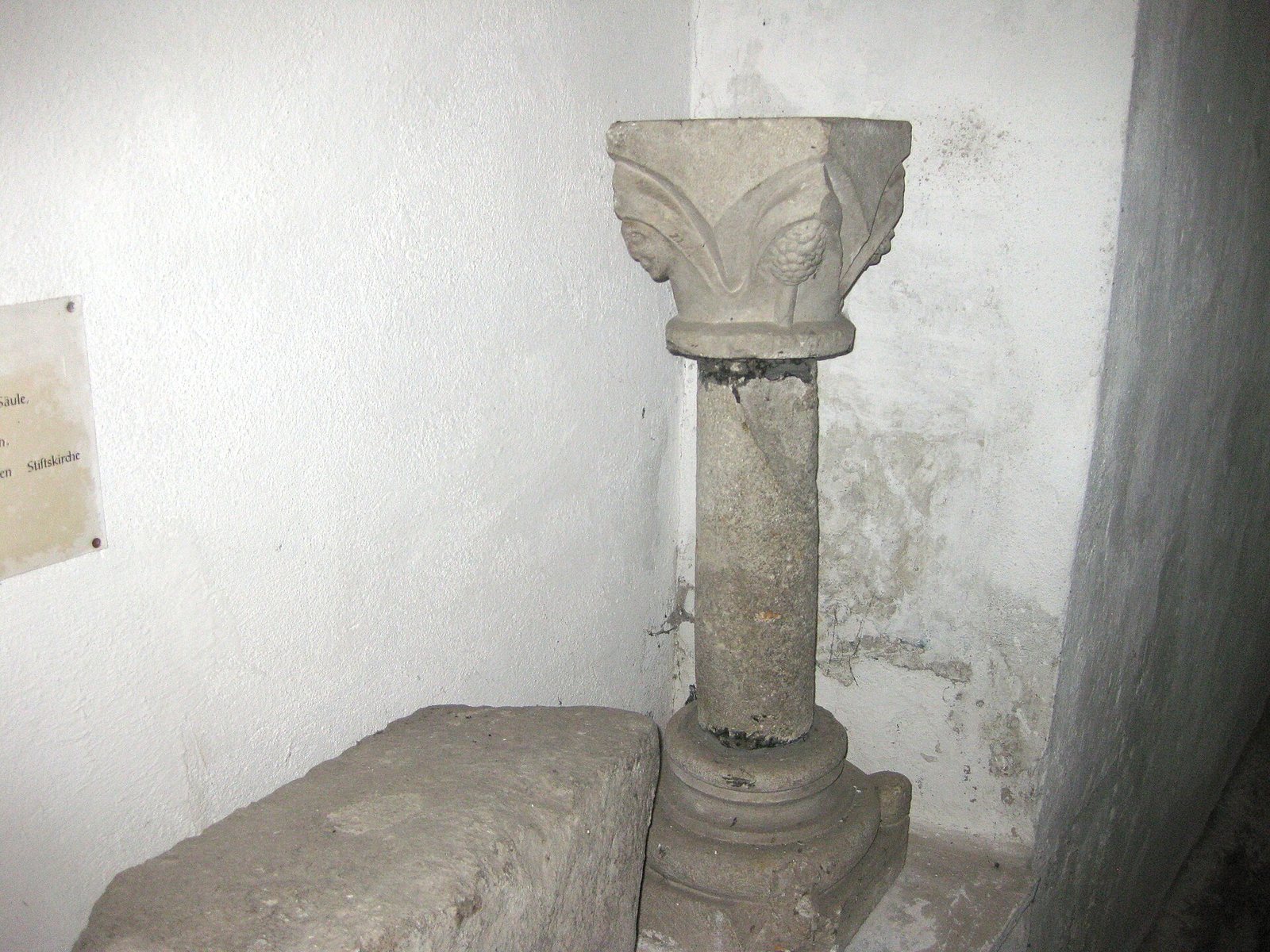
A Romanesque column with an early capital survives and is dated to around 1136. Tuta’s epitaph depicts her holding a church with Romanesque features. Four tombstones commemorate Provost Georg II, who died in 1622; Ernest Theophil, who died in 1696; Gregor II, who died in 1720; and Ildefons, who died in 1767.
Former Church of St Mary
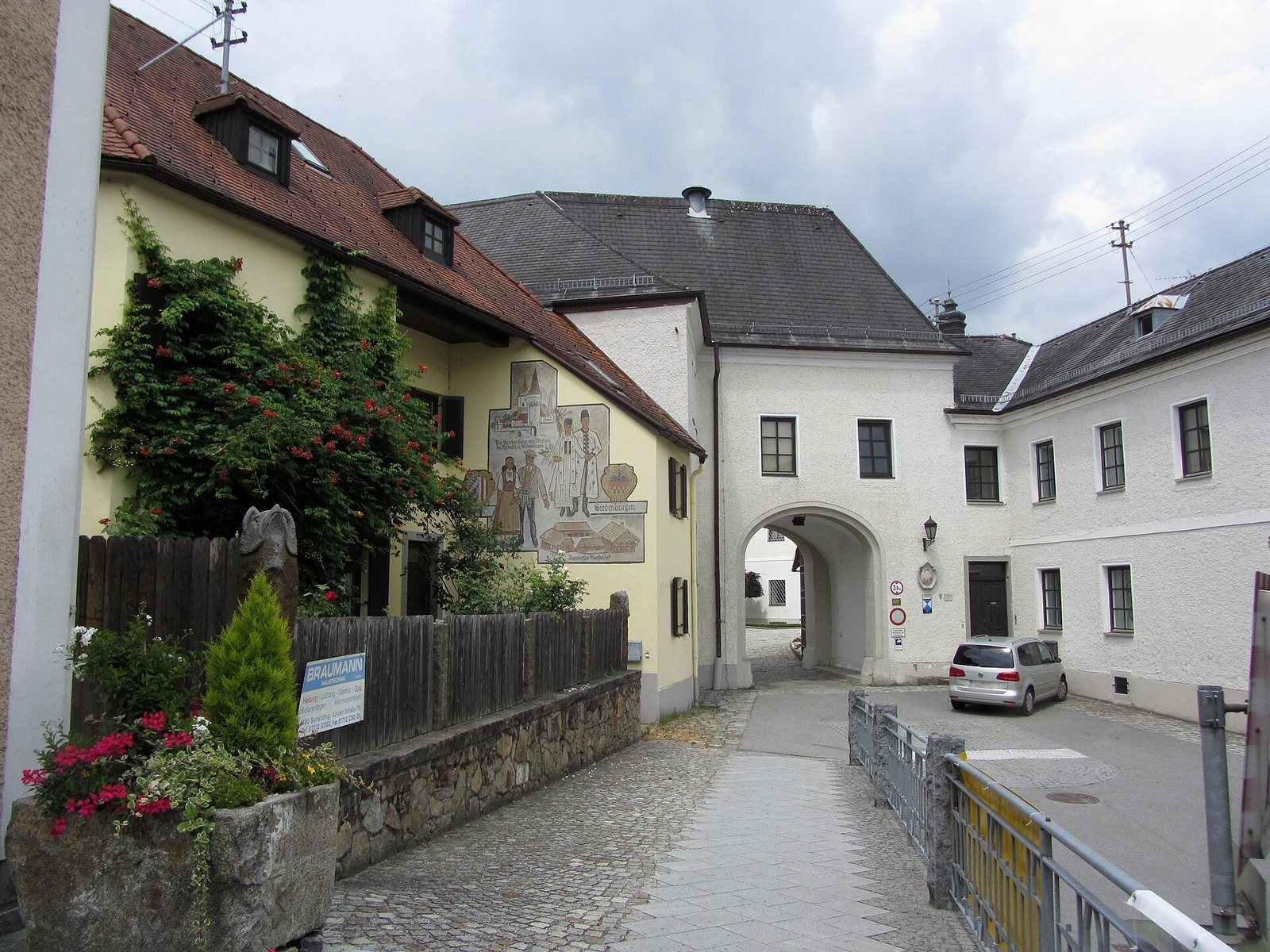
The former parish church of St Mary stood outside the monastery buildings, immediately beside the entrance to the monastic courtyard. It was restored shortly before 1784. After the monastery’s dissolution, it was sold for 65 gulden to a surgeon, who converted the building into a residence.