Aldersbach Abbey: A Former Cistercian Monastery in Germany
Site at a Glance
- Popularity
- High
- Country
- Germany
- Primary era
- Early Modern
- Eras represented
- Medieval, Early Modern, Modern
- Civilizations
- Duchy of Bavaria, Electorate of Bavaria, German, Holy Roman Empire
- Site type
- Religious
- Remains
- Monastery
On this page15 sections
History
Aldersbach Abbey is a former Cistercian monastery in Germany, founded around 1120 on a site where a church had existed by the mid-eighth century. The early church was consecrated to Saint Peter in 880 by Engelmar, bishop of Passau. The event appears in a record of monastic gifts and legal matters associated with Mondsee Abbey, during Engelmar’s episcopate, which lasted from 875 to 899.
Early church and monastic foundation
Local nobles established a house of Augustinian Canons at Aldersbach around 1120. These clerics lived in a religious community under the Rule of Saint Augustine. Bishop Otto I of Bamberg soon intervened and secured the house’s independence. In February 1123, he granted Aldersbach and three other monasteries annual deliveries of salt from Hall, now Bad Reichenhall.
In 1146, monks from Ebrach Abbey took over the community and made it a Cistercian house. The Cistercians were a monastic order rooted in the Benedictine tradition, with a strong emphasis on communal religious observance. A local tradition gives 2 July as the date of the transfer. Abbot Siegfried and monks from Ebrach took possession, and Bishop Egilbert, Otto I’s successor, was associated with the change and a new church. Ebrach had been founded in 1127 by Morimond Abbey, an early Cistercian center.
Cistercian growth and medieval crises
Aldersbach belonged to the regional Upper German Cistercian Congregation, with Ebrach as its mother house and Morimond as part of its order lineage. It remained under the Wittelsbach dukes, the Bavarian ruling dynasty, rather than becoming an imperial abbey directly subject to the emperor. Pope Eugenius III placed the monastery under his protection in 1147, and its privileges were strengthened under Abbots Siegfried and Eberhard.
In March 1183, Abbot Eberhard recovered the lay-protection rights over the abbey after Alram of Chamben had taken them unlawfully. Such rights gave a secular protector legal duties and powers concerning a monastery and its property. In 1200, after the monks had elected him, King Philip of Swabia took on that protective role and pledged not to separate it from the Empire. Later, from 1283 to 1292, Aldersbach and Zwettl Abbey contested the right to present a priest for appointment at the church of Thaya. The Kuenring nobles backed Zwettl, while Count Gebhard VII of Hirschberg supported Aldersbach. After arbitration, Abbot Ebro of Zwettl relinquished the parish to Aldersbach in June 1292.
The abbey built up its resources through gifts, bequests, land exchanges, and purchases. Its income included grain tithes, wine from the Wachau, and salt trading from Hallein. It also held toll exemptions for goods carried along the Danube, Inn, and Salzach. Aldersbach founded daughter abbeys at Fürstenfeld in 1263, Fürstenzell in 1274, and Gotteszell in 1285; Walderbach was counted among its daughter houses from 1669. Monks also served in nearby parishes. In the thirteenth and fourteenth centuries, the community maintained a manuscript-copying workshop and a goldsmith’s workshop.
A disputed abbatial election in 1361 brought the monastery close to ruin, and its recovery took about a century. Aldersbach supported Emperor Louis the Bavarian in his prolonged conflict with the papacy and was placed under an interdict, a church sanction restricting religious services or sacraments. Plundering during wars, plague, and wider religious decline also affected the monastery and its community.
Reformation and renewed prosperity
During the Reformation-era decline, Abbot Wolfgang Marius, in office from 1514 to 1544, tried to reform the community. A humanist poet and chronicler, he achieved no lasting change. Abbot Bartholomew Madauer, who led the abbey from 1552 to 1577, was forced to resign under suspicion of heresy. An administrator then took charge, and the community dwindled to one monk.
Aldersbach flourished again during the Counter-Reformation, the Catholic Church’s response to the spread of Protestantism, and remained prosperous until its dissolution. Its abbots commonly served as vicars general, senior officials exercising delegated authority, for the Bavarian ecclesiastical province. In that role they oversaw seven men’s monasteries and the women’s community at Seligenthal. From the seventeenth century, Aldersbach also supervised Seligenthal and sent ordained monks to local parishes, including Rotthalmünster.
Abbot Malachias Niederhofer, in office from 1669 to 1683, established a school of philosophy and theology. A wider plan for a central Cistercian college in Bavaria was never realized before secularization. The abbey also sustained an extensive musical life: several abbots were musicians or composers, and the community kept an orchestra and a large collection of printed and handwritten music, including 58 symphonies. The monastery’s condition during the Thirty Years’ War, a major European conflict fought from 1618 to 1648, is uncertain.
Dissolution and later use
On 21 March 1803, a commissioner announced the abbey’s suppression to the community under Abbot Urban Tremel. Forty-two monks were present. This took place during secularization in Bavaria, when the state dissolved church institutions and transferred their property. The monks and employees were dismissed. Some monks received small pensions or found work in nearby parishes, while the abbey’s fishponds, farms, forests, furnishings, and other property were sold.
The library held more than 40,000 volumes. Library commissioner Johann Christoph von Aretin sent manuscripts, books printed before 1501, and rare printed works to the Bavarian State Library in Munich. Most of the remaining books, chiefly eighteenth-century works, went to the university library in Landshut and a secondary school in Straubing. Official registers and records passed to the Bavarian Main State Archive, and other books were sold by weight. The abbey church was threatened with demolition, but protests by local residents helped secure its use for parish worship in 1806. The brewery was sold in 1804 to a brewer from Passau and in 1811 to Johann Adam von Aretin, who also acquired much of the monastery’s land, buildings, and forests.
Parts of the former complex later housed a kindergarten run by the Mallersdorf Sisters until the 1930s, while other rooms became apartments. The buildings served as a military hospital during wartime and provided initial housing for refugees from the east after the Second World War; the former library became a gymnasium. In 1983, an Aldersbach Abbey support association took over the monastery from the Aretin family and began restoration to prevent the buildings’ decay and find new uses for them. A Cistercian monk from Zwettl lived at Aldersbach from 1990 until the summer of 2004, but monastic life was not re-established.
Remains
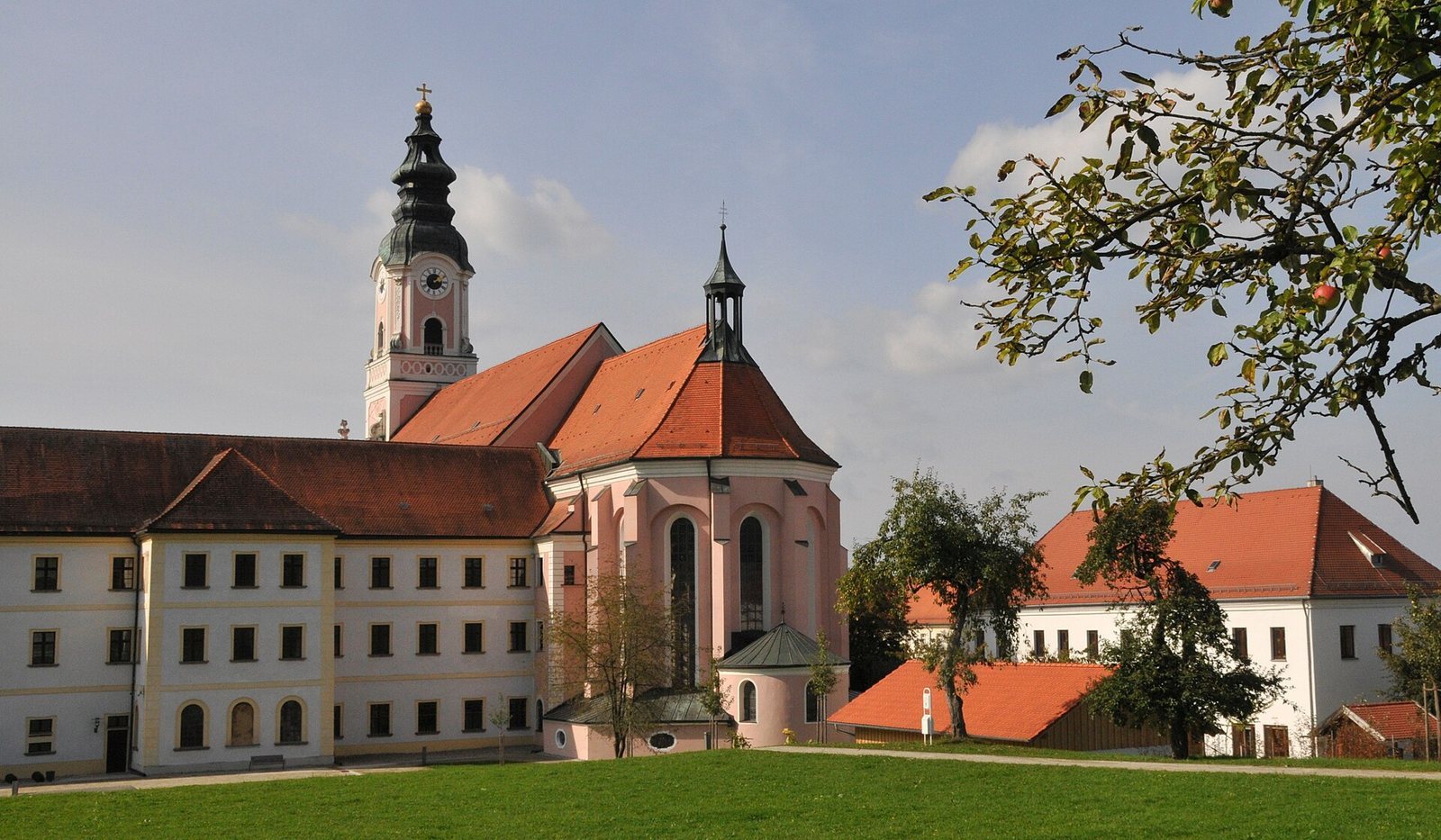
The surviving complex includes the former abbey church, now the parish church of Our Lady of the Assumption, and a group of former monastic buildings. The church combines a twelfth-century foundation with later rebuilding and Baroque decoration. The surviving buildings include the gate church at the monastery entrance, former residential and service quarters, and the Prince’s Hall, now commonly called Solomon Hall.
Abbey church
Exterior and plan
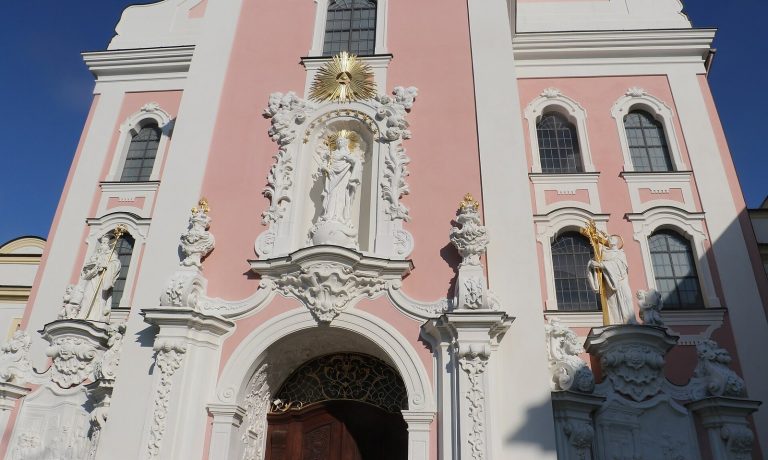
The church was first consecrated in the early thirteenth century. Its chancel, the area around the main altar, was replaced in 1617. Under Abbot Theobald, the nave, the main body of the church, was demolished and rebuilt in Baroque style during the 1720s, to designs by the Italian architect Domenico Magzin. A sculpted western facade designed in 1746 stands out against the otherwise modest exterior. Its portal has a high niche containing the Immaculate Conception. To the left is Saint Benedict, with a stone relief below showing his meeting with the Gothic king Totila; a relief on the right depicts Saint Bernard meeting William of Aquitaine.
A small porch dating to about 1760 stands before the entrance, while the three-storey western tower received a late-Baroque dome in 1755. Inside, five pilasters, shallow wall projections resembling columns, divide the nave, which has side chapels. The choir ends in a many-sided apse, a recessed space at the end of the church. Two projecting pillars support the organ gallery, with a sculpted, powerful-looking angel figure beneath each pillar.
Painted interior
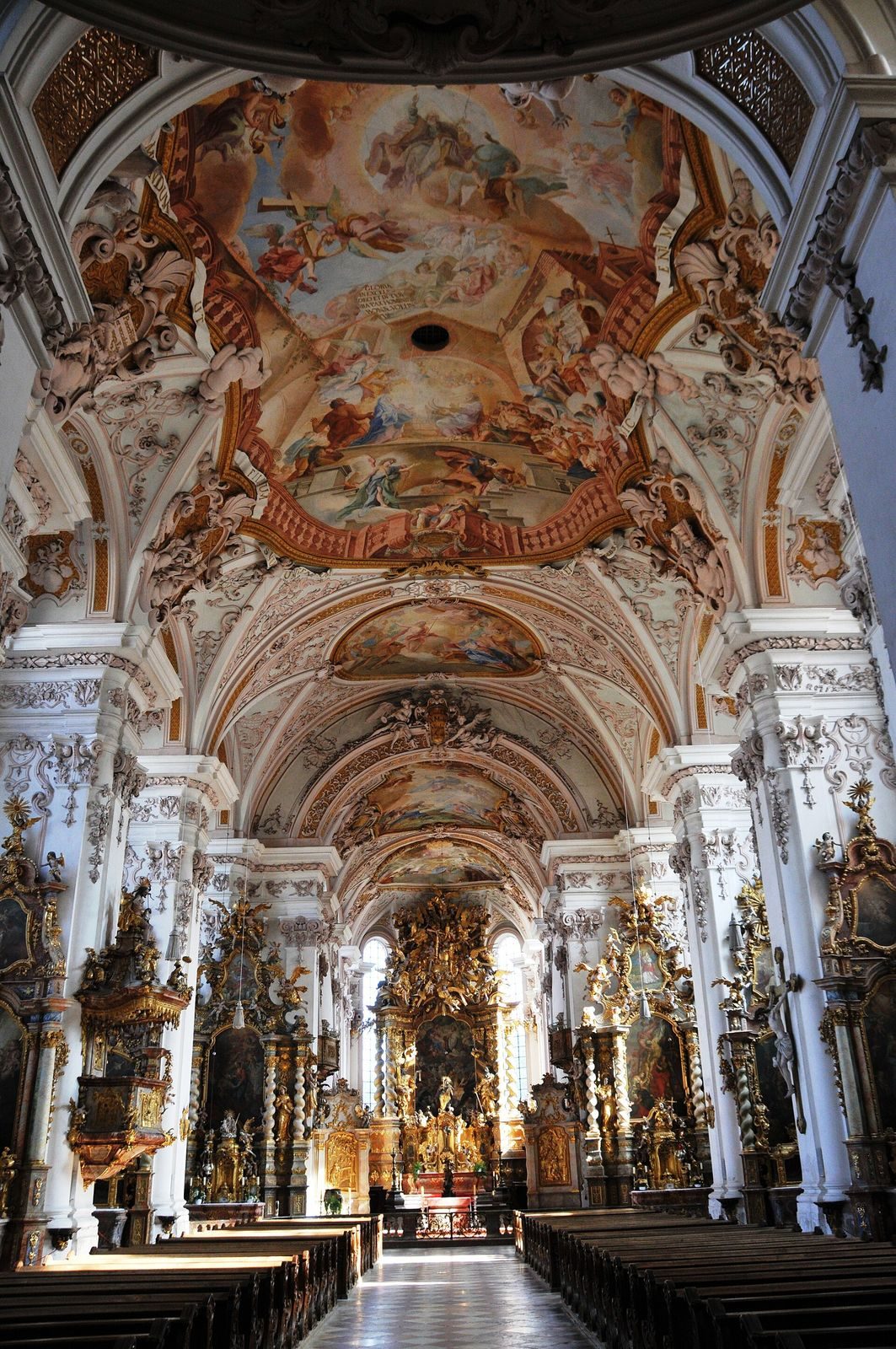
Cosmas Damian Asam painted the ceiling frescoes, while his brother Egid Quirin Asam created the ornamental plasterwork. The interior was their first joint project, completed in 1720, and its decoration survives in its original state. The ceiling paintings present the religious feasts of the year and emphasize Mary’s role in redemption. Beginning at the western end, the cycle shows the Annunciation. Its central scene extends across three bays, depicting Christ’s birth, the shepherds’ adoration, and a multitude of angels. Above the architectural decoration, the heavens open to reveal God the Father. The eastern scene depicts the Resurrection, while paintings in the choir show the Ascension and the descent of the Holy Spirit.
Altars and sculpture
Joseph Matthias Götz made the monumental high altar in 1723, giving it twisted columns. It incorporates a 1619 altarpiece by Matthias Kagers showing Saint Bernard’s vision and his mystical nourishment by Mary’s milk. Statues of Saints Peter and Paul stand at the sides. Above the container for the consecrated Eucharist is a Madonna standing on the moon, made by Johann Degler around 1620.
About 400 angels, made of wood or ornamental plaster, appear in the church. Eighty-eight surround the halo of the Trinity in the upper part of the high altar alone. The choir stalls and two side altars are richly carved, and Johann Georg Bergmüller of Augsburg painted the panels of the side altarpieces. Johann Jakob Zeiller painted the apse chapel of the Blessed Sacrament around 1745.
Tower and bells
Two historic bells cast in 1769 were removed during the abbey’s suppression and assigned to Saint John the Baptist’s Church in Vilshofen, rebuilt after a fire. The bells were later destroyed during wartime. Bells cast in Bochum were installed in 1946, but concerns about their sound and safety led to their replacement in 2013 by six bronze bells covering a wider range of tones.
Monastic buildings
Gate church
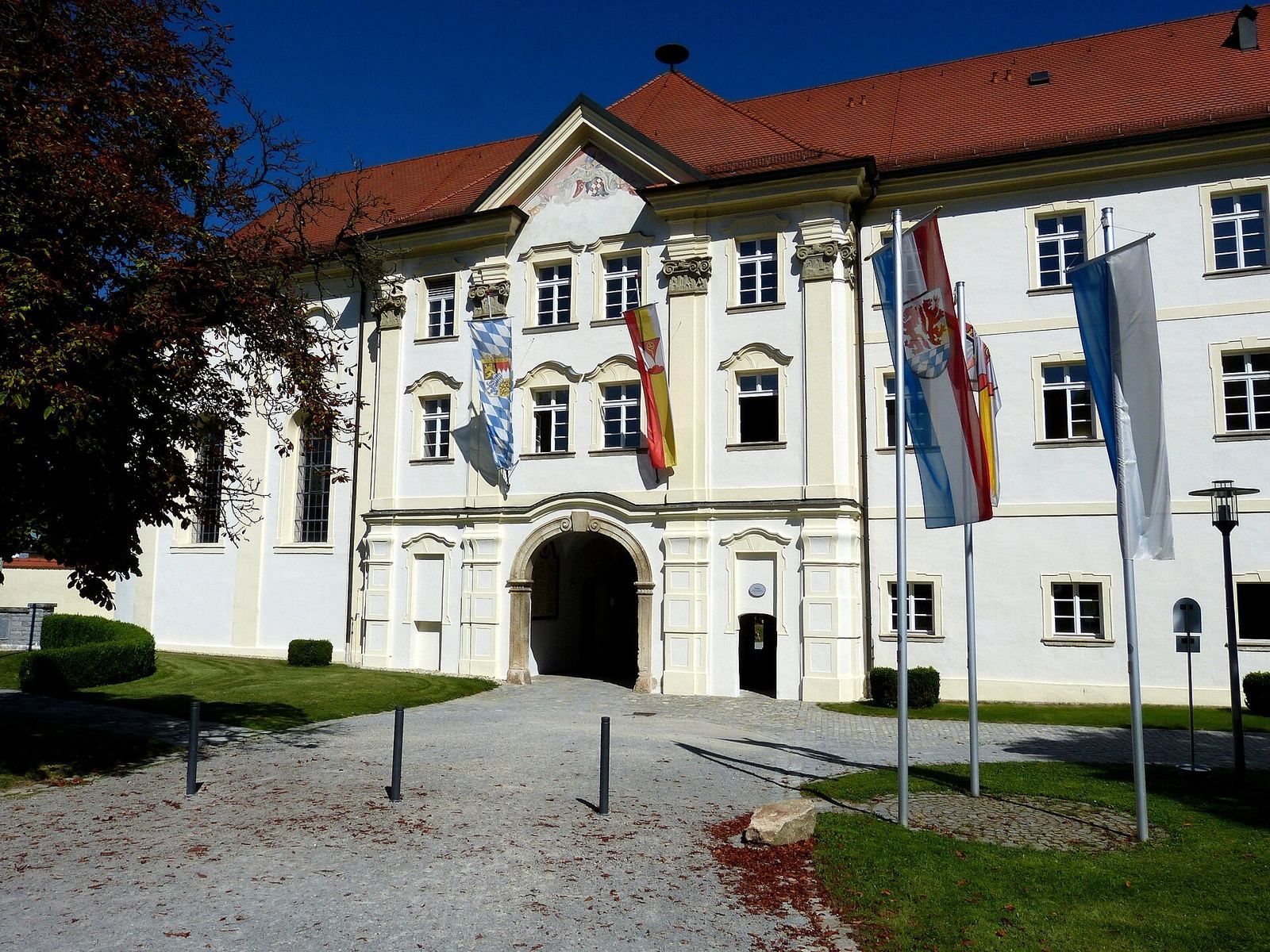
The gate church stands at the monastery entrance. After the abbey’s suppression, it was temporarily used to store fertilizer.
Former community and service buildings
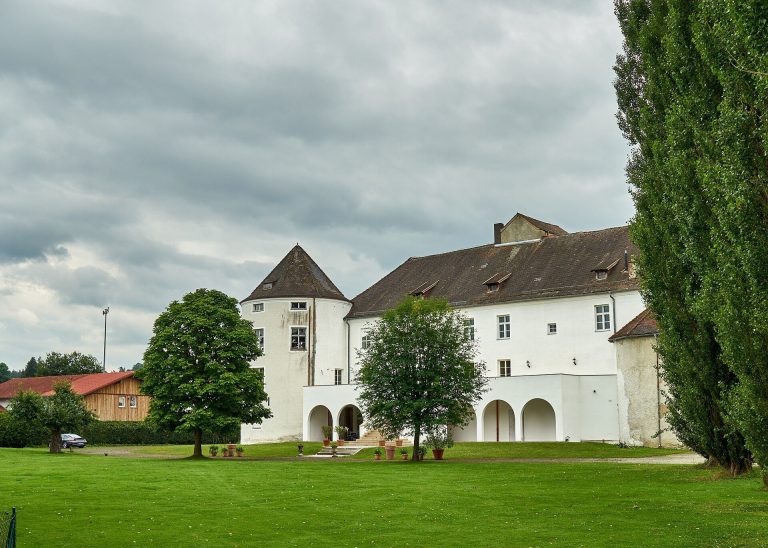
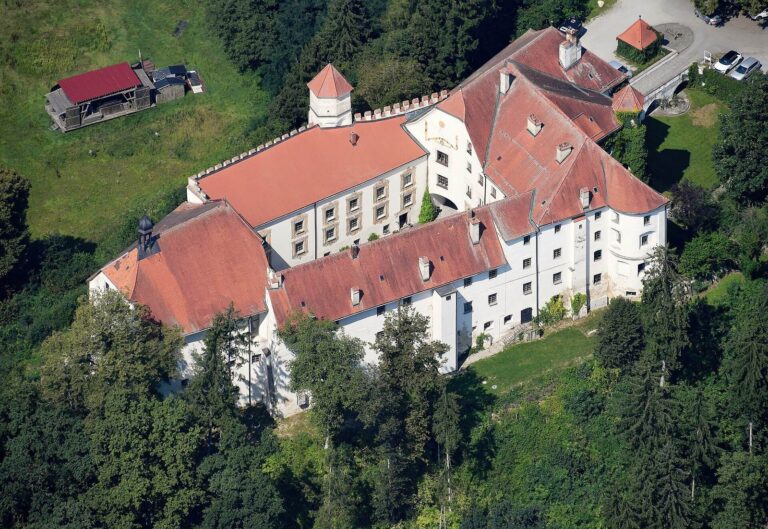
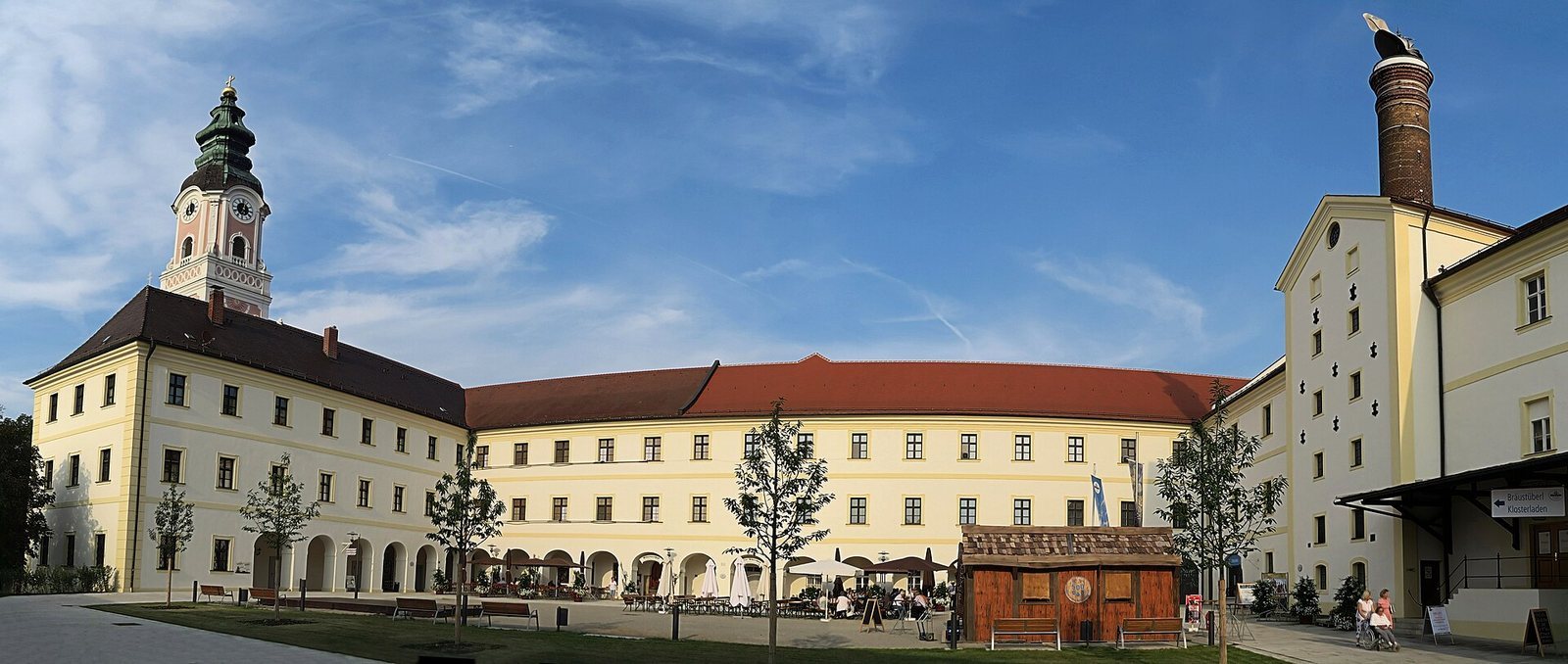
The surviving buildings include the monks’ former cells, school, agricultural buildings, infirmary, and refectory, as well as the former dining room used by the abbot and his guests, now called the Modlersaal. The former cells serve as guest rooms, while the Modlersaal and other rooms are used for seminars, training, and private events. The former school houses the town hall and municipal administration; the agricultural buildings serve as the municipal works depot. The infirmary is now a kindergarten, and the refectory serves as a brewery function hall and forms part of the brewery tavern.
Prince’s Hall
The former Prince’s Hall contains frescoes depicting episodes from the life of King Solomon. Restored and reopened in 2007, it became commonly known as Solomon Hall because of these paintings.