Notre-Dame du Taur: A Gothic Church in Toulouse
Site at a Glance
- Rating
- 4.3
- Popularity
- High
- Country
- France
- Primary era
- Medieval
- Eras represented
- Medieval, Early Modern, Modern
- Civilizations
- French
- Site type
- Religious
- Remains
- Church
On this page17 sections
History
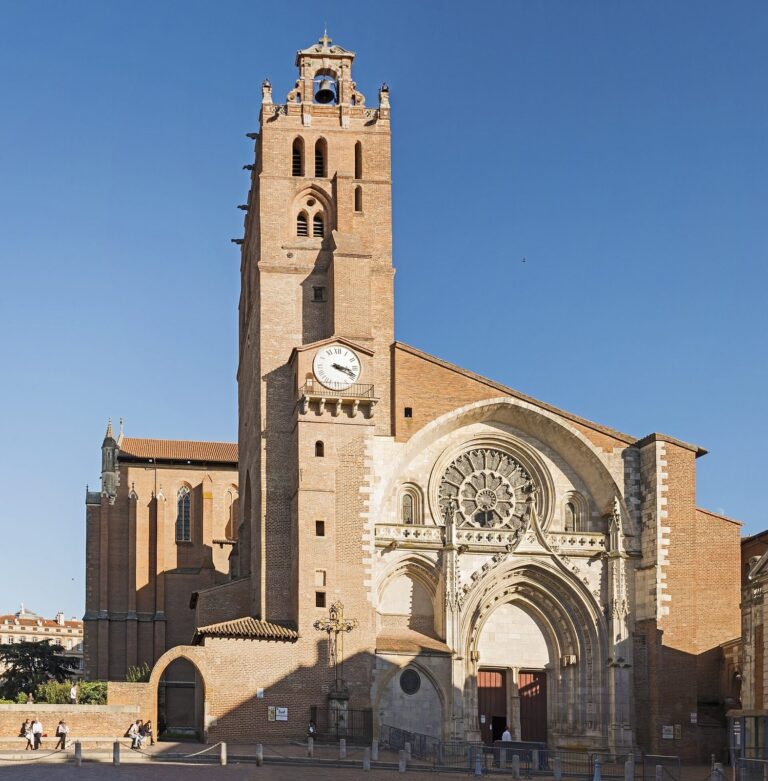
Notre-Dame du Taur is a Roman Catholic church in Toulouse, France, built between the fourteenth and sixteenth centuries in the Southern French Gothic style. Tradition places the martyrdom of Saturnin, Toulouse’s first bishop, at the site, which later lay on a pilgrimage route to Santiago de Compostela.
Saturnin and the early shrine
Saturnin established a Christian community in Tolosa during the first half of the third century. He was martyred in 250 amid persecutions ordered by the Roman emperor Decius. A narrative of his martyrdom, probably written in the fifth century, tells that he was tied to a bull and dragged along the city’s main north–south road. The animal released him where the present church is traditionally believed to stand.
Tradition credits the bishops Hilaire and Silve with beginning a shrine to Saturnin in the late fourth century. The location of his original grave and shrine remains uncertain: excavations inside the church in 1969–70 found no early Christian building. The traditional association with the place where the bull released Saturnin is distinct from the unverified claim that his first shrine stood there.
Pilgrimage and the medieval church
Saturnin’s relics remained at the shrine until 402, when they were ceremonially transferred to the Basilica of Saint-Sernin. Pilgrims travelling to Santiago de Compostela later passed by the church. Their growing numbers helped prompt the construction of the larger Basilica of Saint-Sernin in the eleventh century.
The church’s name reflected its connection with Saturnin and the bull in his martyrdom story. It was called the Church of the Bull until the eleventh century and Saint-Sernin of the Bull in the twelfth. Saint-Sernin is a local form of Saturnin, while taur means “bull” in Occitan. The church took its present name in 1534, honouring the Virgin Mary, although its earlier dedication was to Saturnin. Its present building was constructed between the fourteenth and sixteenth centuries. The nave was extended eastward in the late fifteenth century, around the time the Shroud of Cadouin, a relic cloth traditionally venerated as Christ’s burial shroud, arrived in Toulouse.
Interior changes and restoration
In the seventeenth century, workers covered the nave walls with wood paneling and installed large benches on both sides. Moisture damage led to the paneling’s removal in 1872, uncovering medieval wall paintings. A major programme of interior decoration and restoration followed in the late nineteenth century, first under Eugène Viollet-le-Duc and then Anatole de Baudot.
The church was classified as a Historic Monument in 1840. In 1970, following changes to worship arrangements associated with the Second Vatican Council, the choir was reorganized and a new altar consecrated on 22 November. The former marble altar, from the chapel of the Grey Penitents, a Catholic lay confraternity, was sold to a church in Lux. The instrumental part of the gallery organ received Historic Monument classification in 1987.
A municipal plan for renovating the church and two other Toulouse religious buildings was established in 2010. The church closed in August 2023 for a major restoration led by heritage architect Axel Letellier. The work addresses damp and includes changes to the roof structure intended to reduce fire risk, as well as repairs to paintings, wall decoration, ironwork, furnishings and about twenty stained-glass windows.
Remains
The church is a brick-built, single-nave structure in the Southern French Gothic tradition. Its west façade follows the line of the adjoining street houses, while the nave, crosswise transept and choir form the principal interior sequence.
Exterior and entrance
Bell-gable
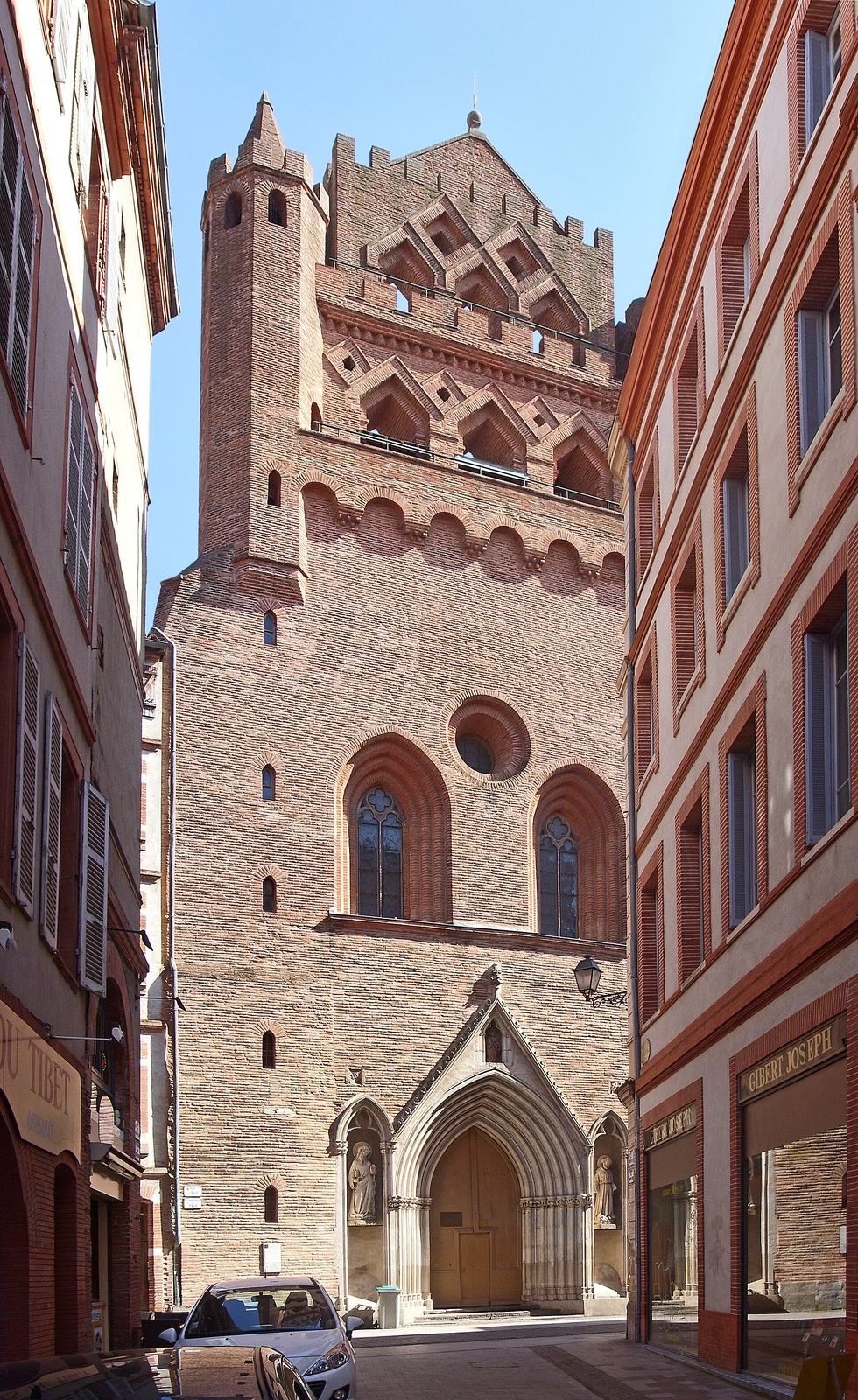
The west façade rises as a monumental bell-gable, a wall with openings for bells rather than a separate tower. It reaches 42 metres and has two levels above the church roof, flanking turrets, a triangular pediment and crenellations. Each level contains three openings with pointed, mitre-shaped arches. The carillon, a set of bells arranged for melodic playing, has thirteen bells. One is probably from the fifteenth century; the other twelve were cast in 1893 by the Toulouse firm Lévêque-Amans. The façade’s design served as a model for other churches in the region.
West portal
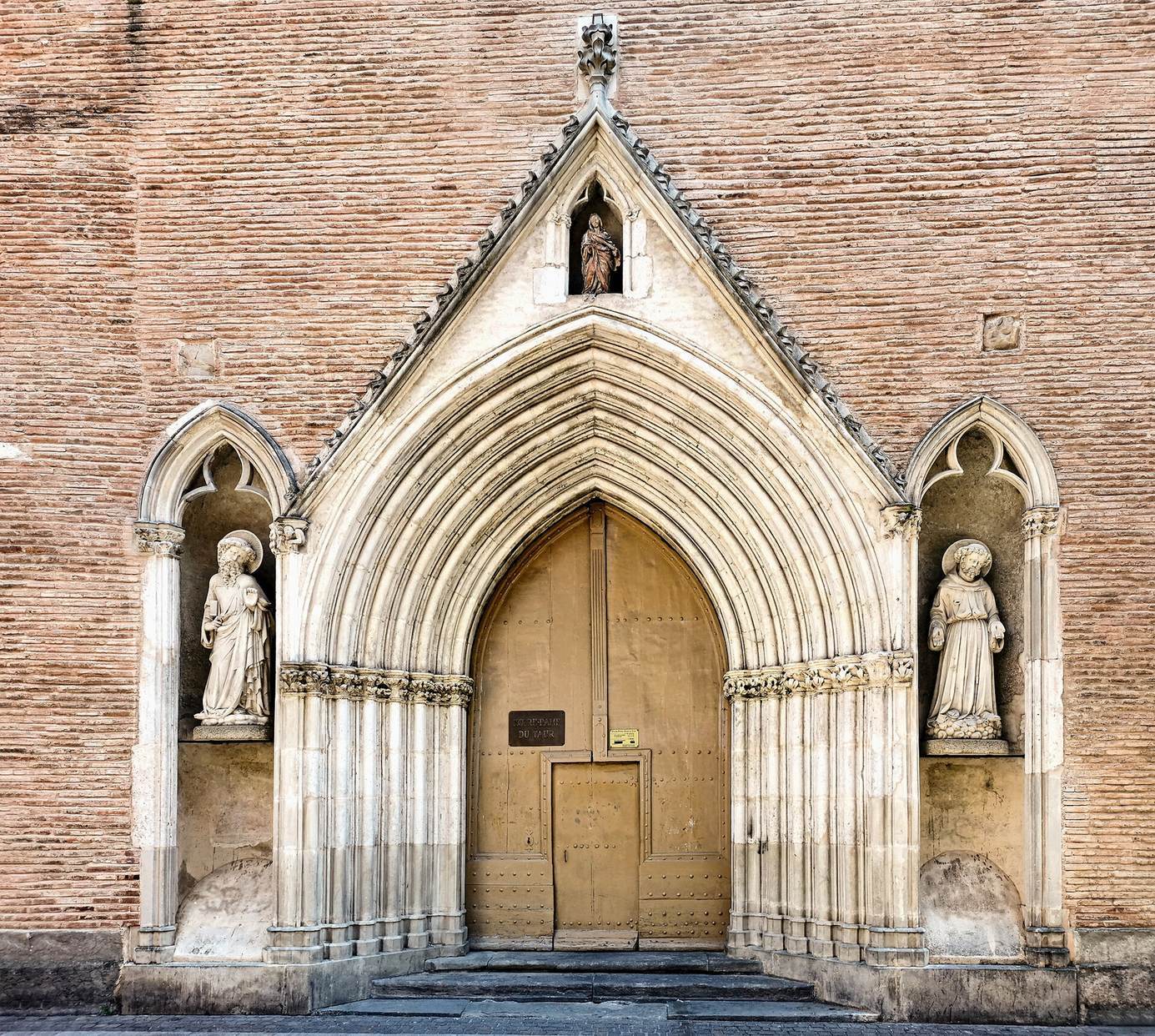
The Gothic portal is framed by six carved arch bands resting on slender columns with foliage capitals. Two large niches beneath three-lobed arches once held statues, lost during the French Revolution. They were later filled by statues of Francis of Assisi and an apostle brought from the Rieux chapel, demolished in 1846. Above the portal, a decorated gable contains a triangular niche with an eighteenth-century statue of the Virgin.
Interior plan
Nave and chapels
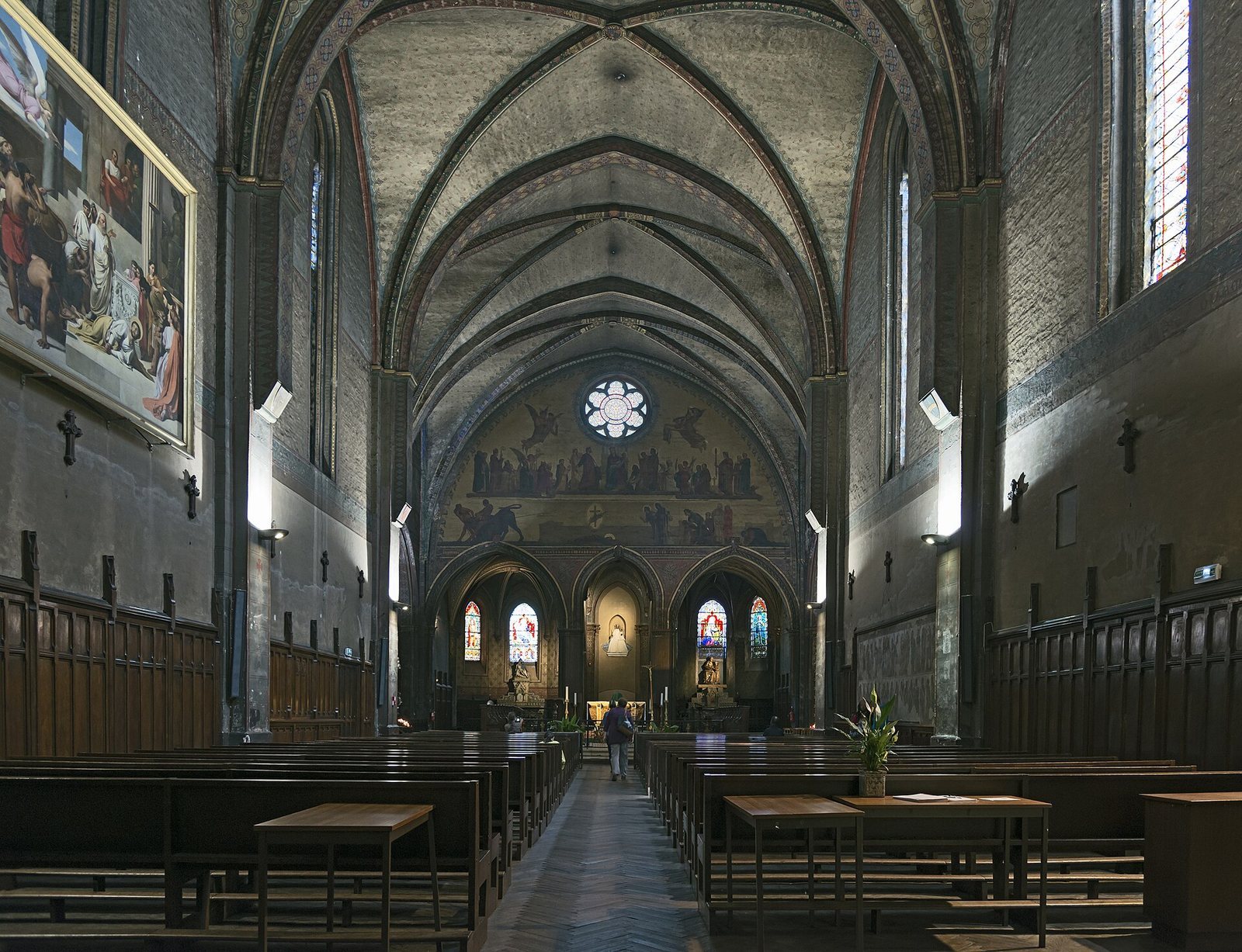
The nave is 40 metres long, 12 metres wide and 16 metres high, with a rib-vaulted ceiling supported by stone ribs. It was originally three bays long and measured 25 metres. Its two easternmost bays are widened by rectangular side chapels. The transept, the crosswise part of the church intersecting the nave, contains four chapels, two on each side.
Eastern end and choir
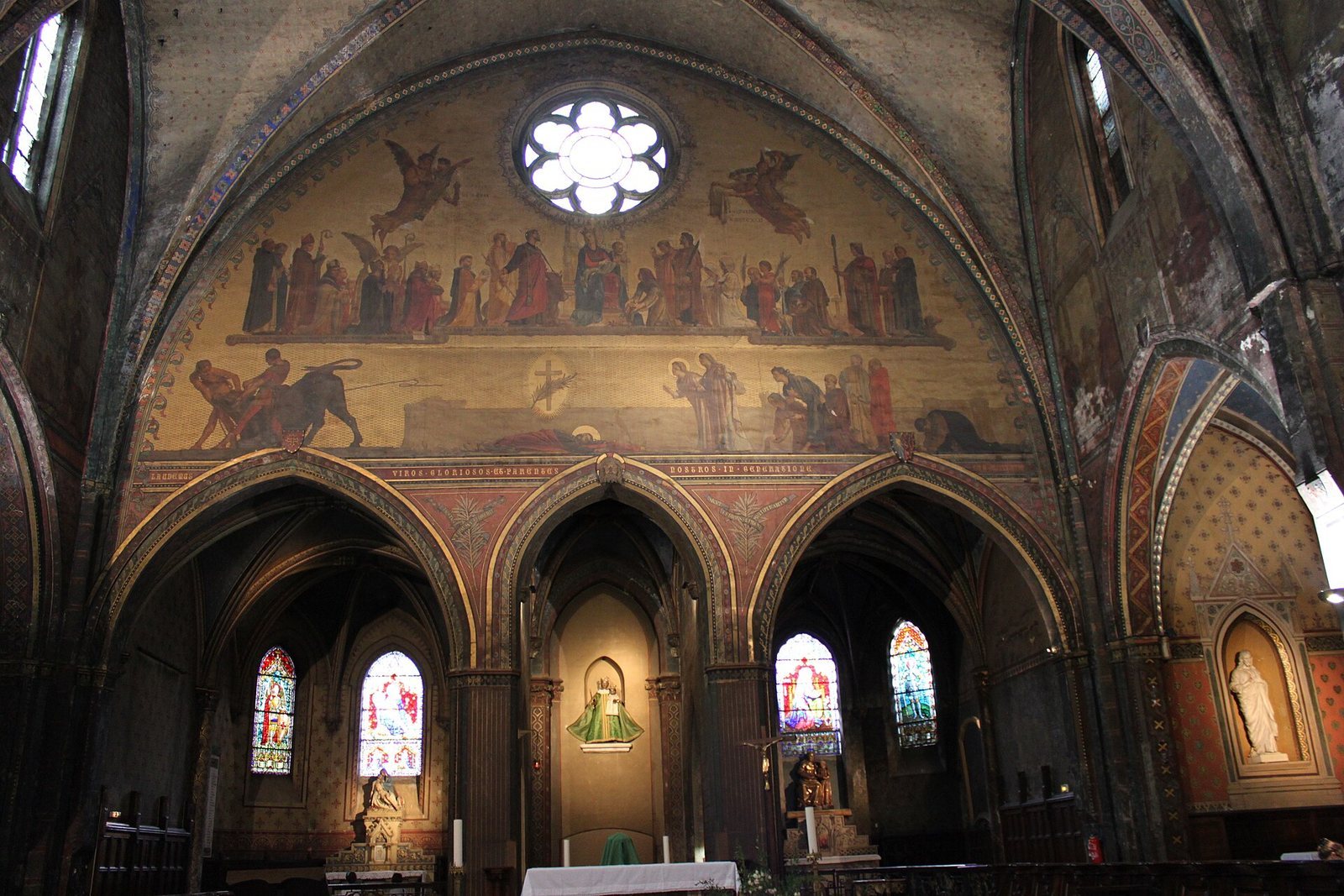
At the eastern end, a small square central chapel is flanked by two larger, five-sided chapels. The original east end may have included a large apse, or curved sanctuary end, above a crypt. The choir occupies the area shaped by the late-fifteenth-century extension. It contains relics of Saints Saturnin, Florian and Quentin. On its altar wall, a painting by Bernard Bénézet, made in 1881–82, depicts Saturnin’s martyrdom and elevation to heaven alongside the glorification of the Virgin. The figures are set against a gold ground and outlined in dark tones.
Art and furnishings
Nave paintings
A fourteenth-century painting on the south wall traces Jacob’s genealogy through 38 figures arranged in two registers, leading to Jesus Christ. On the nave’s left, or north, wall, a nineteenth-century painting by Jean-Louis Bézard depicts Saturnin’s martyrdom.
Painted decoration and stained glass
Jean-Pierre Lavilledieu made neo-Gothic painted decoration in the late nineteenth century using stencils. Floral forms associated with the gardens of Paradise and repeating patterns associated with the divine and the infinite appear on the walls, friezes and stained glass. Windows made during the restoration campaign were created by Victor Gesta of Toulouse and Marcel Fleur of Bordeaux.
Our Lady of the Rampart
The sixteenth-century wooden statue of Our Lady of the Rampart, also called Our Lady of Deliverance or of Good Help, stands in the central eastern chapel. It came from an oratory near the former Porte Villeneuve, a gate in Toulouse’s old walls. The oratory and statue commemorated the Catholic party’s expulsion of Toulouse’s Protestants after a week of fighting in 1562, during the French Wars of Religion between Catholics and Protestants. The oratory was demolished in 1783. The statue wears brocade robes whose colours change with the liturgical calendar.
Other chapel works and furnishings
A painting in the left-hand chapel depicts the death of Joseph. Bernard Bénézet made it around 1890. In the right-hand chapel, a gilded wooden group shows Saint Anne, traditionally identified as the Virgin Mary’s mother, teaching Mary. It may be part of a Baroque altarpiece carved in 1627 by Arthur Legoust for the Saint Anne confraternity. A Pietà, showing Mary holding the dead Christ, is in the north chapel. The sanctuary has wrought-iron grilles dated 1778, and the church also contains a baptismal font.
Organs
The gallery organ was built between 1878 and 1880 by Eugène Puget’s Toulouse firm and inaugurated on 17 June 1880 by organist Alexandre Guilmant. Its 40 stops control sets of pipes, played from three keyboards and a pedalboard. In 1939, Maurice Puget altered its Positif, a secondary organ division, rearranging several pipe ranks. The instrument was renovated in 1992 and 2017. A choir organ is also present.