Palazzo della Zecca Vecchia: A Papal Mint and Bank Headquarters in Rome
Site at a Glance
- Popularity
- Medium
- Country
- Italy
- Primary era
- Early Modern
- Eras represented
- Early Modern
- Civilizations
- Papal States
- Site type
- Economic
- Remains
- Production Complex
On this page5 sections
History
Palazzo della Zecca Vecchia is a former papal mint and bank headquarters in Rome, Italy, adapted in 1504 and given a Renaissance façade completed in 1524.
The papal mint, 1504–1541
In 1504, Pope Julius II’s monetary reform led him to commission the architect Bramante to convert an existing building into a papal mint. It produced silver coins called giulii, each worth one-tenth of a gold ducat, along with other coins and medals. Some medals were made by the sculptor and goldsmith Benvenuto Cellini.
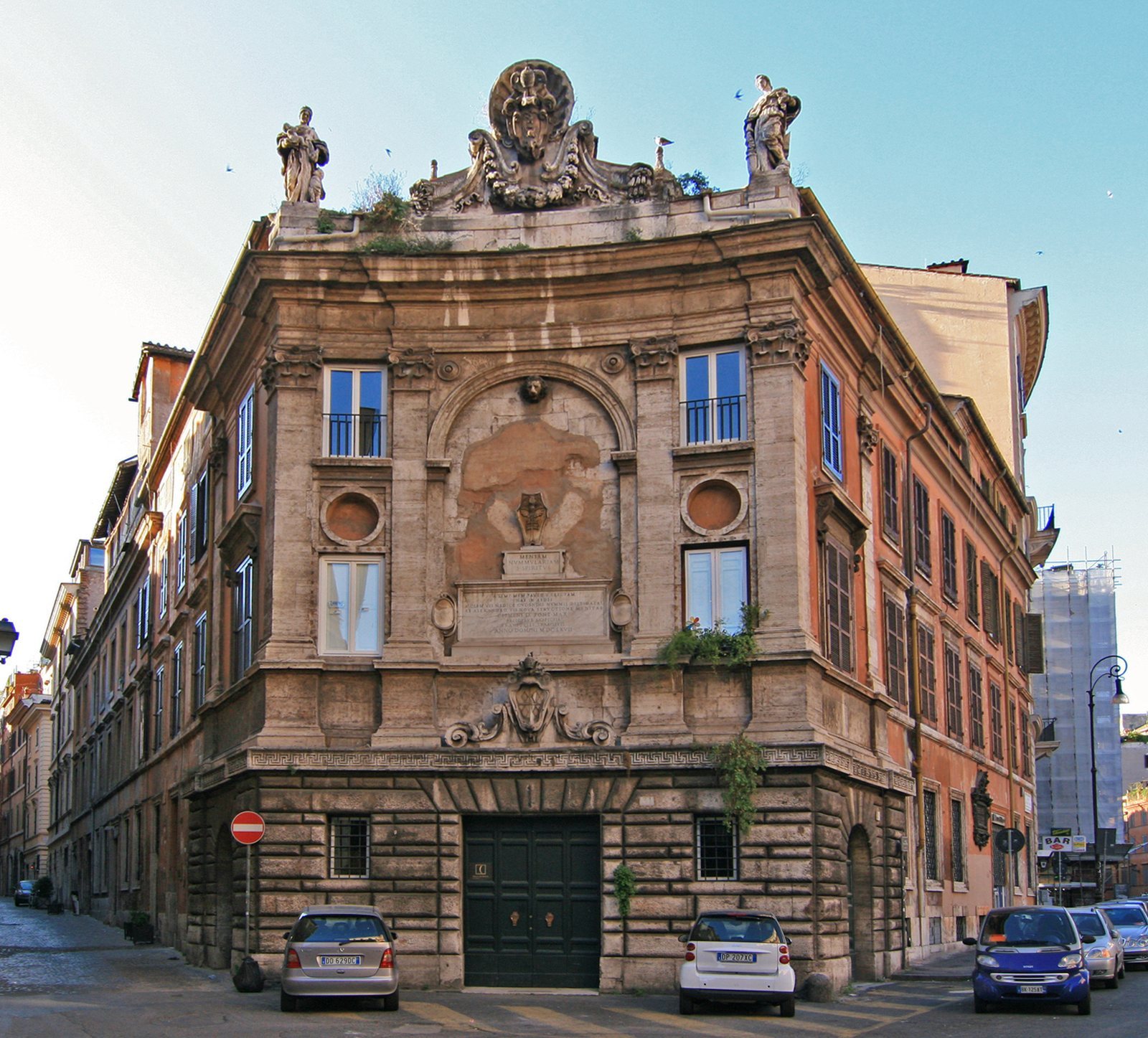
A few years later, Pope Leo X commissioned Antonio da Sangallo the Younger to design the façade, which was completed in 1524. Its unusual form attracted attention and anticipated a feature that later became characteristic of Baroque architecture. The mint moved elsewhere in 1541, and the building fell out of use while retaining the name Zecca Vecchia, or “Old Mint.”
The bank headquarters
In 1605, as an economic crisis in Rome brought down several bankers, Pope Paul V founded Banco di Santo Spirito. The bank’s capital was guaranteed by property belonging to the Hospital of Santo Spirito in Sassia.
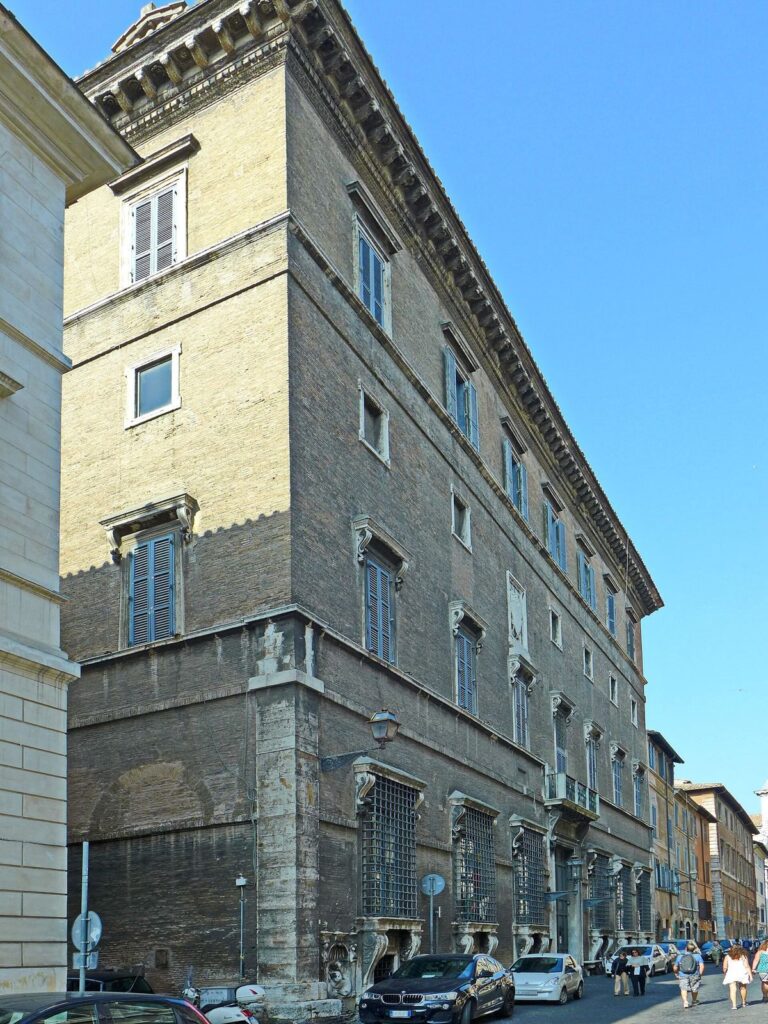
In 1666, at the direction of Pope Clement IX, the hospital acquired the former mint for the bank’s headquarters. Architect Giovanni Tommaso Ripoli oversaw the internal alterations needed for its new use. Before urban clearances for Corso Vittorio Emanuele II, the building stood as a corner endpiece where Via dei Banchi Vecchi and Via dei Banchi Nuovi met the Canale di Ponte.
Remains
The façade
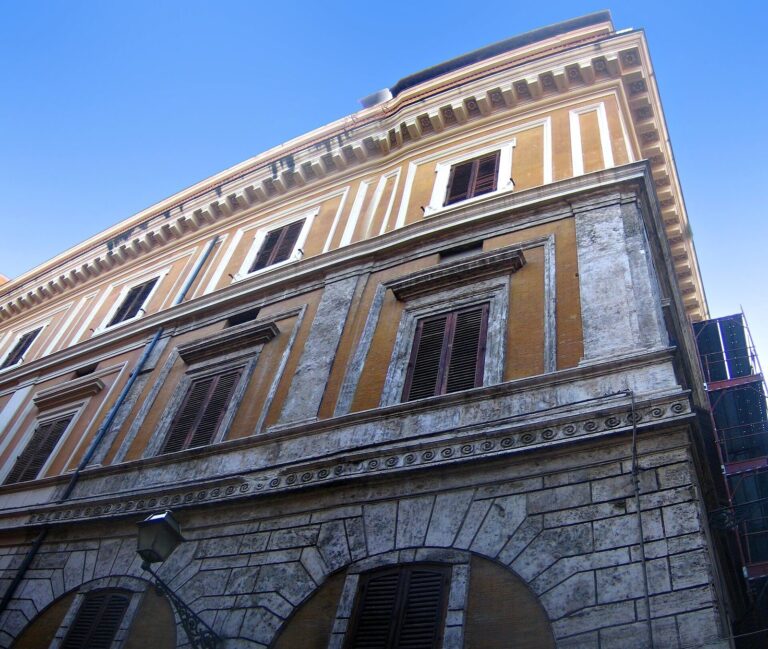
The two-storey building has a slightly concave façade that continues along both sides for the depth of one window. Rough-faced masonry forms the base, which ends in a band of repeating geometric ornament. A rectangular entrance, flanked by two windows, is topped by Clement IX’s coat of arms. Above it, four pilasters, shallow wall projections resembling columns, rise from plinths. The two outer pilasters mark the corners, while the inner pair frame a large arch bearing inscriptions and the hospital’s coat of arms, with a lion’s head above. Between the pilasters are two windows, two circular windows, and two openings styled as small roofed galleries. A projecting cornice crowns the façade, carrying statues of Charity and Abundance at either end and a central feature bearing Paul V’s coat of arms.