Palace in Ciechanowice: A Historic Residence in Poland
Site at a Glance
- Popularity
- High
- Country
- Poland
- Primary era
- Early Modern
- Eras represented
- Early Modern, Modern
- Civilizations
- Habsburg, Habsburg Austria, Holy Roman Empire, Kingdom of Prussia
- Site type
- Domestic
- Remains
- Elite Residence
On this page9 sections
History
The Palace in Ciechanowice is a historic residence in Poland, developed from a fortified Renaissance manor built by the von Reichenbach family in the second half of the sixteenth century. The manor is first documented in 1568, while the palace is broadly dated to the seventeenth century.
Medieval and Renaissance Origins
A knight’s seat, a fortified residence associated with a local noble landholder, stood at Ciechanowice by the fifteenth century. The von Reichenbach family held the estate from the late fifteenth century and built a fortified manor there in the sixteenth century. After 1596, the property belonged to the von Polsnitz family, also known as von Dachs. In 1637, they sold it to Hanns Christoph von Schweinitz.
Baroque Expansion and Wartime Damage
From 1732, the manor was enlarged in the Baroque style. A contemporary view by the Silesian artist Friedrich Bernhard Werner depicts the palace during this phase. The building was devastated in 1760 in connection with the Battle of Landeshut, fought during the Seven Years’ War, a conflict involving Prussia and Austria among other powers.
From 1763, the owner was Karl Ferdinand Sigismund von Seherr-Thoss. That year, Frederick II, king of Prussia from 1740 to 1786, granted town status to the locality, then known by its German name, Rudelstadt.
Classicist Remodeling and Later Owners
Beginning in 1797, Karl Heinrich von Prittwitz had the palace remodeled in the Classicist style, which drew on ancient Greek and Roman forms. Count Friedrich Bernard von Prittwitz commissioned another remodeling in 1846. The estate later belonged to Friedrich Freiherr Senfft von Pilsach from 1900, then to Eduard von Eichborn from 1917.
Twentieth-Century Uses and Restoration
Nationalized in 1945, the palace served as a children’s holiday camp, then housed a children’s home from 1970 and later a school. It fell into neglect during the 1990s. Andrzej Meller bought the property in 2008 and financed a comprehensive restoration of the historic complex, work that began in 2010. The palace is now privately owned and protected as an immovable monument; the park is also protected as a historic site.
Remains
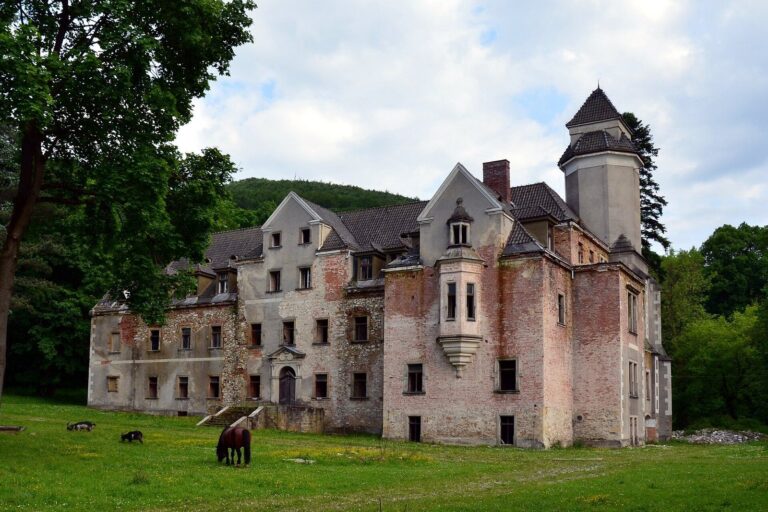
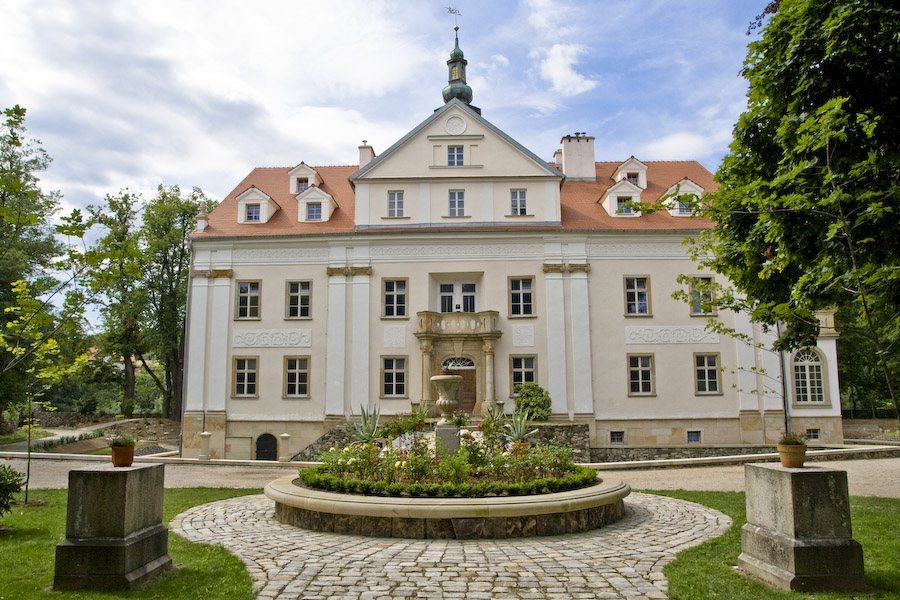
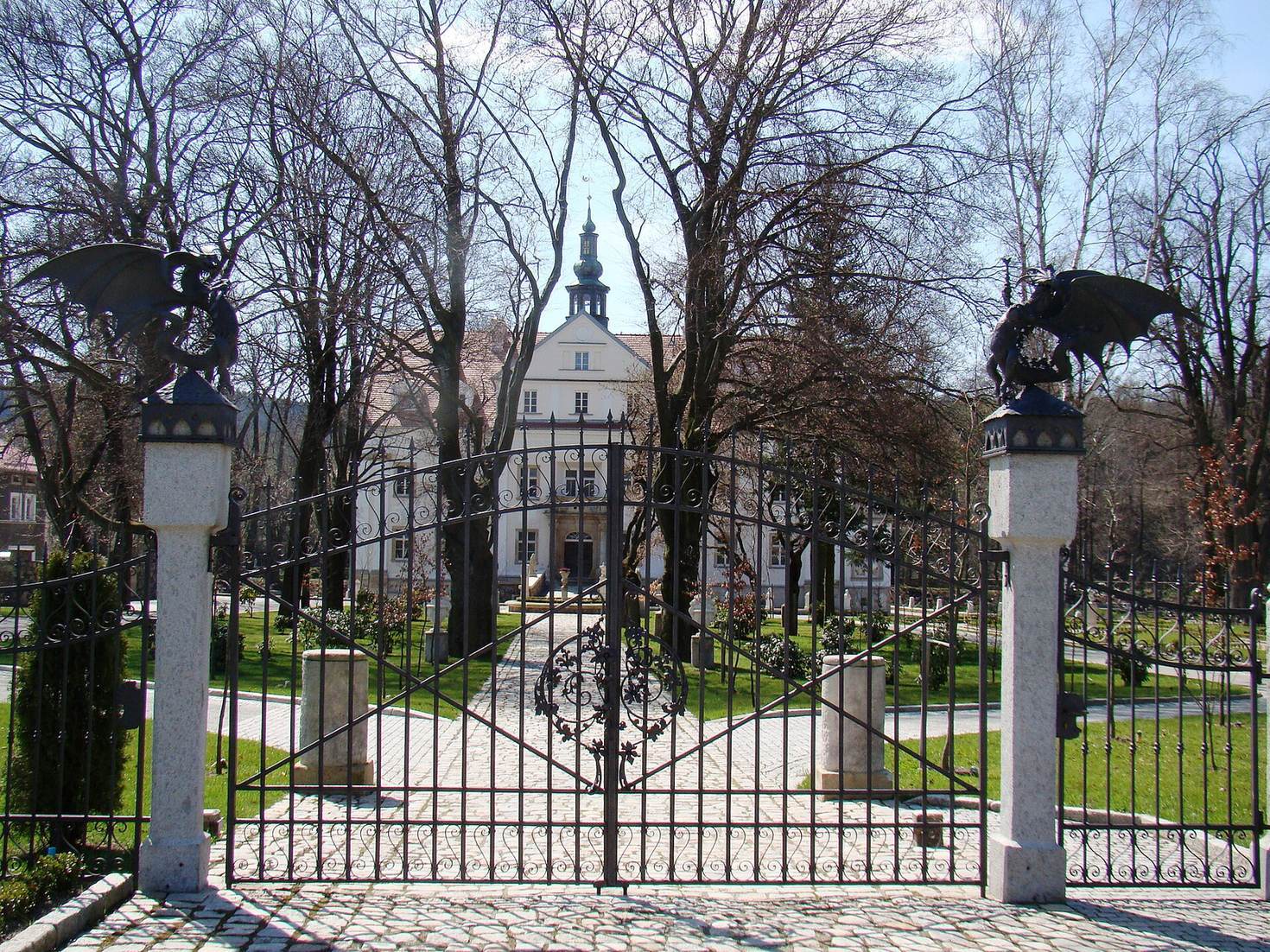
The palace stands in the Bóbr River gorge, on the boundary between the Kaczawskie Mountains and the Rudawy Janowickie in the Western Sudetes. The surviving complex includes the palace and a surrounding landscape garden. The building is described as Neo-Baroque, with features reflecting successive renovations.
Palace Exterior
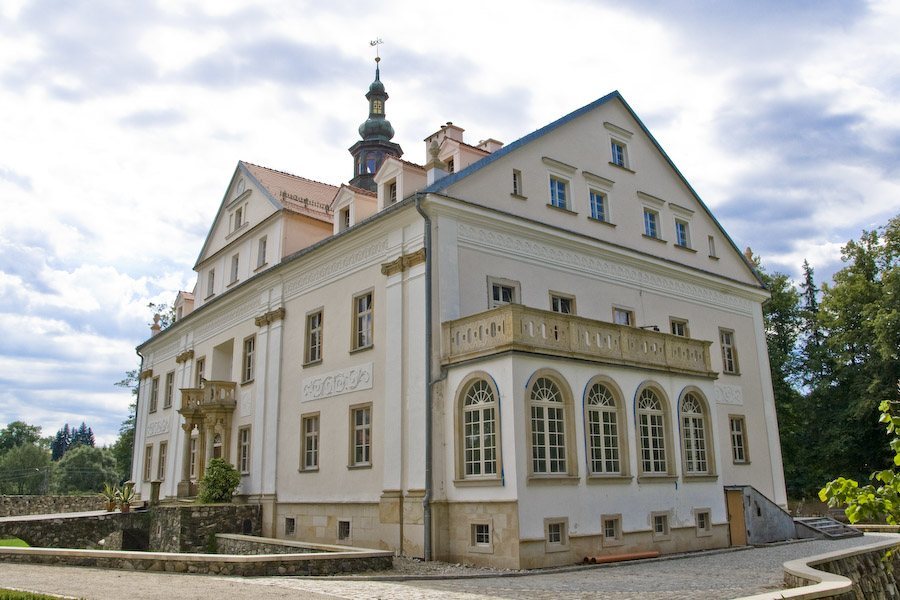
The sixteenth-century manor was fortified and surrounded by a moat. In the early eighteenth century it became a Baroque water palace, a residence set amid or directly associated with water. The present building has a gabled roof with a dormer on its main axis and a glazed veranda on the northwest side. Its seven-part main façade features composite pilasters, shallow column-like projections from the wall. The entrance portal, dating to the first half of the eighteenth century, supports a balcony; the windows have sandstone surrounds, and the staircase also dates to the Baroque remodeling. Changes begun in 1797 added façade divisions over Baroque plaster panels, with Ionic-style pilasters extending across multiple storeys and decorated with stucco leafy tendrils and a palm-leaf frieze. A two-storey wooden loggia, a covered gallery open on one or more sides, was added in 1846.
Interior and Wall Paintings
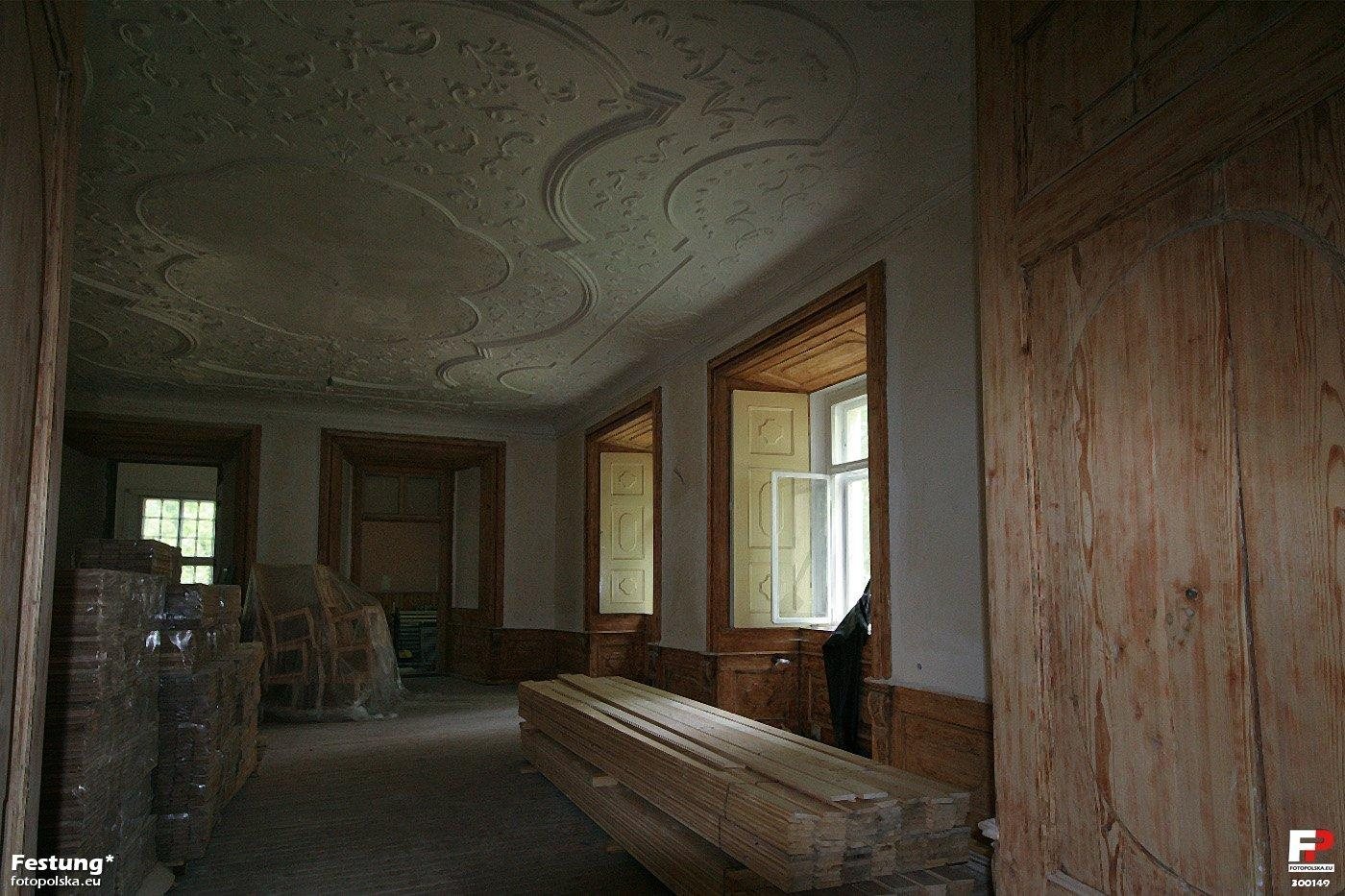
Stucco decoration and wood paneling survive inside the palace. During electrical work in 2010, workers uncovered sixteenth-century frescoes beneath thick plaster. These paintings, made on plaster, cover nearly all the walls in the first-floor rooms, across a total extent of 570 metres, and also decorate the ceiling of the ground-floor Knights’ Hall. One room contains a series of Roman emperors dated to 1588. The frescoes are considered comparable in artistic value to those at Wawel.
Landscape Garden
A landscape garden dating to the first half of the nineteenth century surrounds the palace. A stone wall once enclosed it, resting on plinths, several of which survive.