Călugăra Monastery: A Romanian Orthodox Pilgrimage Site
Site at a Glance
- Popularity
- Medium
- Country
- Romania
- Primary era
- Modern
- Eras represented
- Modern
- Civilizations
- Austria-Hungary, Austrian Empire, Habsburg, Hungarian
- Site type
- Religious
- Remains
- Monastery
On this page11 sections
History
Călugăra Monastery is a Romanian Orthodox monastery in Romania’s Ciclova valley, founded in 1859 on an older monastic cell and continuing a local tradition of hermit life. Its beginnings are associated with stories of sacred singing, a cave beneath the surrounding cliffs, and the growth of a local pilgrimage.
Hermit traditions and foundation
Local tradition tells of two monks from Ciobeni Monastery who visited the valley each year. One was said to have taken shelter in a cave beneath the cliff between Ciclova Montană and Ciclova Română, where the Roman Catholic church of Maria Fels was later built. The other reportedly stayed in a cave on the slopes of Rol, possibly near the place where people heard singing. A hermit called Eftimie is also associated with the site, although his identity is uncertain.
On 8 June 1830, a goatherd named Iancu Cârșovanul was said to have heard angelic singing in the forest below Stânca Rolului. Villagers began visiting the spot and placing crosses and icons in trees. In 1858, shepherd Ioța Văegariu reportedly heard sacred singing there, and on 8 July worshippers, including theology graduate Alexie Nedici, heard it coming from within the rock.
The place became a focus of local pilgrimage, with worshippers gathering on Sundays and major feast days and lighting lamps above the icons. Another tradition concerned an image of the Prophet Elijah visible in a beech tree, said to remain uncovered as the trunk grew. Stories of healing also strengthened the site’s reputation. They tell of a woman blind from birth who regained her sight, a Catholic carpenter from Oravița who recovered from paralysis after a vision, and cures involving Dumitrache G. and Desanca Lazarovi.
In 1859, local residents including Mihai Nafir, Ilie Strâmbei, and Ioan Izverniceanu explored a cave and found human bones, a soft-stone altar, church objects, and an icon of the Mother of God with the Child. The bones were believed to be those of a hermit. The icon may have been the image known as Prodromița and may have come from Mount Athos, though neither identification is certain. An old chronicle recounts that worshippers took it to a church in Oravița, where it disappeared two days later and was found again in the cave.
The cave was adapted for worship and blessed on 10 June 1859 by priests George Petrovici and Alexie Nedici, with the approval of Bishop Emilian Kengelaț of Vârșeț, head of a regional Orthodox church jurisdiction. Nedici became a monk in 1860 and took the name Alexie. He organized fundraising for a permanent monastery, supported by local people and neighboring communities. The Orthodox church in Ciclova Montană lent money, while the Hungarian railway company granted land.
Work on the stone church began in 1860–61 and was complete by 1862. It was consecrated on 1 October that year, on the feast of the Protection of the Mother of God, which commemorates a traditional account of the Virgin Mary protecting worshippers. The monastery was also dedicated to Saint Procopius, an early Christian martyr venerated in the Orthodox Church, whose feast falls on 8 July. Alexie died on 23 July 1862, after the demanding work of establishing the community.
Administration and later history
The monastery was initially officially named Călugăru, probably after the hermit associated with the cave. From about 1880, German settlers used the form Kalugera, and Călugăra became the usual name. From its foundation until 1919, the institution was under Hungarian political rule and Serbian church administration. After Alexie’s death, parish priests managed it for much of the period before 1910, alongside periods of monastic leadership. Its first administrator, Ioan Murgu, served for twelve years and died when a falling boulder crushed his dwelling. Later administrators included Petru Popovici, Iacob Munteanu, Pavel Bufanu, and Valeriu Dabici. The hieromonk Dionisie Văcărescu, a monk ordained as a priest, led the monastery from 1910 to 1913.
Bartolomeu Durăin administered the monastery from 1913 to 1949. A major flood in 1942 damaged his residence, carried away timber, and destroyed the road. Repairs to the church followed, and Bishop Veniamin Nistor of Caransebeș consecrated the renovated building on 30 October 1943.
Leadership after Durăin passed to Nectarie Pintilie (1949–50), Ieronim Balinton (1950–57), and Paisie Răileanu (1957–60), followed by parish priests including Pavel Coadă (1960–73). Eftimie Bilan led from 1973 to 1999, entering monastic life and becoming a priest during his tenure. A fire in 1973 destroyed much of the monastic quarters and the library, including valuable books and documents. Extensive renovation of the quarters and other supporting buildings took place between 1987 and 1990. Casian Onița assumed administrative and spiritual leadership on 1 November 1999 and is identified as the monastery’s abbot.
Călugăra became a pilgrimage destination and an important center of Orthodoxy in the Banat, a historical region now divided chiefly among Romania, Serbia, and Hungary. The church is protected as a Romanian historic monument. Restoration and renovation continued in 2000 and 2011, and Bishop Lucian Mic consecrated the church in 2017.
Remains
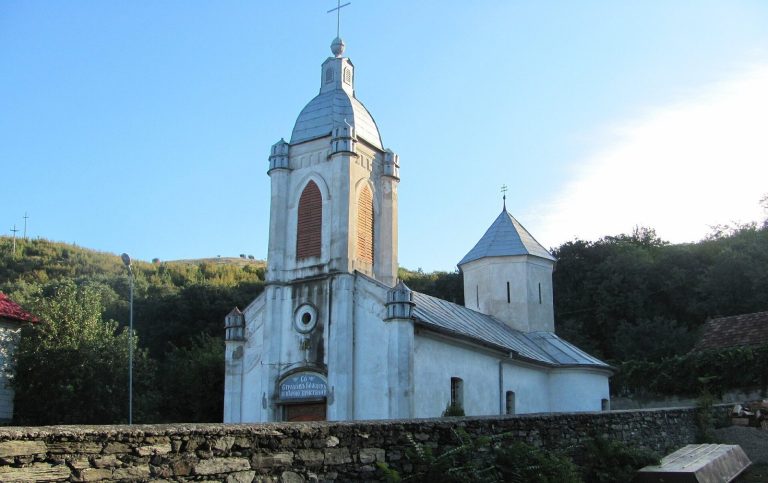
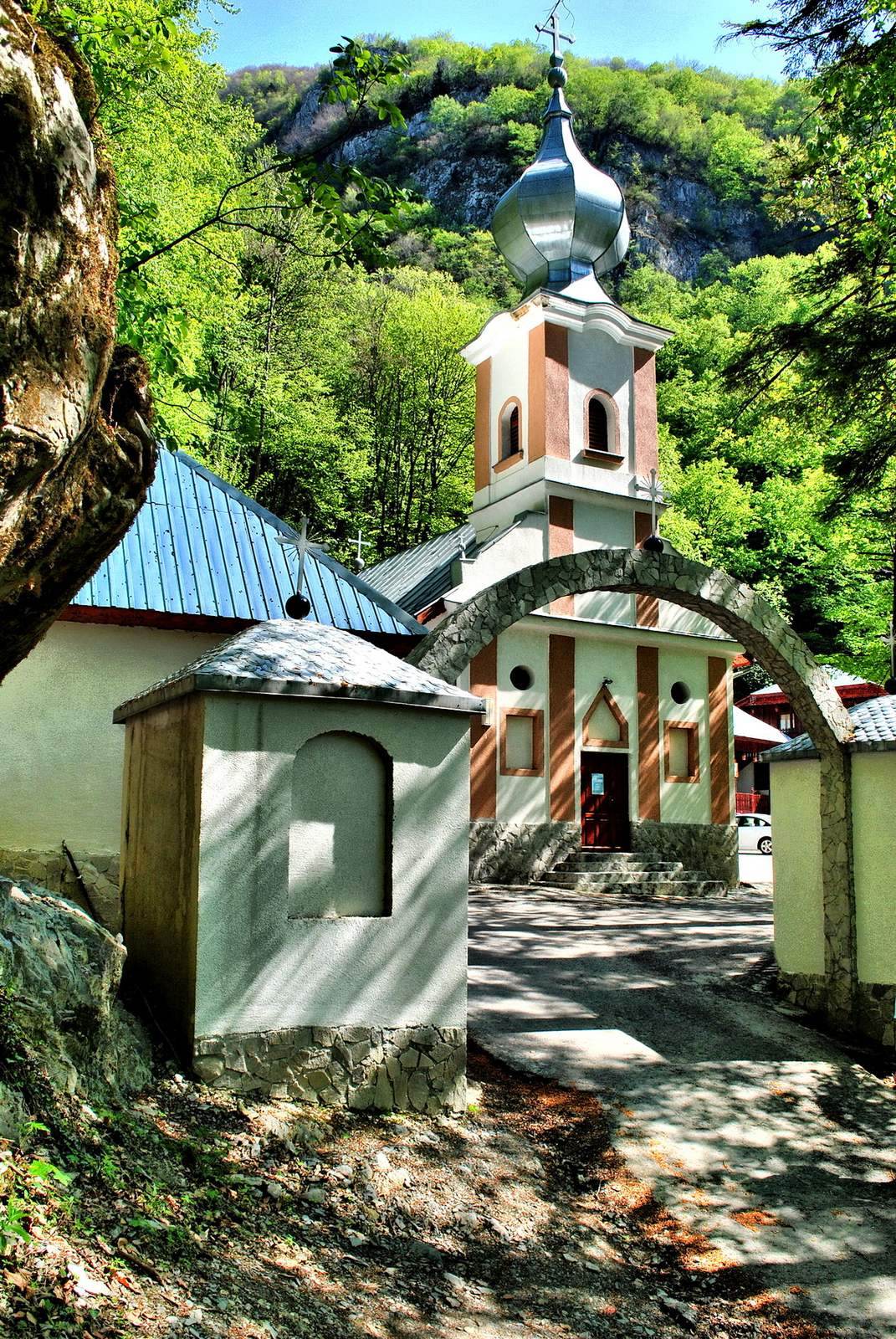
The monastery stands in the Ciclova valley, about two kilometres east of Ciclova Montană and near Oravița, at the foot of Stânca Rolului. The cliff rises nearly 1,000 metres, amid old forests of the Banat Mountains. Springs descend the surrounding slopes and run among limestone rocks. The complex centers on a stone church, with monastic quarters and other buildings nearby; the cave associated with the site lies beneath the church’s altar.
Church and cave
The cave beneath the altar
The cave was enlarged to accommodate worship, and the church’s altar was built above it, preserving the place’s religious use within the later building. Human bones found inside are kept in the church as relics. The finds also included church objects and a small lead cross. A large wooden cross made by Pavel Andrei was placed at the cave, and Mihai Moalarul donated two icons.
Church plan and construction
The church has a rectangular plan, measuring 17.30 metres long and 7 metres wide. Its eastern end forms a semicircular sanctuary, followed by the nave, the main worship area, and a narthex, or entrance vestibule. The building is made of stone, and its western foundation extends four fathoms deep. A fathom is a traditional arm-span measure whose length varied.
Tower and interior
The original tower was square and built by Franz Verdeț, a mason from Oravița Montană. Its first roof had four triangular faces and a pyramidal form; this was later replaced with a Baroque-style sheet-metal roof. In 1904 the tower was renovated and sheet metal was laid over its wooden shingles. A bell was installed there.
During the church repairs of 1942, architect Dimitrie Boitor planned work on the interior. Aurel Cotârlă carved the iconostasis, the icon-bearing screen separating the sanctuary from the nave, as well as the choir stalls. Priest and painter Nicolae Popovici made the interior fresco in a Byzantine style. Mihail Popovici painted icons for the chapel, while Dumitrie Turcu painted the principal church icons. Ieronim Balinton carved a sculptural Throne of the Mother of God for the nave.
Monastic grounds
Cells and veranda
In 1879, masons separated the church from the surrounding rock. A veranda serving the monastic cells was added in 1907. Inscriptions above its entrances state that donations paid for the work.
Spring and courtyard features
A spring once flowed inside the church. Work to control its flow began in 2004 because water threatened the walls; the intention was to let it pass through the nave once it could be safely contained. A well built in the courtyard in 2002 is associated with the Healing Spring. An outdoor altar was constructed in 2005.