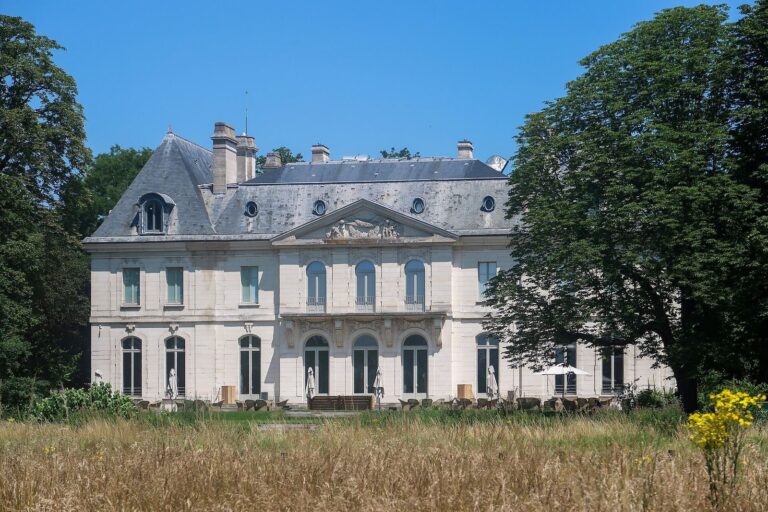
Château de Neuilly: An Aristocratic and Royal Estate in France
Site at a Glance
- Popularity
- High
- Country
- France
- Primary era
- Modern
- Eras represented
- Modern
- Civilizations
- French
- Site type
- Domestic
- Remains
- Palace
On this page11 sections
History
The Château de Neuilly was an aristocratic estate and royal residence in France, with its principal residence above the Seine. Its first château was probably built in the second quarter of the seventeenth century, and a new residence was commissioned in 1751. The estate later became a favored summer home of the Orléans family and witnessed major political events in 1830 and 1848.
Seventeenth and eighteenth centuries
In 1668, the estate belonged to Louis de Béchameil de Nointel, a royal official. It passed to Mr. de Sassenaye in 1702 and was sold to the Duchess of Biron on 11 July 1740. By her will of 16 August, she gave the Count d’Argenson legal ownership without the immediate right to use the property, while Mr. de Villars received the right to benefit from it. After Villars died in 1741, d’Argenson became full owner when the Duchess died on 4 August.
D’Argenson commissioned a new château in 1751 and welcomed the Enlightenment writers and philosophers Diderot, Voltaire, and Rousseau. In 1757, at Madame de Pompadour’s request, he fell from favor and was sent into exile at his estate at Les Ormes. He returned to Paris in 1764 and died soon afterward. He left Neuilly to Louis XV, who declined the bequest.
On 10 July 1766, d’Argenson’s heir, Marc-René de Voyer de Paulmy d’Argenson, sold the estate to the financier Radix de Sainte-Foy for 100,000 francs. Radix sold it to Madame de Montesson in early 1792 for 370,000 francs. On 8 May 1794, she transferred it for 230,000 francs to the businessmen Delannoy and Ignace-Joseph Vanlerberghe, who rented it as a secondary residence to the diplomat Talleyrand. General Joachim Murat bought the property on 4 March 1804 for the same price.
Murat and the Orléans family
Murat also acquired the Château de Villiers from General Bessières and joined the estates by purchasing land and roads between them. He enlarged and improved Neuilly from 1804 to 1807, and held celebrations there, including one on 23 May 1805 for Napoleon’s coronation as King of Italy. When Murat became King of Naples in 1808, his French properties passed into the extraordinary domain, a group of estates held at the disposal of the imperial Crown. On 28 October, his sister Princess Pauline Borghese received Neuilly as a grant. Villiers was separated from the estate and lent in summer 1809 to the Russian ambassador Prince Alexander Kurakin, who stayed there for treatment of gout. Pauline considered Neuilly unhealthy and repeatedly sought an exchange for another property.
The estate returned to the Crown in 1814. The Duke of Angoulême declined Neuilly but accepted Villiers on 18 November 1816, intending to establish a horse-breeding farm there. Plans were prepared, but the scheme did not proceed. In 1818, the Duke of Orléans, later Louis-Philippe I, acquired Neuilly and Villiers in exchange for the Chartres stables on Rue Saint-Thomas-du-Louvre. He took possession immediately. His wife gave birth to the Prince of Joinville at Neuilly on 14 August. The duke wanted a country residence near Paris after the Château du Raincy had been destroyed during the French Revolution.
The Orléans family enlarged its estate through further purchases, and Neuilly became a favored summer residence. During the July Monarchy, the constitutional monarchy ruled by Louis-Philippe from 1830 to 1848, it remained part of the king’s private property rather than the Crown’s domain. The court usually stayed there from May until late July.
Revolution and later history
During the Revolution of 1830, which brought an end to the Bourbon Restoration and led to Louis-Philippe’s rule, the duke and his family were at Neuilly. Amid rumors that liberal deputies might offer him the throne and royalist troops might arrest him, he left for the Château du Raincy on the morning of 30 July. He returned the next afternoon, accepted the office of lieutenant general of the kingdom, and was later proclaimed King of the French.
On 25 February 1848, during the revolution that ended the July Monarchy and established the Second Republic, Neuilly was looted and burned. After soldiers withdrew, the caretaker opened the gates to the park, and the gathering crowd became increasingly disorderly. Fires and theft spread from the service areas into the apartments. Firefighters faced obstruction and attacks. Employees and students from the École polytechnique, sent by the provisional government, rescued paintings, rare books, and silverware and took them to the town hall. The roofs collapsed around midnight, and the neighboring Château de Villiers also burned. The Petit Château was initially spared but was later destroyed. General Ordener and his troops occupied the property at about 10 a.m. the following day.
Wine and rum taken from the cellars added to the disorder. Around 100 to 130 men fought violently below ground; 120 to 130 bodies were recovered the next day, many bearing visible injuries. People trapped in the cellars died in the fire or from smoke. The ruins and estate remained with Louis-Philippe until his death in 1851, then passed to his heirs. Napoleon III confiscated the Orléans properties in 1852. From 1854, the estate was divided into 700 plots and sold at public auctions after seven broad boulevards and nine narrower streets had been laid out. Construction of the Galignani Foundation on part of the former park began in 1885.
A surviving wing housed the Notre-Dame-des-Arts boarding school from 1863 to 1874, then a workshop for poor young women directed by Miss Glaudel from 1874 to 1907. The Congregation of the Sisters of Saint Thomas of Villeneuve bought the property in 1907, after its Paris house was expropriated, and moved into the new convent on 23 September 1908. The congregation continues to occupy the complex.
Remains
The former estate covered about 170 hectares, across the part of present-day Neuilly between Avenue du Roule and Levallois-Perret. Its two châteaux occupied distinct parts of the grounds, with Neuilly to the west above the Seine and Villiers to the east. By the end of the Orléans building programme, the estate measured 650 arpents, compared with 33 arpents around 1750. An arpent was an old French land measure whose size varied by region.
The principal château
The principal residence designed by Jean-Sylvain Cartaud, with François II Franque later taking over the project, stood on terraces above the Seine. Its Ionic columns used a classical design recognizable by scroll-shaped capitals. Murat’s enlargement added the left wing, a dining room, part of the right wing, and an extension to the garden-facing façade. The two side wings framed a U-shaped court of honor, a formal courtyard in front of a principal residence; the left wing contained the large dining room.
Villiers
Villiers was a large house with 24 rooms and a garden separated from the main park by a palisade. It was incorporated into the Neuilly estate in the early nineteenth century and restored in 1821. Its dependencies and the surrounding estate buildings formed part of the wider complex.
The Orléans building campaign
Residence and service buildings
From 1820 to 1831, architect Pierre-François-Léonard Fontaine directed extensive work. In 1820, the right wing was enlarged to provide apartments for the Duke of Orléans and Princess Adélaïde. New kitchens were built in 1821; the following year, work added cellars beneath the dining room, a chapel, servants’ quarters, and a connection between the small château and the main residence. The court-facing façade and two entrance pavilions were rebuilt in 1823. In 1824, work included the main gate, adjoining buildings, and Villiers’s dependencies. Later additions included a coach court, new apartments for the Duke of Orléans and the Duke of Nemours, and further service buildings. By the programme’s completion, the estate had 30 principal lodgings and beds for 500 members of the household’s entourage. Its stables could hold 200 horses and 40 carriages, and the grounds provided space for 150 infantry guards and 100 cavalry.
Park, islands, and infrastructure
New entrances and dependencies were built on Avenue Sainte-Foy in 1825 and 1826, alongside a heated greenhouse, a covered riding arena, and cisterns. Drainage aqueducts followed in 1827. The grounds also gained ornamental temples, grottos, guardhouses, and houses along the avenue. The Duke of Orléans acquired seven islets in the Seine in 1821 and connected them to the estate with a wire suspension bridge built by the Séguin brothers. The Temple of Love, erected by his father Philippe Égalité in Parc Monceau in 1774, was moved to the Île de la Jatte. Other works included an iron bridge over the river, embankments, and water pumps intended to support river flow and navigation and supply the estate.
The surviving wing and convent
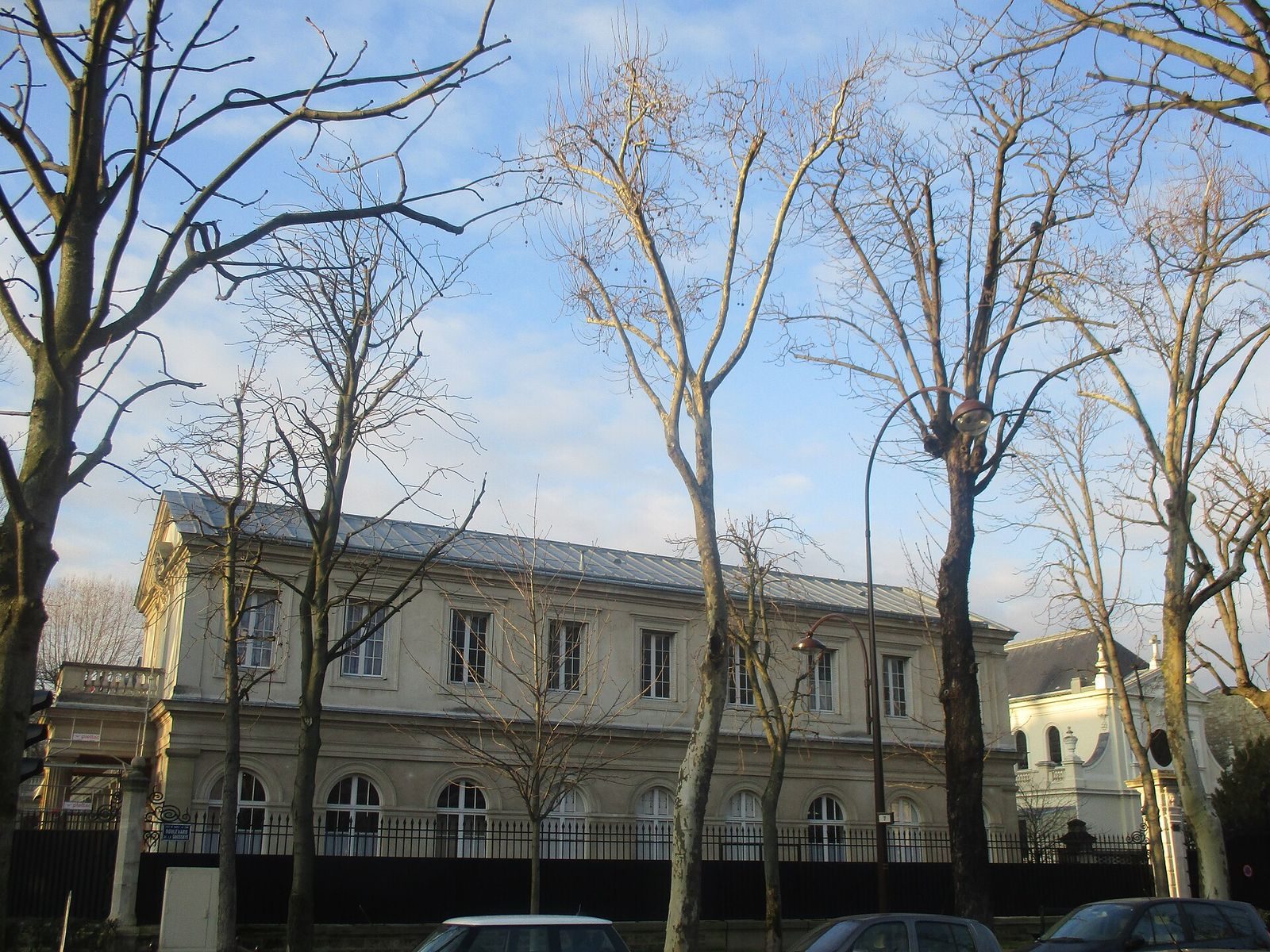
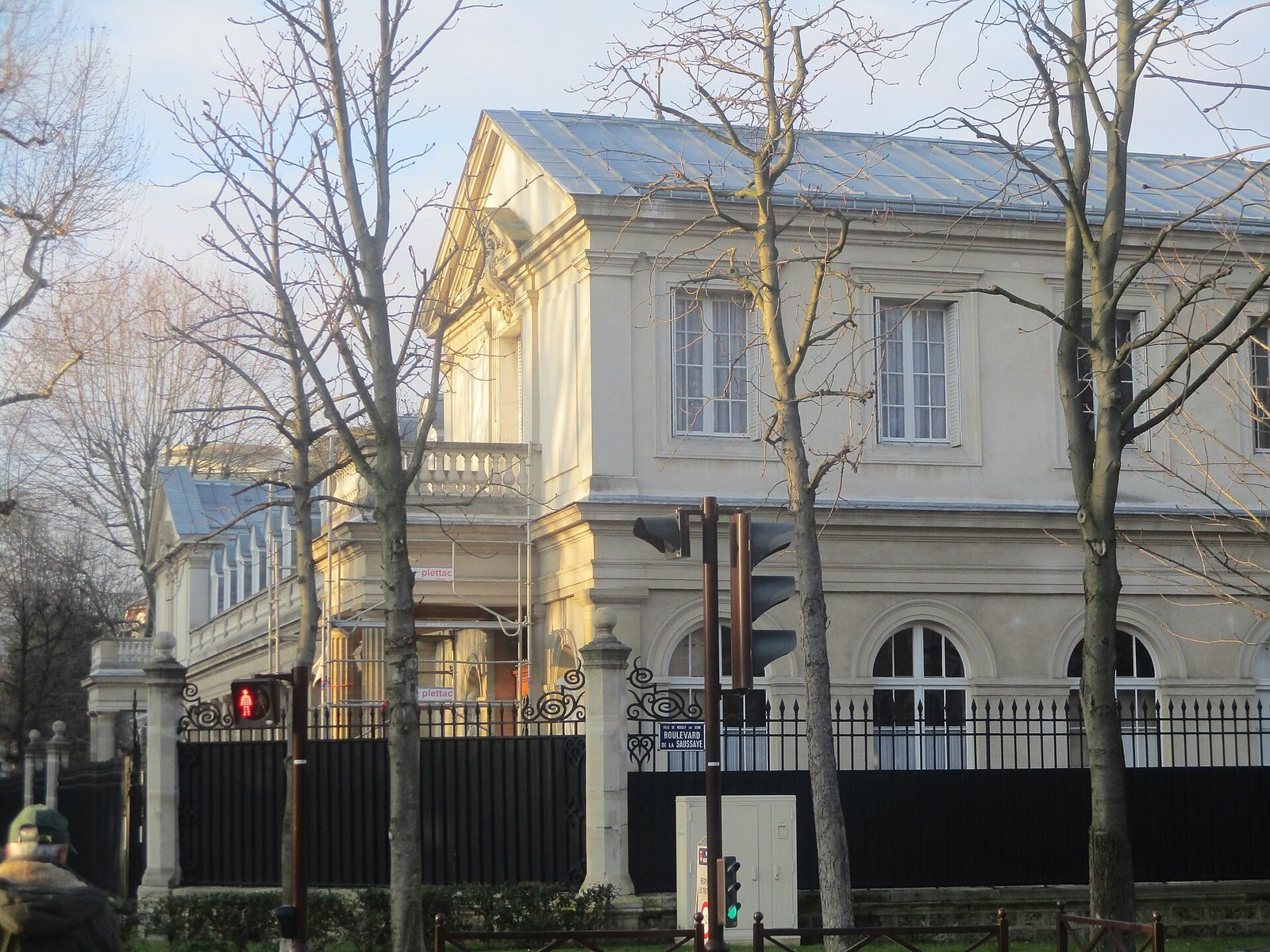
One château wing survives, the nineteenth-century building associated with Fontaine’s work and known as the Wing of Adélaïde or Pavilion of Madame Adélaïde. It now forms part of the convent complex at 52 boulevard d’Argenson. Architect Maurice Humbert restored the buildings and designed the convent to harmonize with the surviving wing. The complex includes the Chapel of Notre-Dame-de-Bonne-Délivrance, which houses the statue of Notre-Dame-de-Bonne-Délivrance, also called the Black Virgin of Paris, a dark-colored image of the Virgin Mary.