Haus Hagenbeck: A Medieval Castle Estate on the Lippe
Site at a Glance
- Popularity
- Medium
- Country
- Germany
- Primary era
- Medieval
- Eras represented
- Medieval
- Civilizations
- Holy Roman Empire
- Site type
- Military
- Remains
- Castle
On this page8 sections
History
Haus Hagenbeck is a ruined medieval castle estate on the north bank of the Lippe in Holsterhausen, Germany. Its name appears around 1150 in an estate register of Werden Abbey, associated with two farmsteads. Hagenbeck was a Schultenhof, or principal manor farm, linked to the lords of Castle Dahl. Its lands had been separated from common ground along the Lippe and the Bieberbach, later known as the Hagenbeck Mill Brook.
The manor and its knightly family
Gerhardus de Hagenbeck appears in a record from 1217 as a witness to a property transfer to Marienborn Abbey. In the fourteenth century, members of the Hagenbeck knightly family repeatedly witnessed transactions in Münster. They held property around Hagenbeck, rights and lands as fiefs from the abbeys of Werden and Marienborn in the Lordship of Lembeck, and ecclesiastical fiefs elsewhere in the Diocese of Münster.
On 23 June 1315, brothers Everhard and Tillmann von Hagenbeck sold the castle to Ludwig II, Bishop of Münster, for 150 marks in Münster denarii, a unit of account. Their agreement made it an open house, meaning the bishop could use it for specified purposes under agreed conditions. He received rights to establish a fortified base and administrative seat and to build there, but those rights were never put into effect.
A contested frontier and divided ownership
Hagenbeck stood at the southwestern edge of the Prince-Bishopric of Münster, a territory in which the bishop ruled both as church leader and secular prince. The County of Cleves lay to the west, while the Vest Recklinghausen, under the Electorate of Cologne, lay south of the Lippe. The border position became more consequential after Münster and Cologne agreed in 1322 that the river would mark their territorial boundary. From the 1330s, the counts of Cleves also sought to extend their power east of the Rhine.
The castle remained a family seat until 1410, with two Hagenbeck branches maintaining separate houses there. The original mound fortifications were replaced by new houses after 1338. That year, Johan de jonge transferred his share to Count Dietrich of Cleves as an open house, on condition it could not be used against the Bishop of Münster in a feud. Dietrich received woodland jurisdiction in the Emmelkämper Mark, a communal tract of land, and fishing rights in former channels of the Lippe. Johan received those rights back as fiefs held through the male line. He then recognized Dietrich and his successor, Count Johann of Cleves, as his lords, breaking his former allegiance to Münster.
In 1340, during a war involving Duke Rainald II of Guelders, the duke sent forces against Hagenbeck. Johan de olde, an uninvolved co-owner, received 80 marks for damage and agreed to make the castle available to the duke for the war. He also undertook to prevent his nephew from using it against Guelders. Johan de jonge later served as bailiff of the Cleves district of Schermbeck from 1354 to 1365.
Johan de jonge subsequently joined the rebellion against Bishop Adolf of Münster during the Guelders succession war. Its decisive battle took place on 25 May 1361, when Count Engelbert III of the Mark, the bishop’s brother, fought the rebels. After action was taken against Johan in July, the castle was besieged in March 1362. Johan lost his shares in the castle and lordship; on 31 May they were granted as an hereditary castle fief to Wessel, son of Johan de olde. Johan pursued his claim in the ministerial court at Lembeck, and the two branches reached an agreement in 1373.
Estate, parish, and changing inheritance
The Hagenbeck estate included freehold lands north of the Lippe between Hohenkamp and Schermbeck, extending about 2.5 kilometres between Werth and Loh and about 1.5 kilometres from north to south. Its lordship rights included authority in the Hagenbeck farming community and at Kreskenhof, a fishing farm used in exercising fishing rights in the Lippe. The Hagenbecks also held the office of mark judge in the Emmelkämper Mark, administering its customary rights, and leased a quarry there to Dorsten. Stone from the quarry went into major works in the town, including its encircling wall and church, as well as the rebuilding of Haus Hagenbeck.
Johan de jonge enlarged the family’s interests by acquiring fields beside the Lippe from House Gahlen and rights in Hünxer Mark and the parish of Hünxe from Johan van den Berghe. These acquisitions included the van den Berghe knights’ holdings and extended Hagenbeck’s reach into Cleves territory. In 1350 Johan bought seven serfs, dependent rural workers, from Sweder von Ringenberg, and acquired ten more before a court at Wesel. Their settlement formed the village of Holsterhausen. The name has been interpreted as meaning a settlement of woodworkers, associated with supplying timber to the Lower Rhine.
Inheritance divisions strained the estate’s finances. Holdings were sometimes sold or pledged, including to Dorsten, but could generally be reunited until the late fourteenth century, when Johan de jonge’s successors began disposing of their shares. Wessel von Hagenbeck died before 1403, ending the castle’s male line of inheritance. His heiress Woltera, also called Woltharda, brought the estate to House von Heiden. Her husband, Wennemar the Elder, received the bishop’s investiture in 1410 and recovered holdings from both Hagenbeck branches.
Wennemar founded the parish of Holsterhausen. Bishop Heinrich II granted it parish rights on 21 August 1443, and Haus Hagenbeck held the right of patronage. Wennemar also established the Hagenbeck mill, which Holsterhausen residents were required to use. For a time, a ferry across the Lippe replaced the older ford. Once the chapel became an independent parish, Holsterhausen displaced Hagenbeck as the locality’s name; thereafter Hagenbeck referred chiefly to the knightly seat and, from 1734, to its estate district. The Hagenbeck arms, dated 1351 and showing three rings, later became the arms of the municipality of Holsterhausen. The municipality was Prussian from 1815 until its incorporation into Dorsten in 1943; since 1975 Holsterhausen has formed a district with Emmelkamp, north of Hagenbeck.
Damage, restoration, and decline
A Spanish incursion in 1587, during the war against the Netherlands, inflicted substantial damage on both the castle and village. By 1620 the castle was badly deteriorated, and Lubbert von Heyden could not afford repairs. His heiress, Cordula Margareta Magdalena, married Lothar von Metternich, an electoral councillor and bailiff of Montabaur. In disputes over inheritance among the houses of Heyden, Metternich, and Vehlen, Cordula received compensation of 38,000 Reichstalers. After her death in 1642, the estate passed to Alexander II von Velen. A year earlier, Alexander had taken part in the imperial siege of Dorsten, then held by Hessian forces, and kept his quarters in Hagenbeck’s deer park. He was raised to hereditary count in 1641.
Alexander began restoring and modernizing the castle in 1645. His son secretly sold portions of the expected inheritance to House Westerholt zu Lembeck from 1661 and served as an officer at the imperial court in Vienna from 1664. By Alexander’s death in 1675, the inheritance had been spent. His grandson Alexander Otto briefly regained Haus Hagenbeck by exercising a reserved right to repurchase it. In 1734 the estate passed permanently to Baron Ferdinand von Merveldt, who had acquired Schloss Lembeck through his 1708 marriage to Maria Josepha von Westerholt zu Lembeck, heiress of the Westerholt-Lembeck line.
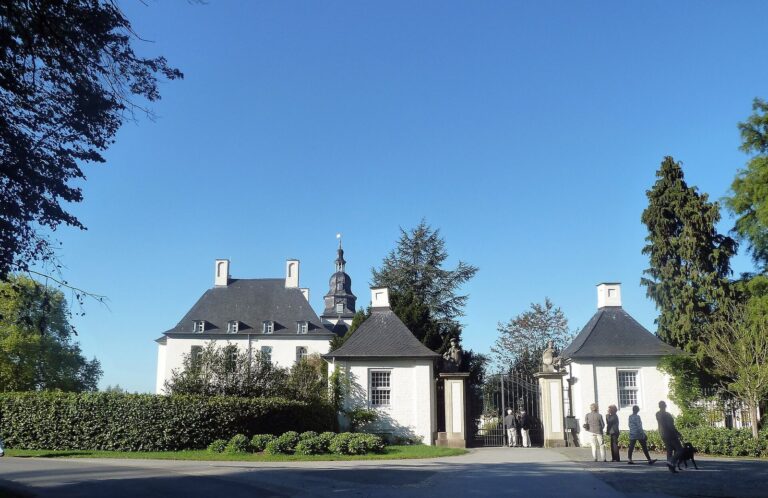
The damaged manor house was not restored after it lost its function. The cause of the damage remains uncertain: it may have resulted from an explosion and fire or from flooding by the Lippe. The estate continued as an agricultural outlying farm; its outer bailey was repaired, and a gate and chapel were built. From 1823 to 1875, during the Prussian period, ownership of the estate entitled its owner to a seat in the provincial assembly. Haus Hagenbeck was sold in 1909. Much of its land went to early industrial development, especially the Baldur colliery, while Dorsten local court judge Thomas acquired the remaining estate. From the late twentieth century, further land was used for settlement and for construction of the A31 motorway to the east.
Remains
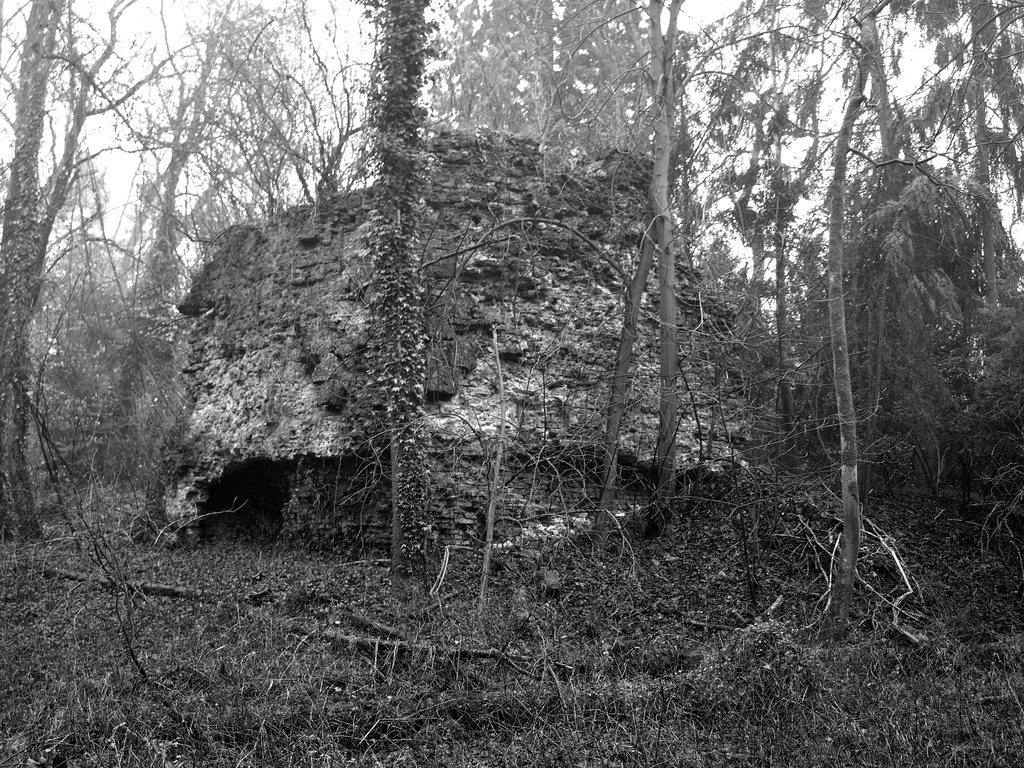
The ruined site occupies a former bend of the Lippe, on an island terrace on the river’s north bank in southwestern Holsterhausen. Severe floods reached the grounds. A ford once crossed the Lippe near the castle, but it lost importance after a bridge was built at Dorsten. Ramparts and moats enclosed the castle grounds, which included an outer bailey, an enclosed area beyond the main castle.
Castle enclosure and main castle
The third castle complex had a three-winged main castle and an outer bailey. Its ramparts and moats enclosed a slightly trapezoidal rectangle about 160 metres from north to south and 100 metres from west to east. The inner area measured 82 by 40 metres. Only ruined remains of the former estate survive.
Estate structures
The estate also included the Hagenbeck mill, associated with the lordly property, as well as a gate and chapel. The outer bailey was repaired for agricultural use. These structures formed part of the estate’s later working landscape alongside the castle grounds.