Skelmorlie Castle: A Montgomerie Family Stronghold in Ayrshire
Site at a Glance
- Popularity
- Medium
- Country
- United Kingdom
- Primary era
- Early Modern
- Eras represented
- Early Modern, Modern
- Civilizations
- British, Kingdom of Scotland
- Site type
- Military
- Remains
- Castle
On this page13 sections
History
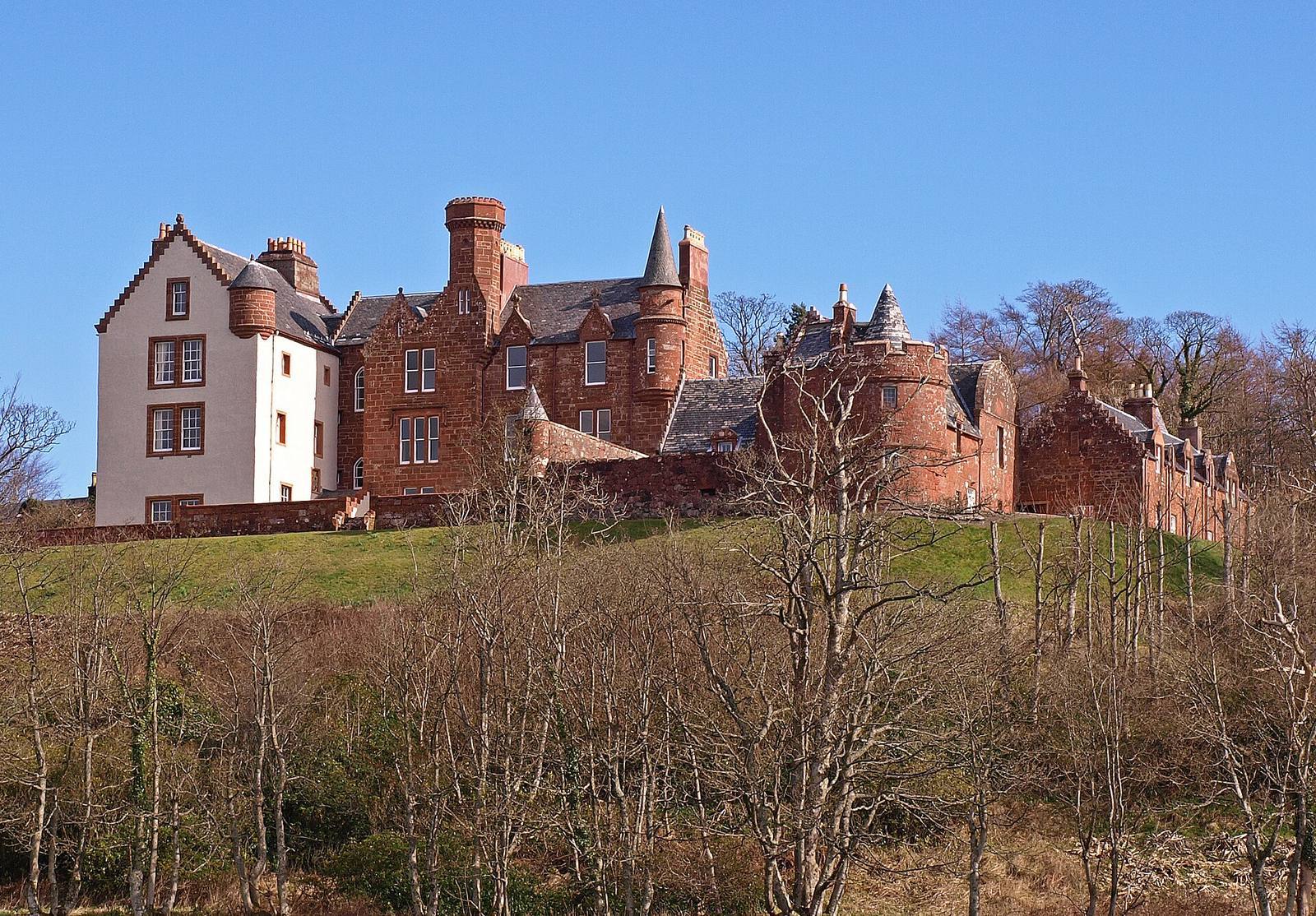
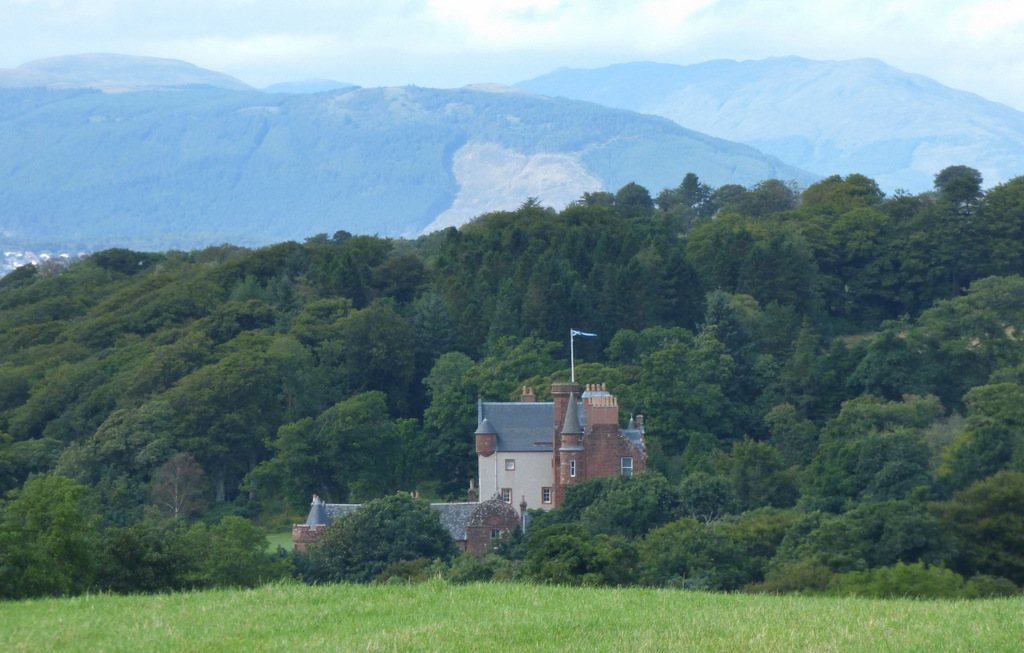
Skelmorlie Castle is a Scottish tower house (a fortified, multi-storey residence) near the village of Skelmorlie in Ayrshire, United Kingdom. The oldest surviving part of the present building dates to 1502, and the castle served as the seat and stronghold of the Montgomerie family.
The Montgomeries at Skelmorlie
During the reign of Robert III, king of Scots from 1390 to 1406, the lands of Skelmorlie belonged to the Cunninghames of Kilmaurs. Around 1460, the northern portion passed to the Montgomeries as Skelmorlie-Montgomerie, while the Cunninghames retained the rest as Skelmorlie-Cunninghame. Anne, sister of Alexander de Montgomerie, had married a Cunninghame of Kilmaurs, a match that may help explain the division.
On 6 June 1461, Sir Alexander de Montgomerie of Ardrossan, the first Lord Montgomerie, granted Skelmorlie to his second son George, whose mother was Margaret Boyd. George established the Skelmorlie branch of the family. A brother of Hugh, the first Earl of Eglinton, may have built the castle, though the attribution is uncertain. The family succession passed through John, the second laird (a Scottish landholder), his son Cuthbert, and Cuthbert’s son George. George’s eldest son Thomas died in 1566, after which Thomas’s brother Robert inherited Skelmorlie and lands at Lochransay, Synnock, and Lochliboside.
In 1586, Robert, the sixth laird, killed Alexander Cunninghame, who administered the property of Kilwinning Abbey. The killing followed the Cunninghames’ death of the fourth Earl of Eglinton. Patrick Maxwell of Newark retaliated by killing an older Sir Robert Montgomerie and his eldest son. The younger Robert, later the seventh laird, subsequently met Maxwell at Newark Castle, apparently seeking revenge for his father and brother. The two men eventually became friends. Robert was knighted by James VI and made a baronet, a hereditary title below the peerage, by Charles I in 1628.
Seventeenth-century family and politics
Robert married Margaret Douglas, daughter of Sir William Douglas of Drumlanrig. She died after falling from her horse at the Colm Fair and being kicked by the animal. A tradition held that her ghost haunted the castle until the fire centuries later. Her death may have changed Robert’s outlook: he undertook charitable acts and spent long periods praying for his salvation in a burial vault.
Robert’s descendant Robert, the ninth laird and third baronet, married Antonia, a Covenanter, one of the Scottish Presbyterians who defended religious covenants against royal policies. Robert was repeatedly fined because she attended conventicles, religious meetings outside the established church’s authorized arrangements. He died in 1685 and was succeeded by his son James.
James, the tenth laird and fourth baronet, sat in the Parliament and Convention of Estates in 1689. The Convention was an assembly that settled the Crown’s succession after the 1688-89 Revolution displaced James II and brought William and Mary to the throne. James Montgomerie was among those selected to offer them the Crown in London. Dissatisfied with his appointment as Lord Justice-Clerk, a senior Scottish judicial office, he later supported the deposed James II and joined him at St Germains in France. Although James II had promised to make him Earl of Ayr, Montgomerie’s Protestant faith left him unwelcome at the Catholic court. He died in London in September 1694, described as dying of vexation.
Later owners, restoration, and fire
Hugh Montgomerie of Busbie, Lord Provost (the chief civic officer) of Glasgow, acquired the estate from the fourth baronet and took possession in 1731. He became the sixth baronet and eleventh laird. A commissioner in negotiations for the union of Scotland and England, he served in Scotland’s last Parliament and represented Glasgow in the first Parliament of the United Kingdom. He died without issue in 1735, and the baronetcy ended in the direct line.
The estate then passed to Lilias, daughter of the fourth baronet. She married Alexander Montgomerie of Coilsfield, and their son Hugh became the twelfth Earl of Eglinton. Lilias sold her Renfrewshire lands and acquired property adjoining Skelmorlie. She died in 1783, a few weeks before her husband. In the early nineteenth century, Major-General James Montgomerie of Wrighthill, an MP for Ayrshire and brother of the twelfth earl, lived at the castle for an extended period. The building remained little altered but became run down.
John Graham, a Glasgow textile and Port wine merchant and arts patron, rented the castle from 1852. In 1856, with the Earl of Eglinton’s permission, he paid to restore the old tower and added a mansion house that joined two existing buildings. The sixteenth Earl of Eglinton moved there from the abandoned Eglinton Castle in the mid-1920s and died at Skelmorlie in 1945.
A fire in 1959 destroyed the upper floors of the keep and the west wing. The wing was demolished, and the keep was restored. The castle and its courtyard buildings received Category B status in 1971, a Scottish designation for buildings of regional or greater-than-local importance. Maps give the name as North Skelmoirluy in 1636-52, Skelmurly in 1685, and Skelmorly in 1745-47. Its origin may mean shelter on the lee side of the great rock; the first element may be related to Skeir or Skerries.
Remains
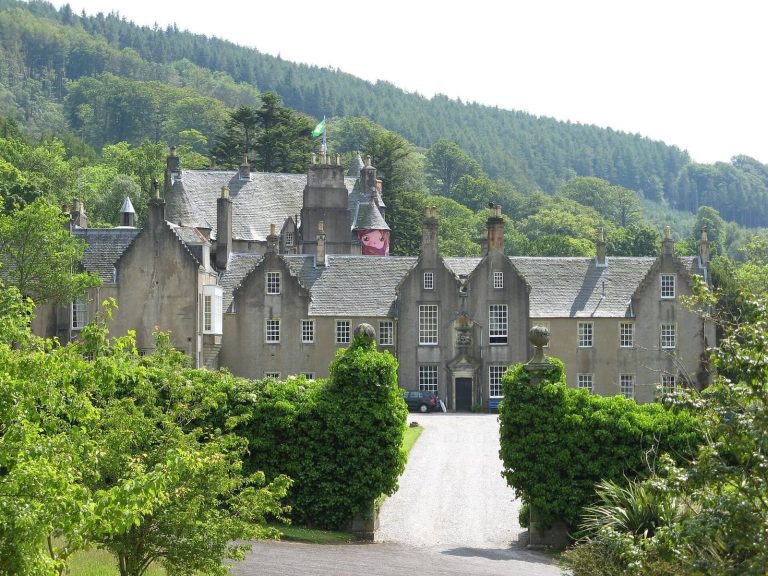
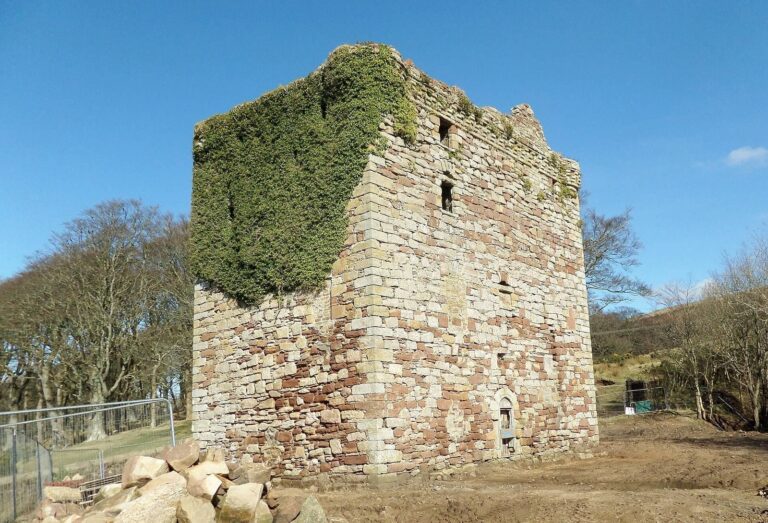
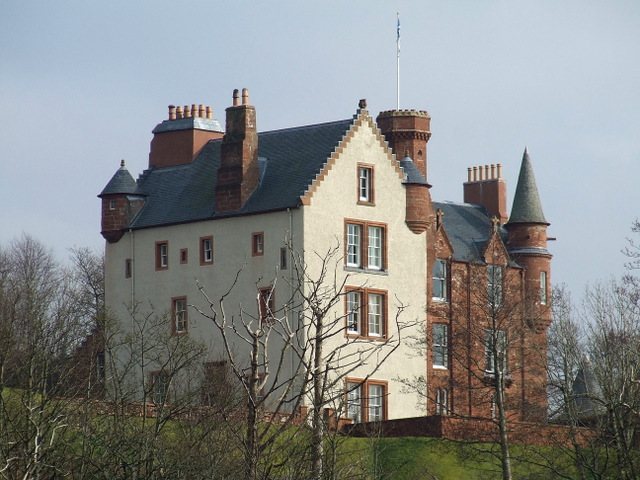
The complex centers on a red sandstone tower house, built from blocks and rubble, with courtyard buildings around its southern side. It stands on the eastern shore of the Firth of Clyde, north of which lies the village of Skelmorlie. The original castle may have occupied a motte (a raised mound used as a base for a fortified structure) on a promontory between a small burn and Skelmorlie Water.
Tower and principal rooms
Keep
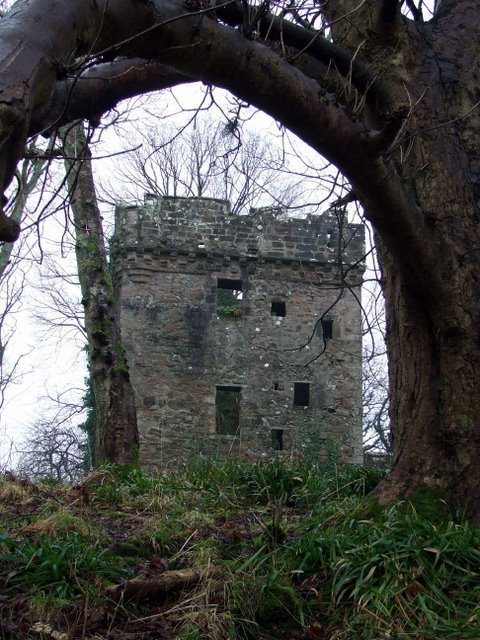
The keep (the castle’s principal fortified tower) retains a silhouette that has changed little over more than five centuries. In 1636, projecting masonry and parapets were removed, and turrets were added at the corners; the turrets received roofs later. The tower’s dimensions and internal arrangement resemble those at Little Cumbrae, Fairlie, and Law. A rough exterior coating was applied in the early 1960s, and the castle is in good repair.
Baronial hall
The first-floor baronial hall later served as a dining room. Its roof bears the date 1762 and the Montgomerie arms combined with Eglinton heraldry. The first and fourth sections of the shield are blue, each with three gold fleurs-de-lis; the second and third are red, each with three gold rings set with gems. A white sword points down at the center. Above the shield is a heart with an eye, and the motto means Everything done well, or nothing attempted.
Courtyard buildings
Former chapel
The castle chapel stands on the western side of the southern courtyard. In the nineteenth century it was converted into stables and servants’ quarters.
Sir Robert’s range
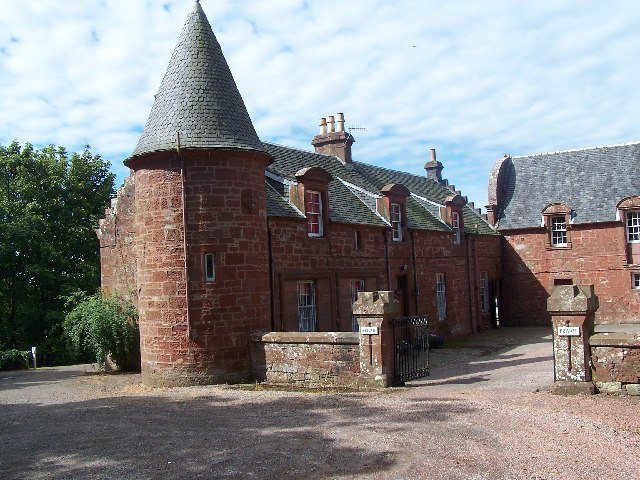
Part of Sir Robert’s seventeenth-century range survives as part of the castle’s associated buildings.
Turret House and Mews
Separate buildings on the south side of the southern courtyard include the seventeenth-century Turret House and a Victorian Mews.
Grounds and estate traces
Around 1600, surveyor Timothy Pont described the castle’s gardens, terrace, and shrubbery, with views across the Firth of Clyde toward Bute, Arran, and the Cumbraes. The grounds were wooded and the approach steep by the early nineteenth century. An 1855 Ordnance Survey map shows a bowling green and a sundial, possibly of a Scottish type, as well as Skelmorlie Mains, the estate farm. The old estate mill is recalled in the name Milnburn near Skelmorlie Water.