Dunoon Castle: A Medieval Royal Fortress in Scotland


Site at a Glance
- Rating
- 4.7
- Popularity
- Very Low
- Country
- United Kingdom
- Primary era
- Medieval
- External website
- Open
- Eras represented
- Medieval, Modern
- Civilizations
- British, Kingdom of Scotland
- Site type
- Military
- Remains
- Castle
On this page9 sections
History
Dunoon Castle is a medieval fortress in Scotland, United Kingdom, first mentioned in the thirteenth century and possibly built as the Stewart dynasty strengthened its authority in Cowal. The castle became a royal stronghold whose history reflects the political and military struggles of western Scotland.
Stewart authority and royal control
In 1333, Edward Balliol, a claimant to the Scottish crown supported by Edward III of England during the Second War of Scottish Independence, besieged and captured Dunoon Castle. Balliol then surrendered it to Edward III. An uprising later drove Balliol from Scotland, and Robert the Steward, who became King Robert II and founded the Stewart line of monarchs, retook the castle with help from Colin Campbell of Lochow.
James III promised in 1468 to repay Colin Campbell for repairs to Dunoon Castle and appointed him keeper in 1472. By the fifteenth century, Dunoon was a royal castle, while members of the Campbell family held the keepership hereditarily.
Conflict in the sixteenth century
In 1544, Matthew Stewart, 4th Earl of Lennox, attacked and captured Dunoon Castle with forces supplied by Henry VIII of England. His force included eighteen ships and 800 soldiers. Archibald Campbell, 4th Earl of Argyll, was driven out and suffered heavy losses.
Mary, Queen of Scots, stayed at Dunoon Castle from 27 to 29 July 1563 while visiting her half-sister, Jean Stewart, Countess of Argyll. During the visit, Mary granted several charters, and her household book recorded the food consumed by her household. In 1565, during the Chaseabout Raid, a political and military struggle involving opposition to Mary, her rebels assembled at Dunoon. The faction in Argyll associated with her brother, the Earl of Moray, included the Duke of Châtelherault and the Earls of Argyll and Rothes. The group left for Ayrshire on 18 August.
Seventeenth-century violence and decline
The Dunoon massacre took place in 1646, when Campbell forces killed men, women, children, and infants of Clan Lamont. After Charles II restored episcopacy, a church system governed by bishops, Dunoon Castle temporarily became the residence of the Bishop of Argyll.
The castle fell into ruin during the seventeenth century. In 1685, during the Earl of Argyll’s rebellion against James VII, Dunoon Castle was destroyed.
Military reuse and protection
Military fortifications were installed on Dunoon Castle hill during both World Wars to defend the River Clyde and its shipbuilding industry. These works altered parts of the surviving medieval remains. The castle ruins and surrounding area have been a scheduled monument, a legally protected archaeological or historic site of national importance, under designation SM5450 from 1992 onward.
Remains
Hilltop enclosure and approach
Dunoon Castle occupied a natural rock plateau on a cone-shaped volcanic hill approximately 80 feet, or 24 metres, above the Firth of Clyde. The plateau was partly cut artificially. A ditch protected the north-western side, while a ring wall enclosed an elongated rectangular area measuring about 26 by 18 metres. This wall formed the castle’s defensive circuit and inner court. The physical layout also included a gently rising approach road and a courtyard terrace, with the remains positioned above the harbour, coast, and Firth of Clyde.
Entrance and medieval masonry
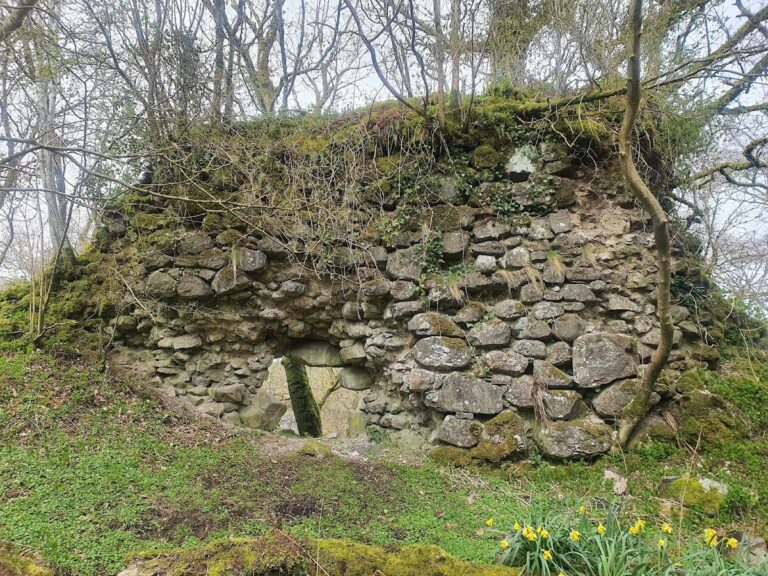
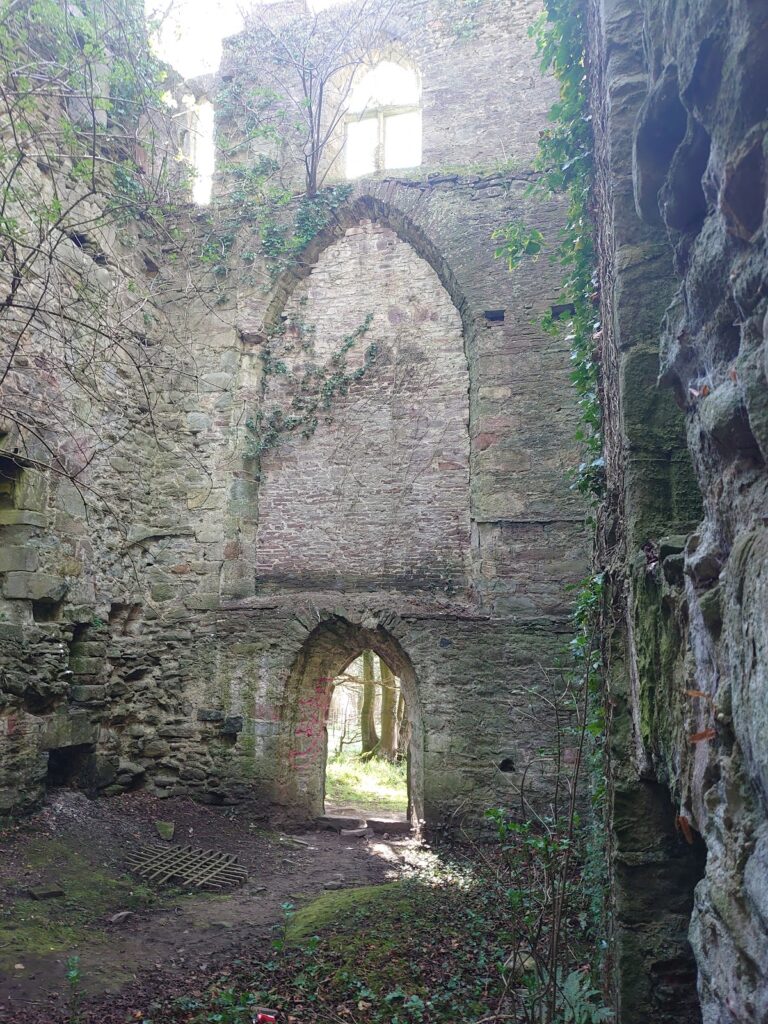
The south-western entrance passage was approximately 1.7 metres wide. Almost 9 metres of its outer wall survive, reaching more than 2 metres in height, while the inner wall rises to about 4 metres. The medieval fabric used locally obtained rubble stone, roughly dressed and set in substantial mortar courses. Elsewhere, the surviving castle consists mainly of isolated masonry stretches and stone fragments, leaving very little of the original structure above ground.
Later structures and buried remains
Concrete foundations and brick walls from the twentieth-century military fortifications cross parts of the hill and overlie sections of the medieval fabric. Subsurface structures beneath the grass reveal further wall lines and ancillary buildings. Castle House, built in 1822, stands a few yards north of the castle ruins.