Skallum: A Historic Estate in Norway
Site at a Glance
- Popularity
- Medium
- Country
- Norway
- Primary era
- Early Modern
- Eras represented
- Early Modern, Modern
- Civilizations
- Denmark–Norway, Norwegian
- Site type
- Domestic
- Remains
- Manor House
On this page12 sections
History
Skallum is a historic estate and surrounding area at Stabekk in Bærum, Norway. The area’s name comes from the farm, also known as Skallum-Stabekk. The name’s recorded forms include Skalmestadbeck in 1617 and Skallum-Stabæk in 1723; Skjelme is another spelling with the same root.
The farm and its owners
During the Middle Ages, Skallum farm belonged to Hovedøya Monastery, a Cistercian monastery in the Oslo area. After the Reformation of 1536 transferred church property in Norway to the Crown, the farm became Crown property. The Øverland family owned it from 1685 to 1812. It received a land-register number in 1826, when its livestock included one horse, two sheep, and two cattle. The Eger family took ownership in 1889; among them was industrialist Conrad Wilhelm Eger.
Occupation and the events of May 1945
During the German occupation of Norway, Eger was forced into exile in 1944, and Nazi authorities requisitioned the property. The Hird, the Norwegian Nazi Party’s paramilitary organization, used the estate. Sports official and judge Egil Reichborn-Kjennerud lived there. Nazi authorities also established an anti-aircraft battery in a field south of Skallum.
On 8 May 1945, as the Nazi government collapsed, a group of Nazis entrenched themselves at Skallum, reportedly against Vidkun Quisling’s orders. Quisling, who led Norway’s collaborationist government, and his followers had barricaded themselves at Gimle, his home at Bygdøy. That same day, Justice Minister Sverre Riisnæs was brought to Skallum by an aide of Police Minister Jonas Lie. Lie and Reichborn-Kjennerud were there, along with police leaders Egil Olbjørn and Henrik Rogstad, other police officers, and SS members. Members of the Home Front, the resistance movement in occupied Norway, began surrounding the farm.
Olbjørn, Reichborn-Kjennerud, and others left by bus, leaving Riisnæs, Lie, and Rogstad at Skallum. The three later tried unsuccessfully to negotiate with the resistance, then resumed their entrenchment. On 10 May, they were asked to leave. Lie, reportedly under the influence of pills and alcohol, fired toward Riisnæs and Rogstad and threatened them with an unsafe hand grenade. The standoff ended on 11 May, when Riisnæs surrendered to the resistance carrying a white handkerchief. Lie and Rogstad were found dead. A note signed by all three was later found, but only Rogstad died by suicide. Lie is believed to have died from intoxication and stress.
Later use
Since 1982, the former manor house has housed the art gallery Galleri Skaugum. Skallum was also one of three excavation locations for the Bærum Tunnel, construction of which began in 2007.
Remains
Skallum occupies a small valley north of Stabekk’s commercial centre and slightly south of Stabekk Primary School and the former college at Ringstabekk. The farm buildings stand within this valley, which was shaped by a creek belonging to the Stabekk Watershed. The surviving features include the pond Egerdammen and historic farm buildings.
Watercourse and pond
Skallumbekken
The watershed flowed south from an area north of Øvrevoll Galloppbane, passing through Voll, Jar, Jarmyra, Tjernsrud, and Ringstabekk. After crossing present-day Gamle Ringeriksvei, the creek descended into the valley as a waterfall. The branch through Skallum was called Skallumbekken. Beyond the area, the waterway continued southeast as Stabekk, crossing Stabekk farm and Ballerud before turning northeast and then south toward Holtekilen. Most of the watershed now runs underground through pipes.
Egerdammen
The pond lies somewhat north of Skallum farm. A former owner probably created it before 1900 by damming Skallumbekken. Egerdammen supports a rich range of biological life and has been used for ice skating in winter.
Farm buildings
Manor house
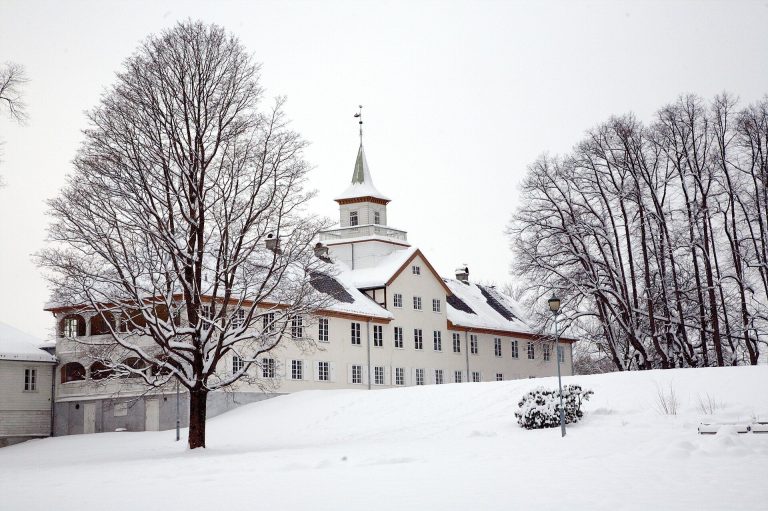
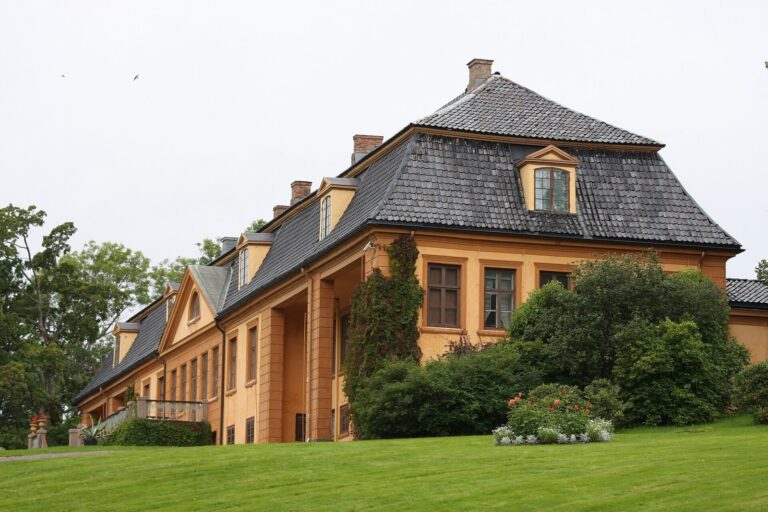
The manor house dates from the late seventeenth century. It was enlarged in the 1880s and given a façade inspired by Swiss building forms of the nineteenth century.
Other farm buildings
Most of the farm’s other buildings were constructed in the late 1880s and early 1900s.
Anti-aircraft battery
Grossbatterie Bertha, an anti-aircraft battery, was situated in a field south of Skallum.