City Hall of Venlo: A Renaissance Civic Building in the Netherlands
Site at a Glance
- Popularity
- Medium
- Country
- Netherlands
- Primary era
- Early Modern
- Eras represented
- Medieval, Early Modern, Modern
- Civilizations
- Dutch, Habsburg, Habsburg Spain, Holy Roman Empire, Spanish
- Site type
- Civic
- Remains
- Town Hall
On this page11 sections
History
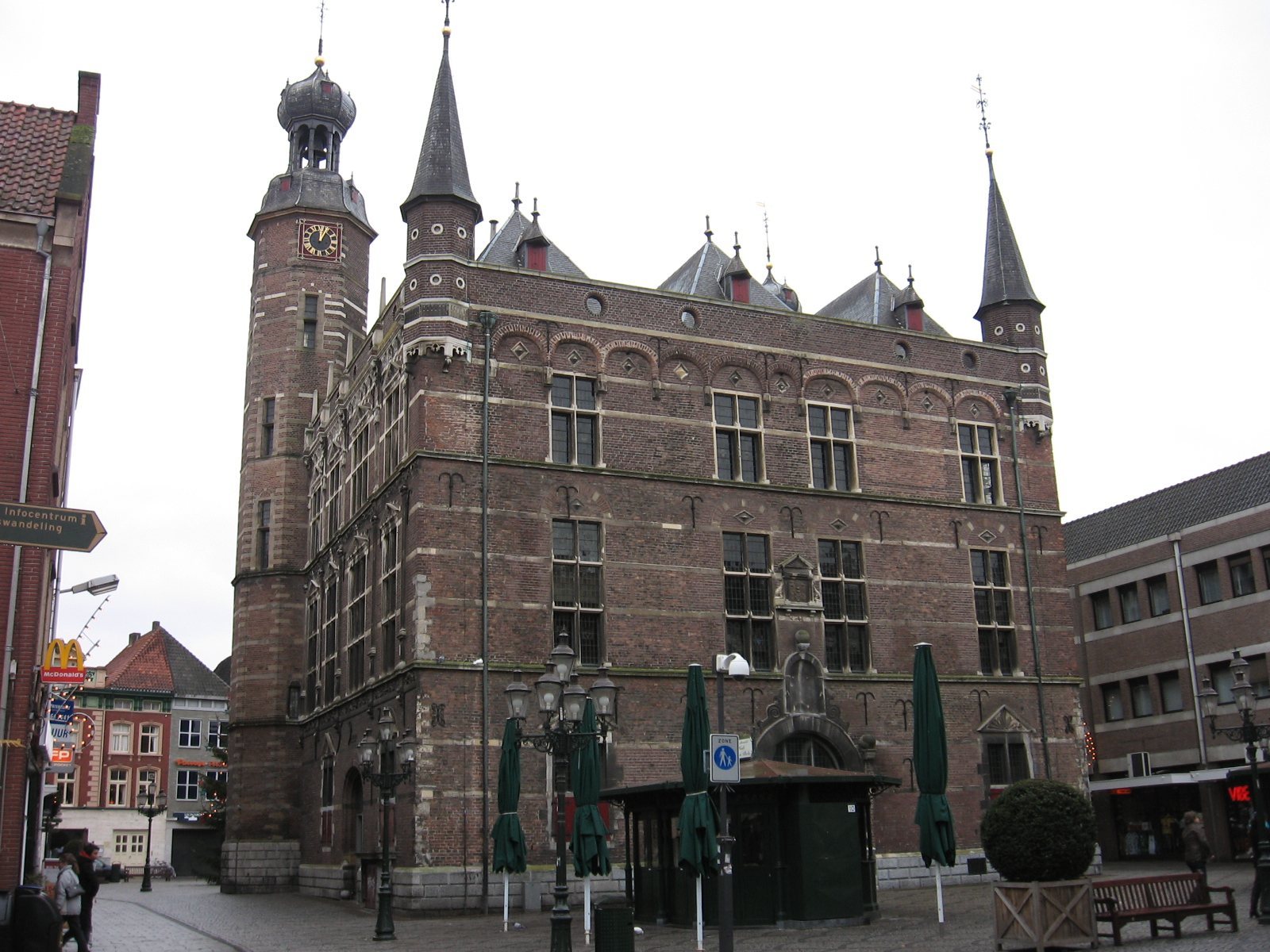
The City Hall of Venlo is a free-standing Renaissance town hall on Markt in the Netherlands, built between 1597 and 1601 in a European movement in art and architecture that revived classical forms. It replaced an earlier hall that had served Venlo’s council and civic life for roughly 250 years.
The early town hall
The first town hall was one of the few stone-built houses in Venlo. Gerard van Bocholt owned it in the first half of the fourteenth century and transferred it to the town council after Venlo received town rights in 1343. Before then, council members had met in aldermen’s homes. The building was named the Stone House in a record of 1374, and it was used for council meetings as well as for the meat trade. Aristocratic lords who held rights in the town had largely been bought out by the Duke of Guelders, a ruler of a historical duchy in the Low Countries, and had left the city.
The hall underwent several changes. A new mechanism was fitted to its tower clock, and a chamber, probably intended for council meetings, was built in 1411. In the fifteenth century, the town received 700 paving tiles without charge for a new floor. Damage during the 1511 siege led to the dismantling and rebuilding of one façade in 1516.
The Renaissance replacement
By 1596, the old building was considered inadequate. A period of peace and prosperity made a replacement possible, and the town commissioned a new hall from architect Willem van Bommel of Emmerich. Built between 1597 and 1601, it replaced almost all of the earlier structure.
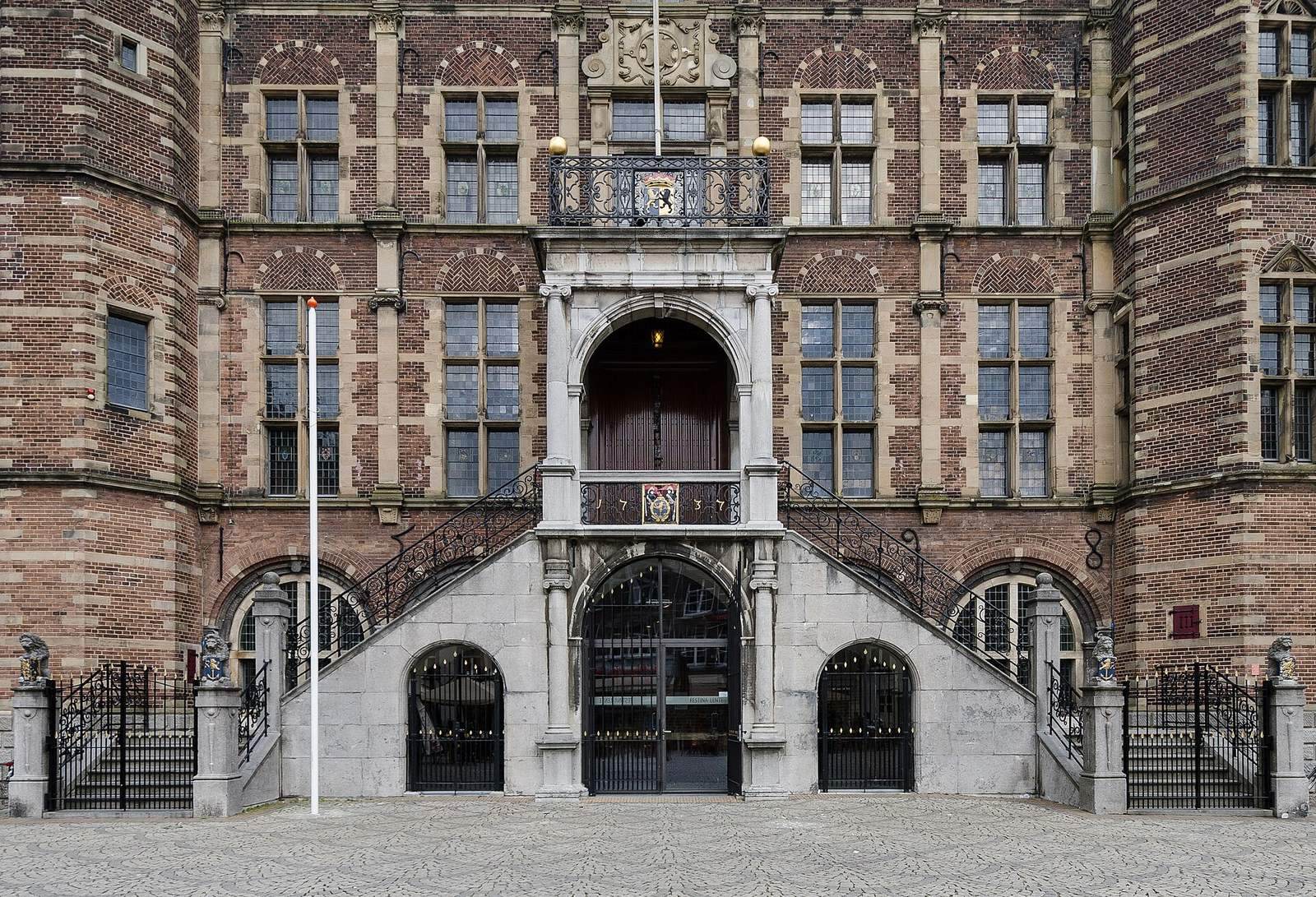
The entrance was later moved from the north side, facing Groenmarkt, to the south side, facing Markt. Steps and a landing were added in 1609, followed by a canopy in 1735. An extensive restoration took place between 1881 and 1887 under plans by Johannes Kayser. Work on the front and sides had begun in 1880 in a Neo-Renaissance style, a nineteenth-century revival of Renaissance design, and rear turrets were added.
Restoration and continued civic use
The town hall survived the Second World War almost unscathed. Restoration in 1956-1957 substantially changed its interior, while some older furnishings remained, including a canopy, a clock in the council chamber, and bells dated 1494 and 1513.
In 2003, the municipality commissioned a study of ways to improve access, climate control, and fire safety while retaining historic fabric. Renovation work in 2007-2009 added an elevator, replaced heating and ventilation systems, and adapted the building for broader access and varied uses. The town hall is protected as a Dutch national monument, listed under number 37165.
Remains
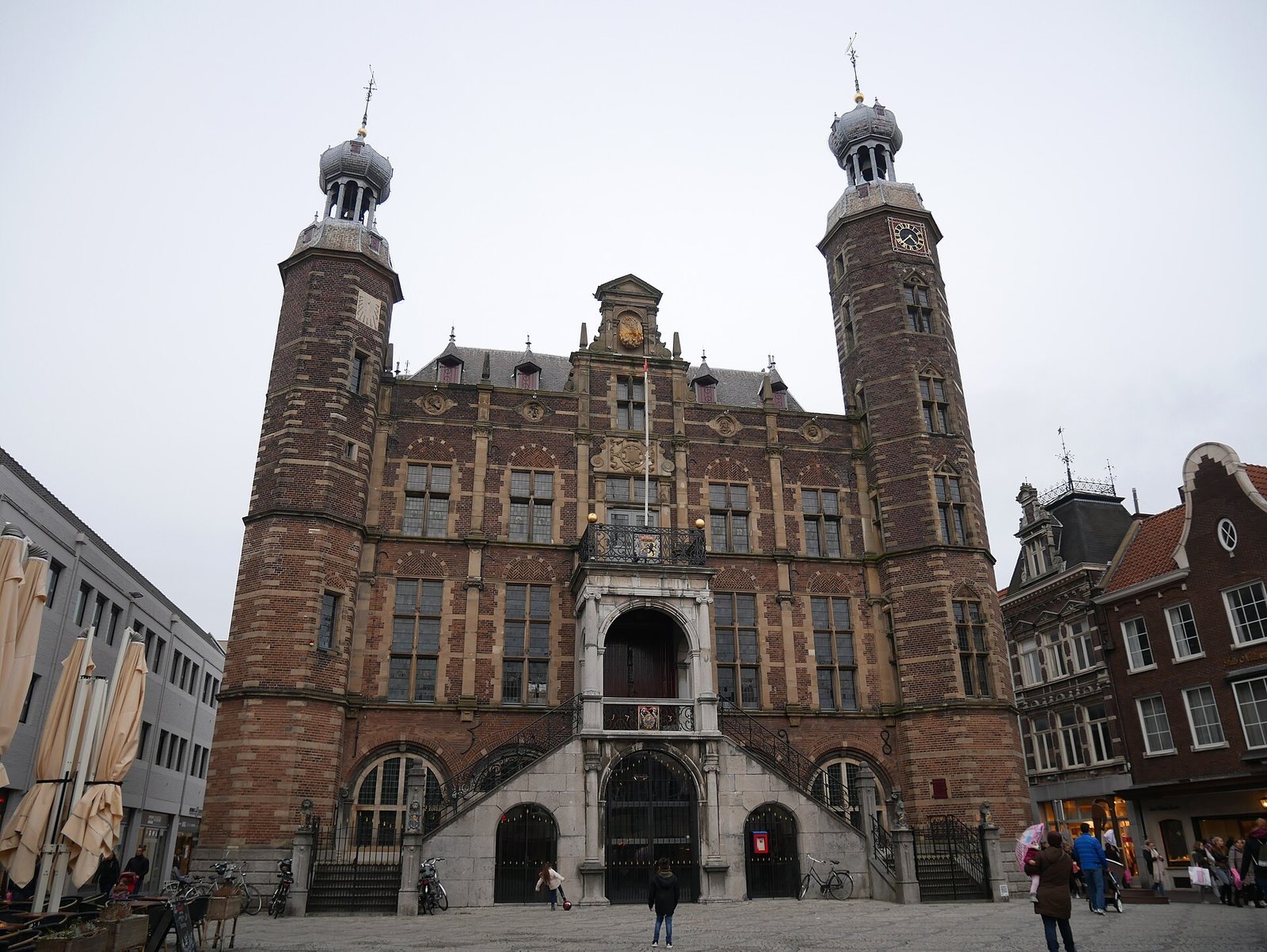
The building stands free on Markt, Venlo’s central square, where Steenstraat, Gasthuisstraat, and Parade meet Lomstraat and Vleesstraat. Its Renaissance design combines a main façade, two corner towers, and a ground floor that originally accommodated public and commercial functions. The building uses marl, brick, and stone.
Exterior and original ground floor
Façade and towers
The present exterior has decorative brickwork and ornamental stone bands rather than plaster. A drawing from 1741 shows the hall with block-pattern plaster, while a photograph from 1880 shows smooth plaster and a partly stripped eastern façade. Metal ties in the masonry mark the year 1598. Two octagonal towers of unequal height flank the façade, each topped by a small open-sided domed roof. A clock is set in the eastern tower and a sundial in the western one.
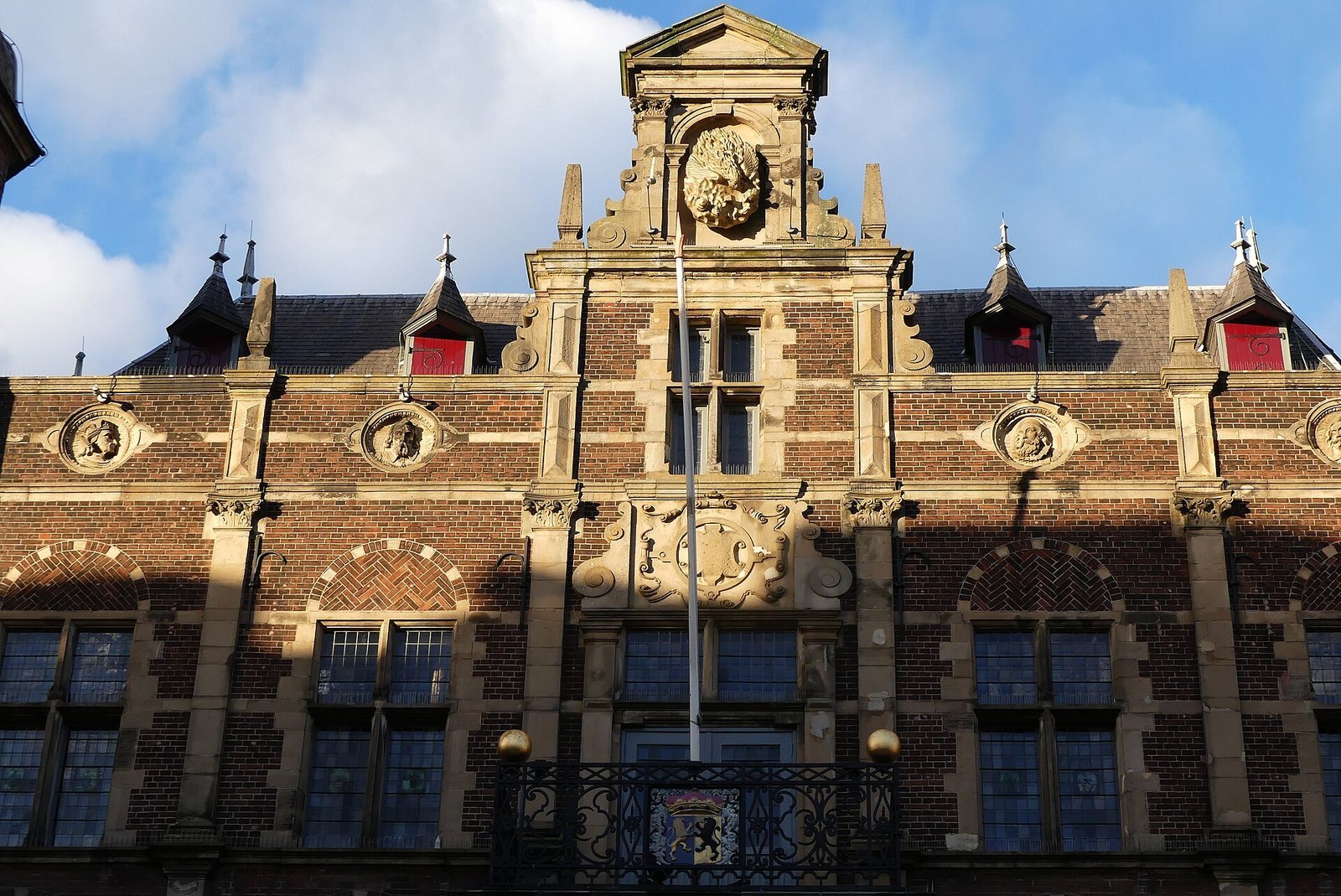
Four medallions on the upper façade portray figures associated with Venlo: bell-founder Jan van Venlo, humanist Erycius Puteanus, coin scholar and engraver Hubert Goltzius, and painter Jan van Cleef. The medallion intended for Hubert Goltzius depicts his nephew Hendrick instead. Van Cleef’s likeness was imagined, since no adult image of him was known. Shields representing Venlo, Guelders, and the United Netherlands also appear on the façade. The stained-glass windows bear the family arms of former town administrators.
Market and weighing hall
The original ground floor served as a market hall and contained a public weighing facility, where goods could be weighed for trade. A stone in the façade indicates this weighing function. Entrances opened on all four sides, and four Tuscan columns, a relatively plain classical column type, supported the ceiling. Cellar vaults from the earlier town hall survive below the replacement building, along with retained remains dating to the middle of the sixteenth century.
Interior rooms
Mayor and aldermen’s room
The mayor and aldermen’s room, once the council chamber, contains a clock dating to 1716 known as the Adam and Eve clock, after the biblical first couple. Gilded-leather wall covering from 1734 also survives in the room. Its so-called Italian fireplace has an eighteenth-century mantel resting on small marble columns and sixteenth-century sandstone supports carved as fauns or satyrs, mythological woodland figures with human and animal features.
Scenes carved on the supports show Adam and Eve beside the tree of the knowledge of good and evil in paradise, and their expulsion by an angel carrying a flaming sword. The expulsion scene follows a late-sixteenth-century Antwerp print engraved by Jan (Johannes) Sadeler I after a design by Crispijn van den Broeck.
Present arrangement
After the 2007-2009 renovation, the ground floor was arranged for multiple uses, including meetings and ceremonies. The first floor contains a civic hall, a wedding room, the mayor’s room, and the black-and-white room. The renovated council chamber occupies the second floor. New stairs and council-chamber furniture are clad in walnut, while slender steel sections form new interior fronts and the elevator structure. The buffet and pantry are finished in lime-colored paint.