Thuré Castle: The Seat of a Historic Lordship in France
Site at a Glance
- Popularity
- Medium
- Country
- France
- Primary era
- Early Modern
- Eras represented
- Early Modern
- Civilizations
- French
- Site type
- Domestic
- Remains
- Castle
On this page8 sections
History
Thuré Castle is a historic lordly residence in La Bazouge-des-Alleux, Mayenne, France. Its present building dates from no earlier than 1500, after an earlier castle was probably devastated during the Hundred Years’ War, a series of conflicts between the English and French crowns in the fourteenth and fifteenth centuries. Thuré was a fief, or land held under obligations to a superior lord, from Montsûrs; the return owed was a pair of golden spurs.
Medieval lordship and the de Feschal family
In 1235, Guillaume de Thuré secured rent from land at Ligneul to fulfill a promise his father had made to the Abbey of Fontaine-Daniel for his burial there. An agreement with the lord of Bourgon gave Thuré 94 arpents, a traditional land measure whose size varied by place and period, in return for giving up rights to use part of Bourgon Forest. This parcel became known as the Triage de Thuré. The estate also included part of Alloué Forest and low-justice rights, meaning jurisdiction over lesser offenses, purchased from the count of Laval.
The lord’s claim to high justice, jurisdiction over more serious offenses, was challenged in 1460. Even so, lords of Thuré exercised castellany rights, local administrative and judicial powers, and appointed notaries to their court from 1400 to 1464, again in 1558, and in the eighteenth century. The lord was also described as the parish’s founder. Repairs and rebuilding at the earlier castle in 1458 included work on its stables, kitchen, doors, windows and other rooms.
The de Feschal family held the lordship across generations. Jean de Feschal was married to Jeanne de Thuré in 1270 and 1272; later holders included Louis de Feschal, husband of Jeanne Auvé, in 1340, and Jean de Feschal in 1384. Another Jean, married to Jeanne de Brée, appears in 1417. A Jean de Feschal formally acknowledged Montsûrs as his superior lord in 1452 and was executor to Guyon du Bouchet in 1478. René de Feschal appears in 1490 and 1499; his wife, Jeanne Cornilleau, was widowed by 1506.
Sixteenth to eighteenth centuries
Jean de Feschal, a younger son of René, succeeded his two older brothers. Claude de Feschal, who died after 1540, married Catherine de la Roussière and divided his children’s inheritance in 1547. Their sons held the lordship in sequence: Charles in 1551, then Louis, recorded in 1558 and 1565. Louis also held La Motte d’Aron, may have been Protestant, and acquired the Monceaux fief in 1561. Jean de Feschal, recorded in 1580 as a knight of the king’s order, left 100 écus, a French monetary unit, to Laval hospital; his widow paid the bequest in 1589.
Brandelis de Champagne, Marquis of Villaines, married Anne de Feschal in 1558. Anne later married Urbain de Bouillé, around 1620, and died at Thuré in 1652. Hubert de Champagné held the estate that year, but it was seized from him in 1670. François Le Clerc du Boisjousse bought it for 40,000 livres, a French monetary unit, in 1682. Jean Le Clerc des Emereaux, first president of the presidial court at Angers, a French royal court of justice, is recorded as lord in 1705 and 1729. Pierre-Jacques-Louis-Auguste Ferron, Marquis de la Ferronays, married Françoise-Renée Le Clerc des Emereaux in 1722 and died in 1753; Pierre-Jacques-François-Louis-Auguste Ferron de la Ferronays is also listed among the lords.
The lordship of Monceaux and the Boisgat fief were later joined to Thuré. By 1778, its lands included heaths at Thuré, Ligneul, la Vannerie, Bourgneuf, les Boullais and la Rosselle; farms at la Rainière, la Bardoulière, l’Oisillère, l’Éturie, la Courtillerie and la Rocoulière; and smallholdings at la Malherbière, le Genetay and la Maison-Neuve. On 20 August 1778, Louis-Gabriel Carré de la Chevronnière, a military administrative official, bought the lordship and its associated lands.
Revolution and later owners
During the French Revolution, which began in 1789 and transformed France’s political and social order, an armed band threatened to pillage the château. On 28 May 1790, the municipal authorities and bourgeois militia of Martigné intercepted the group. After a third demand, its members surrendered their weapons in return for a promise to pay for grain they had taken. The château concierge’s son, the young Huneau, was killed by revolutionaries. Thuré’s woods also sheltered a brigand, a former servant at La Bazouge-des-Alleux who called himself Tranche-Montagne.
Carré de la Chevronnière sold the estate on 1 February 1792 to Louise Turpin, widow of Jean-Baptiste Piquois. Joseph, also called Joso, Piquois later attempted to breed horses and sheep there without success. Anselme Marie Legouis acquired the estate in 1804; Count Michel Ordener and his wife, Marie-Françoise-Pauline Legouis, held it from 1829. Jean-Marie Perdrigeon bought it in 1833, and Daniel-Louis Daudier acquired it by exchange in 1847. Daudier’s son Jules-Marie, a military man, sold the estate in 1902 to Louis du Pontavice des Renardières. The du Pontavice des Renardières family is identified as its current owner.
A chapel dedicated to Saint Sebastian, an early Christian martyr venerated as a saint, was established at Thuré in the seventeenth century. In the early nineteenth century, its preservation was sought for secular use. M. Daudier had it blessed again on 13 November 1853; it also served the chapels of Burdé and Genderie.
Remains
The present château
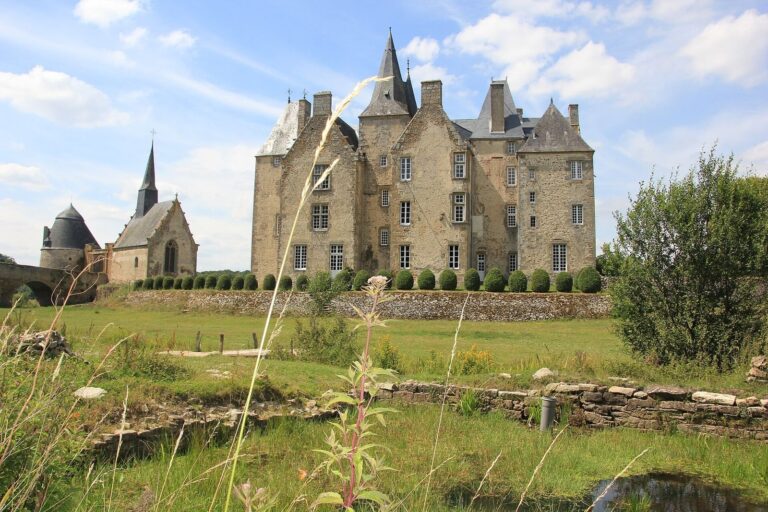
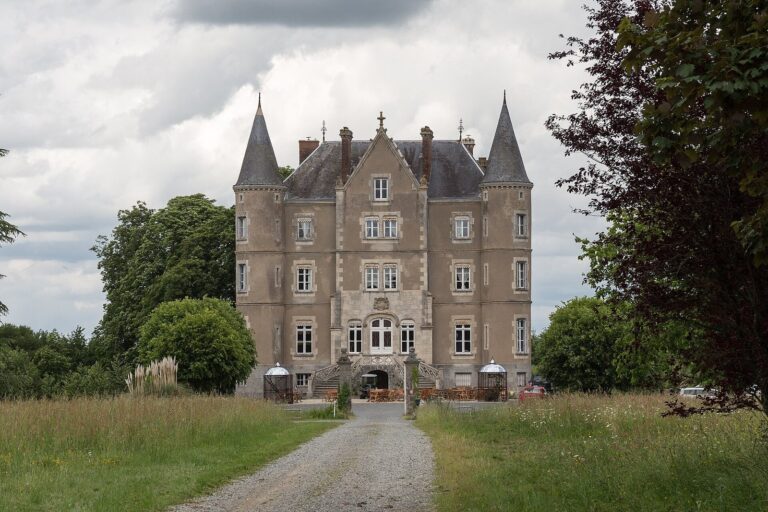
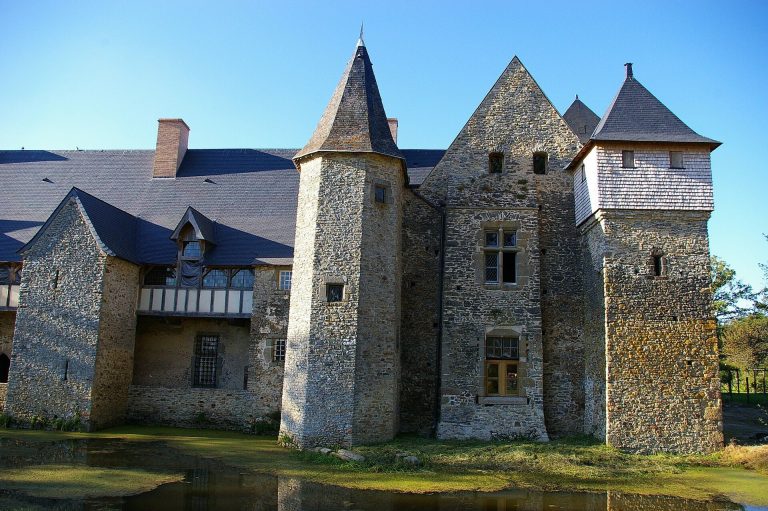
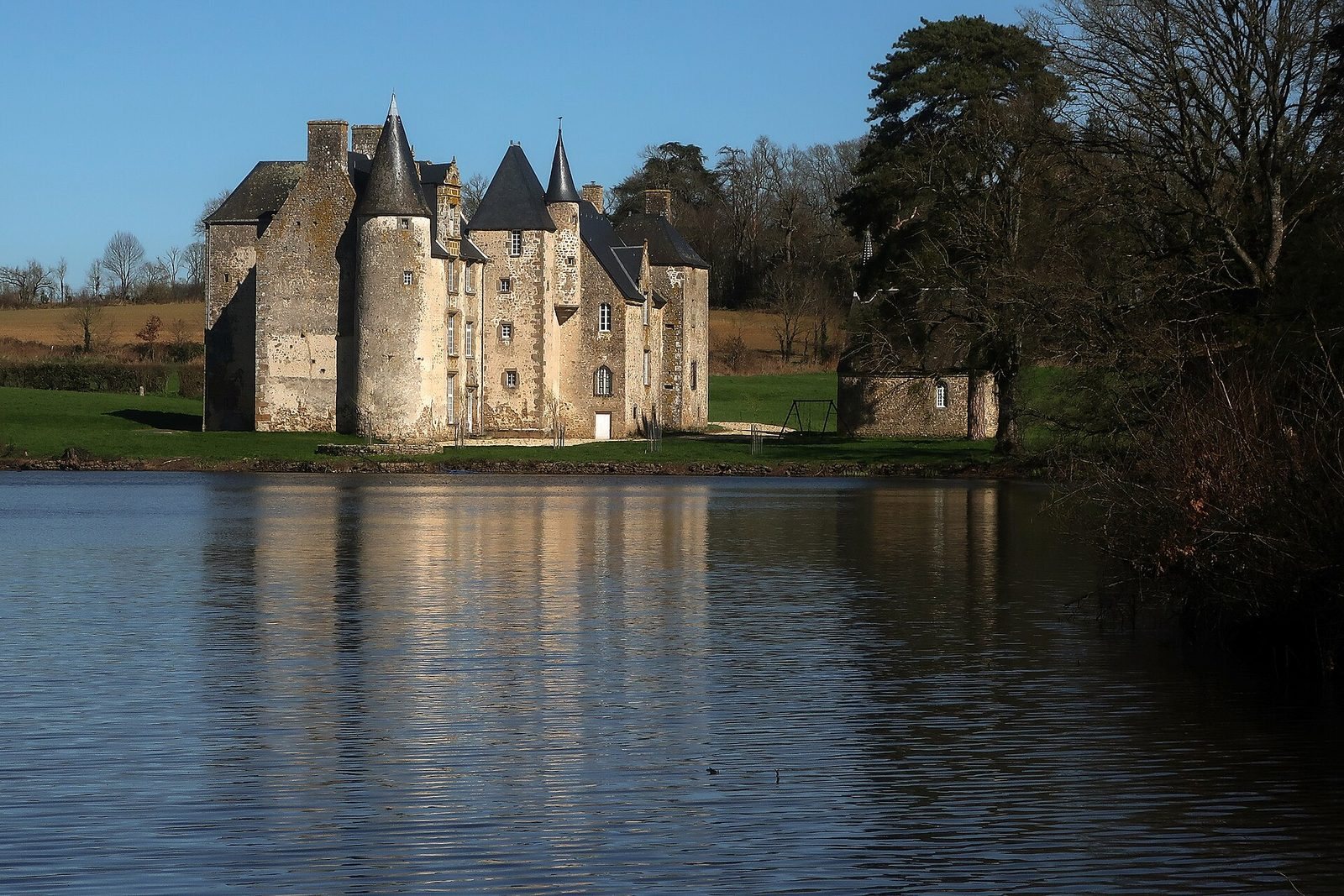
The château comprises two distinct sections of nearly the same age, forming an extensive building with several angles and setbacks. A turret supported by projecting masonry and a tower at the corner of the principal section break up its outline. Two Renaissance dormer windows are set apart from the lower doors and windows. Inside, a large room rising to the height of two storeys has a gallery. It was said to have served as a place for Protestant preaching; Protestantism is a branch of Christianity that emerged from the Reformation. A description from 1670 names a drawbridge and moats among the château’s features.
Courtyard and estate features
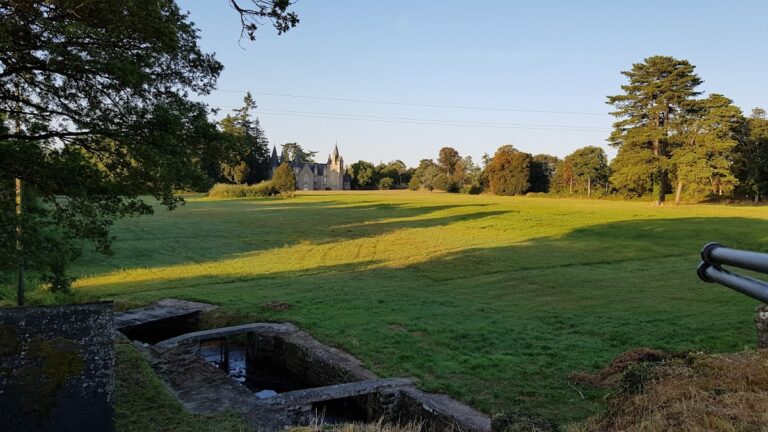
The chapel stands in the courtyard in front of the château. Estate descriptions also list a pond and a mill among the property’s features.
Seal of the court
The château archive held a fifteenth-century seal bearing the arms of the de Feschal family. Its partly reconstructed inscription identifies it as the seal used for contracts made by Thuré’s court.