Ebenzweier Castle: A Noble Estate and Country Residence in Austria
Site at a Glance
- Popularity
- Medium
- Country
- Austria
- Primary era
- Early Modern
- Eras represented
- Medieval, Early Modern
- Civilizations
- Duchy of Austria, Habsburg, Habsburg Austria, Holy Roman Empire
- Site type
- Domestic
- Remains
- Castle
On this page11 sections
History
Ebenzweier Castle stands in Altmünster, Austria, and its history reaches back to the thirteenth century as the ancestral seat of the Schachner family. The estate later passed through several noble families before becoming a country residence and, eventually, an educational complex.
The Schachner family
The Schachners are first recorded at Ebenzweier in 1292, through Ditmayr Schachner. The estate was also known as Schachen; in 1380, during Paul Schachner’s ownership, it was called the Schachnerhof. Ebenzweier derives from a term meaning “beside the pond,” and the family used the names Schachen and Nebenzweier interchangeably.
A feudal register of 1446 lists the Schachners as retainers of the Lords of Ort. Hans Schachner appears in records in 1526 and Abraham Schachner in 1550. The family adopted Protestantism during the sixteenth century. Abraham served as pastor at Altmünster in 1564, and the estate passed to his son, also named Abraham, in 1580.
Confiscation and changing ownership
The Schachners were forced to leave the country because of their Protestant faith. In 1626, during the Counter-Reformation, the Catholic Church’s response to the Protestant Reformation that in some territories included restrictions on Protestant worship and property, the territorial ruler confiscated Ebenzweier. Christoph von Zedlitz held it briefly in 1629, followed by Abraham von Rohrbach. In 1633, Abraham’s widow Regina sold the estate to Thomas II von Seeau. The Seeau family enlarged the older castle.
Johann Philibert von Seeau was identified as Baron of Ebenzweier in 1681. Debt brought the estate under compulsory administration in 1724, and it was offered at public auction in 1742. Anton Nikolaus Franz Xaver von Seeau, the last Seeau baron of Ebenzweier, died in 1743. Baron Elias Engl von Wagrein bought the property from the bankruptcy assets in 1767 and sold it about six years later to Anton von Unkrechtsberg zu Puchberg.
The last Unkrechtsberg died without an heir in 1801, and the castle was put up for sale. Florian Max Clodi acquired the estate in 1802 from the inheritance estate. His heirs later sold it to Archduke Maximilian Joseph d’Este, who substantially renovated the castle and adapted it as a country residence.
The d’Este residence and royal gatherings
Ebenzweier hosted visits by members of royal families. In spring 1834, Queen Maria III arrived with her family, including the future King Francis I. Maria’s sister, Empress Maria Anna of Austria, and her husband, Emperor Ferdinand I, also joined the gathering. Francis returned in 1839, in 1848 with his wife Adelgonde while they were exiled from Modena, in 1850 for the death of his uncle Archduke Ferdinand of Austria-Este, and again in 1852.
A larger gathering in 1856 brought Francis and Adelgonde together with Henri, Count of Chambord, a Bourbon claimant to the French throne, and Francis’s niece, the future Queen Maria IV and III. Archduke Maximilian died at the castle on 1 June 1863, and his niece, Archduchess Maria Theresa, inherited the estate. From 1864, part of the complex housed a convent and a private school.
Bourbon ownership, education, and the 2016 fire
Maria Theresa sold the estate to Prince Don Jayme de Bourbon in 1891, and Alfonso von Bourbon succeeded him the following year. In 1971, Carlos Hugues de Bourbon gave the castle to the municipality of Altmünster. It later passed to the State of Upper Austria, which adapted it for vocational and boarding schools. Before the state acquired it, the complex had been rented temporarily to a United Nations organization. A hospitality vocational school was established there in 1986.
A smouldering fire began near the eastern park entrance on 9 May 2016 and spread to the roof. Investigators initially suspected that a cigarette ignited ivy on a pillar and that strong winds carried the flames upward. As local hydrants could not supply enough water, crews laid 18 lines from nearby Lake Traunsee, temporarily closing the Salzkammergut road. At the height of the response, 31 fire brigades, about 450 firefighters, and 86 vehicles were involved. Firefighting lasted more than 52 hours, ending at 5 p.m. on 11 May. Students were evacuated, and alternative accommodation was arranged for more than 200 boarding pupils.
Remains
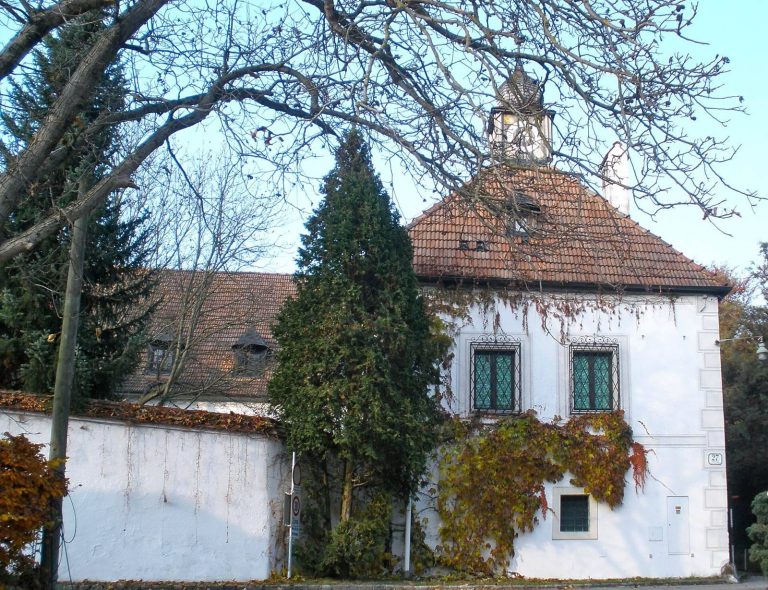
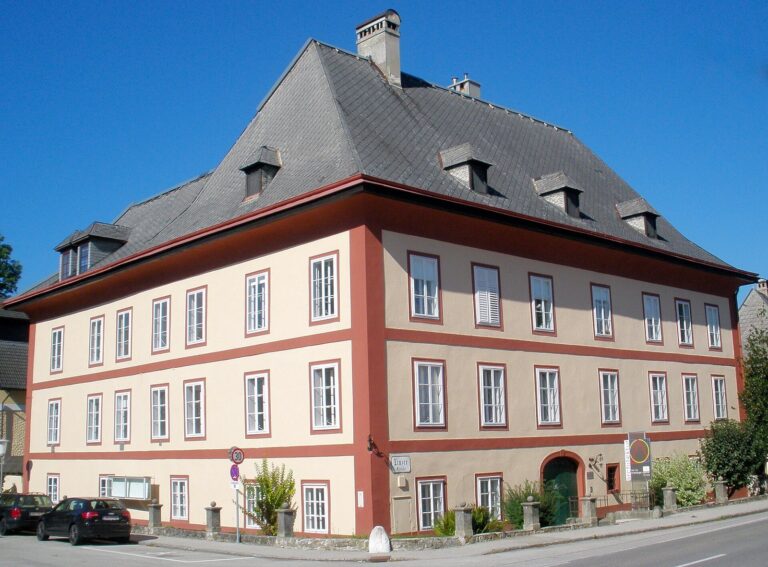
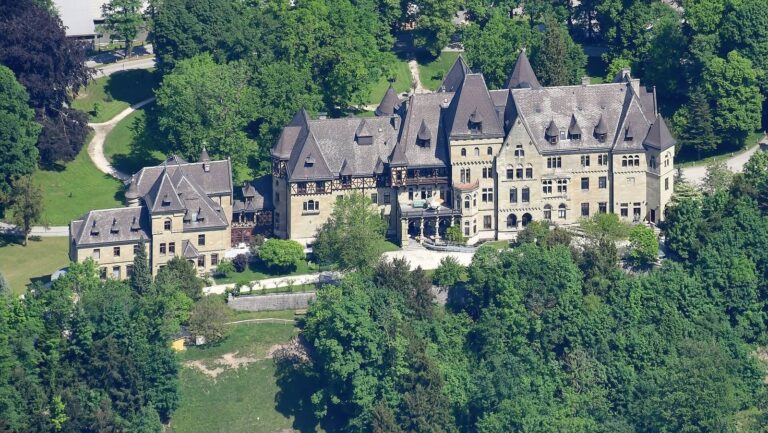
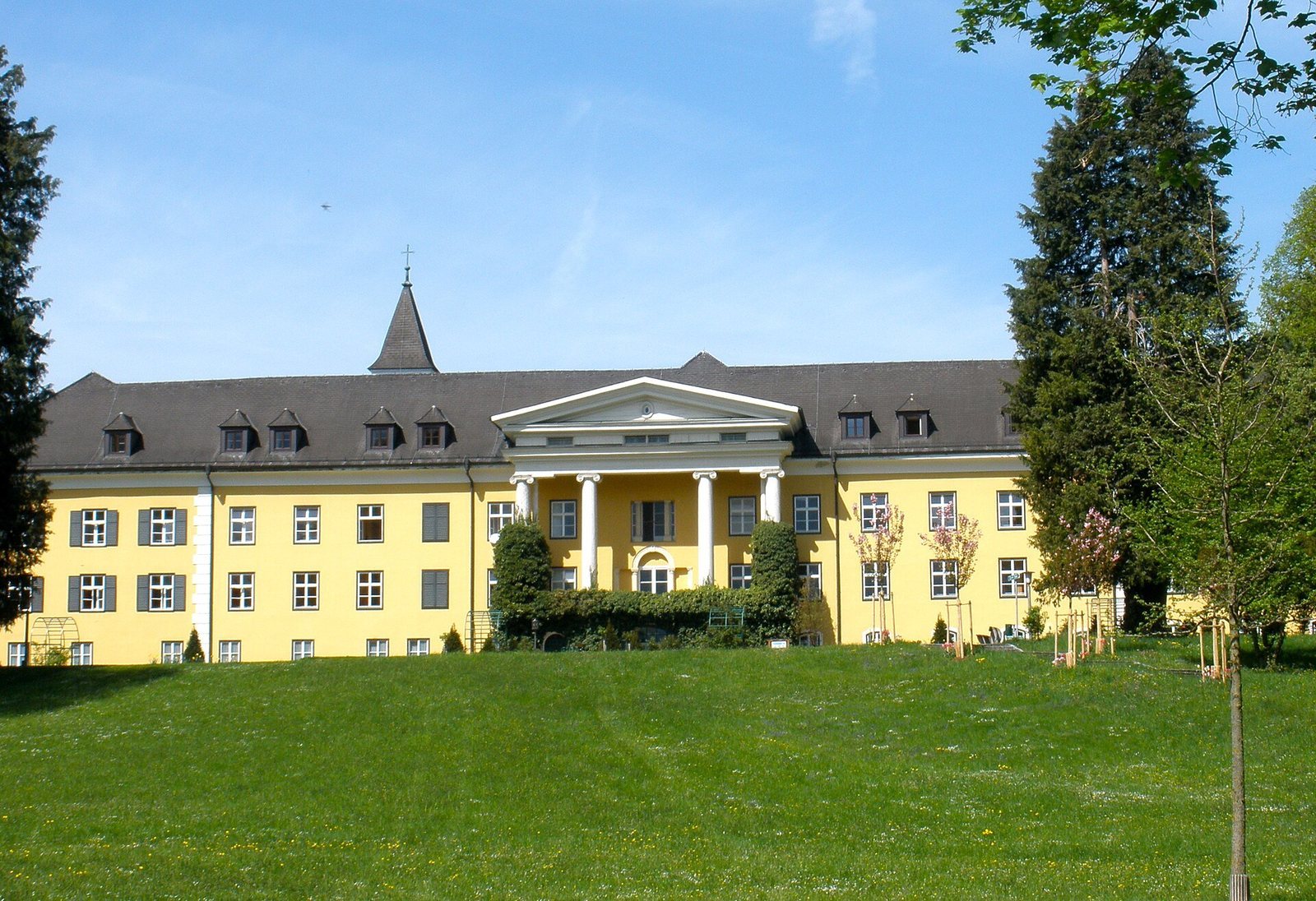
Repeated alterations have produced a three-storey complex with two courtyards, set within a park beside Lake Traunsee. The main facade faces the park and lake, while the grounds now extend only as far as the main road.
Courtyards and forecourt
The inner courtyard is enclosed on all sides by buildings and has been reconstructed. The outer courtyard has building sections on three sides and a wall closing its western side. A separate wall with a broad entrance gate divides the forecourt from the road. In the forecourt, an octagonal stone fountain basin bears engraved or raised coats of arms. Its central stone column has spouts on two sides beneath wrought-iron grille arches and supports a figure of Saint Florian, an early Christian martyr traditionally invoked in Austria for protection against fire.
Facades and upper structures
The three-storey facade facing the park and Lake Traunsee contains 75 windows and a central columned portico, a porch supported by columns. An architrave, the horizontal beam resting on the columns, and a pointed pediment, the gable-shaped element above, complete its central design. This main facade is neoclassical, while the side facades are largely undecorated. Glazed galleries occupy the upper storeys of the central wing. A slender clock turret has a gable above its cornice and a slightly bulging conical roof.
Chapel
The chapel contains a richly carved door dated 1633 and a Baroque altar from about 1660. Images of saints, most dating to the seventeenth century, are also kept there.
Park
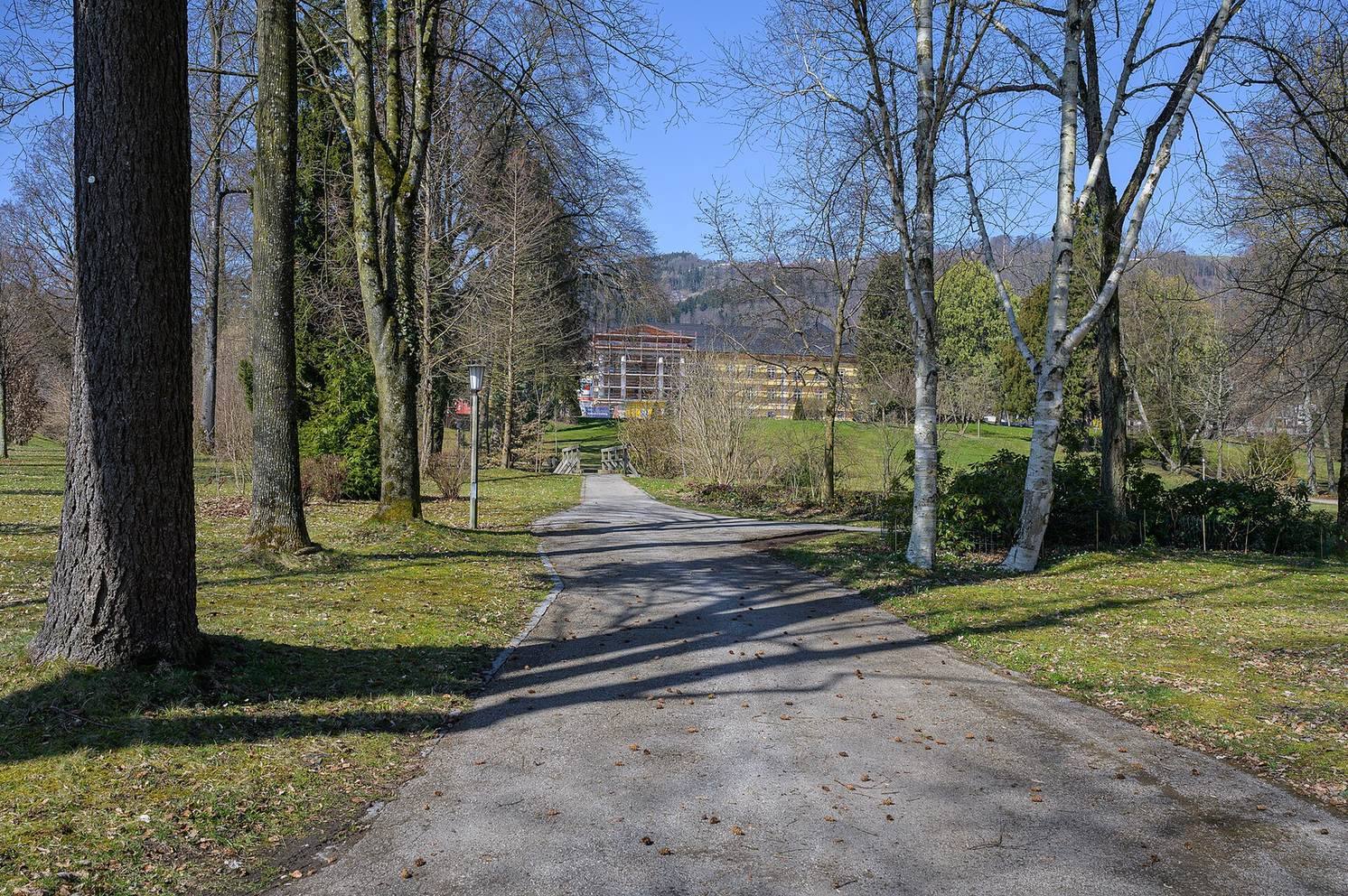
A 1674 engraving by Georg Matthäus Vischer depicts enclosed ornamental, kitchen, and tree gardens. Archduke Maximilian Joseph d’Este laid out the present landscape park, which once reached the lake. Oaks, birches, yews, and maples in the grounds are regarded as monumental trees.
Fire damage
The fire caused extensive damage to the building. Its roof structure and attic level collapsed into the second floor, and the castle was considered at risk of collapse.