Château d’Augerville: A French Château and Historic Estate
Site at a Glance
- Popularity
- High
- Country
- France
- Primary era
- Early Modern
- Eras represented
- Medieval, Early Modern, Modern
- Civilizations
- French
- Site type
- Domestic
- Remains
- Castle
On this page14 sections
History
Château d’Augerville is a château and historic estate in France, developed from a fief, or landholding governed through feudal obligations. Its fortified château took shape at the end of the thirteenth century, and the complex is associated with Gothic and French Renaissance architecture. Built and enlarged by successive owners, it served as the centre of a changing lordship and later became a private residence associated with prominent political and cultural figures.
From hamlet to Beaumont stronghold
Augerville appears in a charter of 1119 as a hamlet. From 1207 it formed a fief held by the knight Philippe d’Augerville, whose sons Thibault and Louis built a small fortified structure with a dovecote. When Louis died without an heir in 1248, the holding passed to Pierre and Dreux de Beaumont. The Beaumonts belonged to a prominent family whose earlier generations had served Robert the Pious, while members of their own generation served Saint Louis and Charles I of Anjou.
Pierre and Dreux built a fortified château at the end of the thirteenth century. In 1290, Dreux’s son Jean inherited and enlarged it. During the Hundred Years’ War, a conflict between England and France over the French crown and territory, Pierre’s son Jean III de Beaumont supported the English. Sentenced to death by the provost of Paris, he was executed on 6 September 1367. His lands were confiscated and managed by the Count of La Rivière before being returned to Jean’s widow, Jeanne de Courtenay. When she died without children, another branch of the Beaumont family took the fief in 1403.
Jean’s brother Pierre inherited the château but fled during the English occupation. The occupiers dismantled the fief and redistributed its lands to French supporters of the English king. Neglect and looting left the château in ruins before the royal financier Jacques Cœur bought it in 1452. After Cœur was tried for embezzling royal funds and sentenced to exile, his property was confiscated in 1453. His son Geoffroy leased part of the fief from 1463. On Geoffroy’s death in 1488, the château passed to his son Jacques II Cœur, who squandered his inheritance. Jacques II died without children in 1505, and his sister Marie inherited the estate.
Marie Cœur and the Luillier family
Royal permission granted Augerville-la-Rivière a market and two annual fairs from 1508. Their income helped pay for work on the château, village, and church. The church received a new bell dedicated to the Virgin Mary and Marie Cœur, who was buried there in 1557. Her son Jean Luillier inherited the fief but rarely lived at Augerville. On 17 September 1562, the château hosted Catherine de’ Medici, queen of France, and her young son, King Charles IX.
An inventory made on 30 June 1582 describes a lordship with high, middle, and low justice, meaning judicial authority at three levels, under the royal castellany of Grez-sur-Loing. Dues owed to the lord of Nemours included two muids, local measures of grain, as champart, a one-twelfth share of the harvest; two muids of wheat for leases of two mills; 60 capons; and three hens. Jean Luillier’s son Nicolas inherited in 1563. Nicolas II Luillier received the fief and his father’s royal offices in 1588, but, like his father, preferred Paris to Augerville.
Nicolas II left the château in ruins to his only daughter, Louise Luillier, in 1618. The lord of Nemours took legal action the following year over her obligation to submit an inventory of the fief. Louise and her husband, Henry de Balsac d’Entraygues, neglected the estate. In 1637, the Parlement of Paris, the monarchy’s high court of justice, ordered its sale to pay transfer duties.
Perrault de Montrevost and the Condé connection
François Sabatier bought the château and fief, adding the lordship of Heurtebise, a marsh, and two warrens, areas managed for rabbits. He enclosed the estate with walls, but the neglected land proved too costly to maintain. The Parlement seized it in 1644. That year Jean Perrault de Montrevost, a secretary and administrator to the Prince of Condé and later his son, the Grand Condé, purchased the property and undertook extensive rebuilding and expansion.
In 1649, Perrault de Montrevost added land at Orville, bringing the enclosed estate to 370 arpents, a historical unit of land area whose size varied by locality. A room and a year-round valet were reserved at the château for the Prince of Condé. After the prince fell from favour in 1650, he and Perrault de Montrevost were imprisoned at Vincennes on the orders of Cardinal Mazarin, the chief minister of France. That year the Princess of Bourbon, escaping from Chantilly, briefly reached the empty château before continuing her flight.
The released Prince of Condé stayed at Augerville in the winter of 1651–52 while awaiting an answer from Anne of Austria, the regent during her son Louis XIV’s minority. Her messenger mistakenly went to Angerville. After waiting without receiving a reply, Condé left for Spain and became a leading figure in the Fronde of the Princes, a revolt against the French crown in the mid-seventeenth century. Perrault de Montrevost returned to Augerville in October 1652 and spent his final years there, even after recovering royal favour.
Perrault de Montrevost’s efforts to restore feudal duties, including compulsory labour, met resistance from local people. Louis XIV ruled in his favour in 1656. In 1658, Perrault bought the lands of Milly for 220,000 livres, but the cost of maintaining his estates became unsustainable. His fief was seized in 1676. He tried unsuccessfully to regain it until his death in 1681.
Inheritance, revolution, and invasion
In 1720, Jeanne-Marie Perrault de Montrevost, an illegitimate daughter of Jean Perrault de Montrevost, obtained the château and fief through an agreement with his family. Her great-grandson Marc Antoine Front de Sainte-Aulaire died in 1761, aged 21, and the estate passed to his cousin Jean-Louis Antoine Dulau, Chevalier d’Allemans. The fief then extended across 39 parishes, contained ten mills, and brought in 10,000–12,000 livres a year. Dulau rarely visited. One of his few recorded stays was for his son’s marriage on 15 February 1770. He left the collection of peasant taxes to farmers and estate management to his notary.
On 3 September 1792, Dulau’s brother Jean-Marie, Archbishop of Arles and a former clerical deputy to the Estates-General, was killed in Paris. The Estates-General was an assembly representing the clergy, nobility, and commoners, convened in 1789 amid the political crisis that led to the French Revolution. The Dulau family emigrated, and commissioners from Pithiviers sealed the château and fief on 24 October. Notary René Prou became caretaker and manager. The fief was split into 36 lots and sold at auction to local inhabitants, despite efforts by Elisabeth Vergès, the Chevalier’s wife, to prevent its breakup.
The property was pillaged. Prou was dismissed after sending Vergès some possessions from the château, and a replacement forest warden could not prevent further damage. In March 1793, gendarmes from Nemours broke into the cellar and drank 50 bottles of wine in one day. When the Dulau family returned to France in 1802, they found the château and estate ruined. They sold them to the de Salgues couple in 1810, who sold the property to Joseph Prévost in 1813.
During the 1814 invasion that followed Napoleon’s retreat from Russia, Cossack forces occupied the Gâtinais and Augerville. Prévost organized local resistance, and a detachment of General Platov’s forces was killed. The dead men and horses were placed in the château’s moat. The invaders were told that the attack had taken place at nearby Heurtebise, which they razed in a punitive expedition.
Berryer and the nineteenth-century estate
Prévost sold the estate in 1818 to the Marquis de Beaunay and Victoire Carrefour de La Pelouze. Unable to maintain it, they lost it at auction in 1825. The buyer, lawyer and royalist deputy Pierre-Antoine Berryer, extensively reworked the château. For the 43 years until his death in 1868, the estate hosted guests including Chateaubriand, Alexandre Dumas fils, Franz Liszt, Gioachino Rossini, Alfred de Musset, and Eugène Delacroix.
Berryer’s sister, the Duchess of Riario Sforza, acquired the estate at auction after his death, paid his debts, and made further improvements. Her nephew Pierre Clément Berryer inherited it and died without children in 1879. The estate was auctioned on 8 August that year. The buyer, the Count of Madre, died six weeks later, and his wife and daughter allowed the property to deteriorate. They sold it by private agreement to the Count of Pange in 1912 for 300,000 francs. He repaired the façades, gardens, and land before selling the estate to industrialist Félix Mouton for 500,000 francs in autumn 1919. Mouton renewed the apartments, converted the stables into garages, and added a tennis court.
Twentieth-century ownership and protection
In summer 1926, American socialite Alva Belmont bought the estate and made it her main residence. Château d’Augerville was one of several inspirations for her châteauesque-style Petit Château in Manhattan, a building designed to evoke French châteaux. Her daughter Consuelo later wrote that she believed the story of Jacques Cœur’s ownership had partly prompted the purchase. Belmont died in 1933 and left the estate to Consuelo Vanderbilt, who sold it to the Swiss company Balmagera in winter 1937.
Balmagera’s majority shareholder, the German chemist Dr. Kopp, lived in the service buildings while the château stood unoccupied. During the Second World War he became a colonel in the Wehrmacht, Nazi Germany’s armed forces, and remained at Augerville after France’s liberation. He turned the park farm into a stud farm and established a laboratory in the service buildings. In December 1958 he signed a preliminary sale agreement with theatre director René Sanselme. After the transaction ran into difficulty, Kopp was arrested in 1962 for illegally possessing weapons of war and trafficking heroin, and the estate was placed under sequestration.
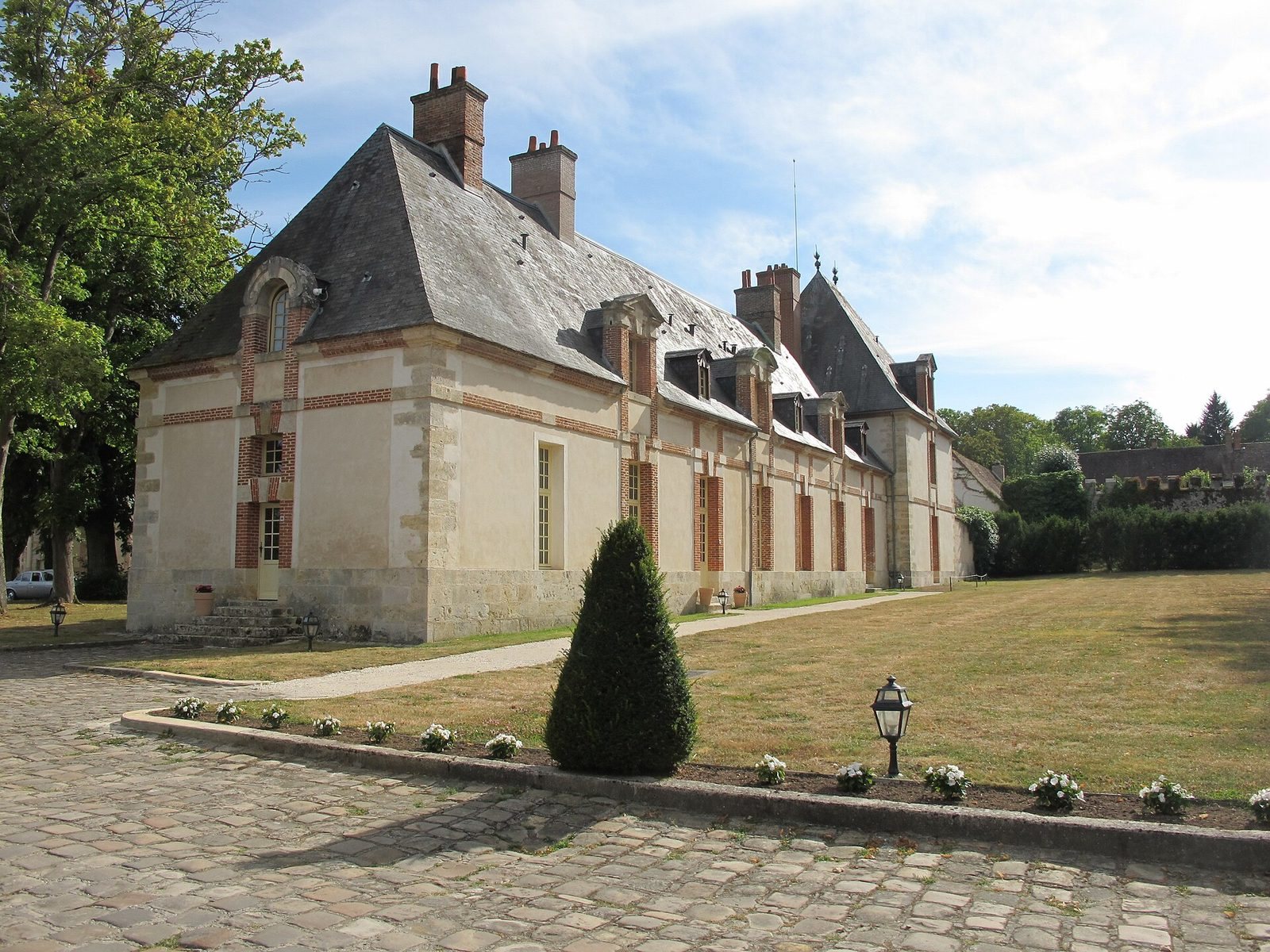
The furnishings were auctioned in September 1976, and the château and estate were sold to a buyer who intended to create a leisure park. Protection under France’s historic-monument inventory, a heritage designation for buildings and other property, prevented that project. The owner instead opened a nightclub in a wing of the service buildings. An arson attack destroyed the club on the night of 6–7 January 1986. By then, a failing roof had made the château uninhabitable. The property changed hands twice between 1986 and 1989. The 1976 protection covers the château façade and the façades and roofs of the service buildings and dovecote. The estate is now a luxury hotel with a golf course; its 18-hole course was established in 1995.
Remains
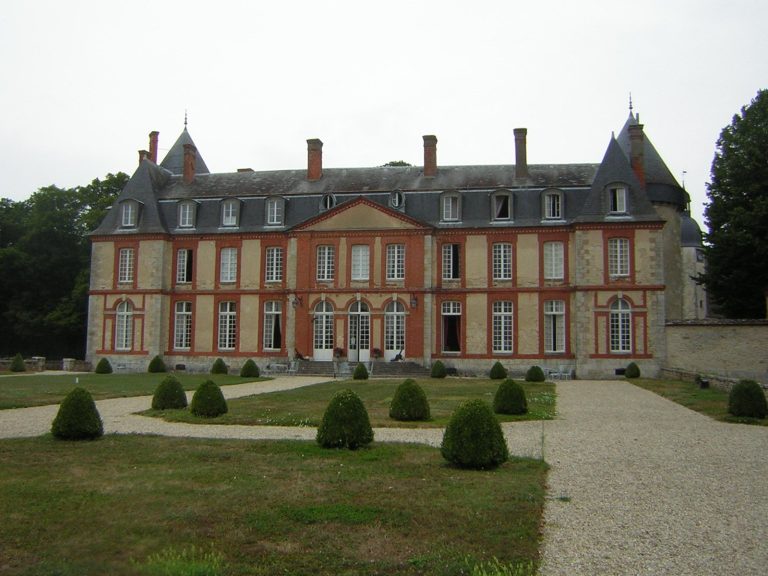
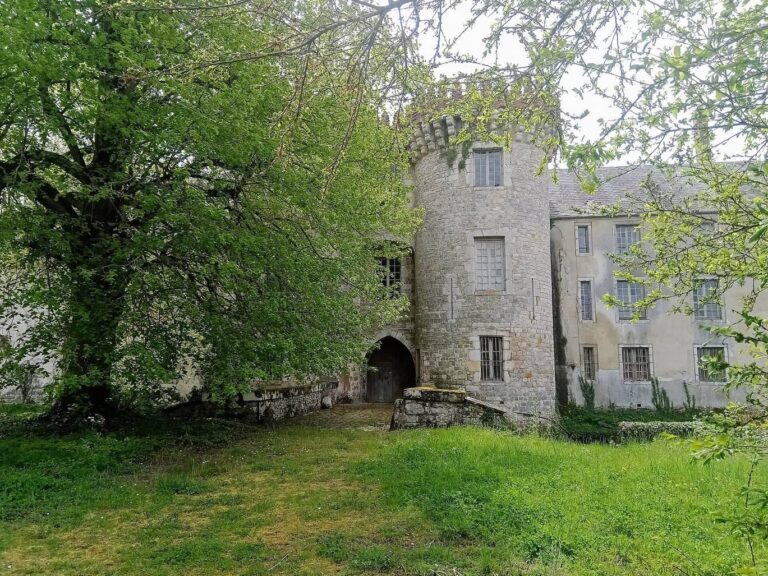
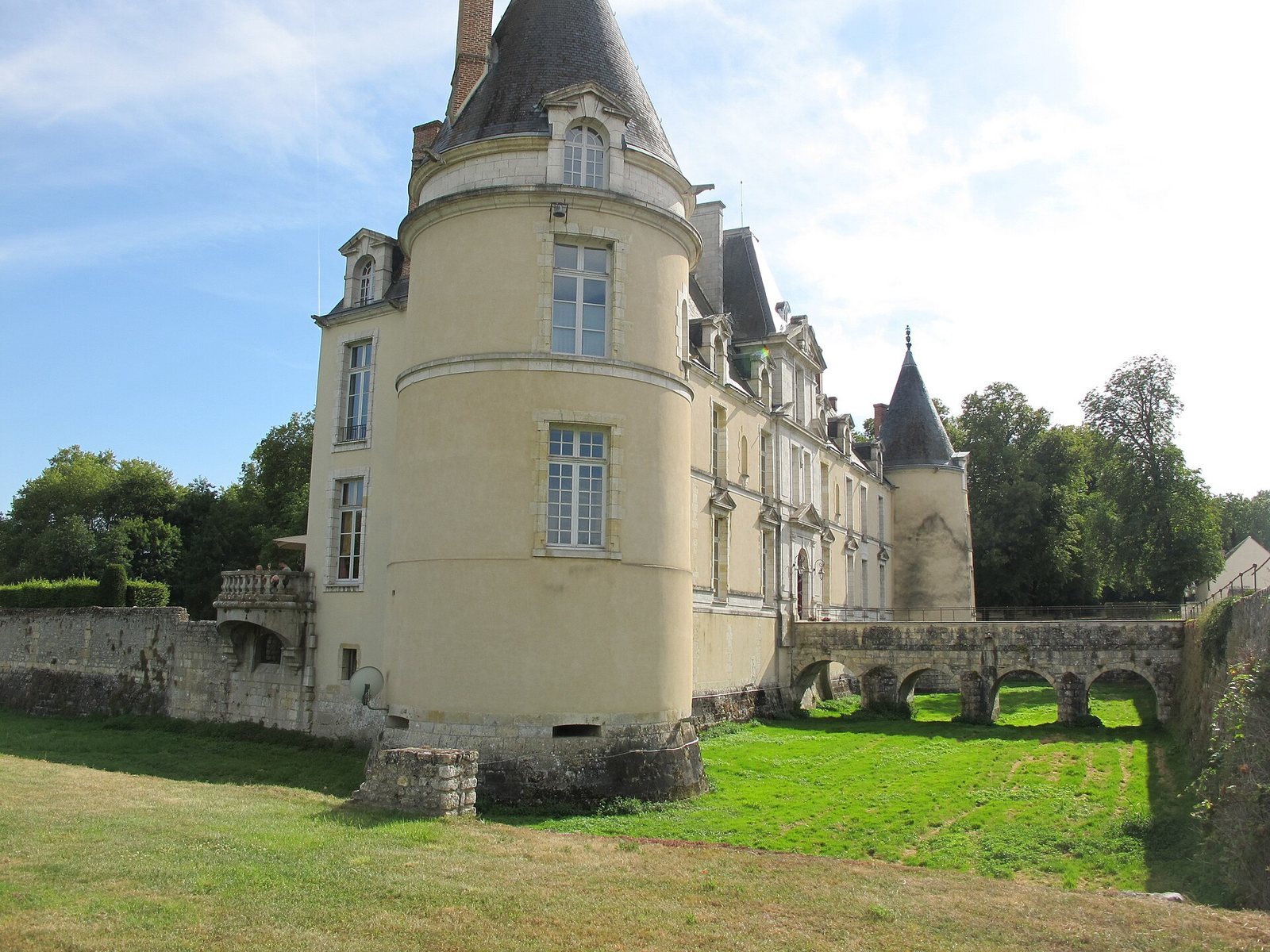
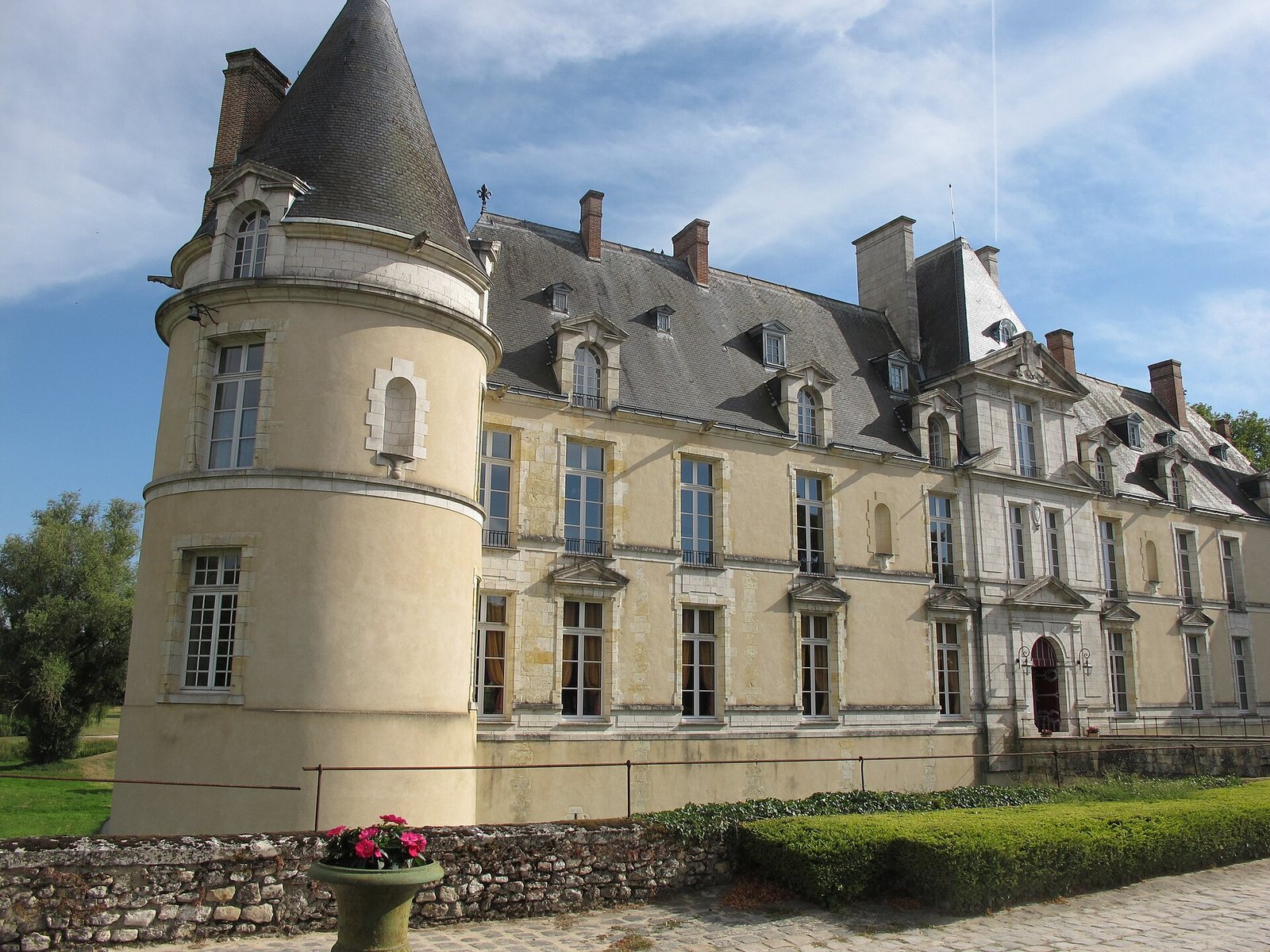
The estate combines a fortified château, service buildings, enclosed courtyards, and landscaped grounds shaped by successive rebuilding. The surviving architectural complex is associated with Gothic and French Renaissance styles. Descriptions from the sixteenth through nineteenth centuries record a walled site with a moat, a main residence and agricultural buildings, and formal grounds extending toward the river.
Château and service buildings
The main château
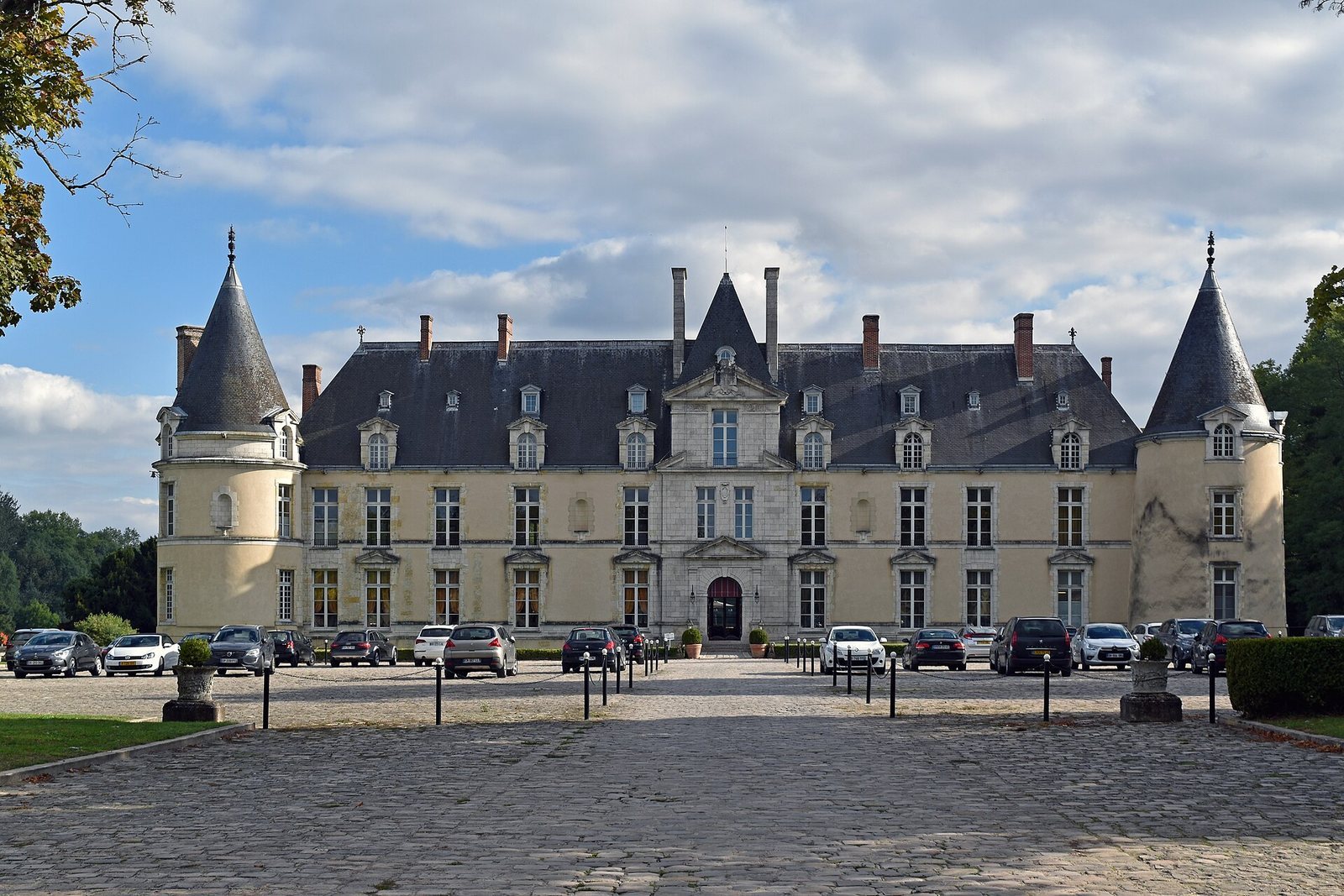
The early fortified structure had a dovecote beside it. A larger fortified château was built at the end of the thirteenth century and enlarged in 1290. In the 1640s, its façades and apartments were renewed. A description from this period presents a substantial main building with halls, rooms, kitchens, offices, and other chambers, and four corner towers roofed with slate.
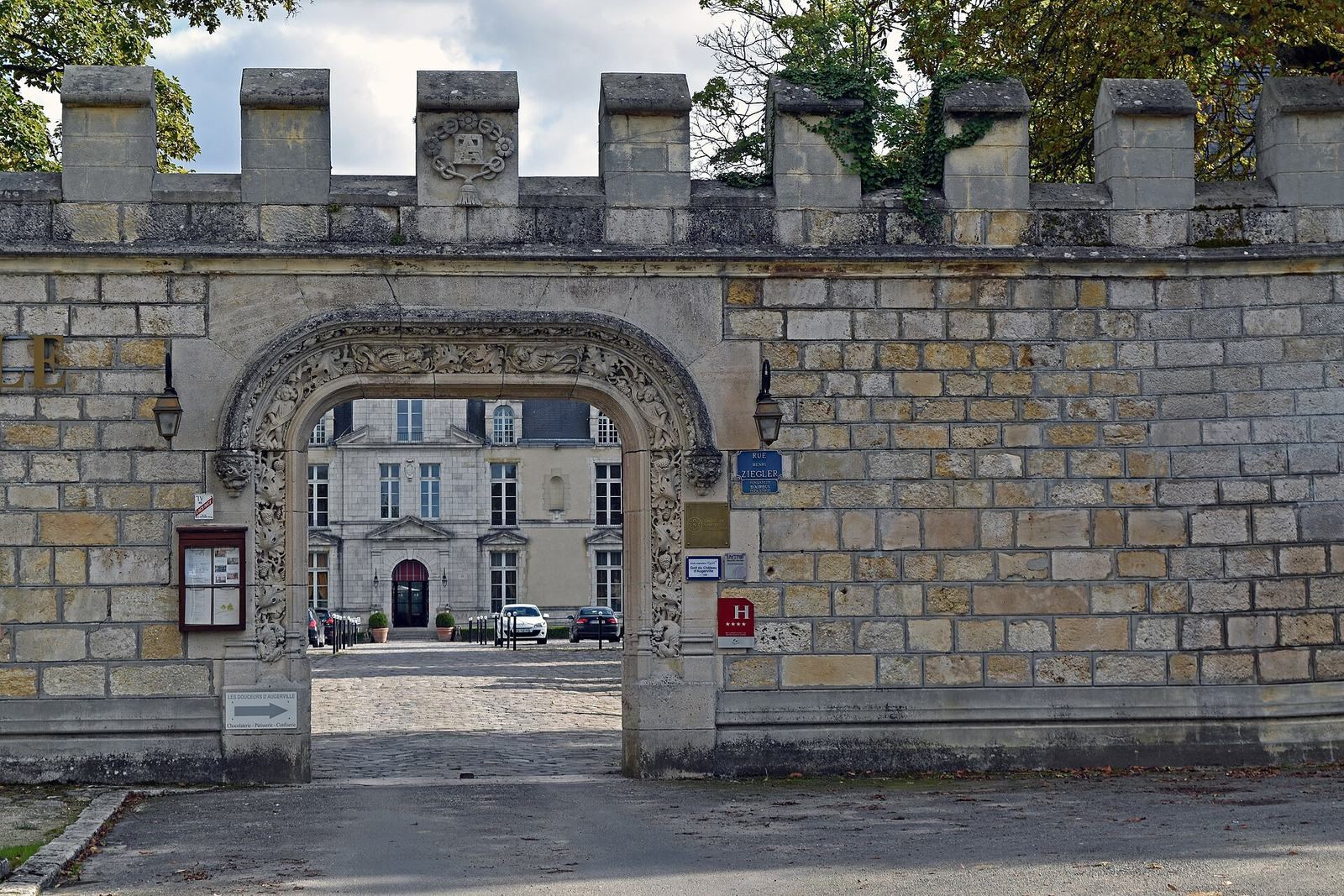
At the 1825 auction, the château was described as having 46 rooms across three levels. Its south side, looking toward the park, had 34 openings, including three entrance doors; the north side, facing the main courtyard, had 30. The Duchess of Riario Sforza later added pediments and statues to the north façade. Under Alva Belmont, the wrought-iron staircase was replaced, the kitchens were moved to the basement, and a crenellated wall was built around the château. Belmont intended the wall to recall the Hôtel de Cluny, a medieval mansion in Paris.
Service and agricultural buildings
The 1582 inventory lists a barn and dovecote among the estate buildings. In 1644, two wings of service buildings were added, and the dovecote and barn were rebuilt. Agricultural buildings were arranged around a courtyard. Mouton later converted the stables into garages; under Belmont, the garages became an apartment. Dr. Kopp used the park farm for breeding horses and installed a laboratory in the service buildings. A nightclub later occupied one wing.
Moat, courts, and grounds
Moat and approaches
The 1582 inventory describes walls around the château and a moat supplied by the Essonne River. By the 1825 auction, the moat was described as 18 metres wide and 10 metres deep, with three crossings, including a drawbridge and a stone bridge. A contemporary description also notes a carriage gate and broad ditches with flat bottoms. Belmont later converted the moats into a pond.
Courtyards, gardens, and park
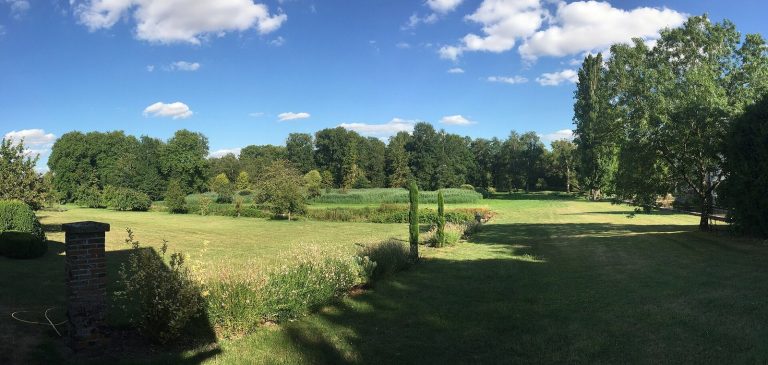
The château grounds included a courtyard, garden, barn, courtroom, woodland, meadow, and rabbit warren. Land leased to inhabitants included vineyard, woodland, and meadow. In 1649 the estate covered 370 arpents within enclosing walls. The river ran between two parks, with two large crossings built over it shortly before the period’s description. Sixteen park paths met at a star-shaped junction centred on a large statue of Orpheus, the legendary musician of Greek mythology.
The 1825 description places a formal parterre, an ornamental garden laid out in patterns, between the château and the park, extending toward two round towers. The property also had extensive cellars. Belmont widened the river, paved the great forecourt with stones brought from Versailles, erected a large Neo-Gothic portal at the north entrance road, and installed a bowling alley in a park building. The estate’s present golf course has 18 holes.