Tolštejn Castle: A Medieval Fortress in Czechia


Site at a Glance
- Rating
- 4.6
- Popularity
- Medium
- Country
- Czechia
- Primary era
- Medieval
- Eras represented
- Medieval, Early Modern, Modern
- Civilizations
- Habsburg, Holy Roman Empire, Kingdom of Bohemia
- Site type
- Military
- Remains
- Castle
On this page16 sections
History
Tolštejn Castle is a medieval Gothic fortress ruin near Jiřetín pod Jedlovou in Czechia, in the Lusatian Mountains of northern Bohemia. Its foundation may date to the 13th century, although surviving masonry belongs partly to the 14th century. The name Tolštejn, also found as Tollenstein, developed from the earlier Dohlenstein, interpreted as “Jackdaw Rock,” a reference to the rocky outcrops on which the castle stands. The castle first appears in written records in 1337, when it was captured and destroyed by troops of the Lusatian League, an alliance of Lusatian towns that conducted military operations against castles during periods of border conflict.
Wartenberg Stronghold
The earliest known owners were members of the Wartenberg family, noble lords who controlled estates and castles in northern Bohemia and the adjoining Lusatian borderlands. The 1337 attack followed accusations that the castle’s burgrave had conducted extensive raids and damaged Lusatian towns. Bohuslav of Wartenberg has been proposed as an owner, but his possession is not certain. Vaněk of Wartenberg is the first securely identified owner. Under a feudal obligation to the Bohemian king, he rebuilt Tolštejn and turned it into an important and well-appointed stronghold.
Tolštejn assumed an administrative role after the nearby castle of Krásný Buk was destroyed in 1339. In 1343, lords connected with the Wartenbergs raided Lusatia, while King Charles IV stationed a garrison at Milštejn. The Wartenbergs retained Tolštejn until the late 14th or early 15th century. After the death of Václav of Wartenberg, who was also known as “of Tolštejn,” the castle passed no later than 1404 to Hynek Berka of Dubá.
The Hussite and Lusatian Conflicts
Following Hynek Berka’s death in 1417, Tolštejn was assigned to his son Jan Berka of Dubá. Jan sympathized with the ideas of Jan Hus, whose reform movement helped provoke the Hussite Wars, a series of religious and political conflicts in 15th-century Bohemia. He nevertheless maintained ties with Catholic allies and tried to balance the competing political forces. Between 1422 and 1426, he appointed Catholic priests on his estates.
During the Hussite Wars, Tolštejn’s garrison raided villages in the Zittau region. In 1425, Jan Berka either allied himself with the Hussites or established friendly relations with them. The Lusatian commander Nicholas of Ponikau, after being captured, was imprisoned at Tolštejn. Jan died without heirs in 1426. His relatives continued to hold the castle, while Lusatian towns attempted to occupy it or acquire it for destruction. By 1427, Hynek the Younger Berka of Dubá held Tolštejn together with the burgrave Mikš of Cottbus.
Beneš, Hynek, and Albrecht Berka later held Tolštejn and neighbouring Vildštejn. Beneš was killed in fighting with the Lusatians around 1440, and Albrecht was captured. After 1442, Albrecht became the principal Berka lord of both castles, and in 1446 he placed them under the protection of the Saxon princes.
Siege under George of Poděbrady
In 1462, during the reign of King George of Poděbrady, Albrecht Berka opposed the king and distributed insulting letters. Royal forces and troops of the Lusatian League besieged Tolštejn from 29 June 1463. The castle fell and was occupied in early July. Albrecht escaped, probably before or during the siege, and later sought refuge in Wrocław.
The king confiscated Tolštejn and the Šluknov estate in 1464, granting the castle jointly to Jindřich Berka and Jan of Wartenberg. Tolštejn remained caught in the conflict between George of Poděbrady, the Lusatian League, and the papal party. In 1467, a papal interdict was imposed on Tolštejn and the surrounding estate during efforts to restore Albrecht Berka.
Forces associated with Tolštejn raided Lusatia in 1467 but were defeated near Breiteberg, where approximately 150 men were killed. The Lusatians besieged Tolštejn for three or four days in 1469, then withdrew when a royal army invaded the Zittau region. The fighting damaged surrounding villages and destroyed local glassmaking, particularly at Glasendorf and the Jedlová glassworks.
From Berka to Schleinitz
War expenses and debt eventually forced Kryštof of Wartenberg to sell Tolštejn and Šluknov to the Saxon dukes Ernest and Albert on 3 December 1471 for 8,300 groschen. The castle was administered by Tyco of Miltitz and Oldřich of Rechtenberg. In 1485, the Saxon rulers sold it to Hugolt of Schleinitz, whose ownership was formally recorded together with eight villages.
Hugolt died in 1490, and his son Jindřich inherited Tolštejn while acquiring additional villages and estates. When Jindřich died in 1518, his sons divided the family possessions. Arnošt of Schleinitz was a Prague canon, later a provost, and from 1539 administrator of the archbishopric. His brother Jiřík of Schleinitz lived at Tolštejn during the middle of the 16th century.
In 1539, Jiřík founded the mining town of Jürgenthal, now Jiřetín pod Jedlovou. At his request, King Ferdinand I removed Tolštejn and Rumburk from feudal tenure in 1558 and entered them as freely disposable properties in the land register. Jiřík later moved from Tolštejn to Rumburk, where he had founded a new church, and died in 1565.
Decline and Destruction
Jiřík’s heirs divided Tolštejn into three parts in 1566. The brothers no longer lived at the castle, and the separate shares were eventually reunited under members of the Schleinitz family. On 25 February 1586, the family sold Tolštejn, then recorded as Talensteyn, and Rumburk with their appurtenances to Dr Jiří Mehl of Střelice, vice-chancellor at the court of Rudolf II.
At the time of Mehl’s acquisition, the lower enclosure remained substantially intact and still contained residential rooms, offices, halls, chambers, a spiral staircase, a kitchen, cellars, a privy, and quarters for a watchman. Its armament included four large guns, one smaller gun, six barrels of gunpowder, and hundreds of iron cannonballs. These supplies indicate that Tolštejn then functioned chiefly as a fortress rather than as a residence.
Under Baltazar Mehl of Střelice, the castle became severely neglected, although it retained defensive importance. It was described as deserted in 1607 and as a “chateau” in 1619, apparently in connection with its sale price. The castle was uninhabited but had not yet been demolished.
In 1642, during the Thirty Years’ War, Swedish forces under General Wrangel besieged Tolštejn, which was held by Imperial troops commanded by Colonel Mathlohe. Artillery fire and fires in the castle forced the Imperial garrison to withdraw into a nearby forest. Tolštejn continued to burn and was partly demolished. This marked its final destruction, and the castle was never rebuilt.
Ruins and Later Use
Prince Florian of Lichtenstein acquired the ruined castle in 1681. During the later 18th century, the ruins were associated with bands of robbers. A field watch of Croats and pandurs occupied the site in 1756 during the Seven Years’ War, a European conflict in which Austria and its allies fought Prussia and other powers.
Tolštejn remained militarily relevant during the Napoleonic period. An Imperial observation post operated there until 18 August 1813. It was then handed over to French forces associated with Marshal Lefebvre, and Austrian troops returned to the Lusatian Mountains in September.
In the 19th century, the ruins acquired a romantic and tourist role. Johann Josef Münzberg established a refreshment stand in 1865 and, with permission from Prince John of Lichtenstein, built a Swiss-style inn in 1866. A bridge connecting the two rock outcrops followed in 1874. Finds made while the inn was being built formed the basis of an exhibition in the restaurant. The collection included historical weapons, arrowheads, locks, Gothic and Renaissance floor tiles, and stove tiles. After the property passed to the state in 1945, much of the collection, especially its weapons and curiosities, was stolen or damaged.
The Münzberg family operated the inn until 1945. Johann Karl Münzberg managed it again from 1952 to 1962, after which changing operators took over. The restaurant closed in 1977 when masonry beneath it collapsed. It reopened in the mid-1990s, and later cleanup, repairs, and reconstruction restored the building and its immediate surroundings to usable condition.
The Lichtenstein family owned Tolštejn until 1923, when the Czechoslovak state acquired it. Following a legal dispute in the late 1990s, the castle hill and restaurant passed to the municipality of Jiřetín pod Jedlovou, which undertook extensive repairs to the ruin, access structures, and restaurant. Tolštejn is protected as a cultural monument of the Czech Republic. Regional legends connect it with hidden underground passages, buried treasure, a gold-bearing spring, and the ghost of Svanhilda as a White Lady.
Remains
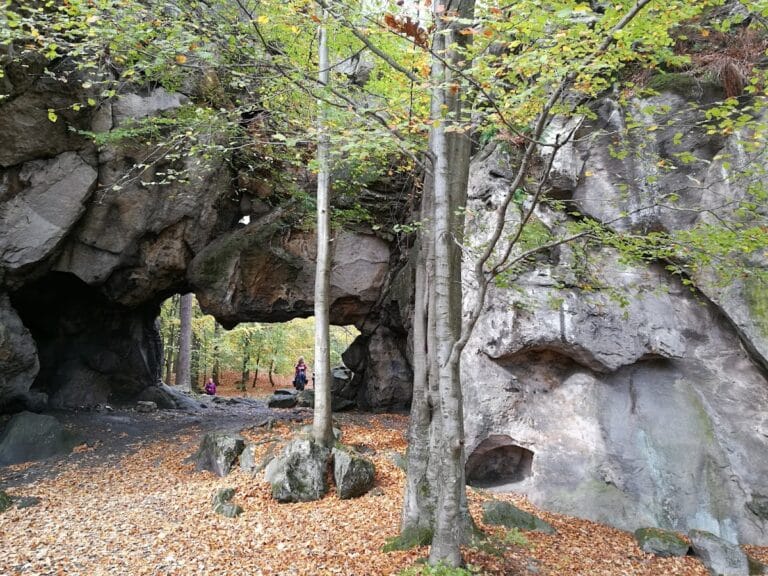
Tolštejn occupies two phonolite rocky outcrops at approximately 670 metres above sea level. Phonolite is a fine-grained volcanic rock that commonly forms resistant hills and outcrops. The southern and eastern sides of the rocks descend almost vertically, while a low ridge links the western side with Mount Jedlová. The lower castle wrapped around the northern sides and foots of both rocks with a ring of walls and towers. Ditches and additional fortifications protected the northern approach, while the steep rock faces strengthened the southern and eastern sides.
Lower Castle Defences
Gates and Main Tower
The approach road entered the lower castle through two gates. The southern gate stood at the foot of the rocks, although its exact position can no longer be determined. It formed a rectangular building with two gates and a passageway. A Berka coat of arms once stood above the outer gate and has been in the Rumburk Museum since 1861.
The main gate incorporated a large square tower that rose to about 20 metres. It contained a kitchen with two chambers, a beer cellar, and another cellar. The tower was roofed and probably had a drawbridge, although the castle’s water-filled moat has not been identified. The passage probably had a pointed arch and included a separate entrance for pedestrians.
Hexagonal Bastion
A hexagonal bastion stood beyond the gate. A bastion is a projecting fortified structure from which defenders could use weapons against attackers approaching the walls. In the early 19th century, this structure was still about 8 metres high. Its cellar is now filled in, but excavations found tiles and channels associated with a bath there. The upper floor probably contained a chapel.
The outer face of the bastion carried the Schleinitz family coat of arms and painted decoration, possibly rustic plasterwork with figures in a 16th-century manner. A short wall joined the bastion to a rectangular defensive building whose upper floor contained a knight’s hall.
Horseshoe Tower and Curtain Wall
From the rectangular building, a wall led to a horseshoe-shaped projecting tower. Its ground floor contained a starvation chamber, where excavations uncovered skeletal remains. The tower had three storeys and no entrance at ground level. Access was gained through an opening about 5 metres above the ground, reached by steps from the adjoining wall.
The southern curtain wall continued from the horseshoe tower toward the steep rock and completed the defensive ring. Wooden buildings stood against the walls, as shown by evidence of a window at wall height. Water was probably gathered in a rainwater reservoir that has since been filled in. A water-supply system installed in the 15th or 16th century brought water from Jedlová to Tolštejn through pipes, fragments of which have been found.
Upper Castle and Medieval Fortifications
Rock Summit and Early Construction
The upper castle stood above the lower fortifications and was especially important during the 14th and 15th centuries. A masonry wall connected the two rock outcrops, and a tower stood on the larger outcrop. The tower was either entirely built of masonry or had a masonry lower section. Wall remains were still visible in the 1950s, together with a substantial layer of burnt material. Steps cut into the rock provided access.
The original Wartenberg castle was constructed largely of wood, most of which has not survived. The earliest surviving evidence consists mainly of masonry in fissures in the rock, datable to the 14th century, together with wall fragments around the highest parts of the castle that may have enclosed an outer ward.
Shield Wall and Northern Bastion
During the 15th century, the Berkas strengthened Tolštejn after experiencing sieges by Lusatian forces. They built a shield wall, a massive defensive wall intended to protect the most vulnerable side of a fortification. It was about 6 metres thick and 15 metres high, allowing an active defence of the castle. A building connected to the wall occupied the position of the earlier gate.
Artillery damage in 1462 led to major rebuilding during the 16th century. New walls extended from the shield wall and its corner bastion around the northern side of the castle. A polygonal northern bastion had walls approximately 3.8 metres thick, sufficient to support artillery. This rebuilding has possibly been attributed to Wendel Rosskopf, a pupil of Benedikt Ried.
Later Renaissance changes were comparatively limited. A transverse wall closed off the starvation chamber, and additional work affected residential buildings that have since disappeared. The 1586 inventory nevertheless gives a detailed picture of the accommodation then present. A long residential building contained a common room with offices and chambers, a hall or entrance hall, a spiral stair, a green room, another office, a second hall or dining room, a room with a chamber, a privy entrance, attic chambers, a room with a clock, and a watchman’s room. A neighbouring building held a kitchen, chambers, and two cellars, including a beer cellar.
Rock Formation and Later Buildings
The castle stands on a phonolite volcanic neck exposed as surrounding sandstone eroded away. Its possible origin as a subsurface laccolith, an intrusive body of magma that spreads between rock layers and domes the strata above, has not been reliably demonstrated.
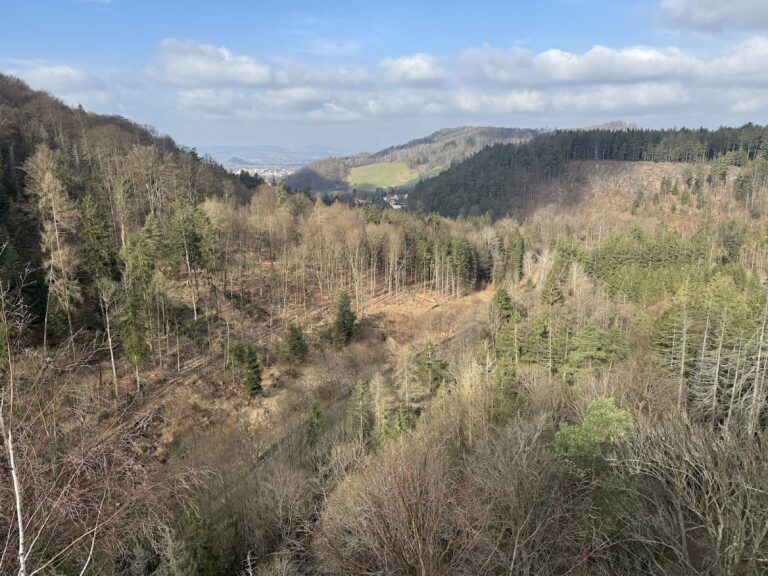
The Swiss-style restaurant built within the ruins in 1866 is a later structure rather than part of the medieval castle. Supporting masonry beneath it collapsed before its closure in 1977. The building reopened in the 1990s and later underwent reconstruction. The summit and the surviving structures provide views toward the Lusatian Mountain peaks and the valleys containing Jiřetín pod Jedlovou, Dolní Podluží, and Varnsdorf. A pond below the castle contains marsh arum, white water lily, and greater duckweed, while the ruin supports rock alyssum and other rare warmth-loving plant species.