Krásný Buk Castle: A Ruined Gothic Stronghold in Czechia


Site at a Glance
- Rating
- 4.3
- Popularity
- Very Low
- Country
- Czechia
- Primary era
- Medieval
- Eras represented
- Medieval
- Civilizations
- Holy Roman Empire, Kingdom of Bohemia
- Site type
- Military
- Remains
- Castle
On this page7 sections
History
Krásný Buk Castle is a ruined Gothic castle in Czechia, probably founded in the second half of the thirteenth century. Also known by the German names Schönbuche and, historically, Schönbüchel, it occupied a fortified position above the Křinice River in the Šluknov uplands.
Foundation and noble ownership
The Markwartitz family may have owned the castle from 1263, although this early association remains uncertain. At the beginning of the fourteenth century, the castle belonged to Henry of Leipa, a prominent Bohemian nobleman. In 1319, he exchanged it, together with other possessions in the Zittau region, with John of Luxembourg, King of Bohemia from 1310 to 1346, receiving estates in southern Moravia in return.
The Wartenbergs, a powerful noble family of northern Bohemia, apparently controlled Krásný Buk soon afterward. They also held nearby Tolštejn Castle. Krásný Buk served as a base for the garrison’s raids, which harmed the interests of Upper Lusatia.
Destruction and archaeological investigation
On 15 September 1339, troops of the Lusatian League captured and destroyed the castle. The league was an alliance of Lusatian towns that used military campaigns to defend regional interests. Krásný Buk lost its function after the attack, was not rebuilt, and gradually fell into ruin.
Archaeological excavations at the castle in 1850 recovered metal objects and pottery fragments, including reported finds of horseshoes, arrowheads, and a weapon resembling a Hussite mace. The surviving remains are protected as a cultural monument.
Remains
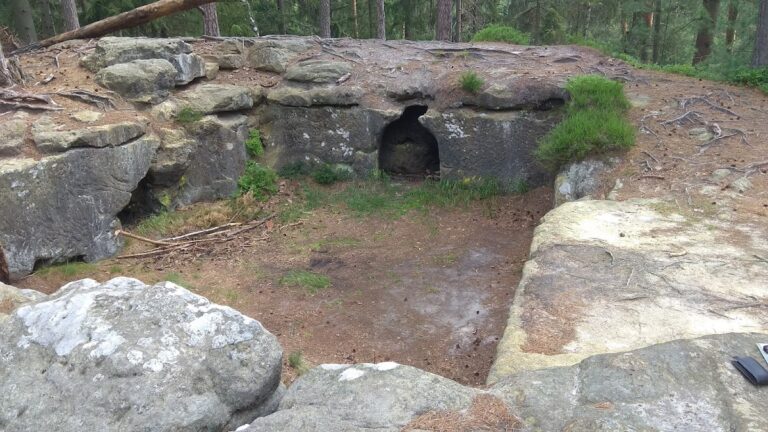
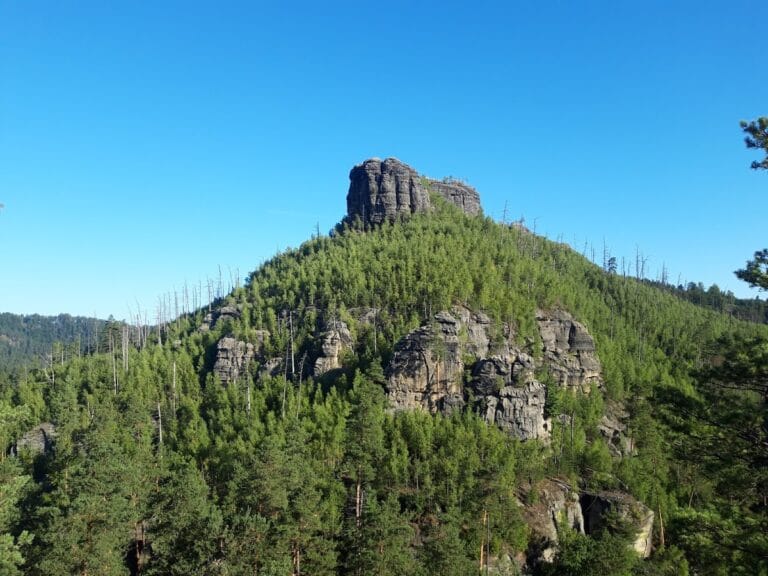
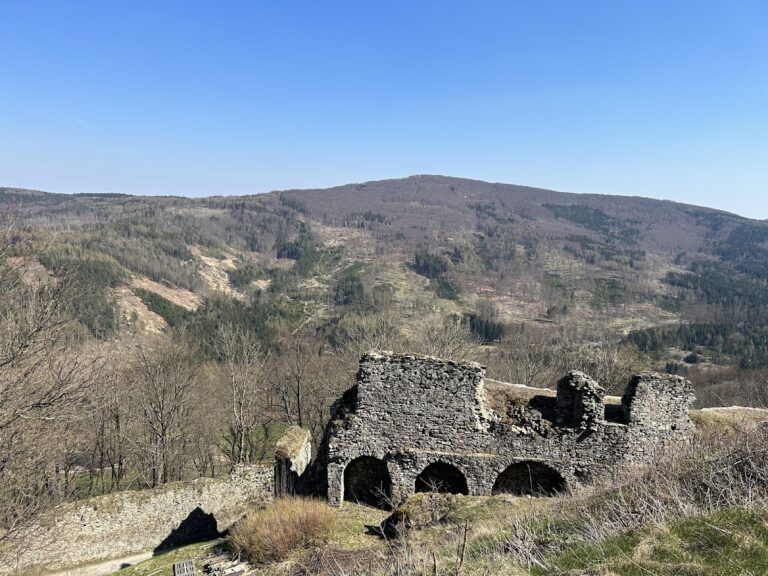
The castle stood on a granite promontory above the right bank of the Křinice River, west of the village of Krásný Buk near Krásná Lípa. It was a two-part castle of bergfried type, with an outer bailey and a smaller inner castle. Today, the site survives mainly through terrain features, sections of defensive earthworks, the castle ditches, and small fragments of masonry.
Castle layout and defenses
Outer bailey
The outer bailey formed one part of the castle complex. Its surviving fortifications include a ditch, an indication of a rampart, and a sunken remnant of a structure. These earthworks and ground-level features preserve part of the arrangement that protected the approach to the inner castle.
Inner castle and bergfried
The smaller inner castle was enclosed by a substantial ditch cut into the rock. Sections of its ring rampart, an earthwork defensive bank around a stronghold, remain alongside small masonry fragments. The only partly preserved masonry building is part of a round bergfried, the principal defensive tower of many medieval Central European castles. Its mass protected a small palace on the southern side of the inner castle. Archaeological research showed that the inner castle’s circuit wall was built after the bergfried.
A badly weathered Roman coin, broken into two pieces and attributed to the reign of Emperor Hadrian, was reportedly found in a field below or near the castle. The excavations also produced the metal objects and pottery associated with the castle’s medieval occupation.