Milštejn Castle: A Medieval Trade-Route Stronghold in Czechia


Site at a Glance
- Rating
- 4.6
- Popularity
- Low
- Country
- Czechia
- Primary era
- Medieval
- External website
- Open
- Eras represented
- Medieval
- Civilizations
- Holy Roman Empire, Kingdom of Bohemia
- Site type
- Military
- Remains
- Castle
On this page12 sections
History
Milštejn Castle is a ruined medieval castle in Czechia, about 3.5 km north of Cvikov in the Lusatian Mountains. Built by Bohemian nobles in the late thirteenth or around the turn of the fourteenth century, it guarded the regional trade route linking Lipé with Zittau. Its position placed it among a chain of fortified settlements established along northern Bohemian routes by the Lords of Vartenberk and the Ronovci, a wider aristocratic lineage active in the region.
Foundation and the Berka Estate
The exact foundation date is unknown, but archaeological and comparative evidence places the castle’s construction in the latter part of the thirteenth century or near the transition to the fourteenth century. It stood on the route between Sloup and Oybin, through a mountain region where roads connected northern Bohemia with Lusatia and Saxony. Milštejn was first mentioned in 1343 as an escort station on the road between Oybin and Česká Lípa. It was probably held by the Berka of Dubá family at that time and certainly belonged to them by 1362.
By the late fourteenth century, the Milštejn estate included Cvikov and several surrounding villages. Marriage alliances also brought the western part of the Lemberk estate temporarily under the control of the lords of Milštejn before the Hussite Wars, the religious and political conflicts that affected Bohemia during the 1420s and 1430s. Jindřich Berka of Dubá held the estate from at least 1362 until his death in 1404. His son Hynek Dubský then became lord of the castle and was the first member of the family to use the designation “of Milštejn.”
Garrison, Trade, and Conflict
After Hynek’s death in 1433, Milštejn passed to his son Jindřich Berka of Milštejn, and after Jindřich’s death in 1444 to his son of the same name. The younger Jindřich lived in Česká Lípa but maintained a strong garrison at the castle. Between twelve and sixteen armed men escorted merchant wagons traveling from Zittau toward Prague, while also collecting customs duties and tolls. A Lusatian army captured Milštejn in 1456, although the fifteenth century was also the period of the castle’s greatest prosperity. A record from 1545 gives the name as “Milsstaain Castle.”
Ownership of the surrounding estates changed during the early sixteenth century. Václav Berka of Dubá acquired Zákupy together with Milštejn in 1502 and sold both properties two years later to his uncle Petr Berka of Dubá. In 1518, Petr’s children transferred Zákupy, but not Milštejn, to their cousin Zdislav Berka of Dubá. Zdislav acquired the Milštejn estate separately in 1532 and moved his residence and administrative center to Zákupy, from which he governed Milštejn and its surroundings.
Decline and Quarrying
A theft recorded in 1588 shows that furnishings remained inside the castle, although the building was already decaying. By about 1590, its protection had been reduced to a single guard. The Swedish army commanded by General Banner, a Swedish military leader during the Thirty Years’ War, damaged Milštejn in 1634.
Quarrying around the castle had begun by the thirteenth century and may have started before the stronghold was built. Extraction intensified during the eighteenth and nineteenth centuries, undermining the castle and removing parts of its foundations. Around 1685, during the rule of Julius Franz of Saxe-Lauenburg, the large tower was demolished because quarrying beneath it endangered workers. Another tower collapsed in 1726, and the remaining tower fragments were blasted in 1793.
After the towers were removed, Milštejn was treated as a quarry belonging to the Zákupy estate. At the end of the nineteenth century, the Istrael brothers of Dresden leased the quarry, which employed about 100 workers. Quartz-bearing stone from the site was made into millstones in nearby Naděje and exported to several European countries. Quarrying ended around 1910, when the workable sandstone had been exhausted.
Later Recognition and Traditions
The ruins are registered as a protected cultural monument of the Czech Republic. Climbing development began in the 1920s, when routes using artificial aids, including pitons and ladders, were created for high-mountain training. The routes now range from grades I to VII under the unified sandstone classification.
Two local legends remain associated with Milštejn. One tells of a girl who sought refuge from robbers in the castle and then threw herself from a window to escape sexual assault. Another places a “devil’s kitchen” in the ruins, where forest witches supposedly prepared magical potions.
Remains
Castle Rock and Surviving Fabric
Rock Formation
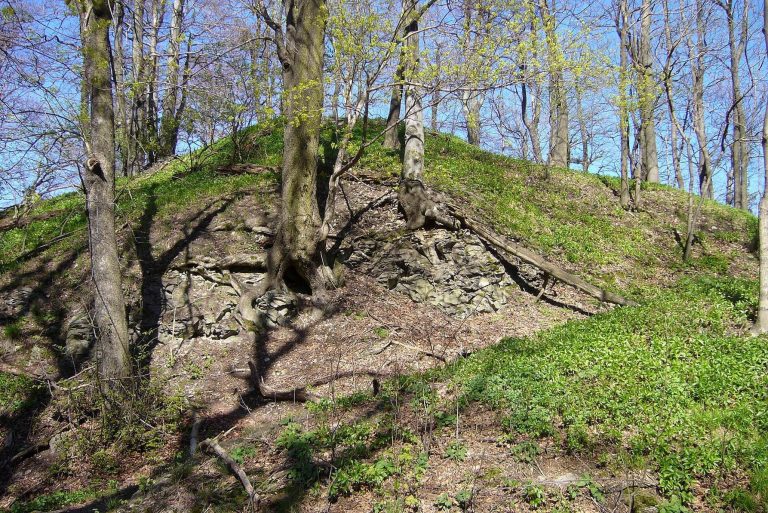
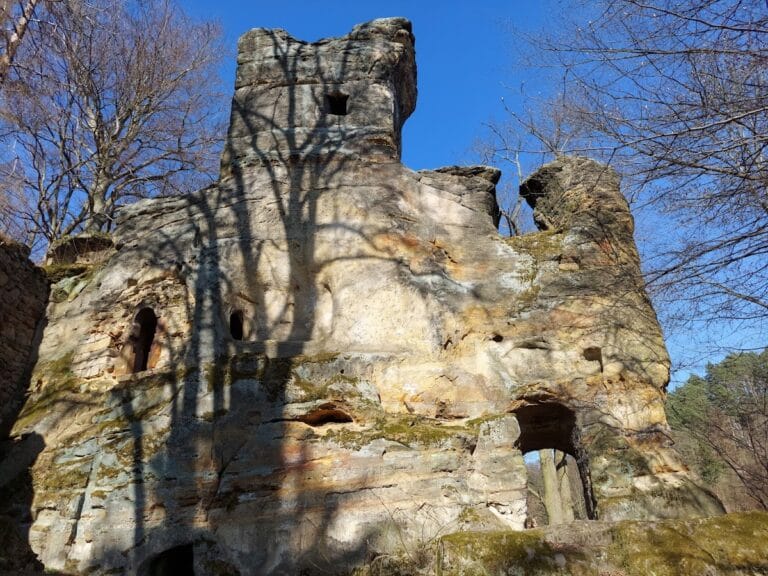
The site occupies the summit of Žernov in the Lusatian Mountains at approximately 544 metres above sea level. The castle stood at the foot of a free-standing, quartz-rich rock formation about 20 metres high. A natural stone gate passes through the central part of the formation, while the rock itself serves as a climbing summit with routes graded from I to VII.
Walls and Entrances
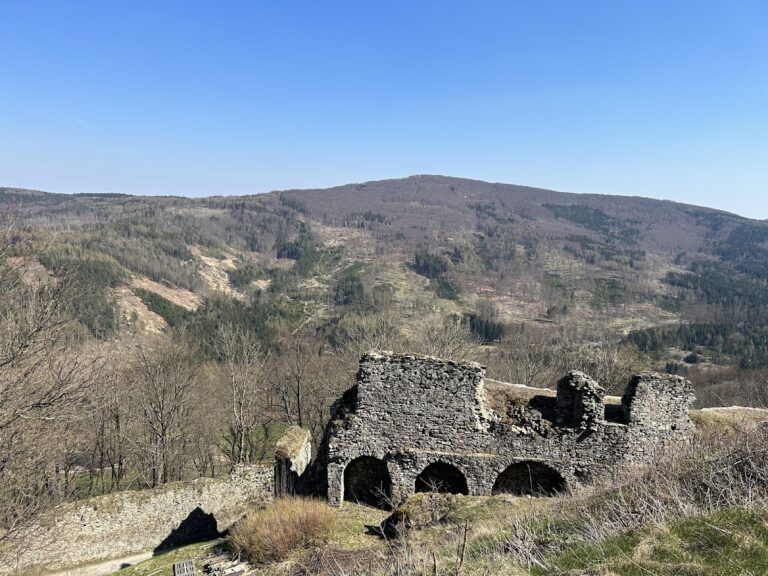
Slight portions of the original masonry survive, including sections of the enclosing walls. The castle area has a natural stone entrance feature and another entrance on the opposite side. The towers were progressively demolished, collapsed, or blasted as quarrying weakened the site, leaving the surviving masonry closely associated with the altered rock landscape.
Quarry Landscape and Water Features
Underground Quarry Spaces
Several collapsed underground spaces lie beneath the castle. They were created mainly through sandstone extraction and belong to the later quarrying activity that removed much of the castle’s physical fabric. The stone was also used for millstones, which were worked in nearby Naděje before distribution beyond the region.
Stříbrná Studánka
About 200 metres from the ruin stands Stříbrná Studánka, a spring whose water once flowed into a pond. The pond’s dam survives as part of the associated landscape.