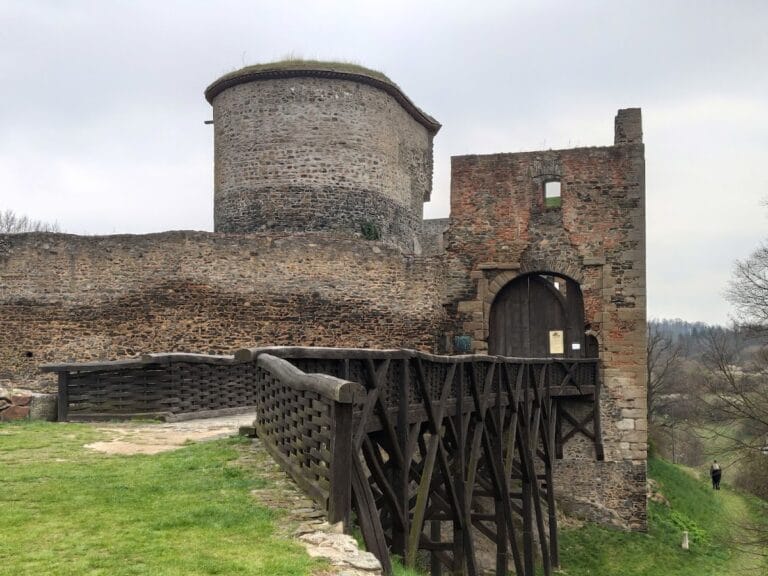
Castle Krašov: A Medieval Gothic Castle in Czechia


Site at a Glance
- Rating
- 4.7
- Popularity
- Medium
- Country
- Czechia
- Primary era
- Medieval
- External website
- Open
- Eras represented
- Medieval, Early Modern
- Civilizations
- Habsburg, Holy Roman Empire, Kingdom of Bohemia
- Site type
- Military
- Remains
- Castle
On this page15 sections
History
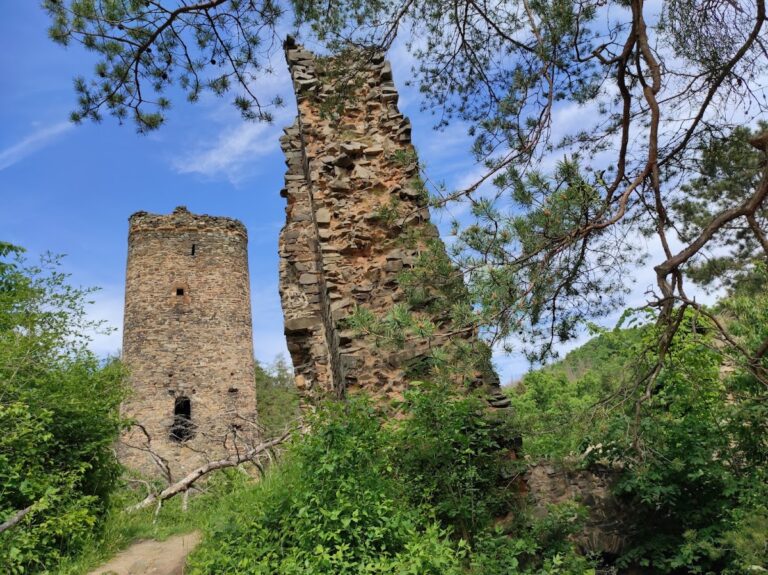
Castle Krašov is a medieval noble castle in Czechia, situated above the confluence of the Brodeslavský Stream and the Berounka River near Bohy. Medieval Czech nobles founded it in the first third of the thirteenth century, and its surviving fabric is predominantly Gothic, with later Renaissance and Baroque changes. The castle became the centre of an estate that included several surrounding villages before passing through noble, military, and monastic ownership.
Foundation and the Lords of Krašov
The castle’s founder is uncertain. Jetřich of the Hroznatovci, a medieval Czech noble lineage, used the territorial name “of Krašov” in 1232, which may mean that the castle already existed by that time. Another interpretation identifies Sezima of Krašovice, recorded as “of Krašov” in 1284, as its founder.
Krašov belonged to the Lords of Krašov, descendants of the Hroznatovci. After Sezema of Krašov died in 1284, he divided his holdings among his four sons. Krašov passed to Bušek and then to his son Vilém, who later sold it to Vilém of Švihov of the Rýzmberk family.
Rýzmberk and Kolovrat ownership
The castle’s ownership during the following decades is not fully clear. It was probably held in 1363 by the brothers Břeněk and Půta of Švihov of Rýzmberk, who sold it in the late 1370s to Albrecht of Kolovrat. The estate then included Bohy, Borek, Kozojedy, Milíčov, and Rakolusky. Its burgraves, the governors who managed the castle for its owner, included Vítek in 1377, Albert Polák in 1382, Vaniš in 1383, Jan of Svinná in 1411 and 1412, and Racek of Švamberk in 1413.
Albrecht the Younger of Kolovrat inherited Krašov in 1392 but lived at Libštejn from 1403, leaving Krašov under burgrave administration. After his death, the castle passed before 1416 to his son Hanuš of Kolovrat. Hanuš supported the Catholic side during the Hussite Wars, the religious and political conflicts in Bohemia involving the followers of Jan Hus and opposing Catholic forces. In 1425, Hussite troops plundered villages around Krašov while besieging Hanuš’s castles at Žebrák and Točník, but they did not try to capture Krašov.
Krašov later belonged to Hanuš II of Kolovrat, who resided at Zbiroh and kept the burgrave Jindřich Hnát at Krašov around 1462. Hanuš’s son, Albrecht Libštejnský of Kolovrat, sold the castle in 1485 to Jetřich Bezdružický of Kolovrat. After Jetřich’s death around 1508, Jiří Bezdružický of Kolovrat administered the inheritance for Jetřich’s minor son Jan. Nykl of Raichau represented the boy at Krašov in 1510.
Renaissance residence and the Sviták family
Jan of Kolovrat died at the Battle of Mohács in 1526, leaving a minor son named Jetřich. The boy’s guardians sold Krašov in 1529 to Mikuláš Sviták of Landštejn for 3,250 kop, a historical counting unit equal to sixty groschen. At that time the estate comprised the town of Kozojedy and the villages of Milíčov, Březsko, Třímany, Rakolusky, Borek, and Bohy.
After 1526, the medieval castle was converted into a Renaissance residence. The rebuilding has sometimes been attributed to Hieronymus the Younger Hrobschitzky of Hrobschitz, but both its precise date and its attribution remain uncertain. Mikuláš Sviták had no children and bequeathed Krašov in 1534 to his brother Vilém, who was first recorded as its owner in 1538.
In 1541, Vilém assigned a jointure, property or income securing a wife’s support after her husband’s death, to his wife Kateřina of Solopisk. Vilém died before 1543, and Kateřina administered the estate for their minor son Vilém with assistance from Jan Mladota of Solopisk, probably her brother. Her administration lasted at least until 1558.
Sales and indebtedness in the late sixteenth century
After reaching adulthood, Vilém Sviták gradually disposed of parts of the estate. He sold Hlineč to Šebestián Lažanský of Buková at Chříč, and in 1576 he sold Milíčov and Břízsko. He transferred the remainder to his wife Barbora of Rabštejn in 1572, sold Krašov to Jindřich Grafinger of Salek in 1576, and recovered it when Grafinger could not pay the purchase price.
Vilém sold the castle again in 1589 because of his heavy debts, this time to Ferdinand Ronšperk of Držkovice. In 1595 or 1596, Ronšperk transferred the estate for 27,500 kop to Hieronymus the Elder Hrobschitzky of Hrobschitz. In the same year, Vilém sold Ostrovec to King Rudolf II.
Hrobschitzky ownership and the Thirty Years’ War
After Hieronymus died, his four surviving sons divided the inheritance in 1600. Krašov and Slatina went to Karel Vratislav Hrobschitzky, who later left his property to his youngest brother, Zdislav Albrecht Hrobschitzky of Manětín. After both brothers died, Krašov passed to Jan Vilém Hrobschitzky.
Jan Vilém sold the entire estate on 26 July 1616 to Helena Regina Příchovská, née Úlická of Plešnice. She transferred it in 1617 to her husband, Petr Jiří Příchovský of Příchovice. He sold Krašov in 1631 for 32,000 kop to Jan David Boryňa of Lhota.
The Thirty Years’ War, the major European conflict of 1618 to 1648, brought military operations and plundering to much of Bohemia. Swedish forces raided the area around Krašov. Jan David probably became indebted as a result and sold the residence on 2 August 1639 for 16,866 florins to Jan Gref of Grefenberg and his son-in-law František Miseroni of Lison. The estate description named Kozojedy as deserted and burned, while Třímany, Bohy, and Rakolusky were partly demolished. The castle itself survived this military activity.
The Miseroni family and the Plasy monastery
František Miseroni eventually became the sole owner. He was reputedly harsh toward the inhabitants of the estate and died in 1656 after allegedly being shot near Kozojedy by the son of a blacksmith from Lednice. A local tradition says that his widow, Anna Splendida, killed her youngest child and leapt from the castle rock after learning of his death. Historical records instead identify her in 1656 as guardian of her children, Norbert Adolf and Jan Augustin.
In 1676, Norbert Adolf sold his share of the Krašov estate, including Třímany and its inn, to Vojtěch Hynek Týřovský of Ensidle at Chříč. The abbot of Plasy, Benedikt Engelken, bought the remainder in 1678 for 27,500 florins and incorporated it into the monastery’s estate.
Destruction and archaeological protection
Krašov was described as deserted around 1700, although the Plasy monastery continued to maintain the complex until its dissolution in 1785. A forester and a key keeper lived there, and monks used the residence for occasional stays. They also carried out minor Baroque alterations.
After the monastery was dissolved, the Religious Fund, an administrative body that managed property transferred after religious institutions were dissolved, took control of the estate and ordered the castle to be demolished. Parts of the complex were dismantled for building material used to repair the Rohy farmstead, while local farmers could buy the remaining materials. By about 1800, Krašov had become a ruin.
The ruin has been cared for since 1931 by the Association for the Rescue of Krašov Castle and its successor, the Association for the Protection of the Krašov Nature Reserve and Castle. Building modifications carried out by the association in the 1960s led to archaeological research in 1970 and 1971. Krašov has been protected as a cultural monument since 1964.
Remains
Krašov occupies a rocky promontory above the meeting point of the Brodeslavský Stream and the Berounka River, at approximately 300 to 310 metres above sea level. The castle stands on a steep valley slope, while a plateau about 50 metres higher overlooks it. A projecting bastion on that plateau helped defend the castle from the elevated approach. The ruin is an irregular highland castle whose surviving arrangement developed from a Gothic two-part core, a fortified outer bailey, and later residential changes.
The castle core
Early core
The original core was divided into a front and a rear part. The front section contained a water cistern. A massive wall protected the rear section, while a small beaked tower, a tower with a projecting angular spur, guarded the approach side. This structure initially took the place of a bergfried, a principal defensive tower intended mainly for military use rather than residence. A small palace stood on the more strongly protected eastern side of the core.
Thirteenth-century expansion
During the second half of the thirteenth century, the front part of the core was enlarged because it lay lower than the outer bailey. Builders added a strong perimeter wall and a round bergfried. A second palace was later constructed in the rear part of the core, with a tower-like structure placed in the corner between the two palaces.
The outer bailey
The original outer bailey, the enclosed service and economic area outside the principal residence, is not known in its initial form. In the second half of the fifteenth century it was newly fortified as firearms developed. A substantial rampart and a battery tower protected the enclosure, although the tower has since disappeared. The bailey contained a brewery, fermentation room, malt house, smithy, inn, brickworks, and bathhouse. A mill stood lower down below the castle.
The projecting bastion
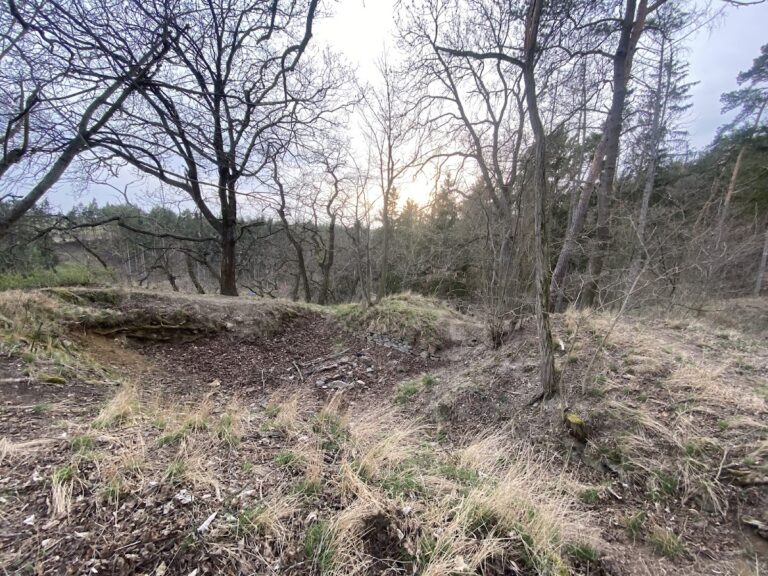
The projecting bastion stood at the highest point along the plateau edge above the Brodeslavský Stream, considerably higher than the castle promontory. A semicircular ditch, partly cut into the rock, separated it from the surrounding ground, and a low rampart stood beyond the ditch. Its frontal rampart reached about four metres in height and became lower toward the rear. On the side facing the castle, the bastion was bounded only by a small wall, probably built without mortar.
The later residence
The later residence included two chapels, a refectory, or communal dining hall, a kitchen, and 27 living rooms. These arrangements belong to the period when the Plasy monks maintained and occasionally used the complex. The surviving castle walls stand within the Krašov Nature Reserve, which forms part of the Hřešihlavská Natural Park, and extend above the Berounka valley.