Anta do Senhor da Serra: A Prehistoric Dolmen in Portugal
Site at a Glance
- Popularity
- Low
- Country
- Portugal
- Primary era
- Stone Age
- Eras represented
- Stone Age
- Civilizations
- Unclassified
- Site type
- Religious
- Remains
- Tomb
On this page4 sections
History
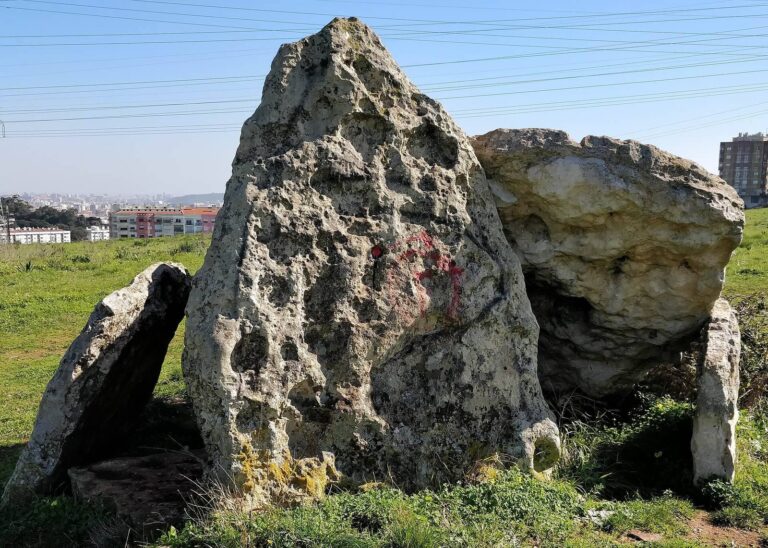
Anta do Senhor da Serra is a prehistoric dolmen at Idanha, in Belas, Portugal. It is broadly dated to 4000–2500 BC, with construction placed around 3250 BC, during the Late Neolithic and Early Chalcolithic. The Chalcolithic, or Copper Age, followed the Neolithic and preceded the Bronze Age. The tomb belongs to the Antas de Belas, a group of nearby monuments that also includes Anta da Estria and Anta do Monte Abraão.
Identification and excavation
Portuguese archaeologist Carlos Ribeiro, a pioneer of prehistoric archaeology in Portugal, identified the tomb in 1856. He excavated it in 1876 after receiving permission from the landowner, the Marquis of Belas. The burial had already been disturbed. Local residents told Ribeiro it had been plundered about a decade earlier, and a Portuguese coin dated 1741 was found among the excavation spoil.
Archaeologist O. V. Ferreira also carried out excavation work in 1963. Later studies by Ferreira, G. and V. Leisner, and Boaventura differed in their interpretations of the tomb’s precise structure and orientation.
Pilgrimage and protection
The monument served as a local pilgrimage place for a long period. A fertility belief held that newly married women who slid down the side of its dominant stone would conceive. Portugal protected the tomb as a National Monument from 1910. Pilgrimages ended in 1942, when the landowner prohibited access.
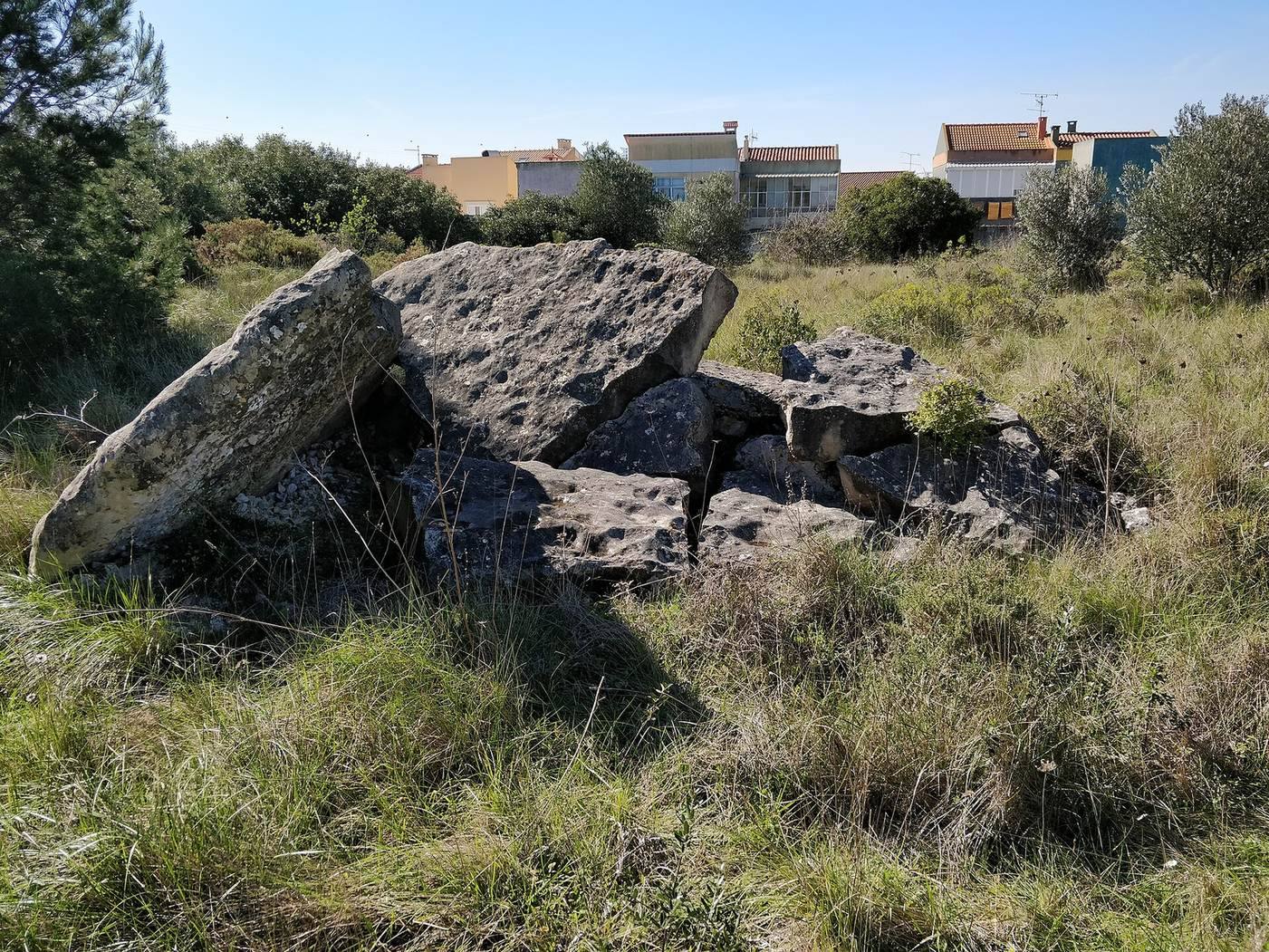
In June 2010, the dominant stone was found shattered into numerous pieces. The cause remains uncertain; proposed explanations include vandalism or explosions during construction of the nearby A9 motorway.
Remains
The tomb’s physical remains center on a burial chamber with large upright supporting stones. The chamber was already in poor condition when Ribeiro excavated it. Three supports remained in place, and one appeared to bear engravings of two human-like figures.
Ribeiro described the largest stone as leaning north. It measured 5 m long, 3.7 m wide, and 0.27 m thick. A second piece, measuring 4.5 by 2 by 0.25 m, partly supported it and touched a third stone about 4 m wide. Because this third stone was broken, it rose only 1 m above ground. Ribeiro also found four smaller slabs during excavation.
Other recovered objects included a stone axe, flint tools, household utensils, vessels, and human and animal bones. The finds are kept at the Geological Museum in Lisbon.