Church of Our Lady in Assens: A Late-Medieval Parish Church in Denmark
Site at a Glance
- Popularity
- Low
- Country
- Denmark
- Primary era
- Medieval
- Eras represented
- Medieval, Early Modern, Modern
- Civilizations
- Danish
- Site type
- Religious
- Remains
- Church
On this page18 sections
History
The Church of Our Lady in Assens is a late-medieval parish church in the old quarter of Assens, Denmark, near the harbour. It developed from a smaller brick church, probably built in the 13th century in the Romanesque style, an early medieval architectural tradition. The large rebuilding that gave the church its principal form was completed in 1488, while tree-ring dating places one building phase around 1490.
Medieval development
The rebuilding replaced the smaller church with a much larger one. Excavations indicate that construction proceeded in two phases and that the plan changed during the work. The site’s development therefore involved more than a single uninterrupted building campaign.
From Catholic church to Lutheran parish
The church served Roman Catholic worship before the Reformation, the 16th-century movement that established Protestant churches in place of Roman Catholic institutions across much of Europe. It became a Lutheran parish church afterward and belongs to the Church of Denmark, the country’s Lutheran national church. Today it is part of the Diocese of Funen and Assens Parish.
For centuries, townspeople were buried inside the church. About 450 people were interred there before health concerns led to a prohibition on church burials in the early 19th century. In 1828, permission was granted to sell six deteriorated grave monuments. Gravestones were removed in 1841 and reused as paving around the church. During the restoration of 1881–84, the best stones were brought back inside, while up to 30 others were discarded.
Restoration and continuing use
Major restoration work took place in the mid-19th century, including a campaign directed by architect C. Møller. A further restoration followed in 1881–84 under architects J. D. Herholdt and C. Lendorf. The church also houses the boys’ choir Syngedrengene ved Vor Frue Kirke Assens, which marked its 160th anniversary in 2016.
Remains
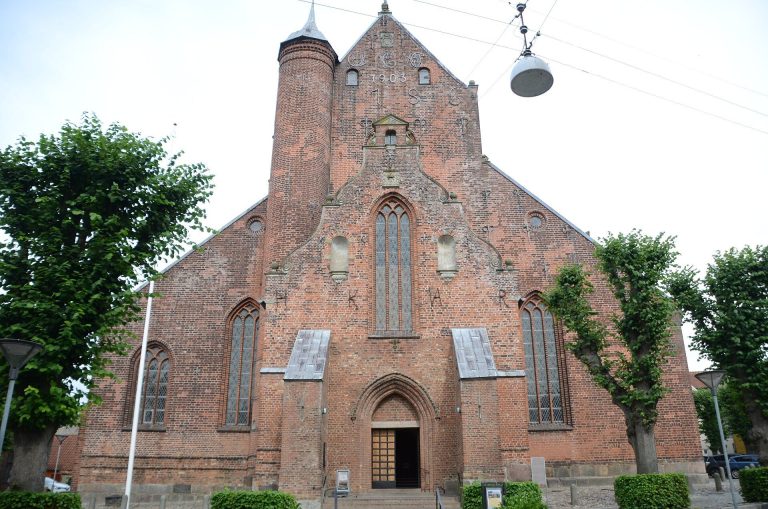
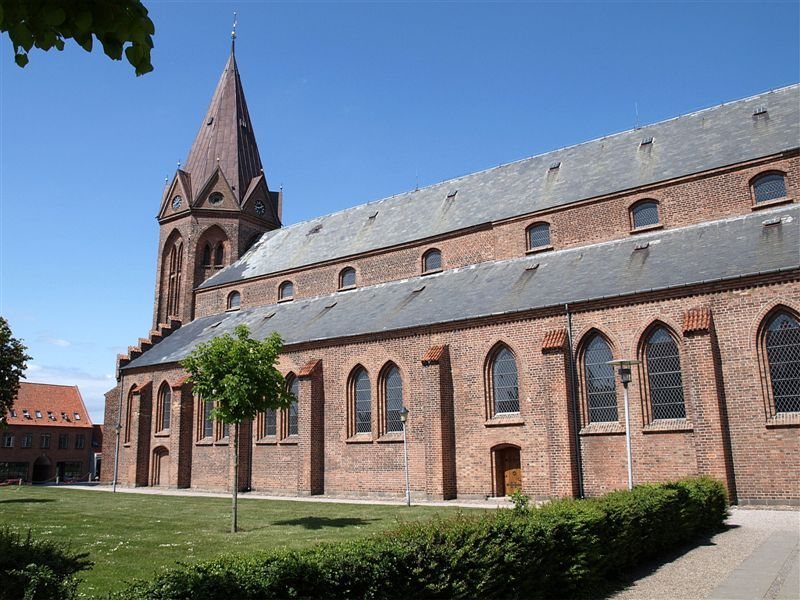
The church is a three-aisled brick basilica, a church with a central nave higher than its side aisles, built from large red bricks and ending in a three-sided east end. It measures about 59 metres long and 20 metres wide. After Odense Cathedral, it is the largest church on Funen and the second-largest in the Diocese of Funen.
Exterior structure
Nave and transept
The lower roofs over the side aisles leave room for clerestory windows, high windows in the central walls that bring light into the nave. Part of the northern transept, the crosswise arm of a church, was incorporated into the building. A porch was added on the north side around 1525.
Tower
The tower’s square lower section survives from the earlier church, while its octagonal upper part was added in the late 15th century. Rising 48 metres, it has a plain lower portion and blind niches in the upper section. Its octagonal form is unusual in Denmark; the only comparable towers are those of the Church of Our Lady in Kalundborg. The tower was covered with copper in 1995 and renovated in 2013–14.
Interior and furnishings
Altarpiece and altar fittings
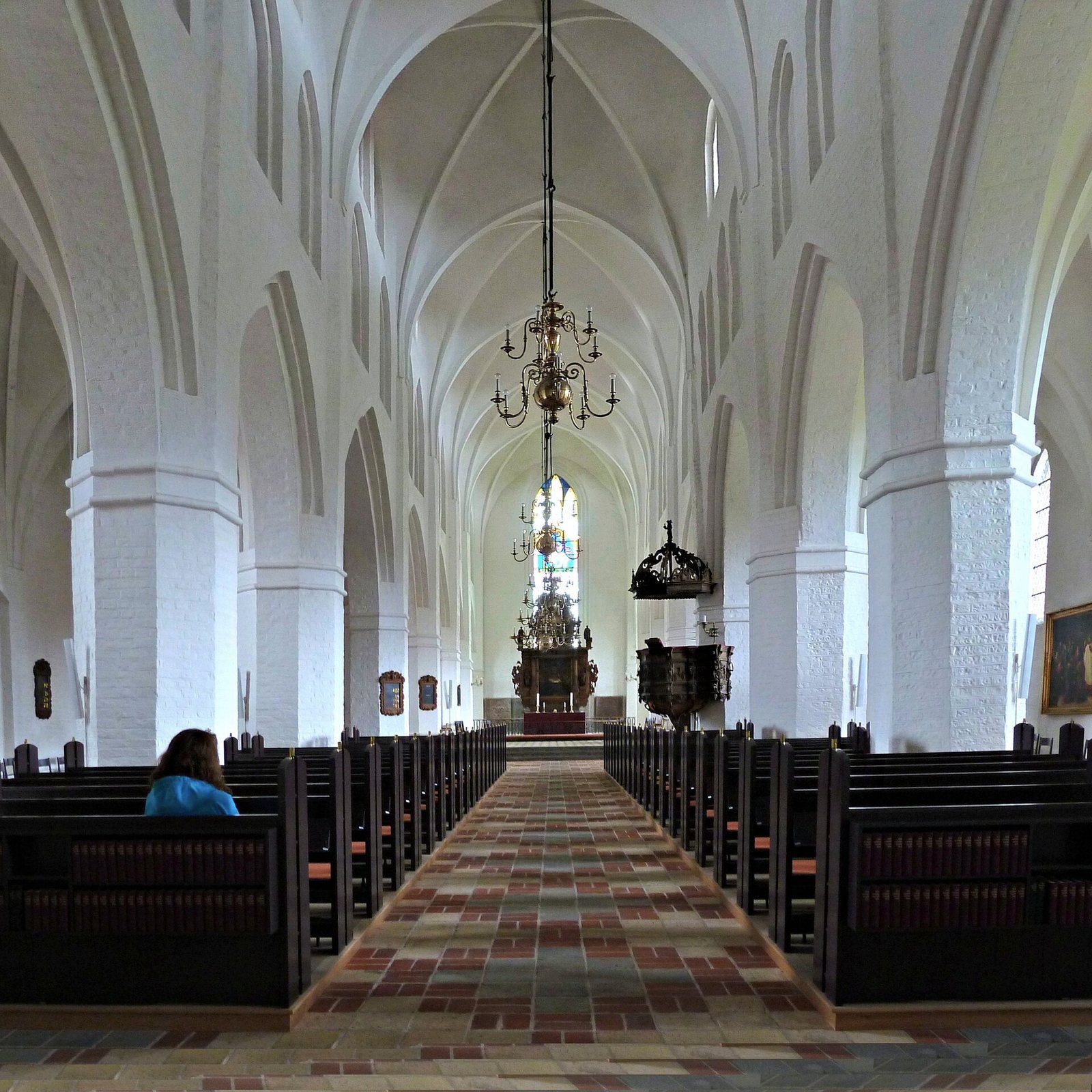
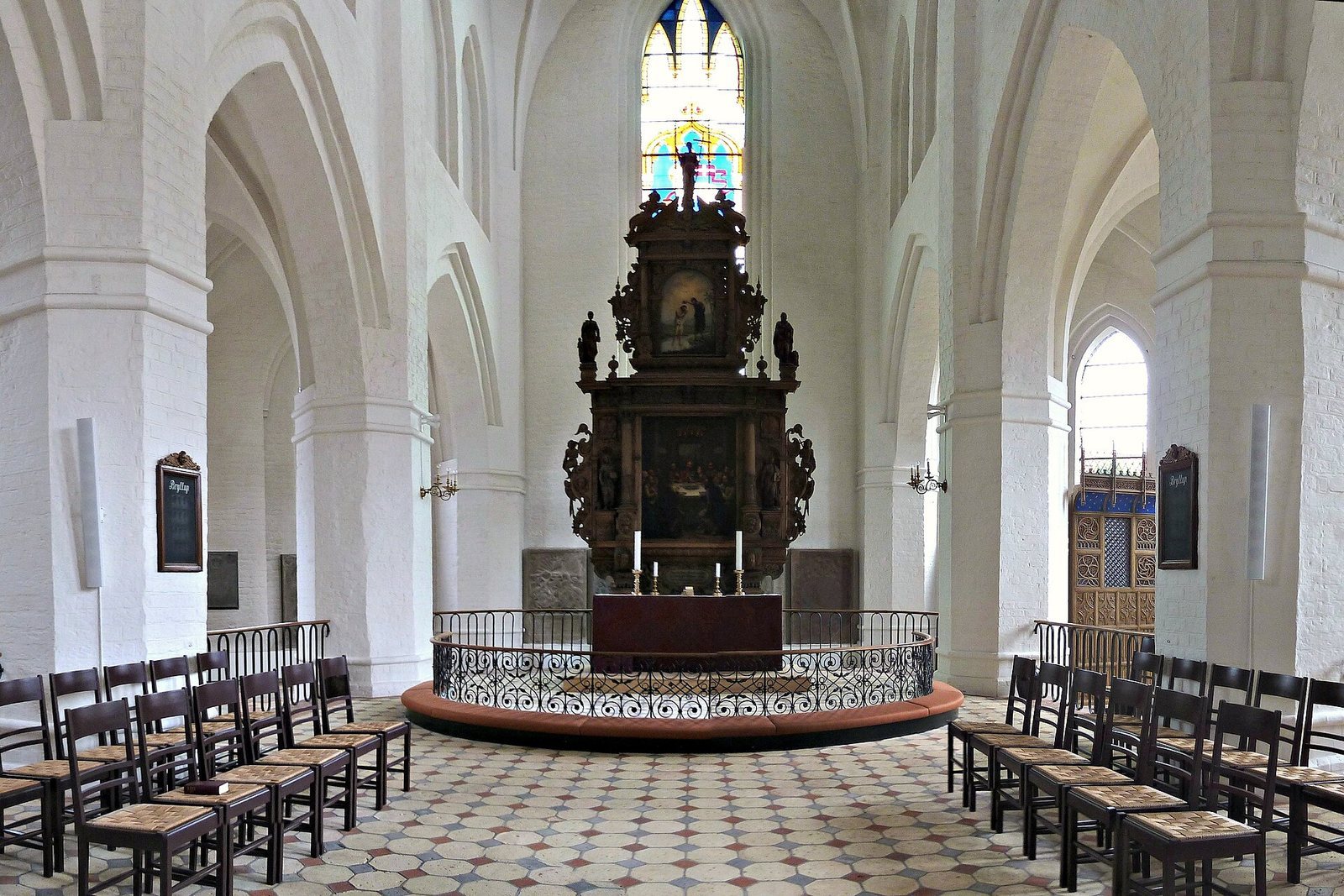
The altarpiece, made around 1620–25, was donated around 1625 by Jens Mand and Karen Berildsen. Its decoration combines Renaissance forms with auricular Baroque, an ornamental style with ear-like curves. Jes Bundsen’s paintings, added in 1826–28 in place of earlier works, show the Last Supper and the Baptism of Jesus. Beside the altar stands a cabinet for a monstrance, a vessel used to display the consecrated host. A Romanesque holy-water basin, used to hold water for Christian rites, is set into the wall beside the porch door.
The wrought-iron balustrade around the altar kneeler bears a crossed hammer and key, the mark of Casper Finck, a court smith to King Christian IV, who ruled Denmark and Norway from 1588 to 1648. Two altar candlesticks were given by Peter Kemp in 1577. The oldest bell was donated in 1631 by parish priest Poul Andersen and several mayors and councillors. The oldest chandelier, given by Niels Iversen and his wife Birte, dates to 1652.
Pulpit and communion silver
Hans Nielsen Bang carved the pulpit around 1670–75. Its carved panels show scenes from the Passion, and figures at its corners probably represent disciples. The last three figures may originally have stood on the pulpit stair. An hourglass from around 1700 was intended to limit services to an hour.
The church’s altar silver was substantially renewed around 1700. In 1670, parish priest Bertel Ludvigsen donated a communion wafer box made by Assens silversmith Christian Callender. In 1686, mayor Thomas Iversen and Helvig Jensdatter paid to have the cup of a late-medieval chalice replaced. Birgitte Fugl gave a North German communion wafer box and an altar jug made by Copenhagen goldsmith Jens Christensen in 1722. A communion set for the sick was made by Assens goldsmith Iver Larsen in 1737, and local goldsmith Niels Iversen made a paten, a plate for communion bread, in 1780.
Lighting and baptismal furnishings
Two seven-branched candlesticks were added around 1900. The town’s women donated one in 1899, and the other was acquired in the early 20th century. The church acquired a copy of a 1645 wall-mounted candle arm in 1913. Harald Plum donated two brass chandeliers in 1919–20, and three more were added later.
A marble baptismal angel made by sculptor Jens Adolf Jerichau dates to 1883. Anders Bundgaard made the cast-metal baptismal font in 1910, and the Assens and Surroundings Savings Bank donated it. It has a brass basin and probably a baptismal ewer designed by Siegfried Wagner, originally made as a beer mug. A stained-glass window showing Assens’s coat of arms was also given in 1910, by shoemaker J. J. Albinus; glazier August Duvier designed and made it. The church received a painting by Dankvart Dreyer in 1842, showing Christ appearing to the apostles and the Three Marys.
Organ and seating
Marcussen & Søn built the organ in 1964. It has 35 stops, controls that select pipe sounds, and mechanical action linking the keys to the pipes. The organ stands on a gallery built at the same time and enlarged in 1999. The pews were renewed in 2007, replacing individual chairs installed in the early 1940s. Those chairs had heated seats and sound systems built into their backs.
Memorials and burials
Epitaphs
The church contains two epitaphs, commemorative monuments for the dead. The older, dated 1657–60, honours the family of Mayor Bunde Jacobsen. Its surviving parts are a group portrait painted by Hans Schütte and an inscription plaque; its architectural frame has not survived. The other memorial, for Mads Sørensen and dated 1763, combines a painted panel with an illusionistic composition.
Memorial plaques
Three limestone memorial plaques date to 1707–24. Each has a central inscription and rectangular floral reliefs in its corners. One is signed H. Roy. That workshop may have made all three plaques and may also have produced a gravestone dated 1723.
Gravestones
The church holds 45 gravestones, most dating from about 1540 to 1800; two are Romanesque. Stones from the 1540s include Gothic heraldic designs, while examples from the 1550s and 1560s show human figures. Both groups are considered local work and may have come from the same workshop. Two aristocratic stones are attributed to regional workshops known as the “Odense Sculptor” and the monogrammist “AS.” Seventeenth-century gravestones often feature inscription panels surrounded by carved figures. Many stones are now fragmented.
Burial chapel
Anne Elisabeth von Trampe established a burial chapel in 1741. Three oak coffins remain inside it.