Alacahöyük: An Ancient Anatolian Settlement and Cult Center
Site at a Glance
- Popularity
- Very High
- Country
- Turkey
- Primary era
- Bronze Age
- Eras represented
- Stone Age, Bronze Age
- Civilizations
- Hittite
- Site type
- City
On this page18 sections
History
Alacahöyük is a multi-period archaeological settlement near Alacahüyük village in Çorum Province, Turkey. Its occupation began in the Chalcolithic, or Copper Age, generally dated to the fourth millennium BCE, though some finds have been taken to indicate activity around 5000 BCE. Alacahöyük became an important cult and artistic center in both the Early Bronze Age and Hittite periods.
Chalcolithic and Early Bronze Age
During the Chalcolithic, residents used copper alongside stone tools. The archaeological sequence comprises roughly 15 settlement or building levels, grouped into Chalcolithic levels 9–15, Early Bronze Age levels 5–8, Hittite levels 2–4 and upper levels from later periods. In the Early Bronze Age, Alacahöyük flourished as a center associated with Hatti culture and Anatolian exchange networks. Charred rye grains indicate that people cultivated rye there.
Fourteen richly furnished royal graves date broadly to the third millennium BCE. Burning and destruction around the cemetery led Leonard Woolley to propose that the graves marked the end of a culture that did not continue into the following period at Kültepe, an ancient Anatolian settlement with evidence of Assyrian trade. Continued burials in the same cemetery, similar rites before and after the fire, and comparable grave goods instead point to settlement continuing in level 5 and a gradual transition into the Assyrian Colony Age, when Assyrian merchant communities operated in Anatolia. Tahsin Özgüç interpreted changes in this period as local development shaped by contacts from the south. Another proposal links the rulers represented by the grave assemblages, sun disks and animal figures to migrants from the Maykop region north of the Caucasus, but this remains an interpretation rather than an established conclusion.
Hittite period
The Hatti period in central Anatolia ended as the Hittites established a kingdom around 1750 BCE, although Hatti traditions continued within Hittite civilization. Alacahöyük’s Hittite levels are dated broadly to about 1800–1200 BCE, and many of its distinctive Hittite remains belong to the fourteenth century BCE. The town was fortified during repeated raids by the Kaska, a people of the mountainous region to the north. Although nearby Hattusa served as the Hittite capital, Alacahöyük remained a flourishing community through the Late Bronze Age.
Two Hittite texts written in wedge-shaped cuneiform mention Arinna and its Sun Goddess. One describes Arinna as a city inherited from ancestors and refers to a golden sun disk representing the goddess. The text may have been sent from or to Alacahöyük, supporting a possible connection between the site and Arinna without proving their identity. Tawiniya and Zippalanda have also been proposed as names for the ancient settlement, but none of these identifications is established.
During the reign of Tudhaliya IV in the thirteenth century BCE, drought threatened crops and contributed to famine. The king imported grain from Egypt and undertook a wider program of dam building. Gölpınar Dam, about 1.5 kilometres south of Alacahöyük, is associated with this effort and was dedicated to the goddess Hebat.
Later occupation and archaeological investigation
Alacahöyük also had substantial Phrygian occupation. Its upper levels reflect later Roman, Byzantine, Seljuk and Ottoman periods, when the settlement’s importance had declined. The broader Boğazköy-Alacahöyük area became a national park in 1988.
William John Hamilton identified the site in the 1830s. George Perrot and Ernest Chantre investigated it in the late nineteenth century, and Perrot was the first to suggest a Hittite date for remains by the gate. Hugo Winckler visited in 1906, followed by a brief investigation by Theodor Makridi Bey in 1907. German teams working in the 1910s uncovered royal graves and part of the Hittite town.
Turkish excavations began in 1935 under Remzi Oğuz Arık and Hamit Zübeyir Koşay, at the personal direction and with financial support of Mustafa Kemal Atatürk, founder and first president of the Republic of Turkey. Work continued under Mahmut Akok in 1968 and through later campaigns, resuming in the mid-1990s under Aykut Çınaroğlu. Excavations in 2002, 2003 and 2005 brought to light four Luwian hieroglyphic documents, a clay sealing, two vessels bearing seal impressions and a fragment of a stele. Since 2009, metal objects from the tombs held in Ankara have been examined by the German Mining Museum.
Remains
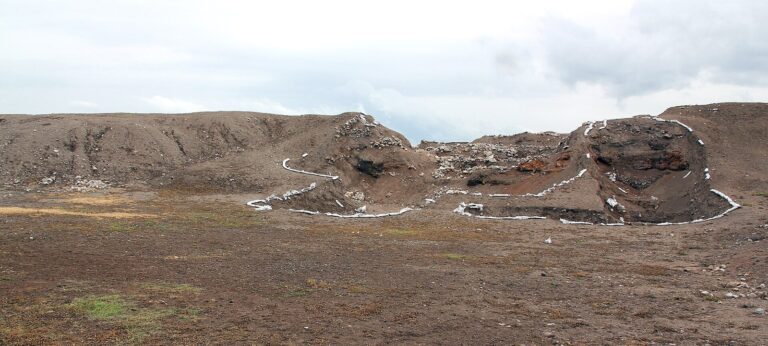
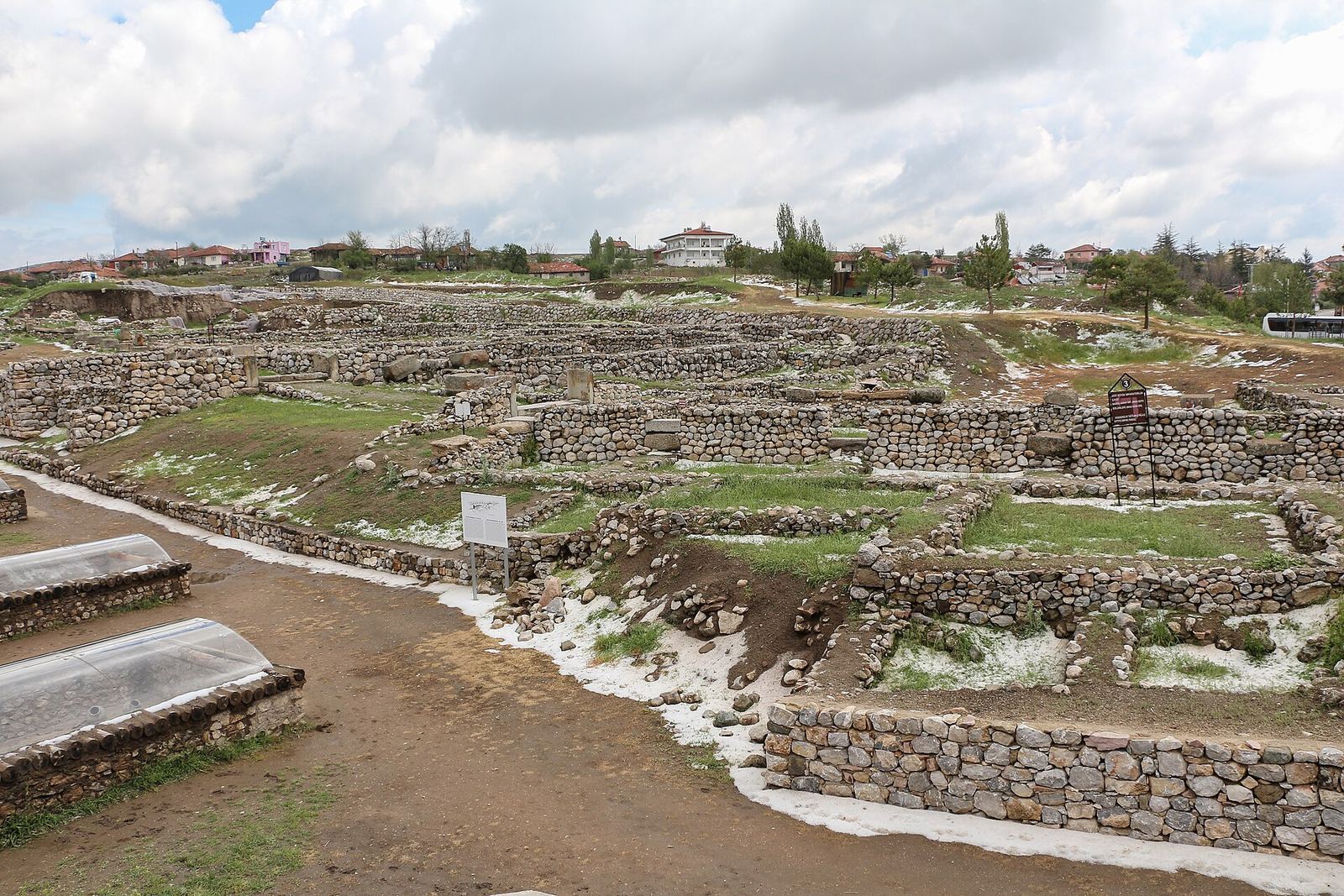
The settlement occupies a mound about 310 by 275 metres across and approximately 14 metres high, with cone-like rises at its southern and northeastern ends. The archaeological area covers about 7 hectares. Its layered remains range from Chalcolithic buildings to Hittite town structures and later occupation. The mound lies near Alacahüyük village in Alaca District, Çorum Province.
Chalcolithic settlement
Buildings
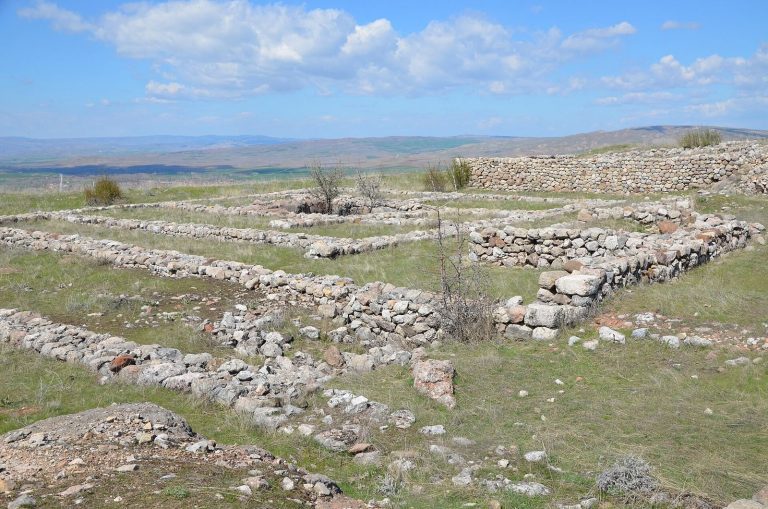
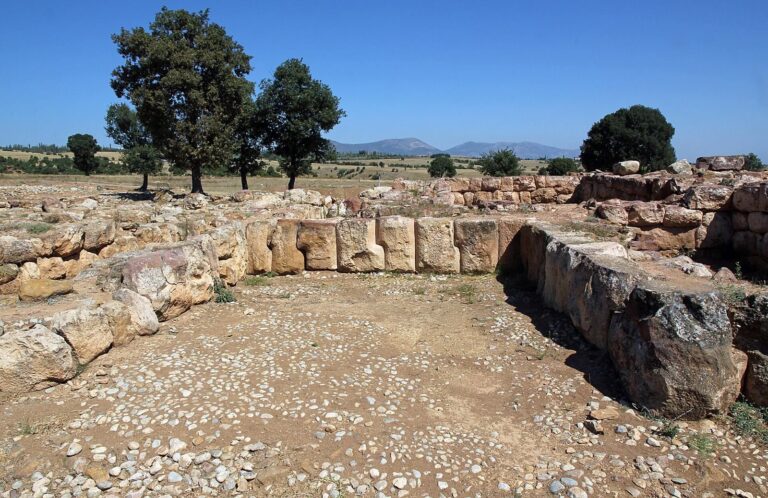
Chalcolithic buildings had stone foundations or low stone bases, thin mudbrick walls covered with plaster, and clay-plastered floors. Excavated plans show adjoining rectangular rooms with hearths. Flat roofs supported by beams and reeds beneath a thin layer of earth are inferred from the building evidence. In 2012, work in trench H4/19 exposed a second fire layer beneath 53 centimetres of fill and burned mudbrick. Dense Late Chalcolithic pottery lay in the fire layer, though it was not linked to a particular building level.
Pottery and tools
Pottery ranges from coarse, sand-tempered and black-burnished wares to finer vessels with dark exteriors and lighter interiors. Finds include wide-mouthed bowls, high-footed stands, pots and small jugs, some decorated with red bands, chevrons, lines, grooves, raised patterns or impressed dots. Handles include simple knob and hook forms as well as animal shapes. Flint was more widely used than obsidian, and blade making was common. Other tools and objects include flint arrowheads, stone axes, grinding stones, clay weights, rings, rattles, spindle whorls, bone awls, bone hammers, handles and horn sickles. A small number of figurines were also found.
Burials
Chalcolithic graves include stone-lined and earth-cut burials, with single or double interments. The dead were placed with their limbs drawn toward the body and sometimes accompanied by grave goods, including vessels and copper bracelets.
Early Bronze Age royal cemetery
Graves and burial customs
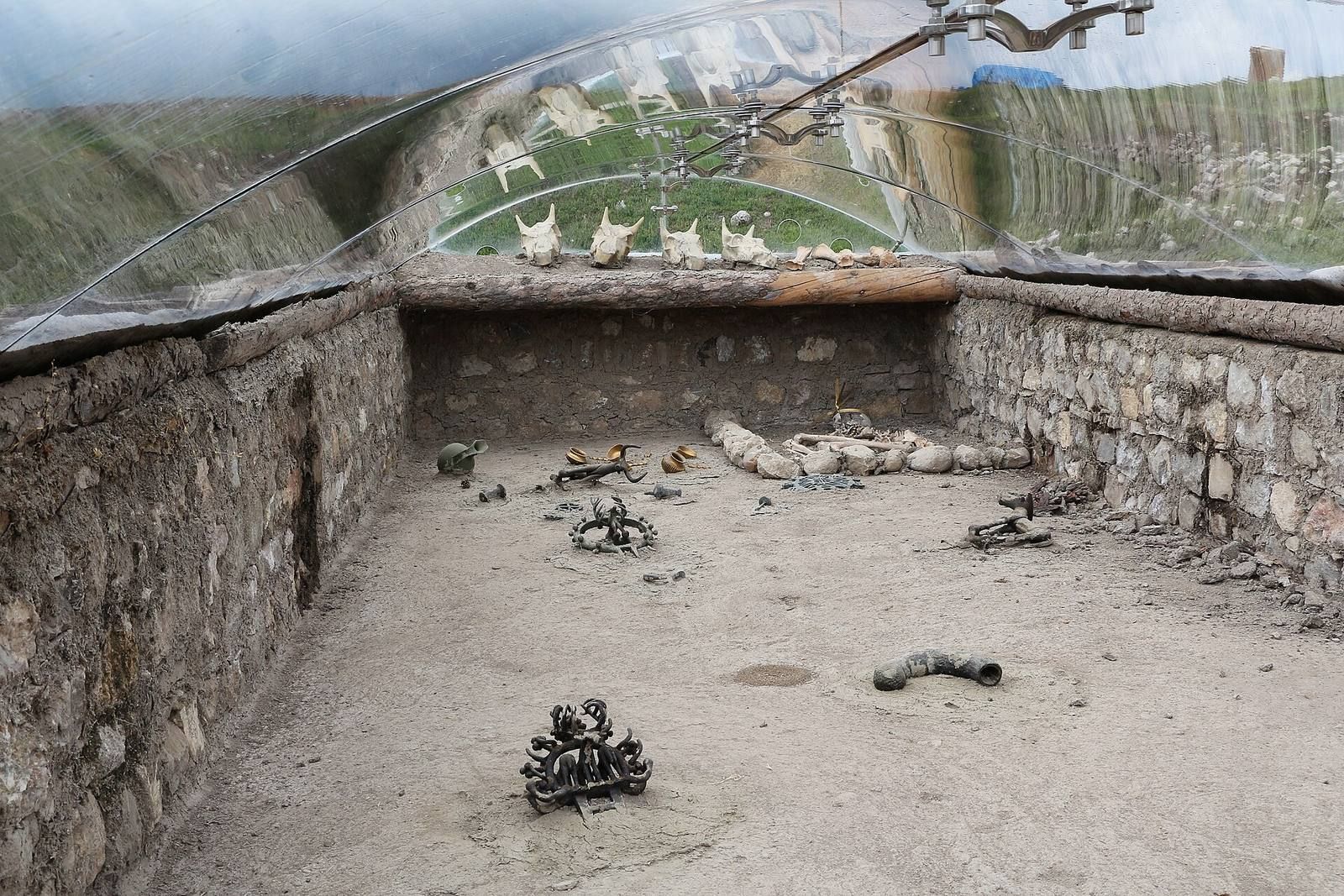
The cemetery contains fourteen rectangular graves reached through vertical shafts. Built of stone and wood, they were about 1.5 metres deep and sealed with wooden beams; some held two burials. Adult men and women were laid in crouched positions with jewelry, cosmetics, tools, weapons and metal vessels. Bulls’ heads and legs were placed on platforms. Seven metal figurines from the graves comprise four bronze and three silver examples.
Tombs H and A
Tomb H measures 8 by 3.4 metres and held a woman. Its contents included a gold diadem, two copper mace heads, a bronze sun emblem, an animal statuette, small gold and silver ornaments, gold and clay vessels, two axes, five pairs of gold twin figures and three female figurines. Tomb A, measuring 5 by 2.3 metres, held an adult woman. Finds there include a gold diadem, four sun emblems, an animal statuette, metal ornaments, fragments of an iron object and two metal human figurines.
Standards and other grave finds
Some grave standards, ceremonial emblems mounted on supports, depict bulls or stags above bases. Made of copper or bronze, they include circular, semicircular and square forms with openwork bars, central crosses and swastika motifs. Their purpose remains debated. A gold-handled dagger from grave K, dated as early as about 2500 BCE, is probably made of meteoritic iron. Many objects from the graves are now in Ankara’s Museum of Anatolian Civilizations, while some are displayed in the local Alacahöyük museum.
Hittite town
Walls and gates
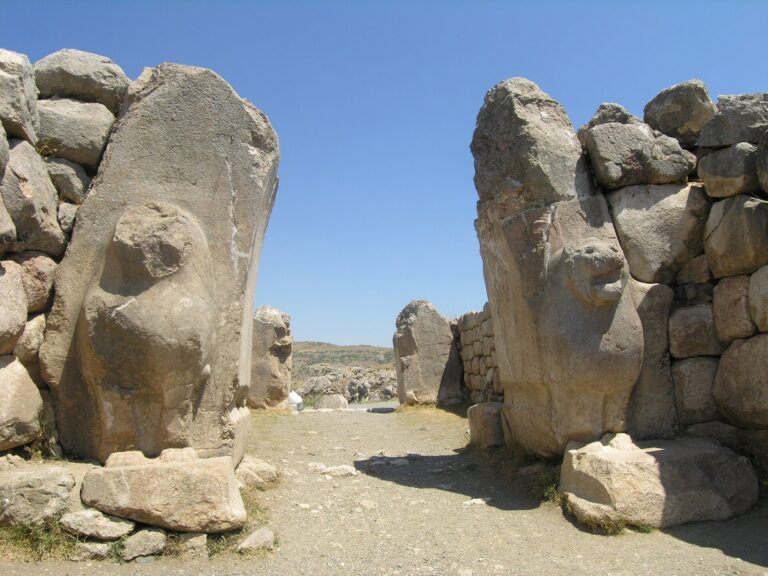
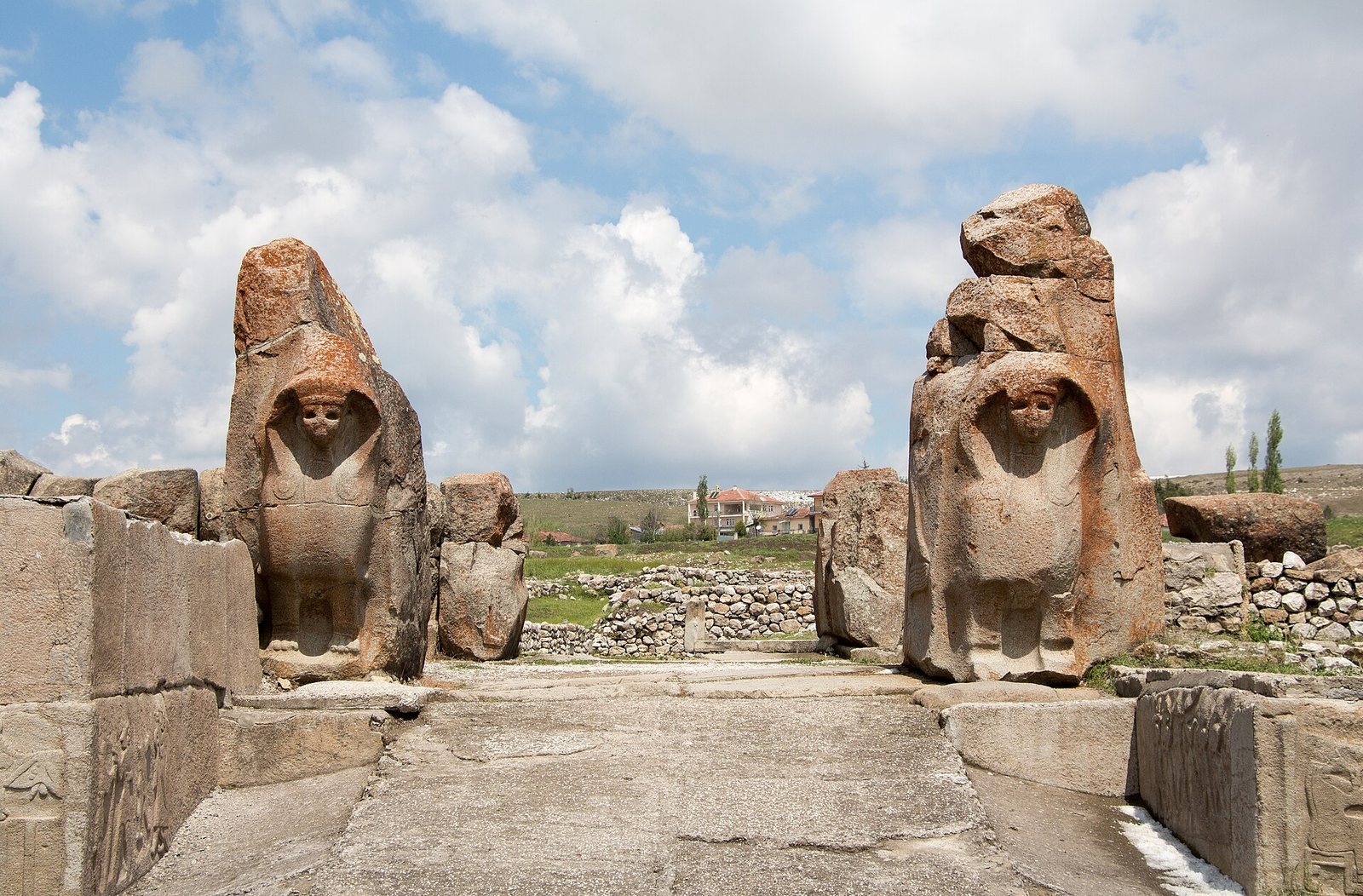
Hittite fortifications included city walls and towers. The monumental southern entrance, the Sphinx Gate, stood between two towers and was guarded by a pair of sphinxes carved from single blocks of stone. Each block is about 4 metres high, with the carved figure measuring approximately 2.1 metres. Ramps formed part of the inner and outer gates, and another entrance stood within the city walls. The sphinxes were believed to guard the surrounding area against evil.
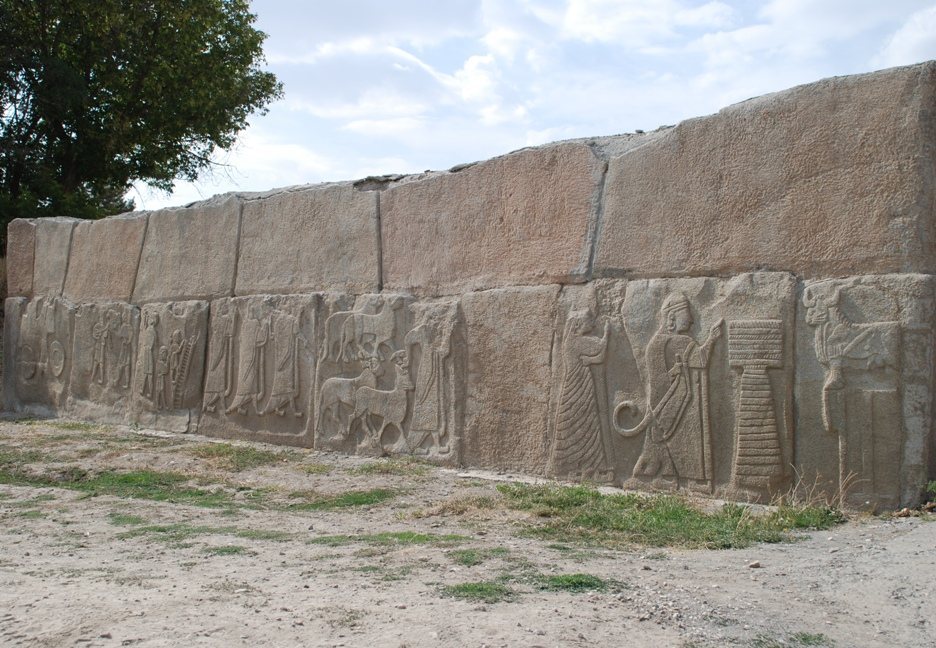
Carved stones and town buildings
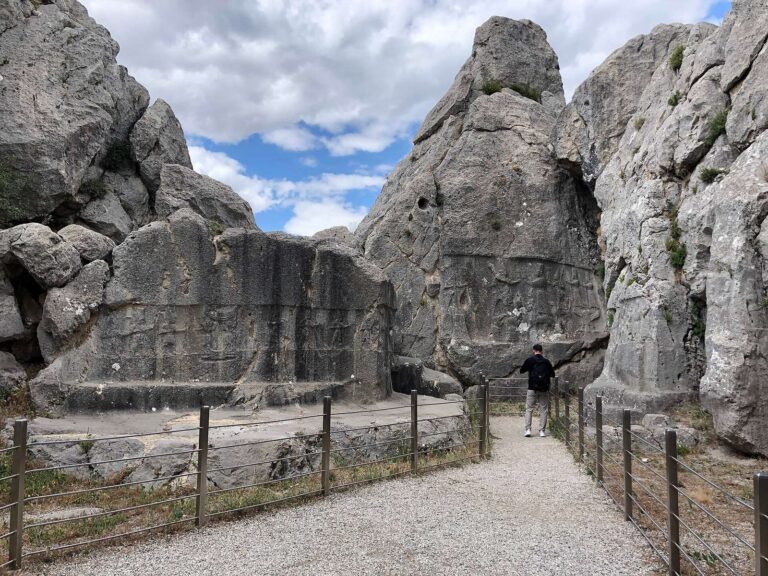
Upright carved stone slabs once covered parts of the walls. Their reliefs include a king and queen before an altar, with a bull representing the Hittite Storm God, a deity associated with storms. Other scenes show a seated goddess, probably the Sun Goddess of Arinna, sacrificial animals, hunting and religious festivals. The sphinxes and most of the carved slabs date to the fourteenth century BCE. The original reliefs were moved to the Museum of Anatolian Civilizations; copies are displayed at Alacahöyük. Beyond the Sphinx Gate lay a large public building, a residential quarter and temples. The town remains also include a large palace, a temple-palace, two monumental gates, and channels for clean water and wastewater.
Gölpınar Dam
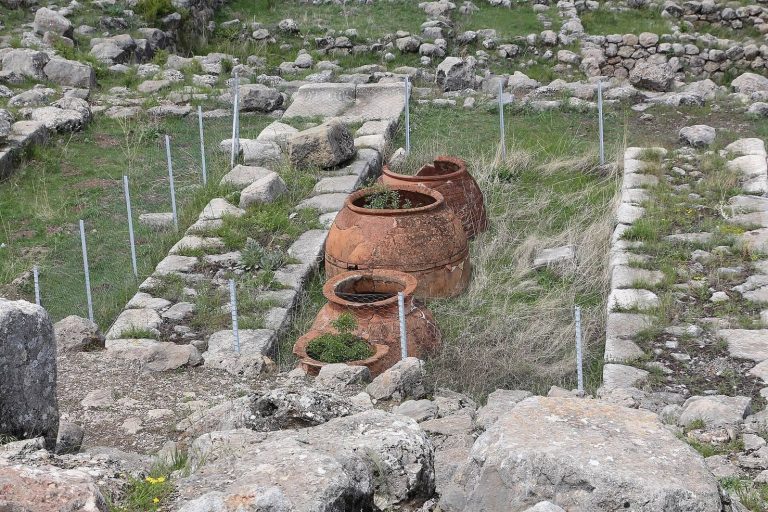
The dam is about 140 metres long and 15 metres wide, built of small stones faced with lime. It reaches roughly 5 metres deep in places and draws water from groundwater within its own basin. Its excavated section contains two channels, a pool and three statue bases. A stone stele found there bears the name of Tudhaliya in Luwian, an ancient Anatolian language, written in hieroglyphs. The reservoir holds about 2.5 million cubic metres of water and is roughly two-thirds full.
Later levels
Material from the upper levels includes pottery, coins, weapons and household objects, reflecting the settlement’s later phases of use.