Otani Kofun: A Fifth-Century Keyhole Tomb in Kyotango, Japan
Site at a Glance
- Popularity
- Low
- Country
- Japan
- Primary era
- Classical
- Eras represented
- Classical
- Civilizations
- Yamato
- Site type
- Burial
- Remains
- Burial Mound
On this page12 sections
History
Otani Kofun is a keyhole-shaped burial mound in Omiyacho Taniuchi, Kyotango, Japan. Grave goods place its construction in the first half of the fifth century, during the Kofun period, named for the large tombs built for powerful individuals. The tomb is interpreted as that of a local minor chief and as part of a sequence of chiefly burials associated with Amino Choshiyama and Shinmeiyama.
The burial and women’s authority
The burial’s objects were interpreted together as echoing the Three Sacred Treasures, symbols of rulership. This association helped prompt a theory that women may have governed the area during part of the middle Kofun period. During excavation, the deceased was popularly compared to the “Himiko of Tango.” Himiko was a third-century ruler of Wa, an early name for the Japanese polity; the comparison was an analogy, not an identification.
The tomb has also figured in interpretations of women’s status and ritual roles in ancient Tango. One proposal connects the burial traditions of the area with female ritual specialists, but this remains an interpretation rather than an established identification.
Tango’s regional setting
Regional interpretations link Tango’s growth to exchange with China and the Korean peninsula. Arable land was limited, and trade and access to advanced technologies are thought to have supported the region’s development. During civil disturbances in Wa, when trade through the Seto Inland Sea weakened, continental goods may have reached the Kinai, the central region around Japan’s ancient capitals, and the eastern coastal region of Tokai by way of Tango. A period of regional prosperity is dated from around the second half of the second century to the latter half of the fifth.
Historian Teiji Kadowaki’s “Tango Kingdom” thesis proposes that a distinct political sphere formed around the Takeno River basin. The distribution of nearby Yayoi-period platform tombs, including graves of the type formed by shaping a slope into a raised platform, has been discussed in connection with this idea and with a distinctive regional culture.
Survey and excavation
Otani Kofun was identified in 1987 during a detailed archaeological survey ahead of industrial development on a hillside. The Kyoto Prefectural Board of Education cooperated with the survey because of the scale of the proposed construction. After Otani Kofun and four other archaeological sites were found, the town education board sought changes to the development plan. The other sites were to be preserved as far as possible, but the plan’s central placement of Otani Kofun prevented its preservation in place. It was excavated and recorded as a means of preserving information about it.
Remains
Mound and setting
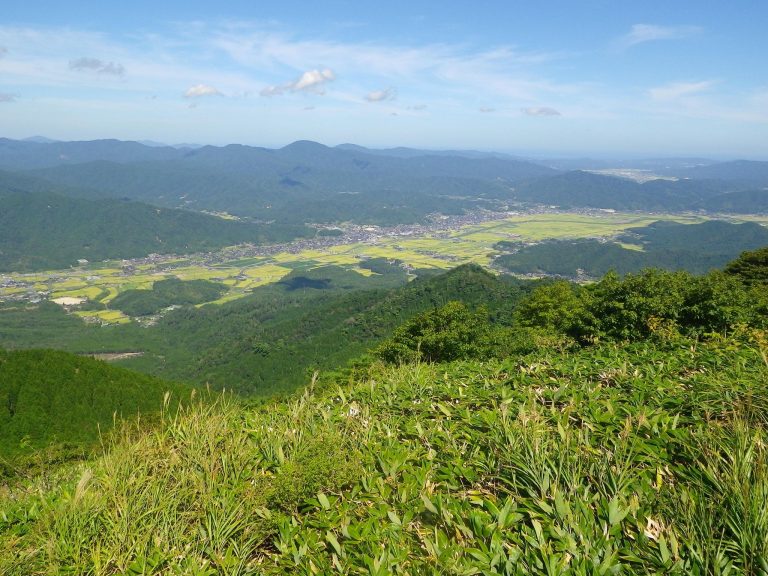
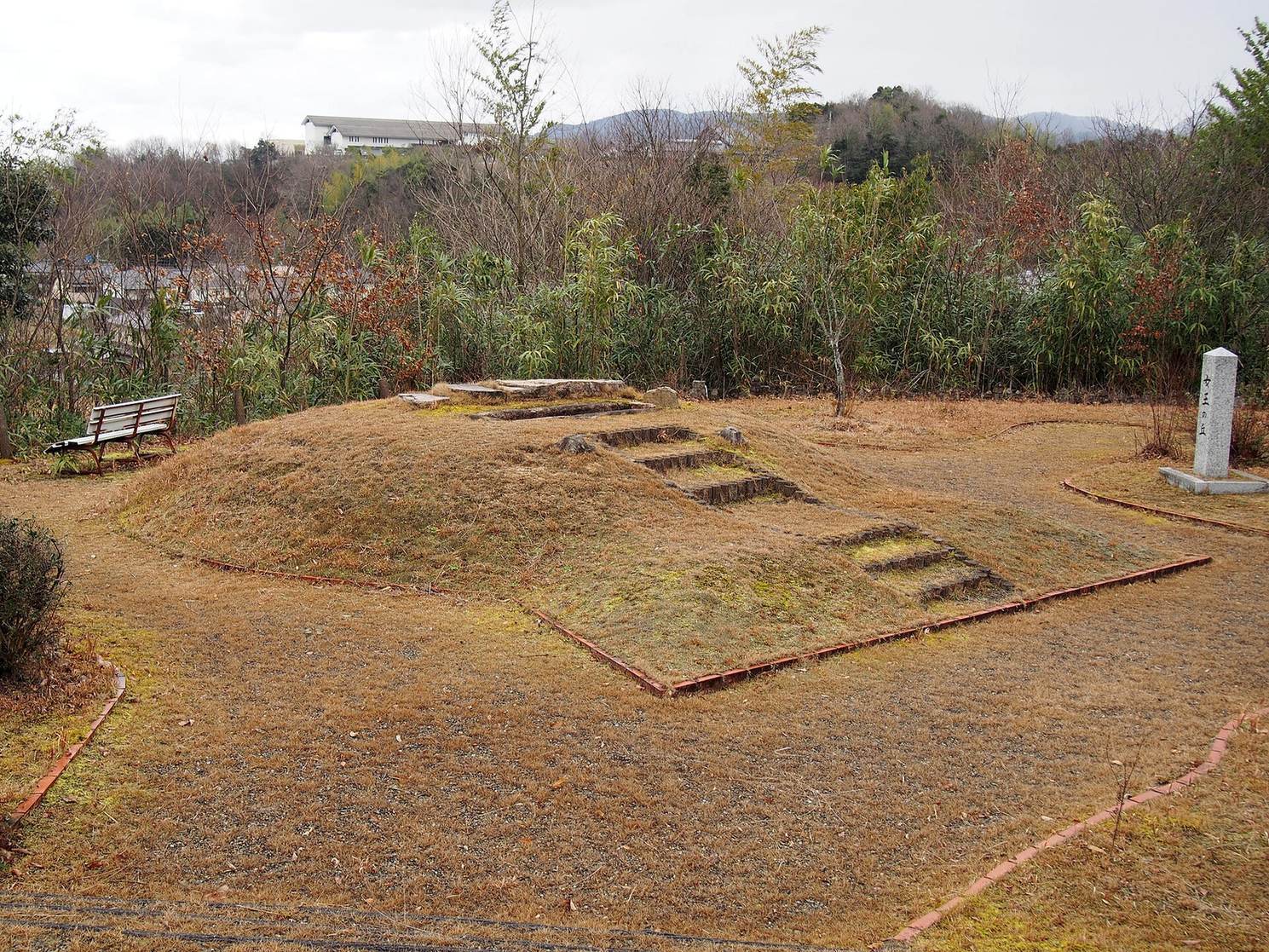
Otani Kofun stood in isolation at the tip of a hill overlooking the Takeno River. Its scallop-shell-shaped keyhole plan has a rounded rear section and a shorter, narrower projection at the front. The mound is 32 m long. Its circular rear section measures 26 m across and rises 4 m, while the short front section is 19 m wide and 2.5 m high.
Stone coffin
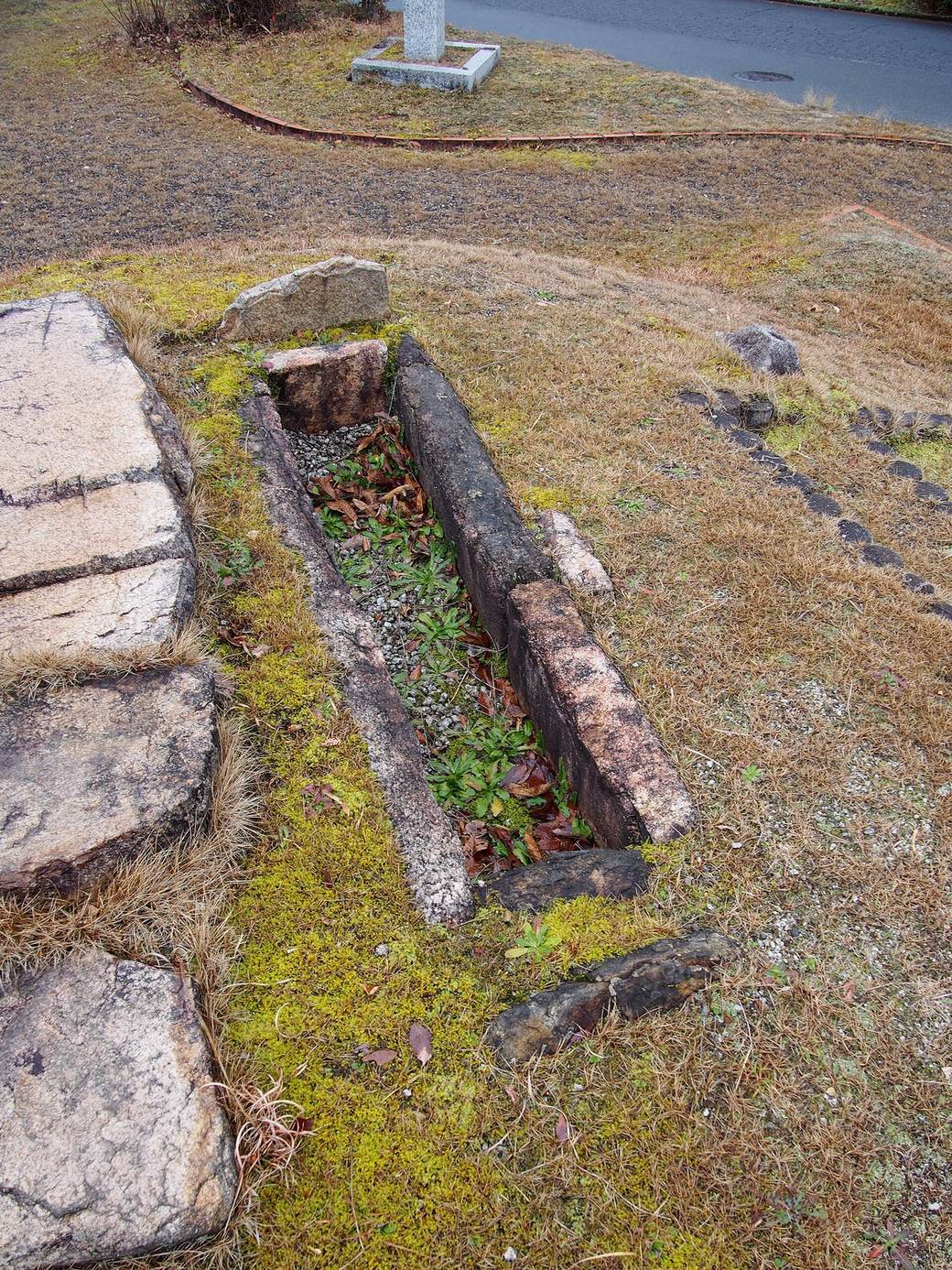
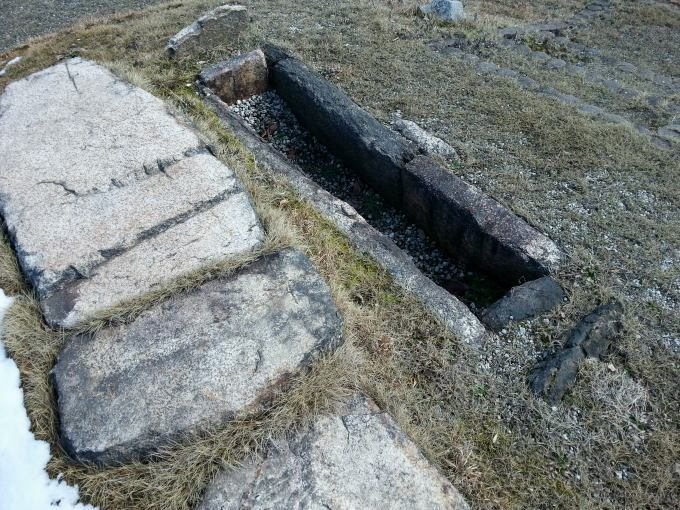
An assembled stone coffin was placed in a cut made into the granite bedrock, perpendicular to the mound’s main axis. Its burial pit measures 4.55 by 2.8 m and is about 1 m deep. A projection on the northeast side may have served as steps, and grooves in the floor held the coffin stones. The coffin’s interior was coated with red iron-oxide pigment, giving it a dark red surface. Clay and other material sealed gaps between the stones; this may have kept soil out for well over a thousand years and helped preserve the coffin.
Human remains
Almost the entire skeleton was recovered, although the bones were badly damaged. The pelvis identified the deceased as female. Heavy wear on the molars and slight beak-like growths on the front of the lower-back vertebrae indicate an estimated age in early middle age. Compared with women from other regions in the same period, the skull was notably long, while the face and nose had very low profiles.
Mirror and beads
The grave goods include a bronze mirror with a face 10.8 cm across, a rim 0.4 cm wide, and a convex surface rising 0.2 cm. It was exceptionally well preserved. A translucent green jadeite magatama, a curved bead, has a C shape and an unworked patch on its inner curve. The burial also contained 33 blue, disk-shaped glass beads.
Weapons and tools
An iron sword measures 43.7 cm overall, with a 33.9 cm blade, a maximum width of 3.0 cm, and a thickness of 0.5 cm. Its blade has a lens-shaped cross-section and shoulders on both sides. The sword’s 9.6 cm tang, the portion fitted into a handle, retains wood, while textile impressions survive on part of the blade. The grave goods also include a forged iron axe with a roughly formed handle socket, 7.2 cm long and with a 3.3 cm-wide blade, and a small knife.
Earlier platform tombs
Yayoi-period platform tombs lay beneath Otani Kofun. Work preparing for relocation revealed six burial facilities in all, including four overlapping principal structures. Associated finds include Yayoi pottery in the forms of jars, pots, and high-footed vessels. An iron arrowhead, thought to have had a leaf-shaped blade and a projecting attachment, was also recovered.
Quarter-scale reconstruction
A park contains a quarter-scale reconstruction of the mound. Its original location is now within a factory site.