Opfermoor Vogtei: An Iron Age Cult Centre in Germany
Site at a Glance
- Popularity
- Medium
- Country
- Germany
- Primary era
- Iron Age
- Eras represented
- Iron Age, Classical
- Civilizations
- Unclassified
- Site type
- Religious
- Remains
- Sanctuary
On this page21 sections
History
Opfermoor Vogtei is an ancient cult site near Oberdorla, Germany, used from the sixth century BCE, during the Hallstatt Period, through the Migration Period. The Hallstatt Period was an early phase of the Central European Iron Age; the Migration Period was an era of large population movements in late antiquity and the early Middle Ages. Regarded as the largest known Iron Age cult site in Central Europe, Opfermoor Vogtei offers evidence of pre-Germanic and Germanic religious practices and served a region wider than a single community.
Hallstatt and La Tène communities
Local communities used the site during the Hallstatt Period. Friedrich Maurer, a scholar of Germanic languages, later placed their descendants within the Rhine-Weser group, a scholarly classification rather than the name of one ancient people. In the succeeding La Tène Period, another phase of the Iron Age, these communities encountered Celtic cultural influences. Pottery also points to some later Germanic migrants having come from the Oder and Warta region. Finds associated with Roman-era Germania suggest that the cult site served people from across a broad area, not one tribe alone.
Hermunduri and Roman-period worship
In the first century BCE, the Hermunduri, an ancient Germanic people, established a major sanctuary at the site. The cult centre grew in importance. Tacitus, a Roman historian, described a conflict near the River Werra between the Hermunduri and the Chatti, another Germanic people. After the Hermunduri won, sacrifices at the lake continued.
During the Roman Imperial Period, the era of Roman imperial rule, worship first involved several deities in shared shrines. From the third century CE, attention shifted toward a more secluded shrine associated with a goddess. Her image reflects Roman and local Celtic influences and has been compared with Diana, a Roman goddess associated especially with hunting and wild animals. A rune, a character in an early Germanic writing system, on a vessel may have indicated the goddess’s name. Religious ideas may also have reached the Hermunduri through workers from the Roman frontier. Possible connections include a craft settlement at Haarhausen, ox sacrifices at the site, and offerings in graves at Haßleben.
Later sacrifices and modern investigation
The site remained an important place of sacrifice during the later Migration Period. Use was not continuous after that era, but pottery and dog bones point to occasional sacrifices in the tenth and eleventh centuries. Isolated offerings continued into the eleventh and twelfth centuries, long after the region became Christian. Pagan worship ended after the establishment of the Archdeaconry of Oberdorla, a district of church administration, probably in response to the cult centre’s regional importance.
Peat cutting began in 1947, and archaeological remains came to light the following year. Excavations from 1957 to 1964 were led by Günter Behm-Blancke, director of the Museum of Prehistory and Protohistory of Thuringia in Weimar. Neo-Pagans have also held rituals at the site. A memorial stone to Behm-Blancke was erected in the museum village in 2012.
Remains
The cult area lies in a shallow natural hollow formed in Middle Muschelkalk, a shell-bearing limestone formation. Groundwater created marshland and an open-water area roughly 700 by 200 metres. Sediment began reducing the open water around 100 BCE; later peat extraction enlarged the lake again, producing its present size and shape. At least 86 distinct cult locations occupied this landscape. Many had circular enclosures made of hazel branches, with an altar, cult post, or wooden figure at the centre.
Hallstatt-period installations
Fire altar and circular shrine
An early Hallstatt-period installation centred on a rectangular fire altar of Muschelkalk limestone, enclosed by a half-circle bank of stone and earth. Food offerings were placed on it in vessels before a fire was lit. Buds preserved in charcoal point to spring rites, perhaps connected with a vegetation goddess. Beside the altar stood a circular, walled shrine containing a divine image shaped like a stele, an upright stone monument. The altar has been compared with both contemporary and earlier installations in the northwestern Alps and with early Greek fire altars.
Small offering places
Smaller oval offering areas from the later Hallstatt Period were bounded by stones or branches. Some contained simple wooden figures, including one with a decorated neck ring. A large loom weight has been interpreted as a possible sign of a female deity. Painted pottery from the site has connections with examples from the Rhineland.
La Tène and Hermunduri sanctuaries
Lake-edge shrines
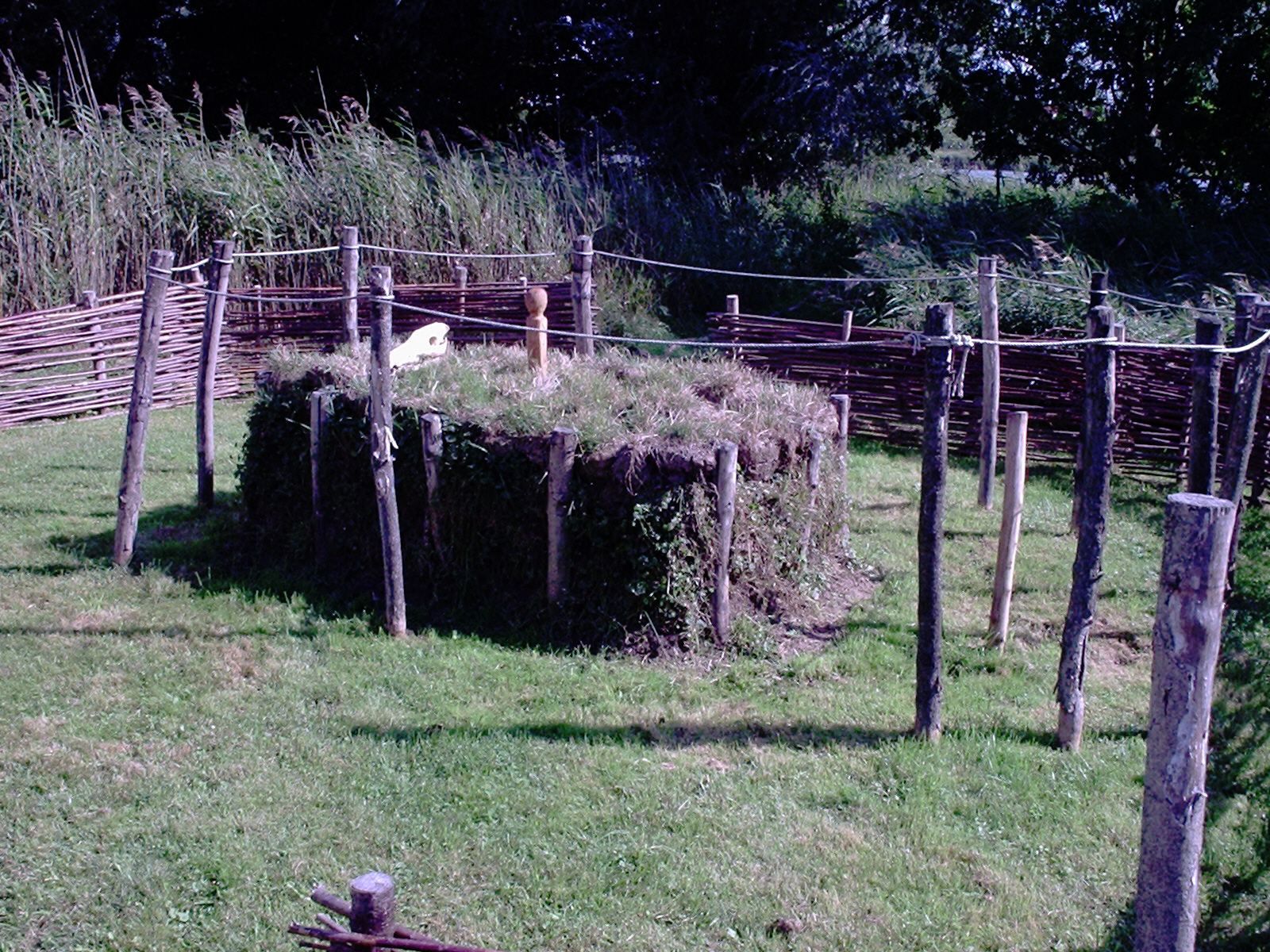
During the La Tène Period, a small lake became a focus for offerings. Wooden figures of different forms stood along its edge through the Migration Period. Rounded-ended enclosures held low altars built from turf or soil and strengthened with woven branches. A tall post or a simple stick-shaped figure rose above some altars, and ritual staffs were associated with them. Later installations included a phallic figure and a female figure made from forked sticks, although the identification of some fragmentary figures as female remains uncertain.
Hermunduri enclosure
The Hermunduri sanctuary had two building phases. Its large circular enclosure contained smaller bounded spaces with cult posts and a forked-stick figure. A rectangular wooden altar, supported by posts at its corners, stood in the centre. Animal bones lay nearby, while fragments of human skulls came from the enclosure’s western edge. Two additional offering places on the northern side were marked by an upright sword and a human skull.
Roman and Migration-period features
Goddess shrine and processional path
In the third-century shrine, a wooden goddess image stood near an altar. A coffin containing a woman’s skeleton was also placed there. The grave was destroyed in the fourth century, possibly amid unrest associated with the formation of the Thuringians. A processional path about 300 metres long, bordered by dog skulls, belonged to the late Roman-period cult complex.
Ship-shaped shrines
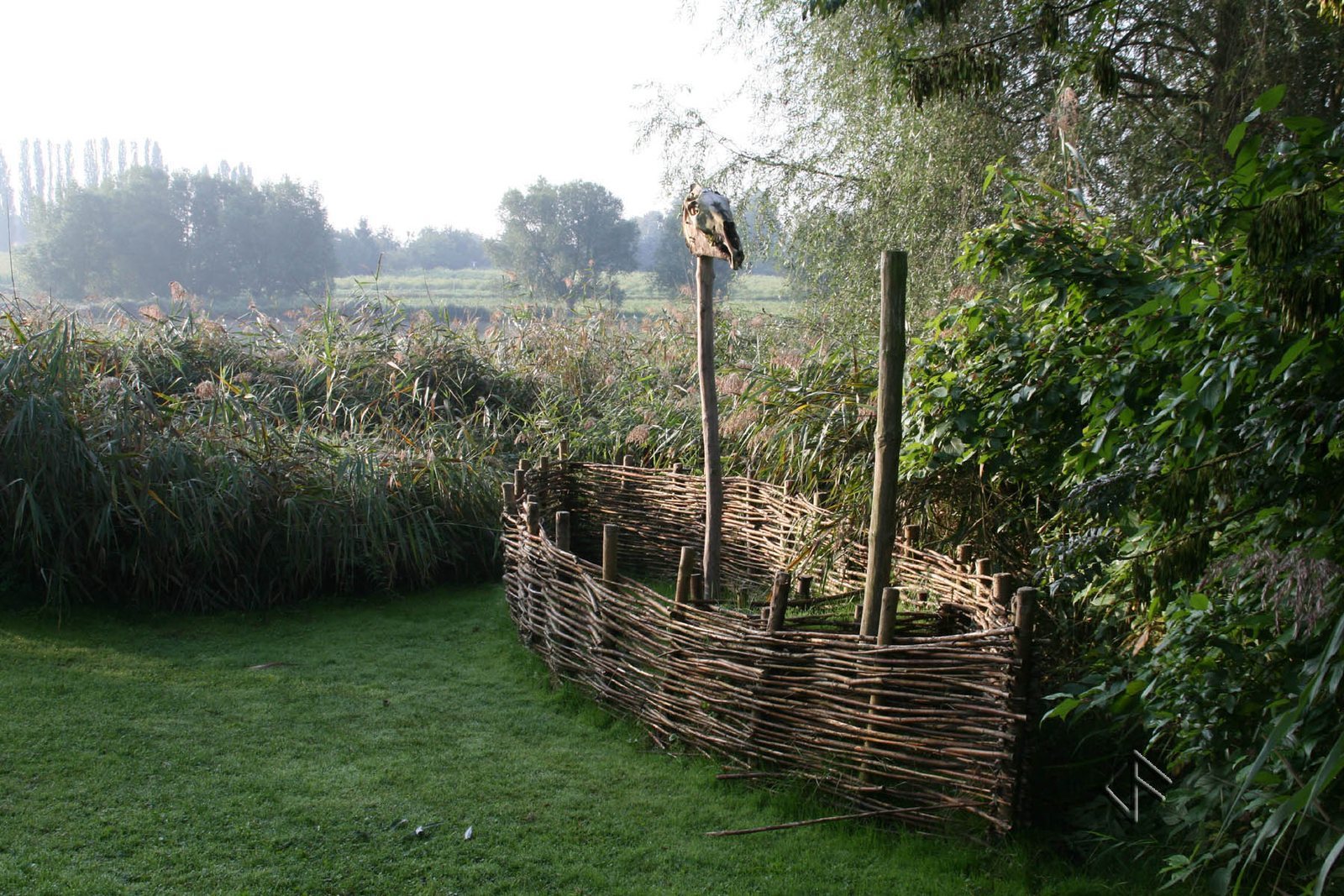
Two shrines shaped like ships date to the fifth century. The larger was made from branches, and a hole in it marked the position of a steering oar. It was associated with a tall post figure topped by a horse’s head. The smaller shrine was linked with a cattle sacrifice and a goddess. A later enclosing structure was destroyed by fire, with offerings inside.
Sacrificial deposits and finds
Human remains
Human remains from at least 40 individuals were recovered. Damage to some bones points to human sacrifice. In one case, a person’s head and extremities had been cut off, and the remains were sunk in the bog beneath branches. The tools used in that act were also broken and submerged.
Animal remains and ritual deposits
Animal remains include cattle, horses, sheep, goats, pigs, and a domestic cat, as well as deer, bison, wolves, wild boar, otters, foxes, and turtles. The site also yielded remains of 35 domestic and wild bird species, at least 27 pike, and some tench. These remains help explain diet and animal husbandry, changes in animal size, and the spread of domestic cats from Roman-settled areas into Germanic regions beyond Roman rule.
Sacrificial deposits take several forms. They include crushed bones scattered on the ground; cleaned whole bones piled or buried beside the lake, sometimes with the skull placed above them or on a pole; leg bones deposited without a skull; and leg bones with a skull placed in the lake, perhaps arranged like an animal hide on a pole. Skulls also occur alone, on the ground, on a pole, or in water. Offerings came from bog, lake, lakeside, and spring settings. The arrangement of many deposits makes their ritual purpose clear, while isolated bones, especially skulls, could represent offerings or remains from sacramental feasts held elsewhere.
Tools and other objects
Other finds include a cult boat, weapons probably used in sacrifices, bundles of flax, everyday objects, tools, and shaped pieces of wood that may have served for divination. Hammers or axes and clubs formed part of the ritual equipment. Fishing gear includes pieces of a fish trap, hand nets, harpoons, and hooks fashioned from sharpened sticks. These hooks turned when tugged after a fish swallowed the bait. The finds also include a bow among the earliest known from Germanic contexts and a weaving tablet with five holes.
Reconstructed museum landscape and collections
Shrines and village
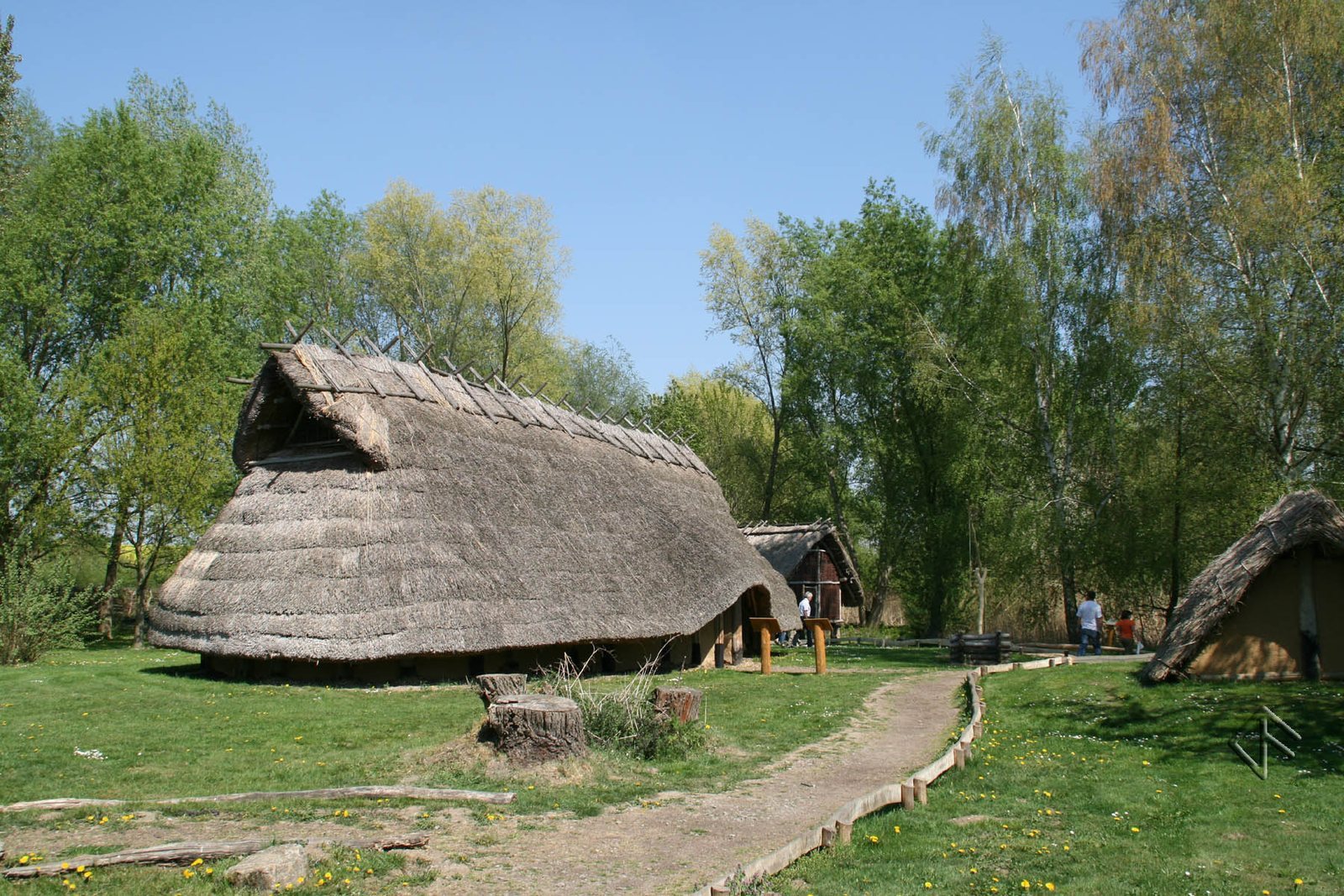
The open-air museum contains ten shrine reconstructions from different periods and a reconstructed third-century village. Its buildings include a longhouse for people and livestock, three pit houses, and a storage building. Excavations at the nearby Mallinden settlement, regarded as the largest prehistoric settlement known in Thuringia, provided models for the village buildings. A prehistoric walkway is also reconstructed, and birch trees line the path to the cult areas.
Museum collections
Some finds are displayed at the Opfermoor Museum, including a woman’s skeletal remains arranged with the skull on a stake to reproduce the position in which they were found. Other finds and Behm-Blancke’s papers are held at the Museum of Prehistory and Protohistory of Thuringia in Weimar. The Museum am Lindenbühl in Mühlhausen also has an exhibition about the site.