San Paragorio: A Romanesque Church in Noli, Italy
Site at a Glance
- Popularity
- Medium
- Country
- Italy
- Primary era
- Medieval
- Eras represented
- Classical, Medieval, Early Modern
- Civilizations
- Holy Roman Empire
- Site type
- Religious
- Remains
- Church
On this page19 sections
History
Early Christian origins
San Paragorio is a Roman Catholic church in Noli, Italy, dedicated to Saint Paragorius and built in the eleventh century in the Romanesque style, a medieval form associated with rounded arches. It is an important Romanesque monument in Liguria, with an earlier Christian history reaching back to the fifth and sixth centuries.
Christian tradition says Paragorius and his companions fled persecution under the Roman emperor Diocletian, who ruled from 284 to 305, and took refuge in Corsica. Paragorius was killed for his faith there. His relics, sacred remains or objects associated with a saint, were brought to Noli in the fifth or sixth century as Vandal invasions threatened the island. Their presence helped the religious complex develop. An early Christian church was built over a cemetery, before the present church was erected in the eleventh century.
Cathedral of Noli
In 1239, San Paragorio became Noli’s cathedral when the town’s bishopric, a diocese governed by a bishop, was established. Pope Innocent IV confirmed its status. On 12 October 1572, the cathedral role passed to San Pietro, a church within the town.
Restoration and archaeological work
An earthquake in 1887 led to restoration work on the church. San Paragorio held Italian National Monument status from 1890 to 2010. In the 1970s, archaeologist Nino Lamboglia led excavations around the building, followed by further investigations by the Ligurian Archaeological Superintendence.
Remains
Plan and exterior
Church plan
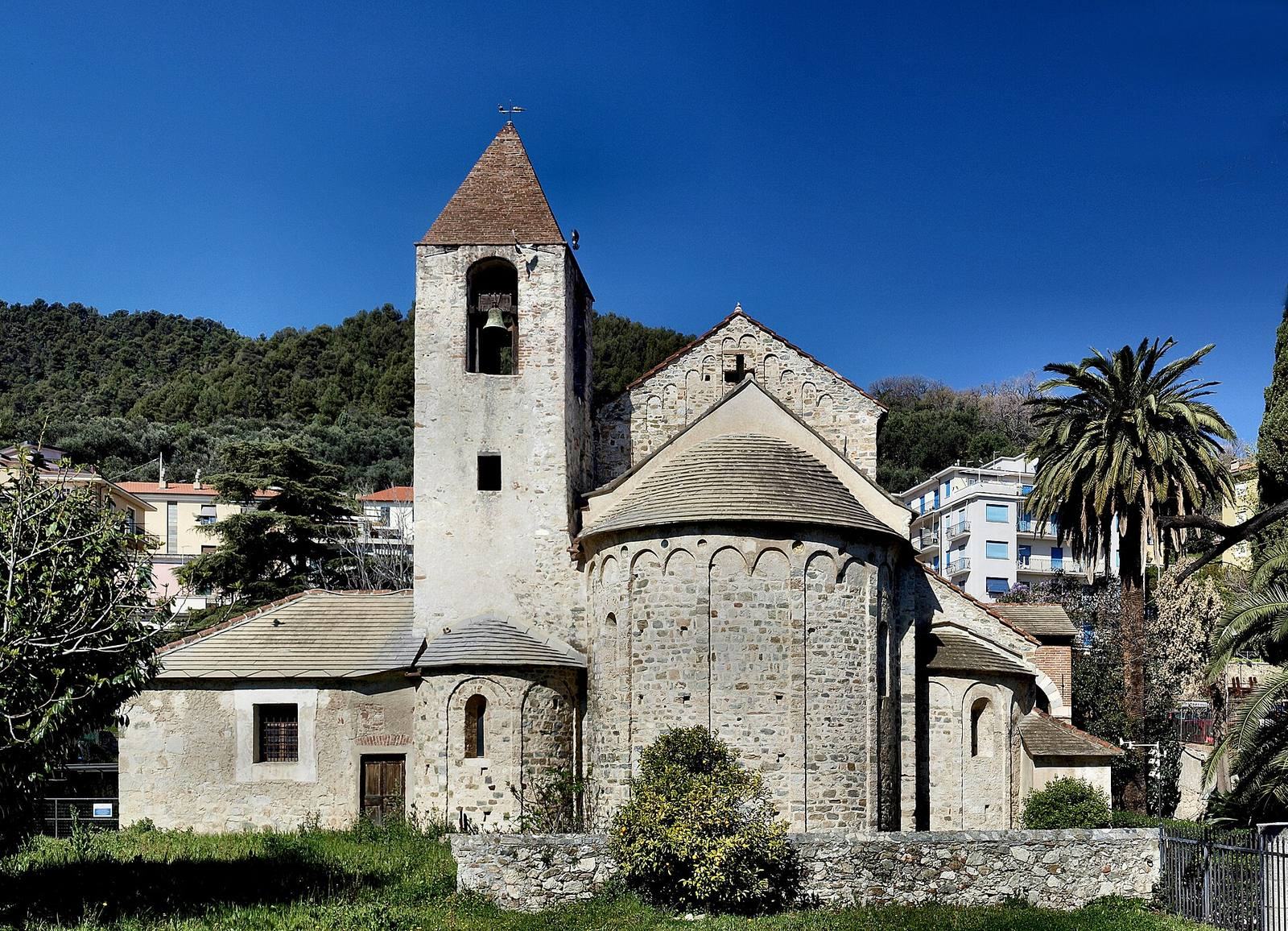
The church stands beyond Noli’s medieval walls and has three naves, or lengthwise sections, each ending in a semicircular apse, a rounded extension at the end of a church. Massive pillars with varied decoration separate the central nave from the two side naves and carry broad semicircular arches.
Entrance and tombs
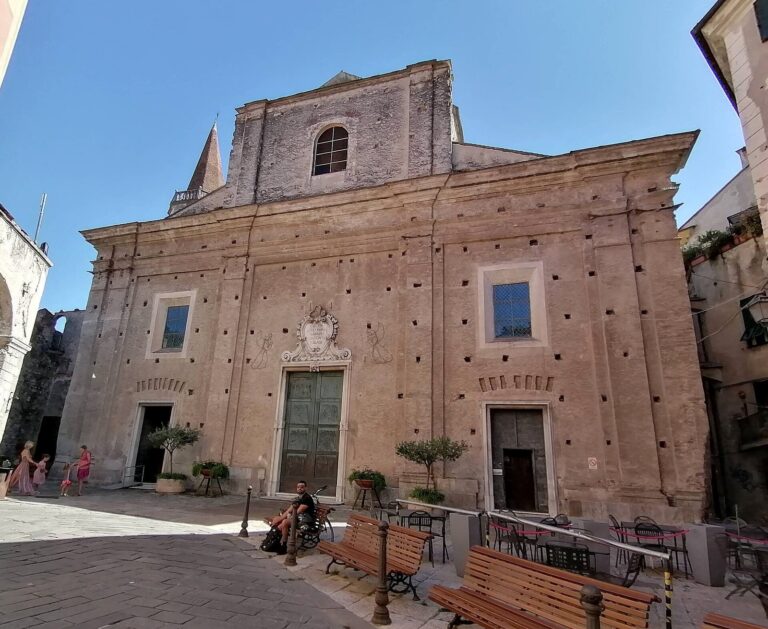
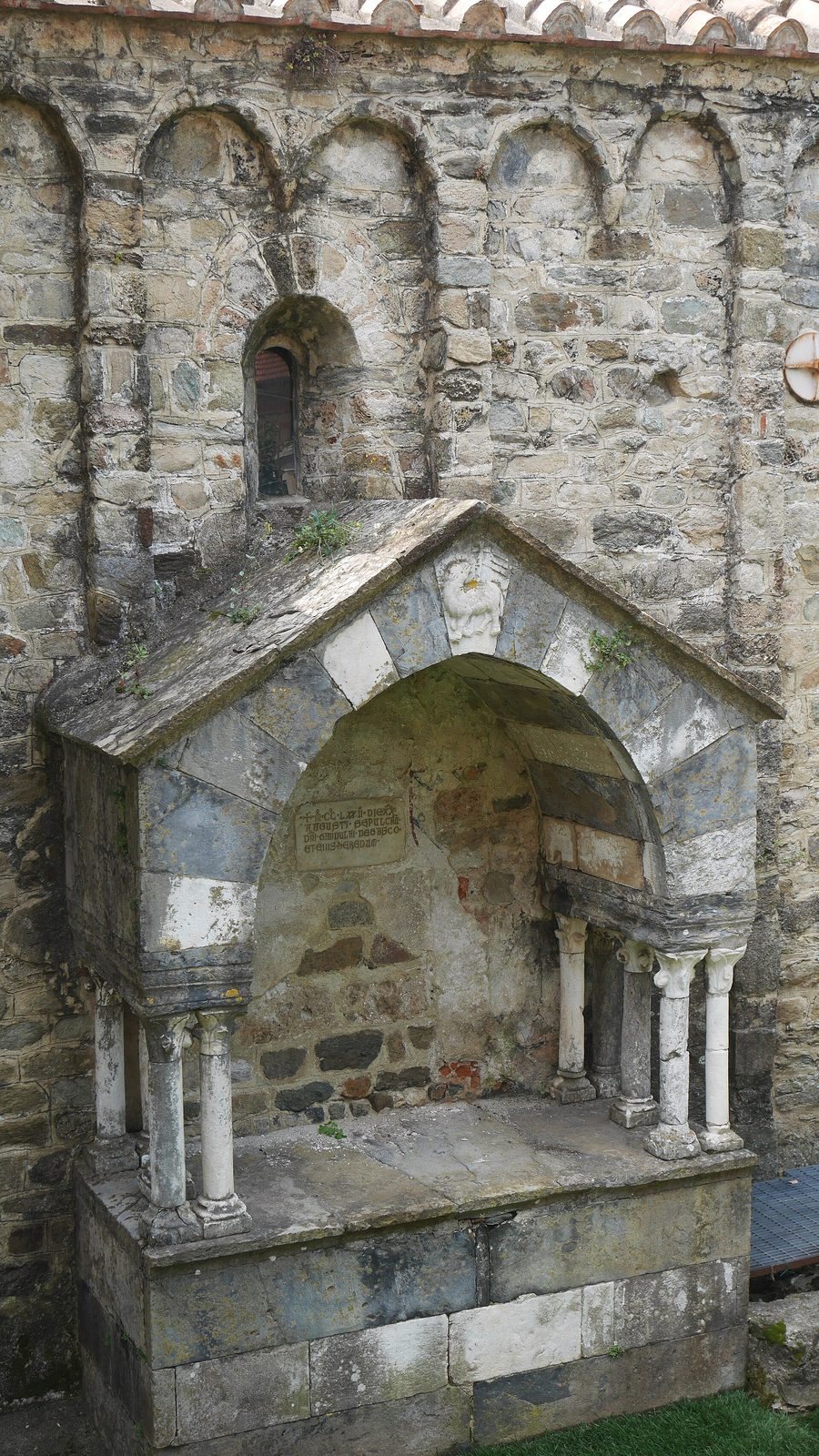
The entrance is on the church’s left side. Its thirteenth-century portal has a black-and-white appearance and sits within a projecting Gothic porch, a structure in a later medieval architectural style, built of stone and brick and supported by two columns. Two monumental tombs occupy arched recesses to the left of the entrance. They date to the thirteenth or fourteenth century, and traces of wall paintings attributed to artists from Lombardy remain on them. To the right of the porch is the tomb of Gandolfo de Gasco, dated 1272 and marked by a Gothic inscription.
Interior
Central apse and presbytery
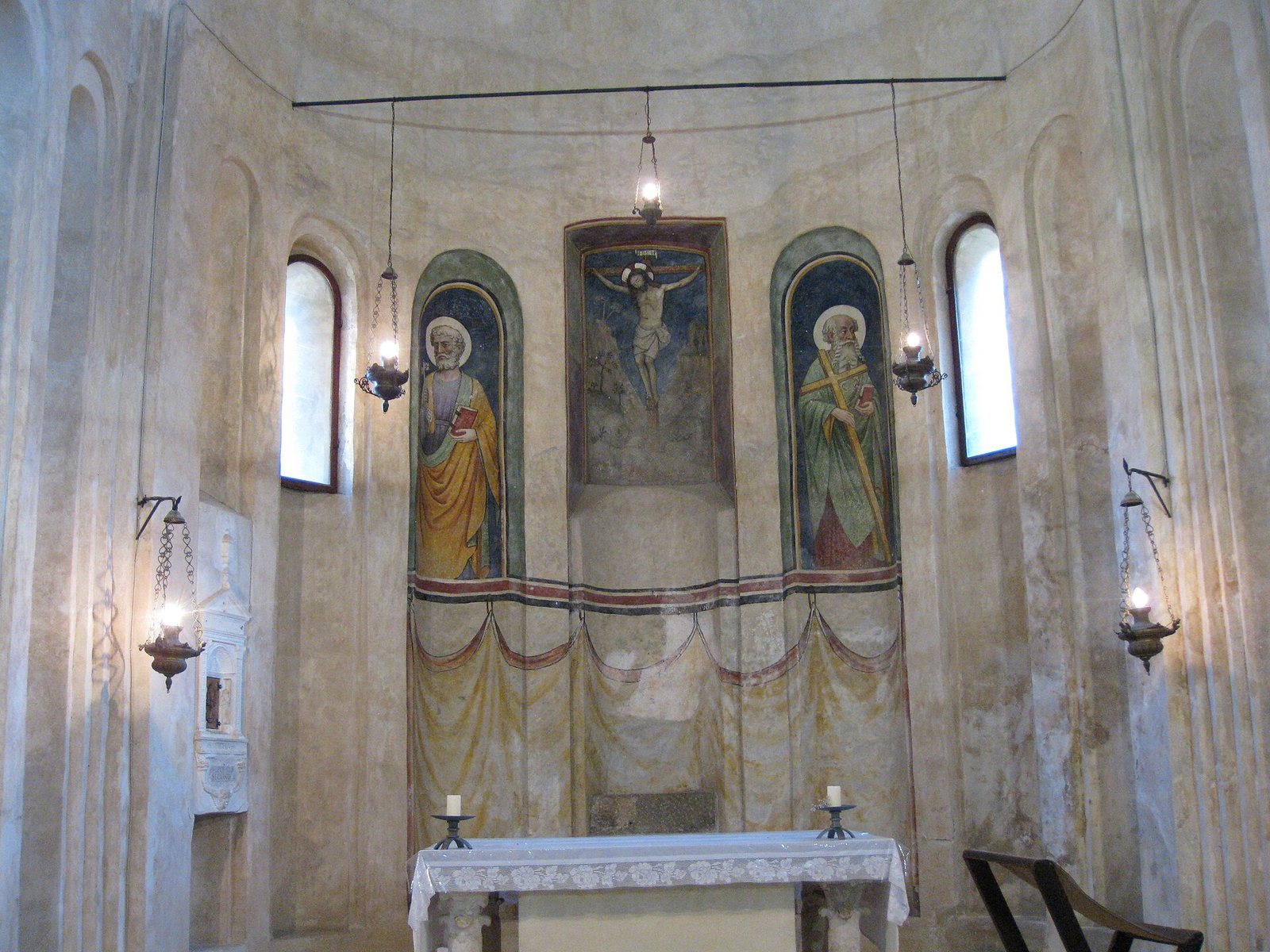
A row of small blind arches, decorative arches that do not open through the wall, runs across the central apse. Above them, eleven Islamic bowls dating to about 1050 were set into the wall as decoration. They are among the earliest examples of this practice in Liguria. The originals have been removed for restoration, and copies now occupy their places. A ramp leads to the presbytery, the area around the altar, where fifteen tall niches rest on a bench along the apse. Three fifteenth-century wall paintings show a crucifix in the central niche and the apostles Peter and Paul in the two flanking niches.
Tabernacle
A Renaissance marble tabernacle on the presbytery’s left wall names its donor, Noli’s bishop Vincenzo Boverio, who held office from 1506 to 1519. His family was related to Pope Julius II.
Bishop’s throne
A copy of a bishop’s throne dated 1239 stands to the right of the altar. Paolo Giustiniani’s coat of arms is engraved on its wooden back. Giustiniani was bishop of Noli from 1459 to 1485.
Roof structure
Decorative wooden frames support the roof over the central nave. An original section is displayed on the rear wall of the left nave.
Baptismal font and crucifix
The right nave contains an octagonal font for full-immersion baptism, rebuilt in 1889, and a painted wooden crucifix known as the Volto Santo (Holy Face). Its twelfth-century figure of Jesus represents him as a martyr and is of Eastern origin. He wears a long tunic, called a colobium.
Pulpit and tombstone
The pulpit near the presbytery was also rebuilt in 1889, incorporating surviving marble panels. Beneath it lies a round tombstone made of slate and marble, dated 1296, that commemorates Domino Verdane, a nobleman of Noli. Its decoration is described as distinctive to Liguria.
Side-nave paintings
Paintings from the fifteenth and sixteenth centuries cover parts of the side-nave walls. One, attributed to the painter Teramo Piaggio, depicts Saint Paragorius on horseback with his companions in faith, Parteo, Partenopeo, and Severino, alongside the Virgin Mary and the Child.
Crypt and archaeological surroundings
Crypt and earlier chapels
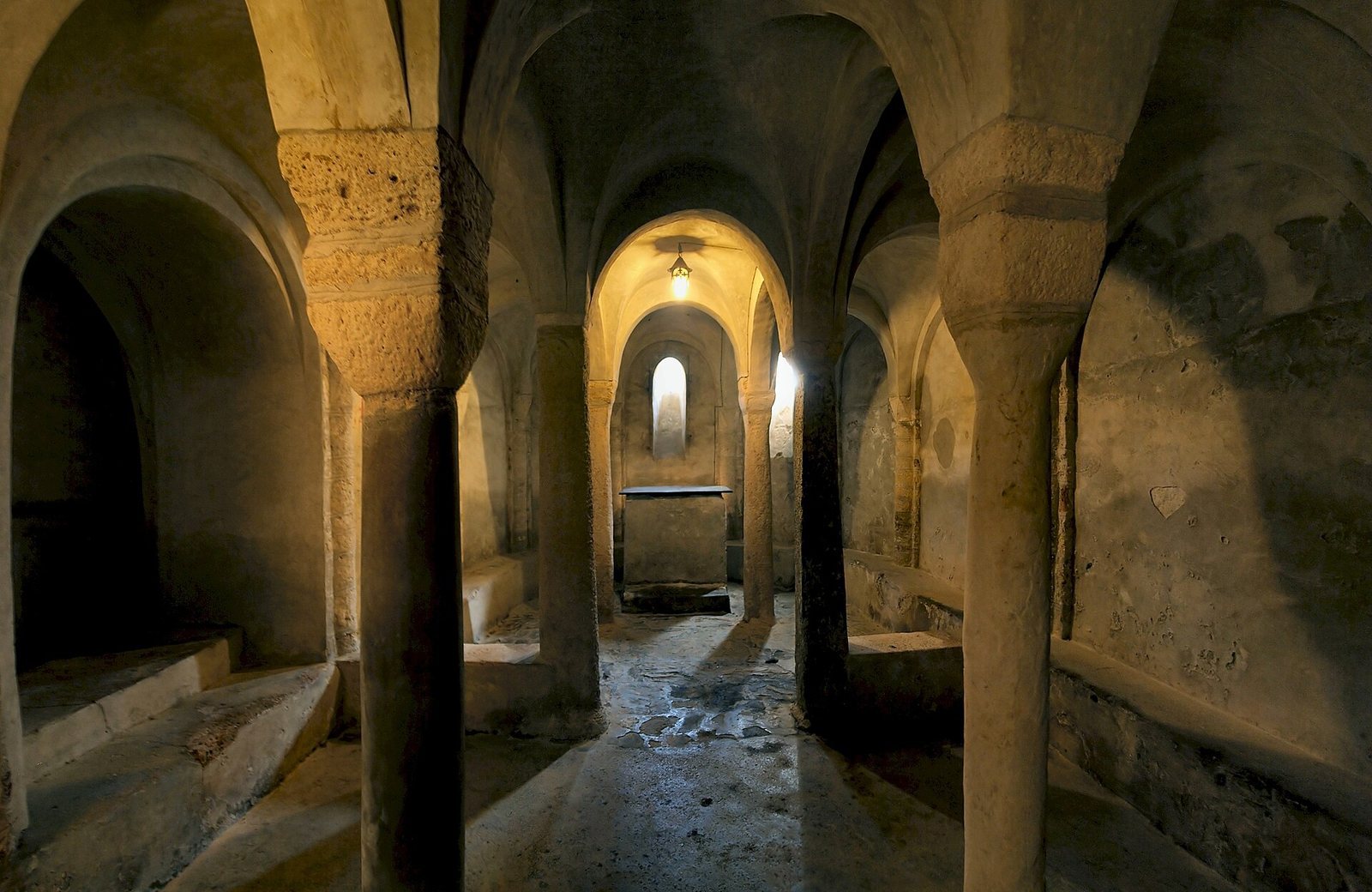
Stairs on both sides of the presbytery descend to the crypt, a chamber below the church. Medieval builders reused Roman columns formed from single blocks of stone as supports there. Before the crypt was made, two small chapels stood in the same location directly on sandy ground, about three metres below the present ground level.
Burials and excavated remains
Four early Christian stone coffins, dating from the fifth through seventh centuries, were found between the church and its surrounding wall. Excavations around the building also revealed a late-antique cemetery, remains of an early Christian baptistery, a craft settlement, and early church buildings dating to the sixth century.