Csorbakő Castle: A Medieval Residence and Fortress in Hungary
Site at a Glance
- Popularity
- Low
- Country
- Hungary
- Primary era
- Medieval
- Eras represented
- Medieval, Early Modern
- Civilizations
- Hungarian
- Site type
- Military
- Remains
- Castle
On this page9 sections
History
Csorbakő Castle is a ruined stone fortress near Szuhogy, Hungary, built around 1300 by the Ládi family, part of the medieval Tekes kin-based lineage. It probably began as a residence for Miklós Csorba, whose name may have given the castle its own. The site later served as an aristocratic residence, a counterfeit-coin workshop and, during Ottoman attacks, a refuge for villagers.
Foundation and Perényi rebuilding
Miklós Csorba appears nineteenth among 46 retainers whom the Aba family offered in return for the release of the sons of Amadeus Aba, a powerful Hungarian nobleman. Retainers were bound to a lord or family through service and allegiance. Miklós’s place on the list suggests that the Ládi family belonged to the region’s middle-ranking landholders.
As the Ládi family’s fortunes declined in the fourteenth century, it sold its estates. András Perényi acquired the property, including the increasingly ruined castle, in 1351. The castle is first named in a surviving document in 1403, when King Sigismund authorized Imre Perényi, a senior royal court officer called the master of the cupbearers, to rebuild it. Imre turned the castle into an aristocratic residence and founded a monastery of the Pauline Order, a Roman Catholic monastic order, at nearby Nyárád, now within Kurityán.
Decline and conflict
After Imre’s younger son István died in 1437, the castle stopped serving as the family’s aristocratic residence. Imre’s elder son János, the heir and master of the treasury, a high-ranking official concerned with royal finances, established himself at Terebes instead. During the civil wars and Hussite incursions of the 1440s, military campaigns by followers of the religious reformer Jan Hus and their allies, Simon Pálóci seized the castle. He returned it to its owners in 1445 only after a resolution by the Diet, the kingdom’s representative political assembly. The owners thereafter lived at Csorbakő only occasionally.
Bebek tenure and destruction
Péter Perényi probably commissioned modernizing work in the sixteenth century, which may have included bastions, projecting defensive works. In late 1540, King Ferdinand I granted the castle to Ferenc Bebek, the military commander of Upper Hungary. Ferenc transferred it in February 1541 to his brother Imre, a provost, or senior cleric who led a cathedral or collegiate chapter. Although a cleric, Imre was married. During his tenure, he held notorious festivities at the castle and operated a counterfeit-coin workshop in its palace for 13 years. The workshop principally forged denars, a silver coin denomination, issued by Louis II that remained in circulation.
After Imre died in 1553, his widow refused to leave the castle. Ferenc besieged it and had it demolished by miners from Rudabánya. Later records describe the castle as a ruin, while the estate was administered from Szuhogy.
Ruin and archaeological investigation
In the seventeenth century, Csorbakő became part of the village territory. Villagers repeatedly took shelter among its ruins while fleeing Ottoman forces.
In 1928, Andor Saád excavated an Ice Age cave on the north side of the castle hill. Silver-plated copper plates found during the work drew the attention of Andor Leszih, who dug several test trenches at the castle and later placed the excavations under the direction of András Szegő, a shoemaker from Szuhogy. By 1935, the inner castle had been extensively excavated and its plan drawn. Leszih’s 1941 article examined the castle’s counterfeiting activity.
In 2002, Gábor András Szörényi resumed surface investigation, surveyed the site and studied its history and earlier finds. He also prepared a theoretical reconstruction and groundwork for further archaeological research.
Remains
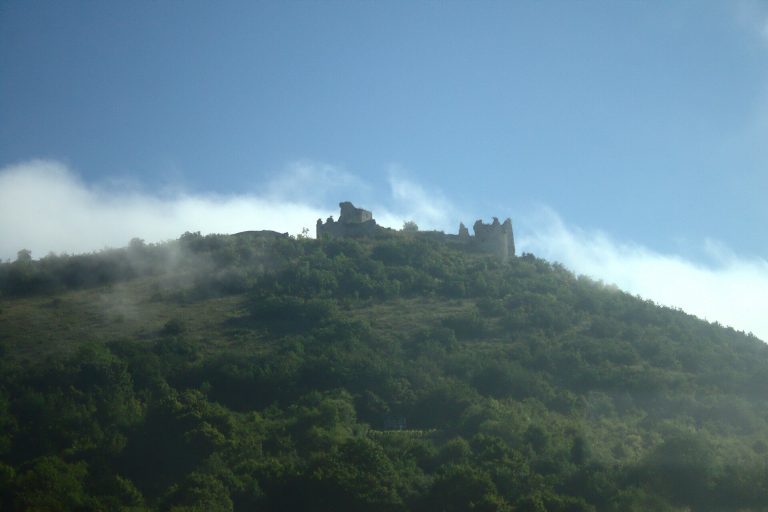
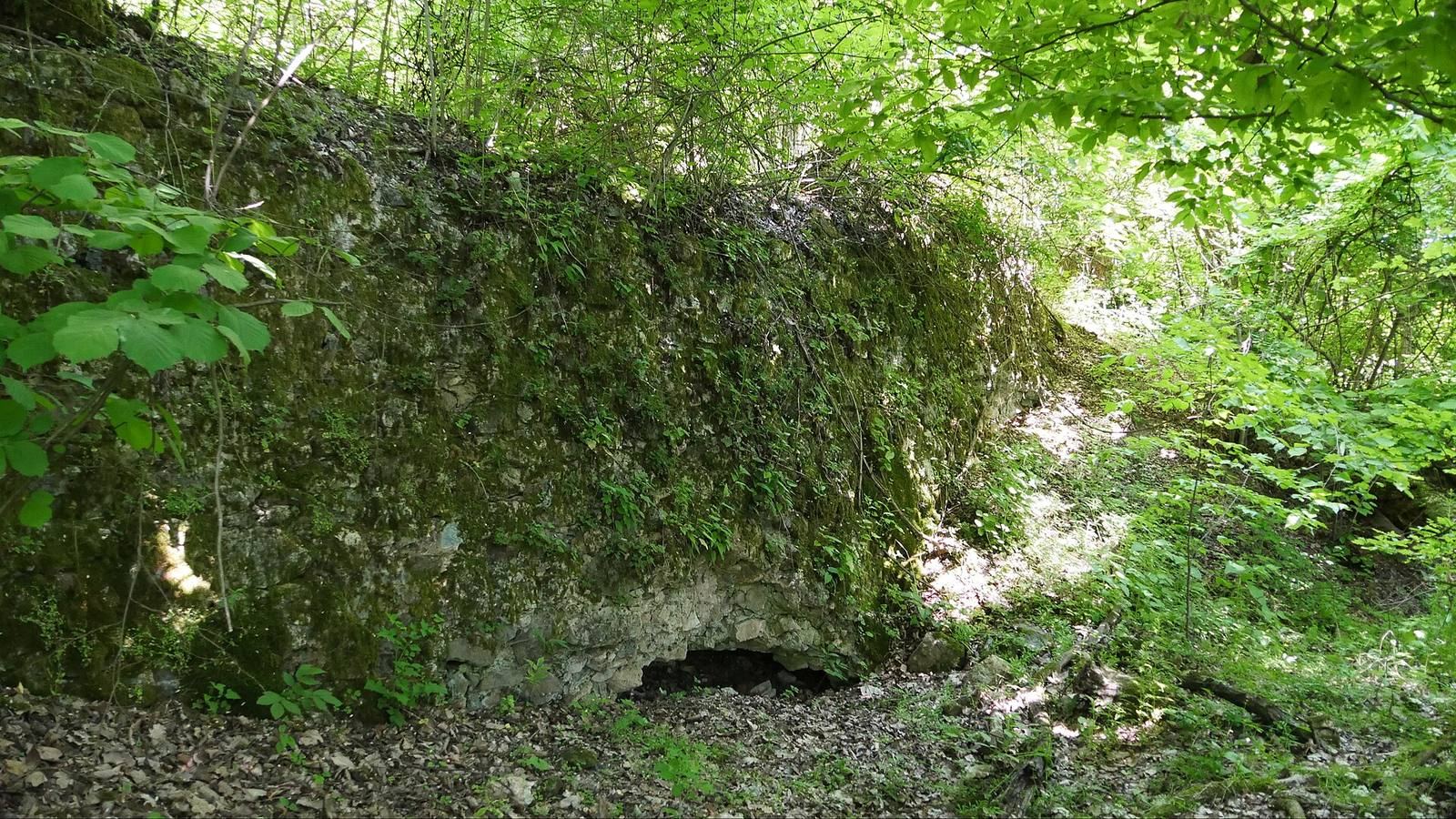
The overgrown stone ruins stand about 280 metres above sea level on the northeastern ridge of Nagy-hegy in the Rudabánya Mountains, roughly two kilometres northwest of Szuhogy. The castle’s layout combined an inner residential complex with an outer northern defense and multiple lines of ramparts and ditches.
Early enclosure and residential buildings
The earliest castle probably consisted of a trapezoidal residential tower within a rectangular wall. A double system of stone ramparts and ditches surrounded it, with three lines on the southern side. The ramparts used stones laid without mortar, with a ditch cut in front; during the Perényi rebuilding, the outer castle wall was built along the inner rampart. The rebuilt palace had three rooms, with a separate two-room building attached on its western side. A 15-step staircase bridged the five-metre difference in height between the buildings. An L-shaped walled defensive passage protected the space between the palace and inner courtyard along the south and east.
Entrance and outer defenses
The outer castle protected the complex from the north and held its main entrance. A spiral route led from there toward the inner castle. A gate between the palace and the outer castle wall could probably be closed in an emergency to protect the inner courtyard. A triangular defensive work with a square gate tower was probably added in the outer castle’s northeastern part during the conflicts of the 1440s. As firearms spread, the outer defenses became less tenable, and an irregular pentagonal bastion was built in front of them in the sixteenth century. Quarrying has reduced the remains of a probable second bastion on the north side.
Finds from the castle
Finds from the castle’s later period point to an affluent aristocratic household. Materials associated with Imre Bebek’s counterfeit-coin workshop include crucibles, metal sheets and coins containing no precious metal.