Lublin Castle: A Royal Residence and Prison in Poland
Site at a Glance
- Popularity
- Very High
- Country
- Poland
- Primary era
- Modern
- Eras represented
- Medieval, Modern
- Civilizations
- Kingdom of Poland, Russian
- Site type
- Civic
- Remains
- Prison
On this page15 sections
History
Lublin Castle is a historic castle complex in Lublin, Poland. Developed from a medieval stronghold into a Gothic and Renaissance royal residence, it later became a prison used by successive authorities for political repression.
Early stronghold and royal residence
Traces of a fortified settlement on the hill date from the sixth to ninth centuries. A wooden-and-earth stronghold and the Lublin castellany, a medieval administrative district centered on a stronghold, were established in the twelfth century. The castle’s origins are also attributed to Casimir II the Just, while an early royal castle is dated to 1115.
In the fourteenth century, Casimir III the Great replaced the earlier stronghold with a stone castle. Frequent raids by Lithuanian, Tatar, and Rus’ forces prompted the rebuilding. The castle became a royal residence on the route between Kraków and Vilnius.
Members of the Jagiellonian royal family often stayed at the castle. From 1473 to 1476, the chronicler and royal tutor Jan Długosz lived there and taught the sons of Casimir IV Jagiellon. Lublin’s administrative importance grew in 1474, when it became the capital of a newly established voivodeship, a province-level region, as well as a growing commercial center.
Renaissance rebuilding and the 1569 union
A major rebuilding began around 1520 under Sigismund I the Old, transforming the castle into a Renaissance royal residence. Italian craftsmen from Kraków worked on the project, which is attributed to the architect Bartolommeo Berrecci.
In 1569, Sigismund II Augustus met envoys at the castle during the Sejm, the Polish national parliament. The Polish-Lithuanian Union was signed and ratified there, establishing the Polish-Lithuanian Commonwealth. On 19 July, Albert Frederick, Duke of Prussia, paid homage to the king at the Lublin Sejm.
War, damage, and decline
During the Polish-Swedish War, the castle was used by John II Casimir, and in 1648 it served as a center for his military operations. Swedish, Hungarian, and Muscovite forces occupied it between 1655 and 1657. The castle burned and collapsed, and later damage in the wars of the seventeenth and eighteenth centuries contributed to its dismantling by the late eighteenth or early nineteenth century. In 1764, a ceiling collapsed in one room, killing four noblemen.
Prison under Russian rule
After Lublin came under Russian rule in 1815, plans were made to build a prison on the hill. A design prepared in 1819 by Alexander Groffe, chief architect of Congress Poland, was approved by Governor Józef Zajączek. Construction took place from 1823 to 1826, at the initiative of Stanisław Staszic and under the direction of architect Jan Stompff. Intended for Congress Poland, the Kingdom of Poland established after the Congress of Vienna and placed under Russian rule, it was the first prison in Poland conceived as a fortified castle.
The prison operated from 1831 to 1954. From 1831 to 1915 it was a Tsarist prison, holding many Polish independence activists, including participants in the uprising of 1863. Between 1918 and 1939, it held criminal prisoners and members of the outlawed Communist Party of Poland.
German occupation and postwar repression
During the German occupation from 1939 to 1944, the Gestapo, Nazi Germany’s secret state police, administered the prison. At least 40,000 people passed through it, including Polish resistance members and Jews. Many prisoners were killed in executions or sent to death camps. On 22 July 1944, shortly before the German retreat, SS personnel massacred 300 prisoners.
From the summer of 1944, the Soviet NKVD, the Soviet internal-affairs and security agency, used the prison, followed by Poland’s communist-era Security Office. NKVD personnel imprisoned Poles arrested by SMERSH, Soviet military counterintelligence, and the prison also served as a transit point for detainees sent to Soviet camps. Repression included the execution of members of the Home Army, the principal Polish underground resistance force during the Second World War. Between 1944 and 1954, about 35,000 people were imprisoned there; 180 of 515 death sentences were carried out.
On 19 February 1945, twelve Polish prisoners escaped. Lavrentiy Beria reported the escape to Joseph Stalin and the Politburo. Discussion of Soviet security-service activity in Poland, including at the Lublin prison, was suppressed in Polish historiography until 1989.
Museum and commemoration
The prison closed in 1954, and the building passed to the Lublin Museum, founded in 1906. After renovation from 1954 to 1956, the museum moved into the castle in 1957. The site has served as the main seat of the National Museum in Lublin since then. A memorial plaque honors Poles who died in Nazi and Stalinist camps. The castle is a protected historic monument, and the Chapel of the Holy Trinity has received the European Heritage Label.
Remains
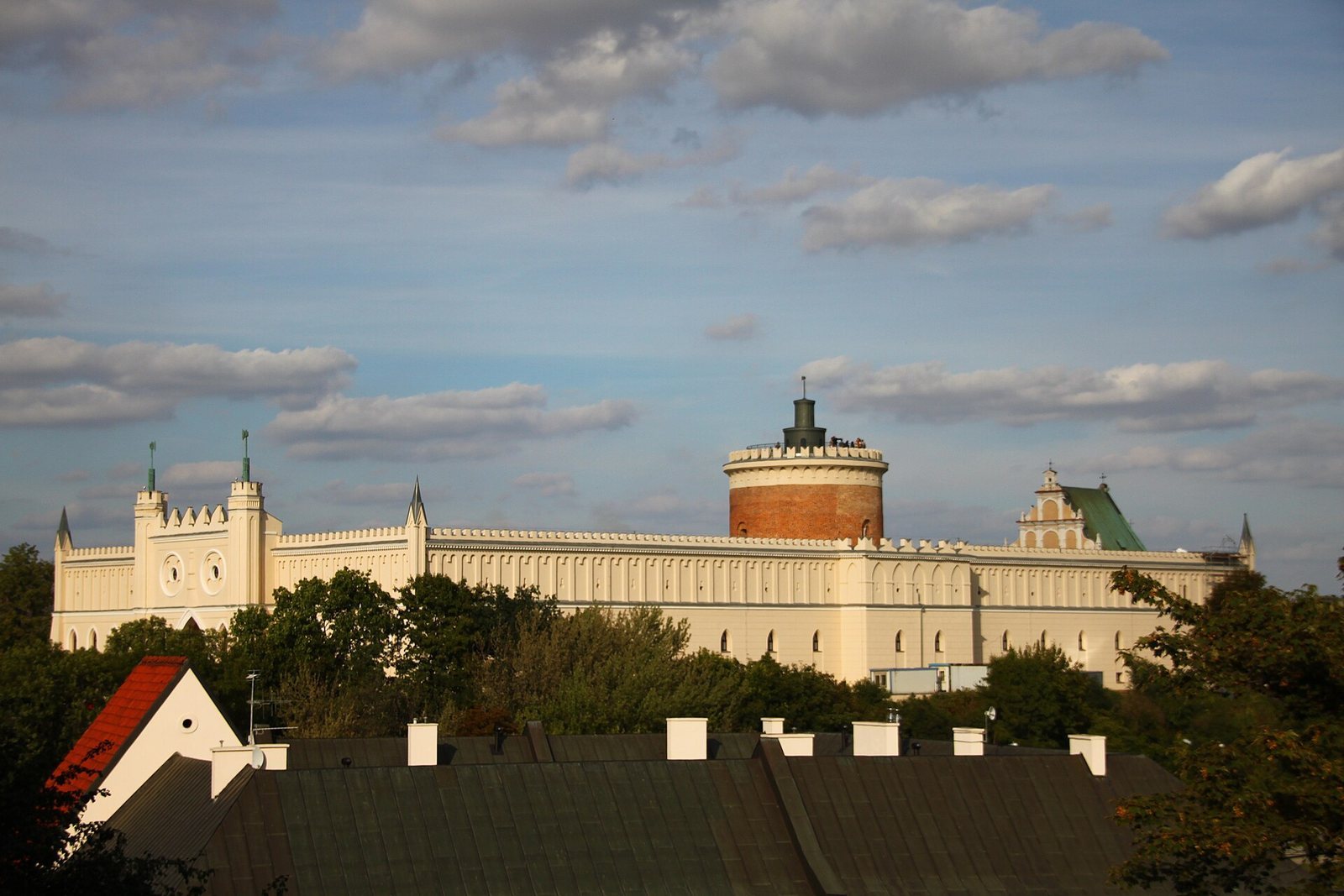
The complex occupies Castle Hill at the meeting of the Bystrzyca and Czechówka rivers, northeast of Lublin’s Old Town and near the Grodzka Gate. Its remains include medieval castle structures, later additions, and a prison arranged around a central courtyard.
Medieval and Renaissance castle fabric
The keep
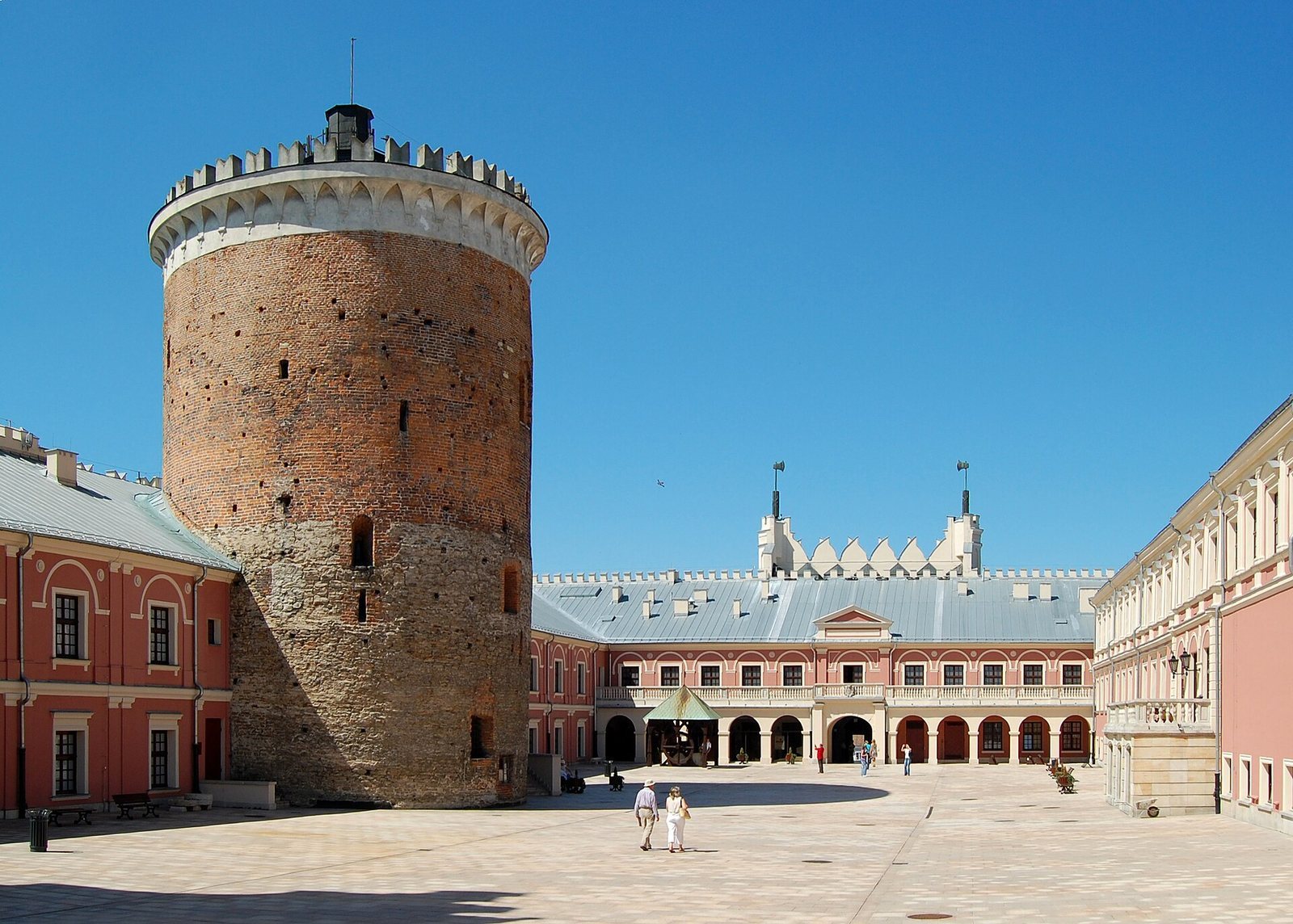
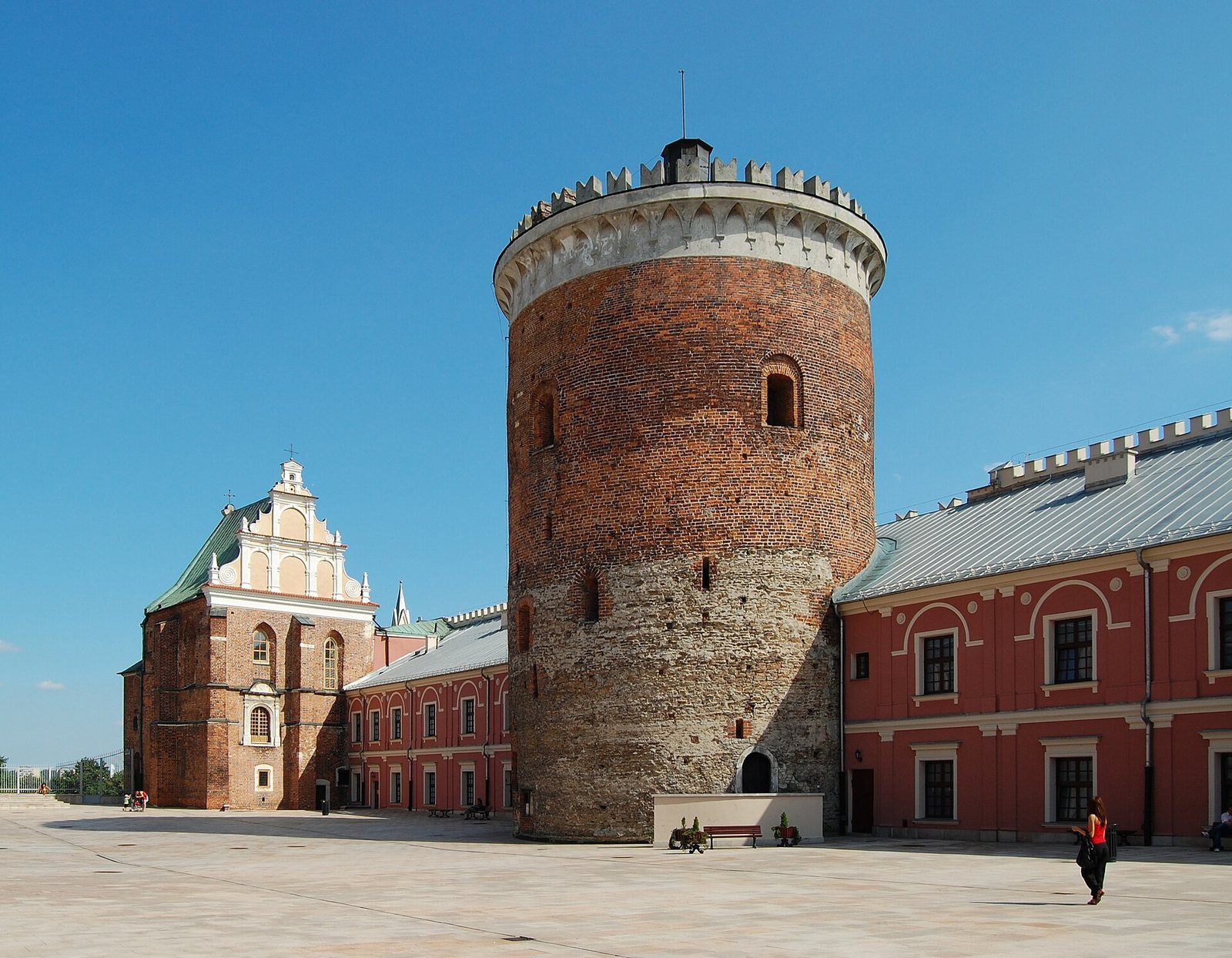
The masonry keep, the castle’s principal fortified tower, stands within the upper part of the earlier stronghold. Its construction date and patron are uncertain: one proposal places its building under Daniel of Galicia in 1243–1244, while others suggest Bolesław V the Chaste or Władysław I the Elbow-high. Casimir III the Great raised its upper part in 1342. The tower has three above-ground storeys and walls up to 3.4 metres thick, with a spiral stairway built within the wall. Its lower courses are rubble limestone, while the upper part is brick laid in a Gothic pattern. A Romanesque twin-arched window survives on the third storey. A Neo-Gothic crown, designed as alternating raised blocks and gaps, was added in the nineteenth century, when the tower was enclosed within the prison building. It is the tallest structure in the complex and the oldest standing building in Lublin.
Chapel of the Holy Trinity
The Gothic Chapel of the Holy Trinity, probably built around 1395, served as a royal chapel. Władysław Jagiełło commissioned its wall paintings, completed in 1418 by Andrei, a painter associated with the historical East Slavic Ruthenian tradition. He signed his work on a wall. The paintings combine Western and Eastern Christian influences and are rare in Poland.
Other medieval and Renaissance structures
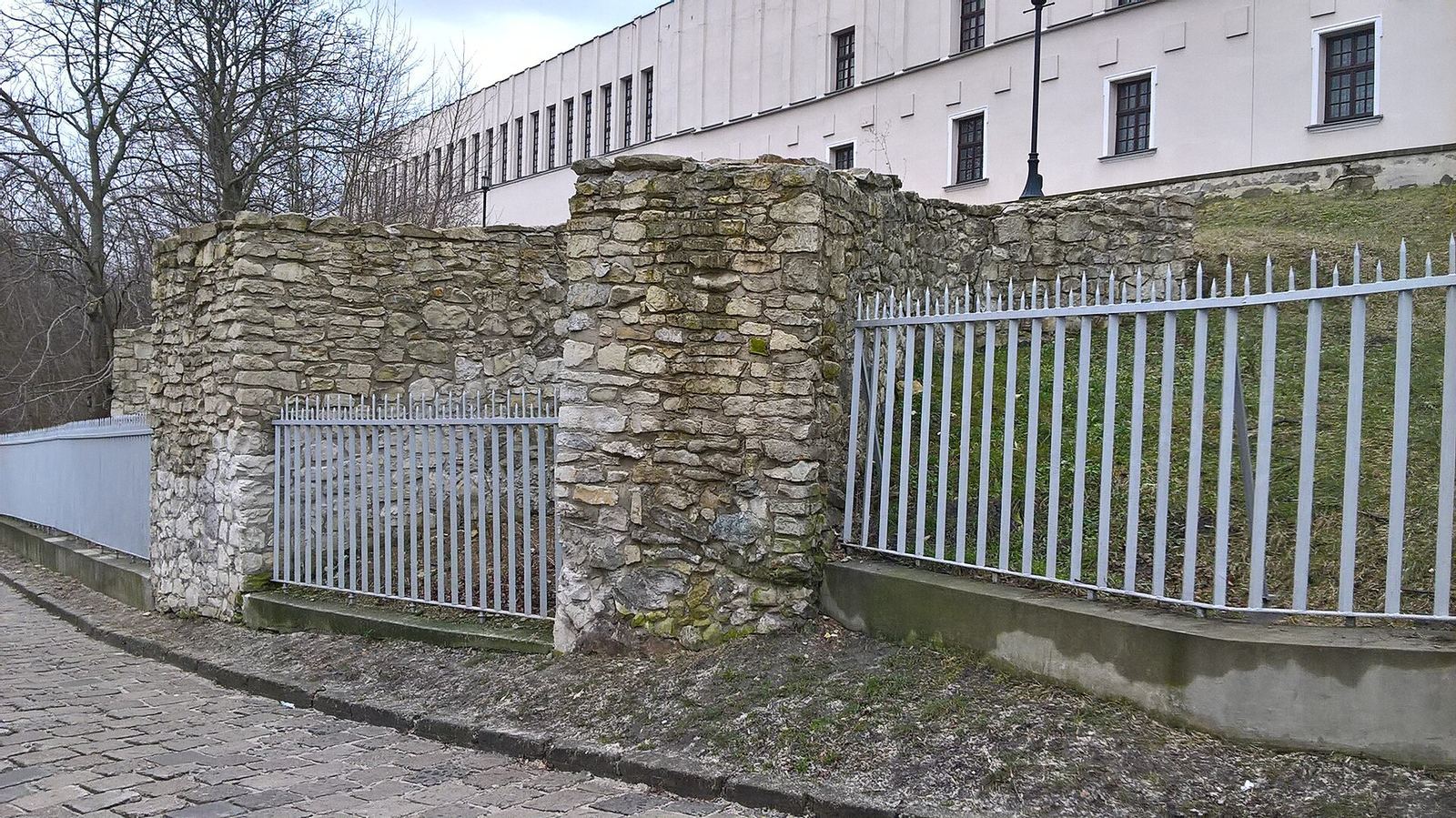
The fourteenth-century stone castle included a defensive wall, a western gate, a residential building, a Gothic royal palace, and the Chapel of the Holy Trinity. A later Gothic tower known as the Jewish Tower survives in ruins. During the Renaissance rebuilding, the royal palace gained an additional storey and richly decorated interiors. New buildings, a gate with a tower, a quadrangular tower, and the Grodzka townhouse were added, and a crenellated wall enclosed the complex. The new buildings had ornamental raised parapets above their main walls.
Later castle additions
The castle was probably renovated between 1635 and 1642. Building work in 1671 added two buildings, a corner tower, extensive cellars, and a chapel in a lower-level space. Chancery and archive buildings followed in 1743. In 1773, the former entrance-gate building was adapted for residential use.
Prison complex
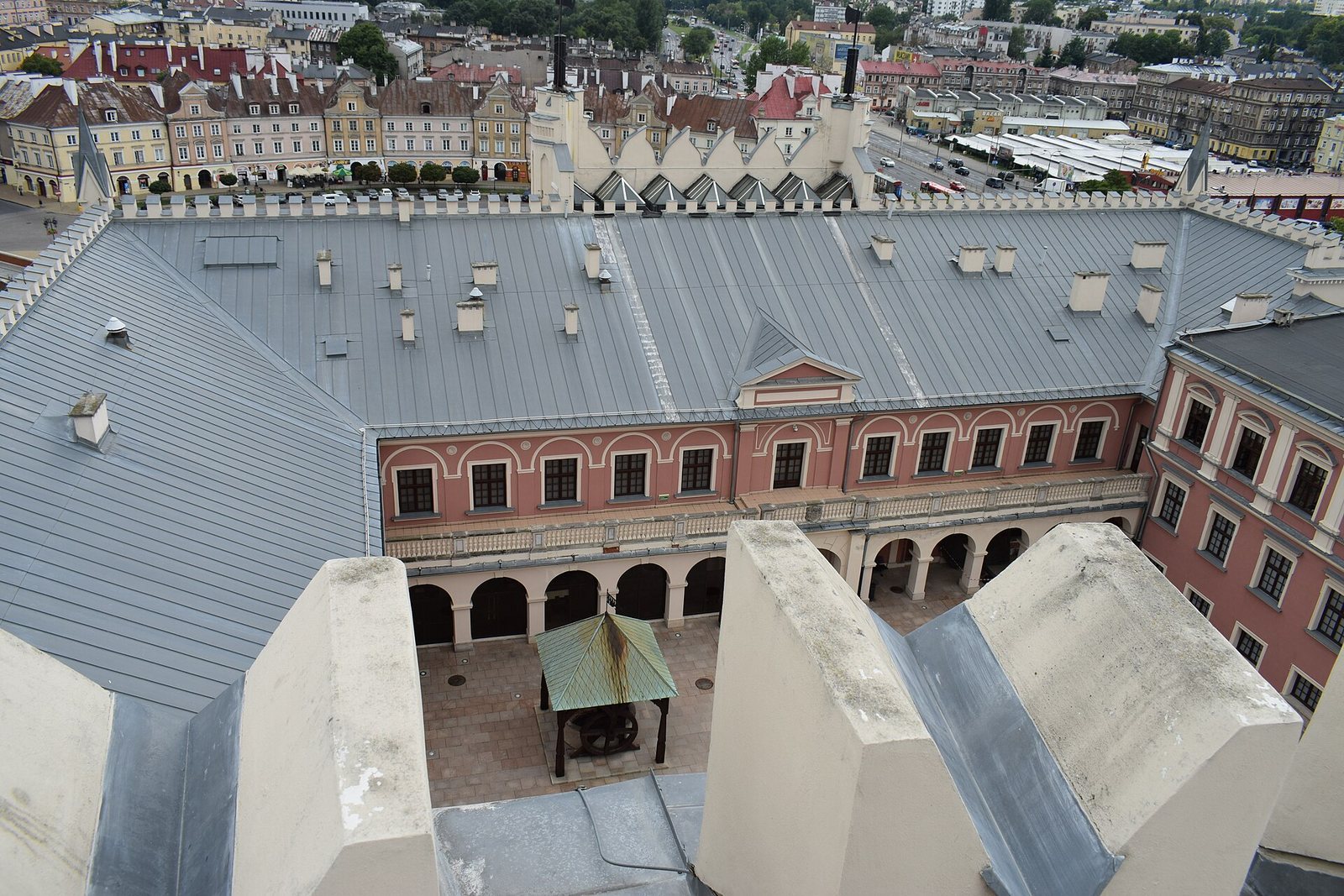
The prison has four wings forming a closed rectangle around a courtyard. Its English Neo-Gothic design, a revival of medieval Gothic architecture, includes Neoclassical details drawing on Greek and Roman forms. Construction began with the south wing, which incorporated the medieval keep and chapel. After the wings were completed, the slopes of the hill were cut back. A main entrance gate marks the Neo-Gothic section. The complex also contained a court, hospital, workshops, and laundry.
Museum collections
Museum displays in the castle include archaeological, ethnographic, military, and numismatic collections, as well as paintings.