Church of the Visitation of the Virgin Mary: A Medieval Chapel in Závod, Slovakia
Site at a Glance
- Popularity
- Very Low
- Country
- Slovakia
- Primary era
- Medieval
- Eras represented
- Medieval, Early Modern
- Civilizations
- Habsburg, Hungarian
- Site type
- Religious
- Remains
- Chapel
On this page12 sections
History
The Church of the Visitation of the Virgin Mary is a medieval church in northern Závod, Slovakia. Its origins are placed in the fourteenth century, and a plaque in its tower bears 1339, the year traditionally associated with the church. Its ground plan is Gothic, a medieval church layout.
Medieval origins and seventeenth-century rebuilding
The church was largely destroyed during the Bocskai uprising, a revolt led by Stephen Bocskai against Habsburg rule in the Kingdom of Hungary from 1604 to 1606. Its restoration was completed in 1622. The building was newly vaulted and painted, and dedicated to the village’s patron, the Archangel Michael, a leading angelic figure in Christian tradition. Bishop Ján Pyber formally consecrated it. A record of the ceremony and relics, objects associated with saints, of Ambrose and Coloman were placed in the altar. The parish of Závod was established in 1630.
Reconstruction and change of dedication
By 1777, the church had fallen into disrepair and underwent reconstruction. The work included a new altar in the Classicist style. In 1897, a larger Neo-Gothic church dedicated to the Archangel Michael was built. The older building became a chapel dedicated to the Feast of the Visitation, which commemorates Mary’s visit to Elizabeth. Its original altarpiece of St Michael was transferred to the new church.
War, repairs, and later history
During the First World War, the army removed two old bells. One small bell remained in the village, in the new church. Three new bells were made for Závod in 1923, with one placed in the older church. Its inscription invoked the Virgin Mary of Mariazell, named priest Ján Boll and donors Mária Iser and Mária Molnár, and identified the Kurbel foundry in Trnava. Andrej Hlinka, a Slovak Catholic priest and political leader who held the honorific title of monsignor, consecrated all three bells.
During the Second World War, soldiers used the tower as an observation post, and the church was damaged after becoming a target. Essential repairs followed the war, with more extensive work in 1949. The church was designated a National Cultural Monument of Slovakia on 14 September 1963. Restoration in 1992 included the altar and sculptures. Two historically important statuettes were stolen afterward and never returned, although the perpetrators were identified. Exterior and interior work was completed by 1997. In 1999, thieves took paintings of the Crucifixion and St Michael, along with a wooden processional statue of the Sacred Heart.
The church belongs to the Roman Catholic Church in Slovakia and is administered by the Závod parish, within the Bratislava Archdiocese, Western Ecclesiastical Province, and Malacky deanery. It has also served as a funeral chapel.
Remains
Layout and exterior
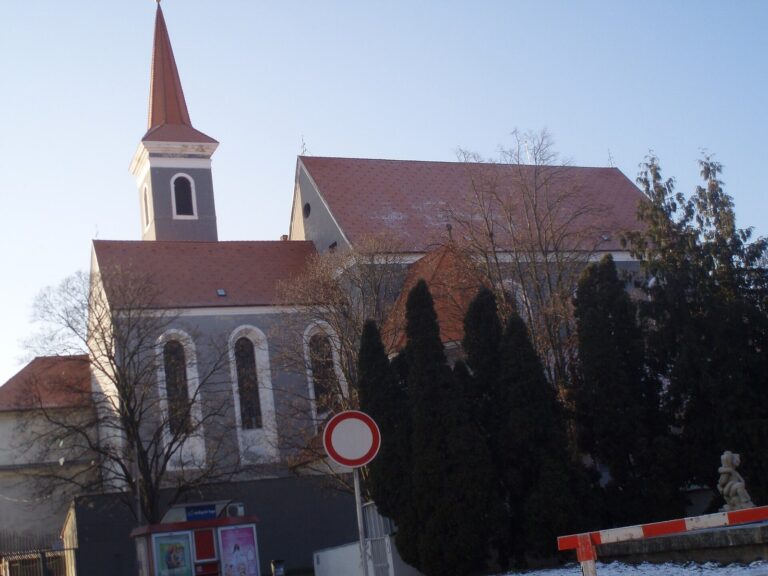
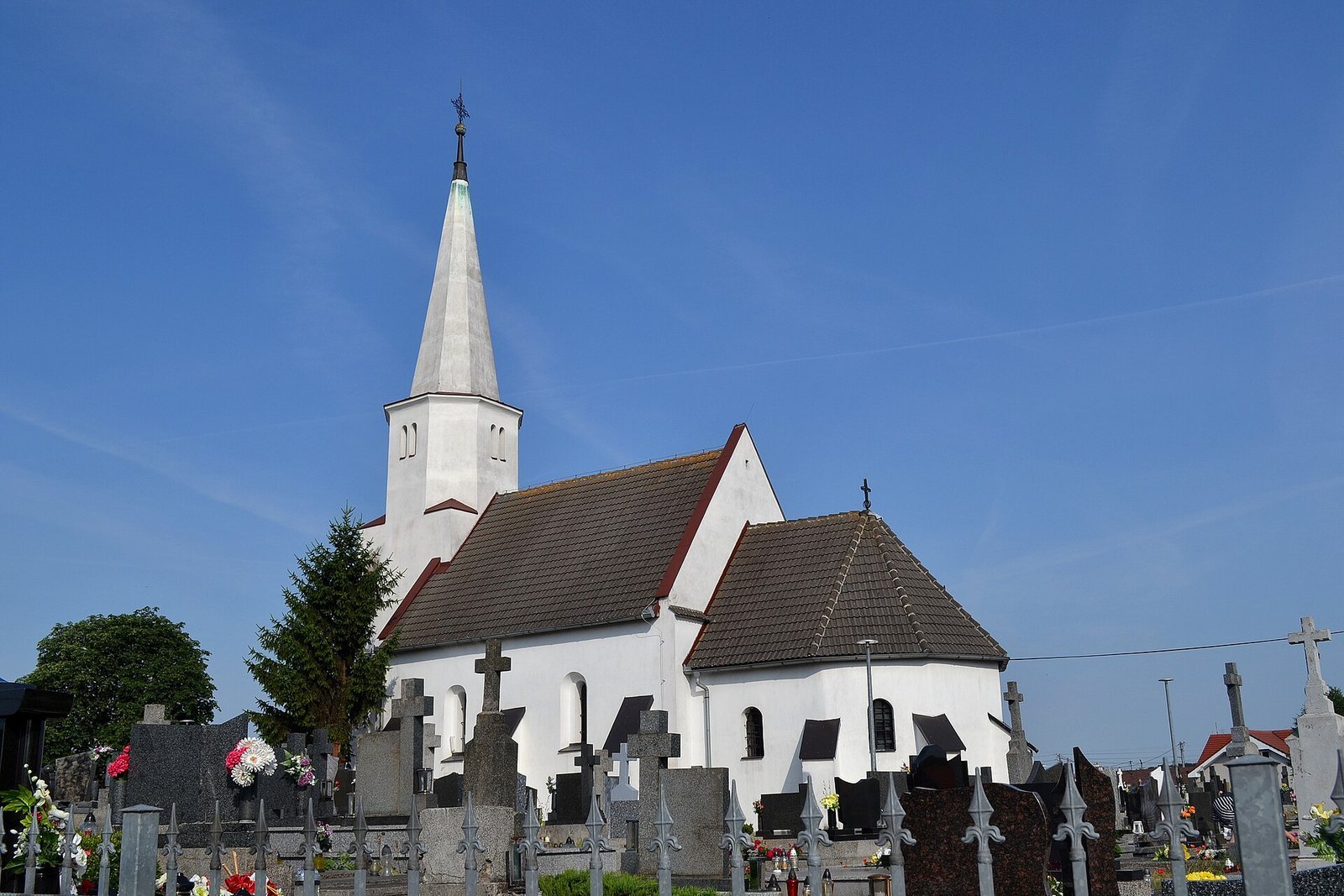
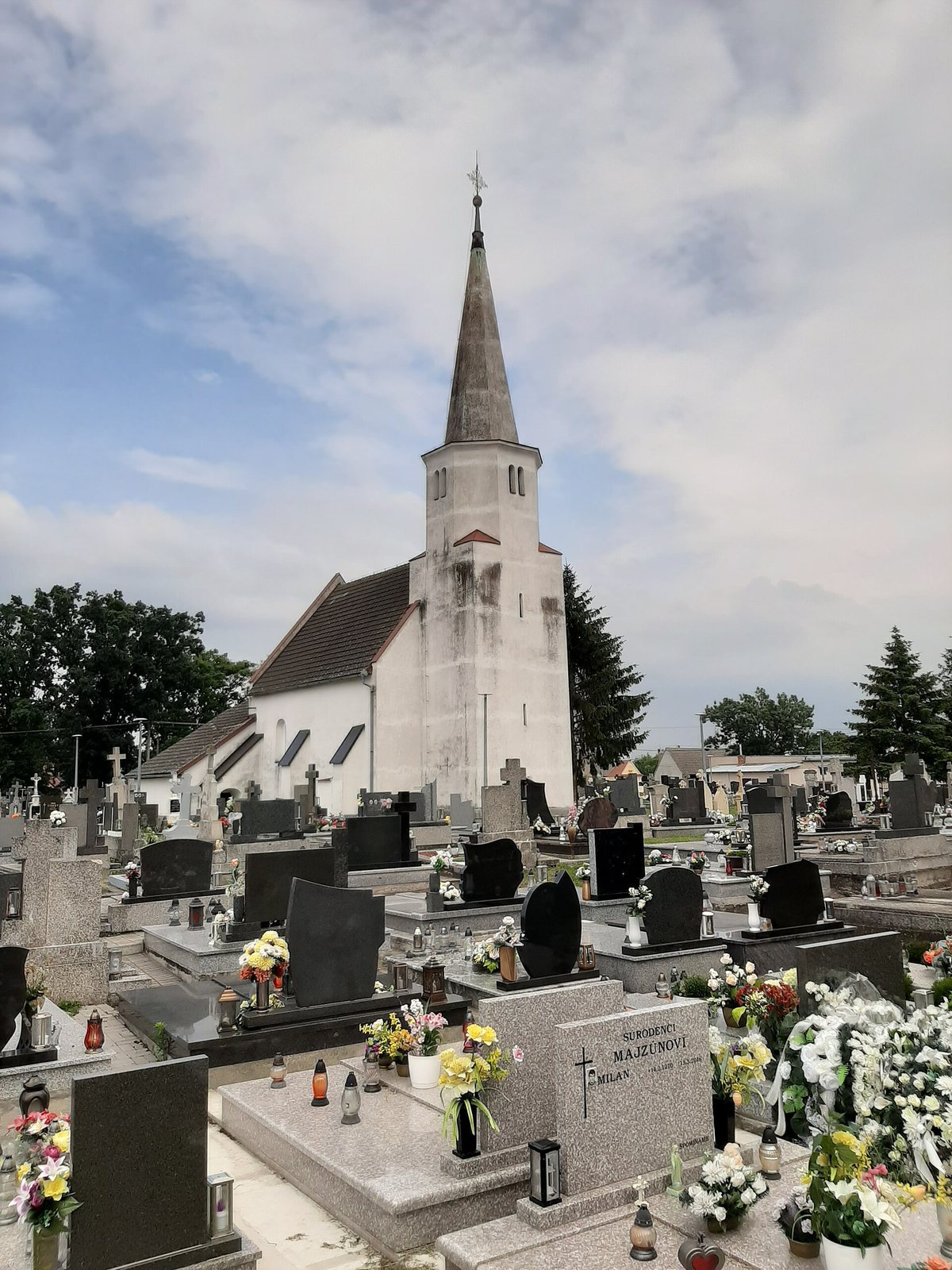
Within the cemetery, the brick church has a single nave (the main body of a church), a sanctuary (the area around the altar) at the east end, a sacristy (a room for church furnishings and preparation for services) attached to it, and a tower projecting from the west end. The white, smooth-plastered walls have a continuous grey plinth, or wall base, and are divided by buttresses, projecting supports. The nave and sanctuary have gabled roofs covered with concrete tiles, while the sacristy has a lean-to roof of the same material. The church roof was originally shingled. A tall, concrete, octagonal pyramidal roof crowns the tower, with a cross above it on a metal cupola.
The sacristy has a small rectangular east window and a separate entrance on its west side. Two rectangular, round-arched windows light the sanctuary on its south and southeast sides. The nave has one round-arched window on the north and two on the south, where its entrance is set between buttresses. The tower is square at its base and becomes octagonal at about two-thirds of its height. Its west entrance has a pointed-arch doorway, with two narrow vertical openings above it. Near the top, each of four sides has a rectangular opening with a semicircular head.
Interior
Vaults and choir gallery
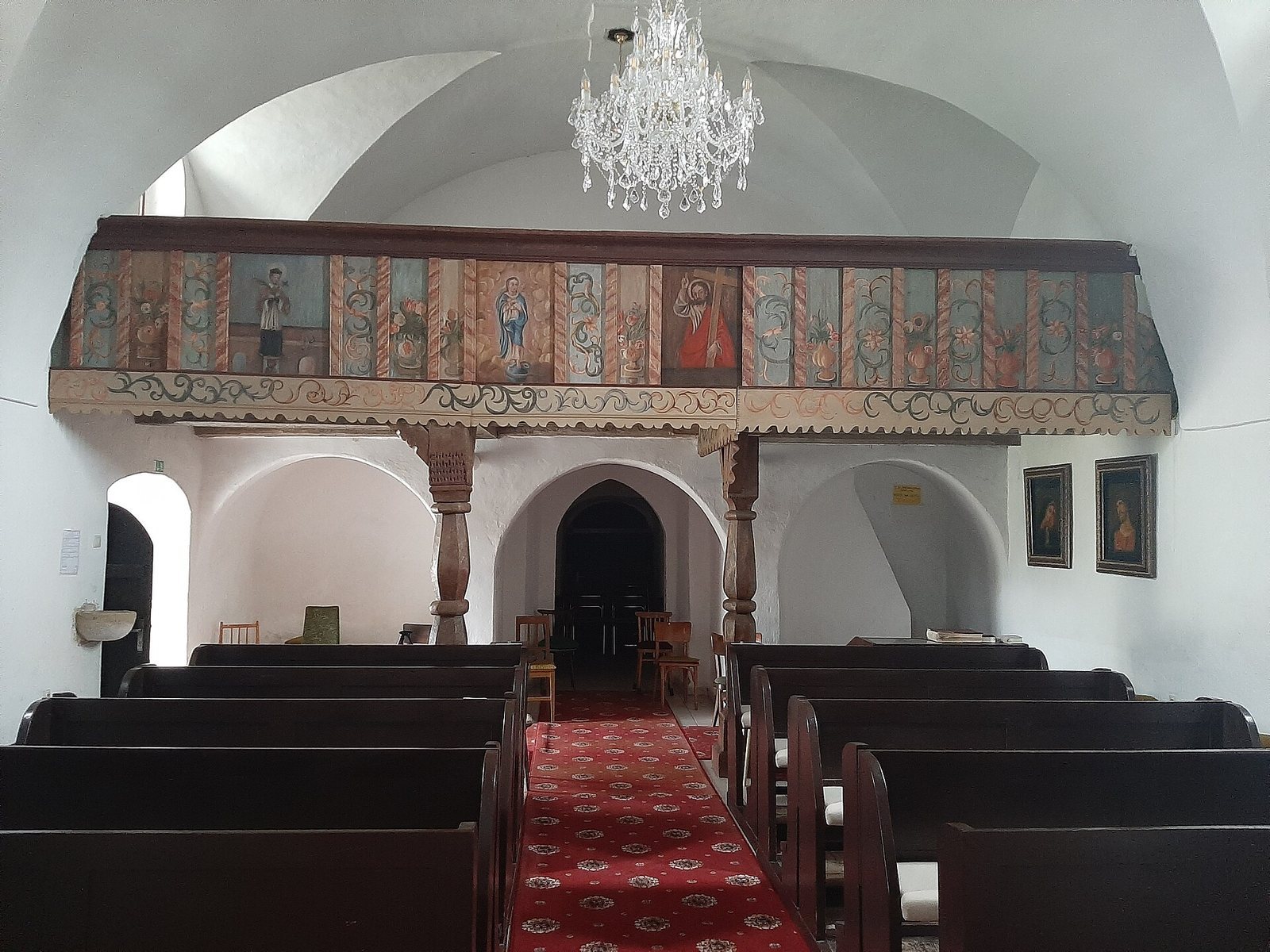
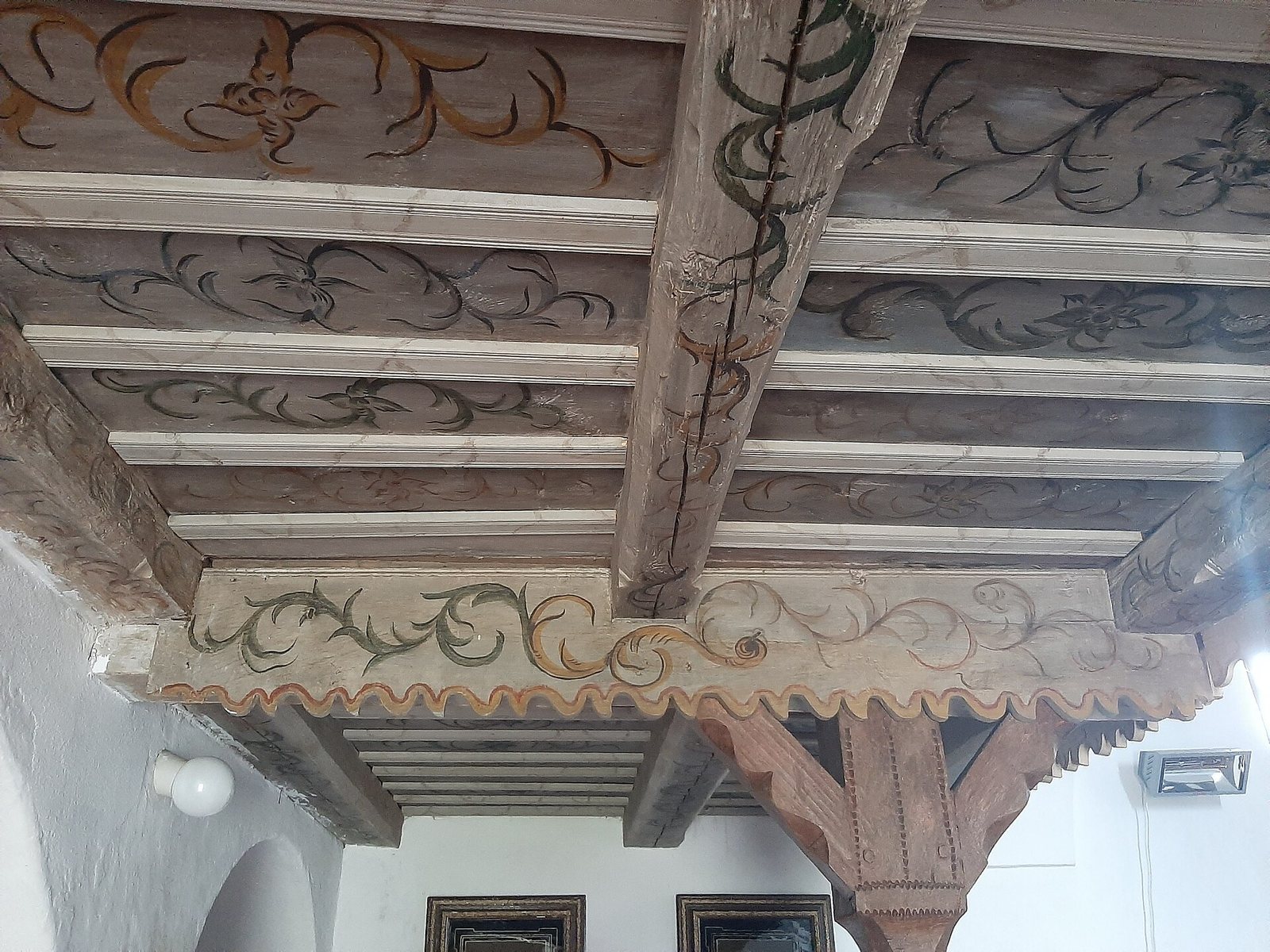
The nave and sanctuary are covered by a barrel vault, a continuous arched ceiling, with lunettes, curved sections of a vault. The sacristy has a cross vault formed by intersecting vaults. Stairs dating from the 1622 restoration lead to the choir gallery, a raised platform for singers or musicians. Beneath it is a wooden coffered ceiling, divided into recessed panels, with Renaissance scrollwork. The gallery rests on carved wooden columns and has a parapet bearing surviving Renaissance paintings of saints. Three arches open it onto the nave, with the middle arch wider than the other two.
Painted decoration
Fragmentary painted decoration from 1622 remains on the sanctuary vault and on the broad wall of the triumphal arch, which separates the nave from the sanctuary. Two angels appear at the top of the composition on that wall. A medallion on the vault above the choir shows a saint, probably the apostle Paul. The paintings are now covered with lime plaster for conservation.
Main altar and Pietà
The gilded main altar is in the Classicist style. Pilasters, shallow wall-mounted columns, support a curved entablature, the horizontal structure above them, topped by the Eye of God. Its central altarpiece is by Pavel Žák, an artist born locally. A tabernacle, the receptacle for the Eucharist, with scroll-shaped ornaments called volutes stands below the image, and statues installed later flank the altar. The Pietà, depicting Mary with the dead Christ, replaced the original altarpiece of St Michael and remains in the church.
Baroque paintings and sculptures
A Baroque painting of Christ on the cross hangs above the sacristy entrance; Mary Magdalene is said to kneel beneath him. A lunette to the left of the altar contains sculptures of female saints and a large wooden cross. Two Baroque statues of saints beside the altar look upward. Features on one suggest that it represents St Bartholomew.
Font, pews, and burial tradition
The historic baptismal font was made of stone and decorated with a wooden crown and iron plates. The present pews were made by local carpenter Jozef Egl. Local residents say that several priests are buried beneath the altar.