Castle of Púbol: A Medieval Barony and Dalí House-Museum in Spain


Site at a Glance
- Rating
- 4.5
- Popularity
- Medium
- Country
- Spain
- Primary era
- Medieval
- External website
- Open
- Eras represented
- Medieval, Early Modern, Modern
- Civilizations
- Crown of Aragon, Spanish
- Site type
- Military
- Remains
- Castle
On this page10 sections
History
Castle of Púbol, in Spain, is a medieval Catalan fortified manor-palace whose origins go back to the eleventh century and whose present core largely took shape during the Gothic and Renaissance periods. Located in the village of Púbol, within the municipality of La Pera in Baix Empordà, it served as the center of the medieval Barony of Púbol.
Origins and medieval lords
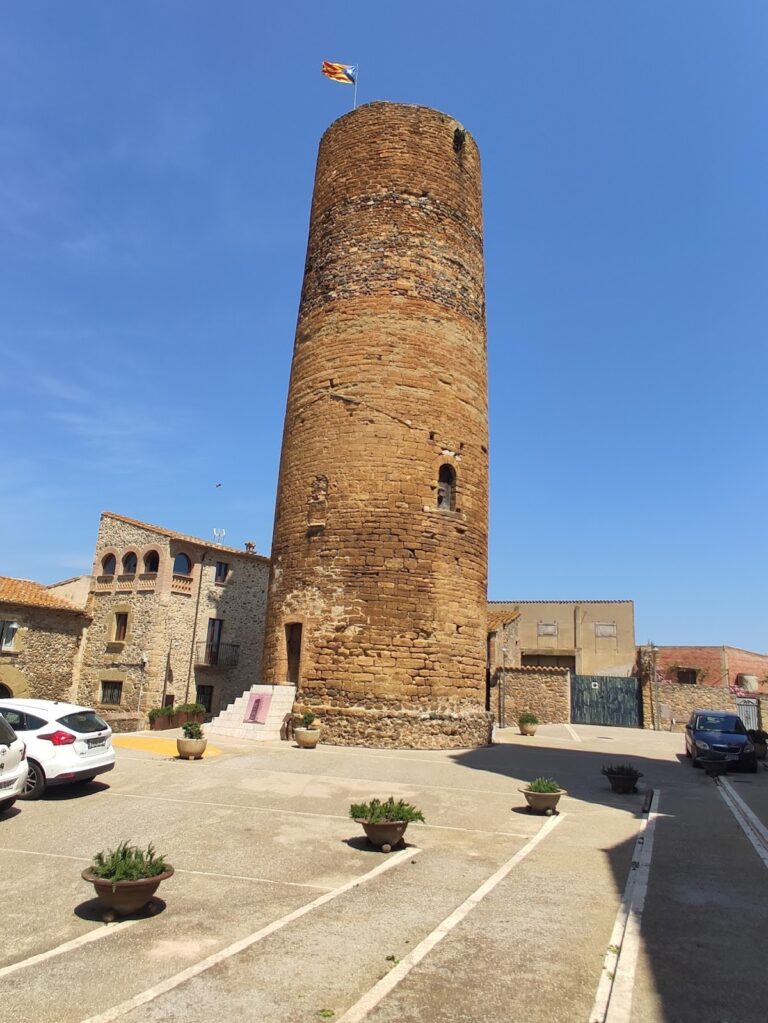
The earliest known documentary reference dates from 1020, when Countess Ermessenda of Carcassonne restored the Tower of Púbol, its church, and associated possessions to the See of Girona. The bishop was her brother Pere. In 1065, Gaufred Bastons swore allegiance to Ramon Berenguer I and Almodis, promising military service with 20 knights and undertaking to surrender the castles of Púbol and Cervià when required.
The castle passed through the Bastons, Cervià, and Llers lineages. In 1139, Guillem Gaufred sought confirmation from Ramon Berenguer IV that the castle had been granted for life to his son Arnau I of Llers, Arnau’s wife Flandina, and their sons Arnau and Guillem. The lords used the surname Llers for three generations before the succession returned to the Cervià name.
The barony and its succession
In 1368, Gispert, also called Jaspert, de Campllong held the castle and barony. A senior notary of Girona and royal treasurer, he purchased jurisdiction over the territory from King Peter the Ceremonious. The king’s son, the Infante John, confirmed that jurisdiction in 1369. Executions apparently took place during Campllong’s tenure.
In 1399, inhabitants of La Pera, Pedrinyà, and Caçà de Pelràs petitioned King Martin the Humane to redeem the jurisdiction. Their territories were separated from the barony, and the Castle of La Pera was built, although the separation was revoked in 1431.
The Campllong succession continued through Jaume de Campllong and his daughter Margarida, who married Bernat de Corbera before 1422. Their son Francesc appears with his mother in the altarpiece of Saint Peter painted by Bernat Martorell, a Catalan painter of the International Gothic period. Francesc later married Violant d’Albert. Their daughter Isabel de Corbera-Campllong i d’Albert married Francesc de Montanyans-Horta, who administered her property during the Catalan Civil War and was recorded as Baron of Púbol.
After her first husband’s death, Isabel married Berenguer Joan de Requesens. Their son Francesc de Requesens i de Corbera-Campllong inherited her property and title and became lord of Púbol. The estate later passed through the Requesens-Campllong, Oms-Cruïlles-Vilademany, Tormo, Balle, Miquel, and related lineages, eventually reaching the Marquises of Blondel de l’Estany. Among the later heirs were Anna de Montanyans-Horta i de Requesens, who died without descendants in 1623 and named her cousin Miquel d’Oms-Cruïlles-Vilademany i de Cardona as heir, followed by members of the Tormo, Balle, Miquel, and Blondel families.
Gala and Salvador Dalí
In 1969, Salvador Dalí promised his wife Gala that he would buy her a castle. After unsuccessful negotiations for the castles of Empordà, Foixà, and Requesens, he acquired Púbol. On 10 November 1969, the last Miquel heirs sold the castle to Gala Dalí, born Elena Ivanovna Diakonova, who was Dalí’s wife, muse, and long-term collaborator.
The building was then in very poor condition. Dalí directed its restoration and created the interior decoration, while the restoration work was directed by Emili Pinyo, a specialist and friend of the artist. Structural elements were strengthened, but much of the damaged and timeworn character was retained, including a deep crack in the facade. Collapsed sections were adapted into high-ceilinged rooms that contrast with the smaller chambers rather than being entirely concealed or rebuilt.
Gala used the castle mainly during the summers of the 1970s and early 1980s. She required Dalí to obtain a written invitation before visiting, a condition he accepted. After her death in 1982, she was buried in a crypt at the castle designed by Dalí. On 24 June 1982, King Juan Carlos I granted Dalí the title Marquis of Púbol.
Dalí lived and worked at Púbol for approximately two years after Gala’s death and completed his final painting there in 1983. A fire in 1984 caused severe burns and nearly killed him. The circumstances were uncertain, being described either as a possible suicide attempt or as an accident caused by staff negligence. After treatment, Dalí moved to the Galatea Tower at the Dalí Theatre-Museum in Figueres, where he remained until his death.
House-museum and heritage protection
The Gala-Dalí Castle House-Museum opened to the public in 1996. The state heritage administration restored and reconstructed the building’s furniture, exhibits, and smaller decorative objects, while other rooms were retained in the condition associated with Salvador and Gala. The Spanish state owns the castle, and the Gala-Salvador Dalí Foundation manages it.
Castle of Púbol is protected as a National Cultural Heritage Site and historical monument. Together with the Salvador Dalí House-Museum at Portlligat and the Dalí Theatre-Museum in Figueres, it forms the Empordà Dalinian Triangle.
Remains
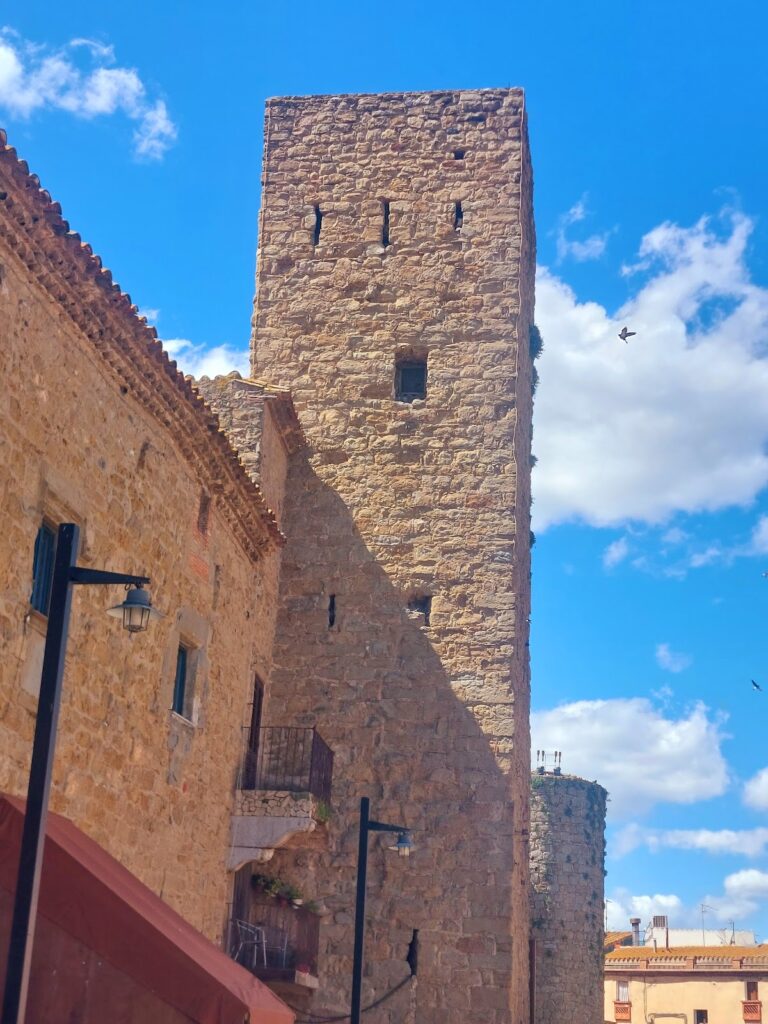
The complex combines a fortified manor-palace, a walled garden, the parish church of Sant Pere de Púbol, and an adjoining building known as the Tithe. The structures are arranged around a high, narrow central courtyard. The castle and church occupy a prominent part of the village, whose feudal appearance is linked to surrounding houses and remains of the medieval fortified enclosure.
Fortified manor-palace
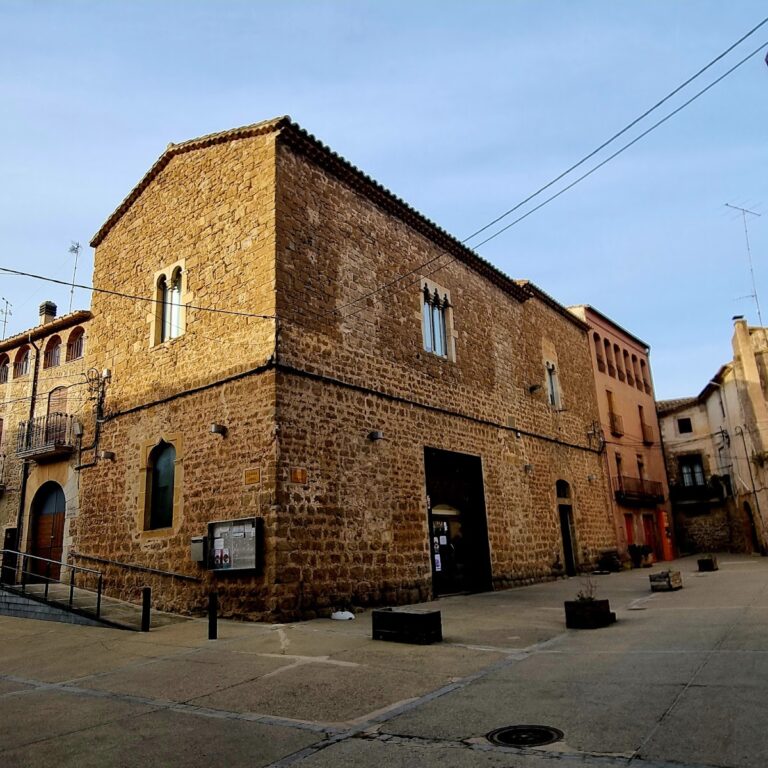
The present castle core has three floors and largely developed during the second half of the fourteenth century and the beginning of the fifteenth, when the barony was at its most prosperous. Substantial Gothic and Renaissance structures survive despite later transformations. The principal facade has a semicircular entrance arch formed from large wedge-shaped stones, known as voussoirs, together with Gothic windows on the main floor. Other parts retain Gothic and Renaissance windows, reliefs, and portals decorated with emblems.
Parish church of Sant Pere
Sant Pere de Púbol was built in Gothic style between 1327 and 1341 and remains the parish church. Its single nave is covered by a pointed vault and ends in a polygonal apse. Two side chapels open from the south wall. One is dedicated to the Virgin Mary and has fifteenth-century sculptural decoration; the other dates from 1631. A choir was added in the seventeenth century and a sacristy in the eighteenth.
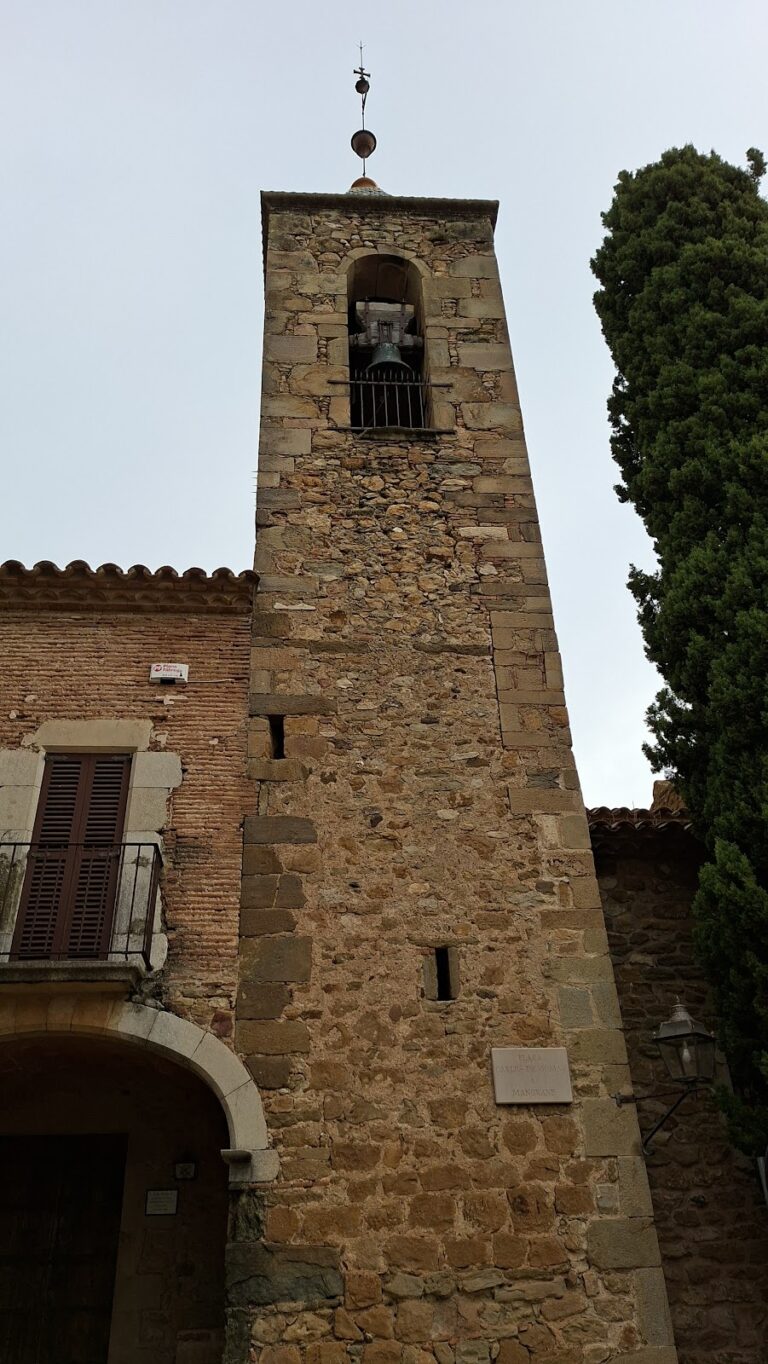
The church facade has a central portal, a late-Gothic rose window, and a bell tower above it. Until 1936, the church housed the Saint Peter altarpiece, a painted religious ensemble made by Bernat Martorell probably around 1437. It is now in the Girona Art Museum. The work depicts Saint Peter and other figures alongside Bernat de Corbera, Margarida de Campllong, and their son Francesc de Corbera i de Campllong, members of the family that owned the castle.
Dalí interiors and associated buildings
Dalí created the interior decoration for Gala with wall paintings using trompe-l’oeil, a technique that makes painted surfaces appear three-dimensional, as well as baroque fabrics, antiques, romantic symbols, furniture, and numerous decorative objects. The house-museum contains paintings and drawings that Dalí gave Gala for display in the castle, along with Gala’s haute-couture clothing collection.
The interior spaces include the Hall of Shields, Piano Hall, Gala’s bedroom and bathroom, library, guest room, attic, distribution hall, dining room, and loggia. The attic holds the permanent display of Gala’s wardrobe, while the lower floor contains the house-museum shop. The Tithe building includes the crypt, which serves as Gala’s mausoleum in the basement area.
Garden and garage
The walled garden contains sculptures of long-legged elephants, some shown carrying ravens. The swimming pool is decorated with colored ceramic busts of the composer Richard Wagner. In the garage are a taxidermied horse, Dalí’s Cadillac, and a carriage formerly belonging to the Barons of Púbol.
Nearby sites