Church of the Protection of the Mother of God, Miroľa: A Wooden Greek Catholic Church
Site at a Glance
- Popularity
- Very Low
- Country
- Slovakia
- Primary era
- Early Modern
- Eras represented
- Early Modern, Modern
- Civilizations
- Habsburg, Hungarian
- Site type
- Religious
- Remains
- Church
On this page11 sections
History
The Church of the Protection of the Mother of God, Miroľa, is a wooden Greek Catholic church in Miroľa, Slovakia, built between 1746 and 1770 with Baroque and folk architectural features. It stands on the site of a church from the late seventeenth century and is dedicated to the Protection of the Mother of God, a title for Mary. The church remains active as a dependent church of the Greek Catholic parish of Hunkovce. It belongs to the Svidník Deanery, a group of parishes, within the Prešov Archeparchy, an Eastern Catholic archdiocese. Its Byzantine-Slovak rite is an Eastern Catholic tradition that follows Byzantine liturgy.
War damage and restoration
Artillery and mortar fire damaged the church in November 1944 during the Carpathian-Dukla operation. Residents repaired it in 1945, with further repairs taking place after the war and again in the 1990s. The church was registered as a cultural monument on 7 March 1963 and designated a National Cultural Monument of Slovakia in 1968.
The iconostasis was restored in the 1970s. From 2005 to 2008, the wooden church underwent a full restoration. During the twenty-first century, its nave icons were restored in stages, and the altar was returned to an earlier state.
Remains
Exterior and layout
Church structure
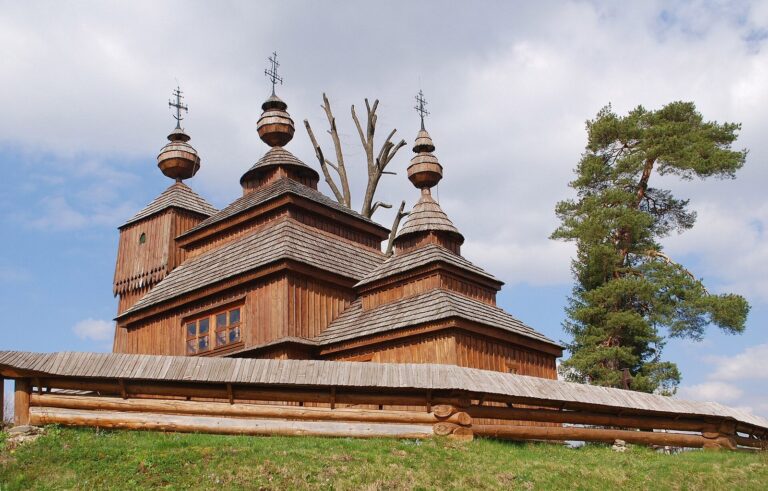
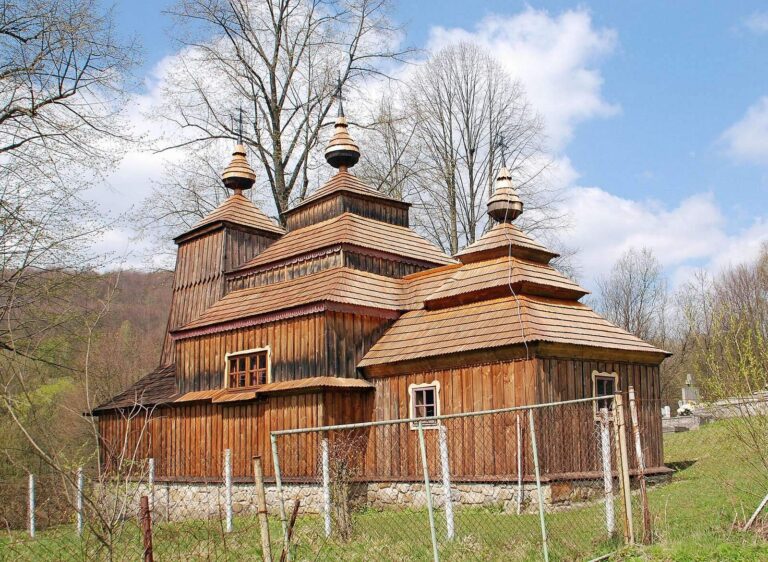
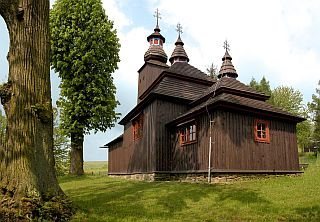
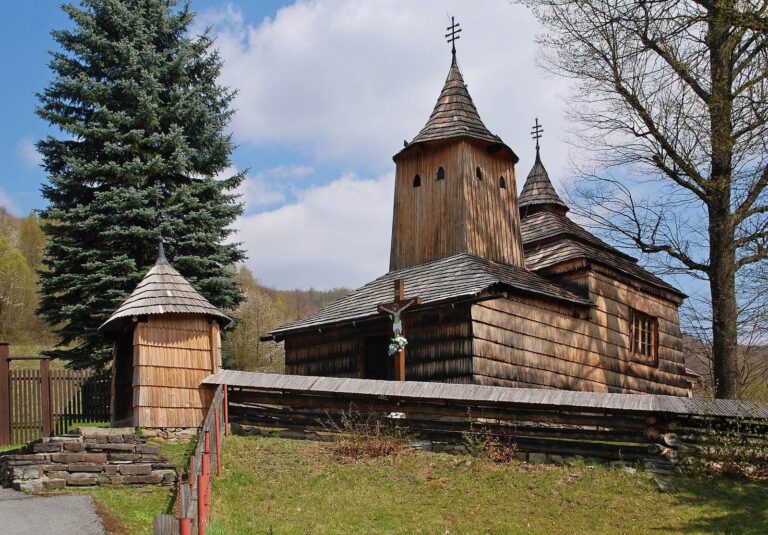
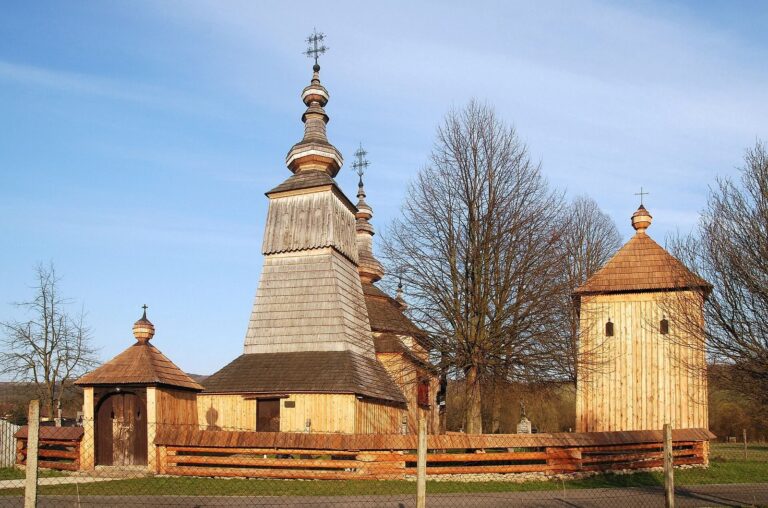
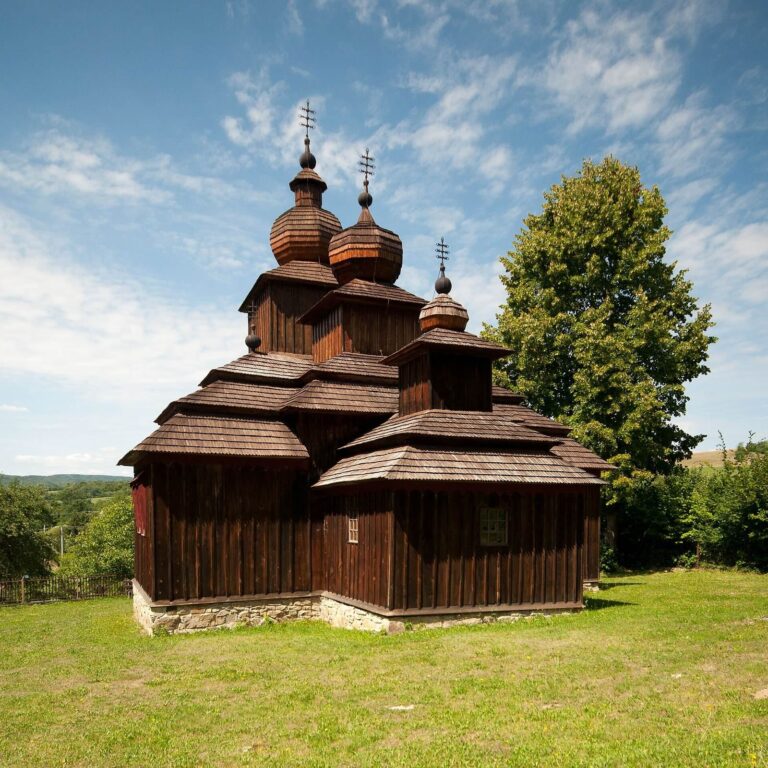
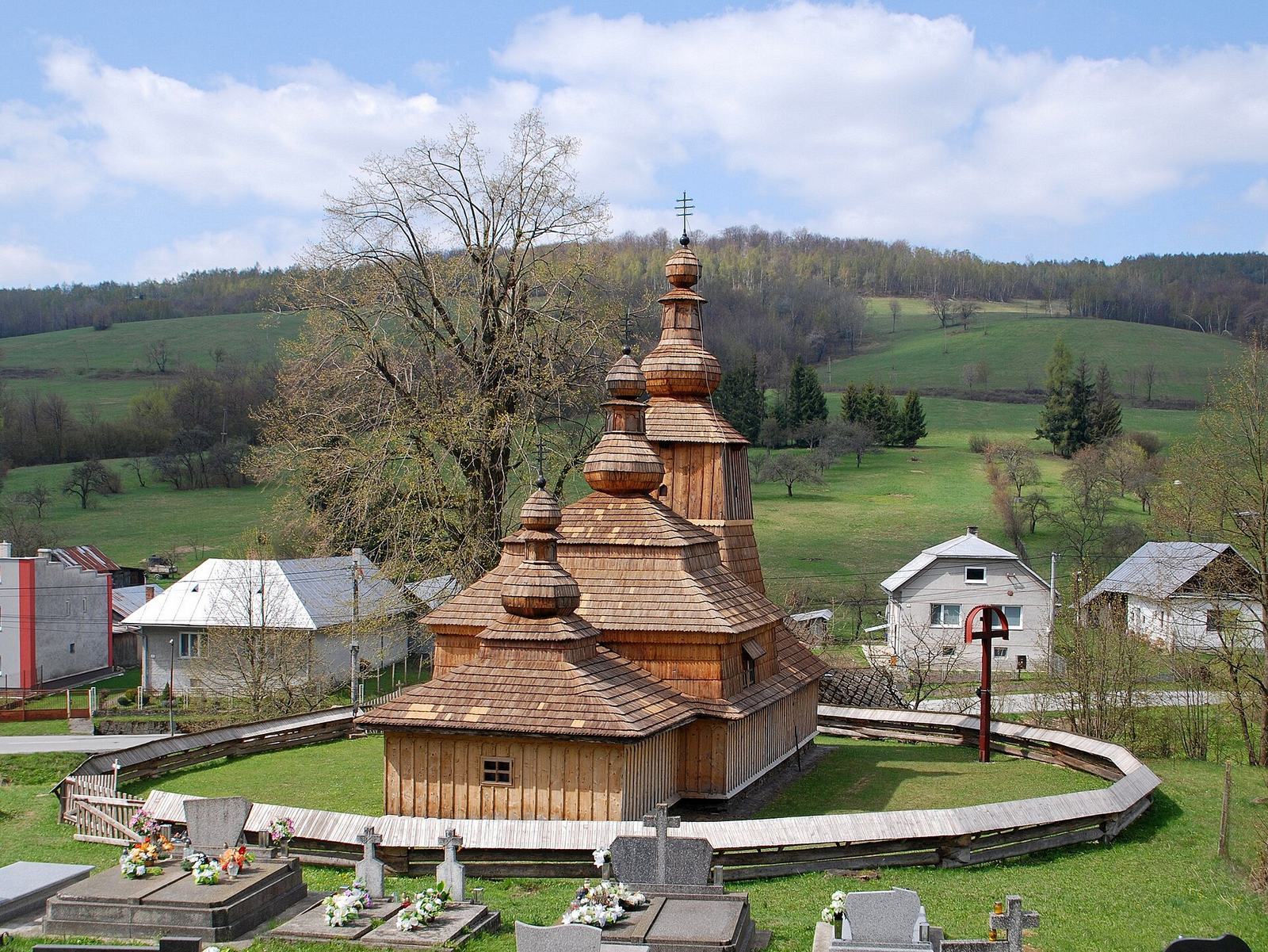
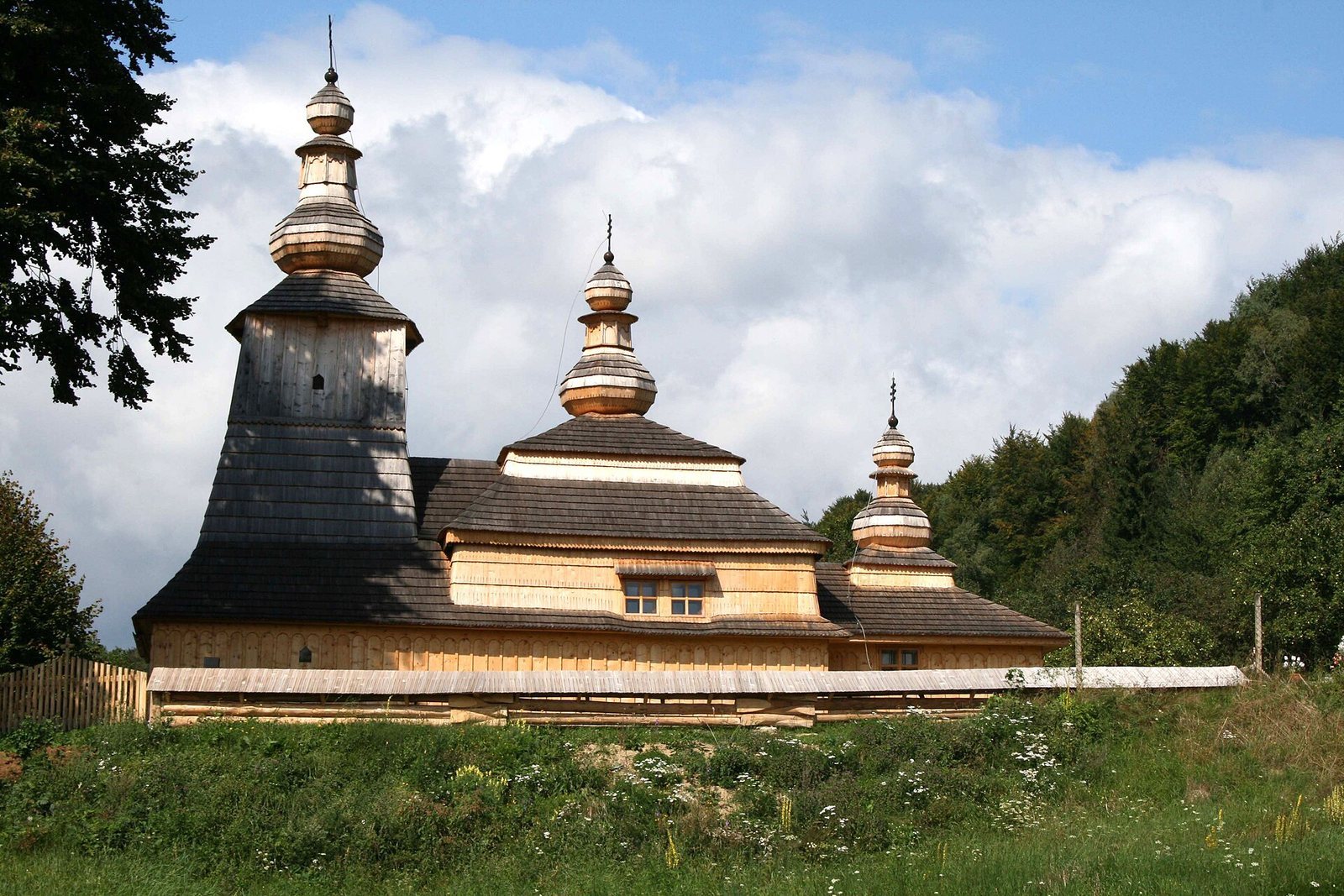
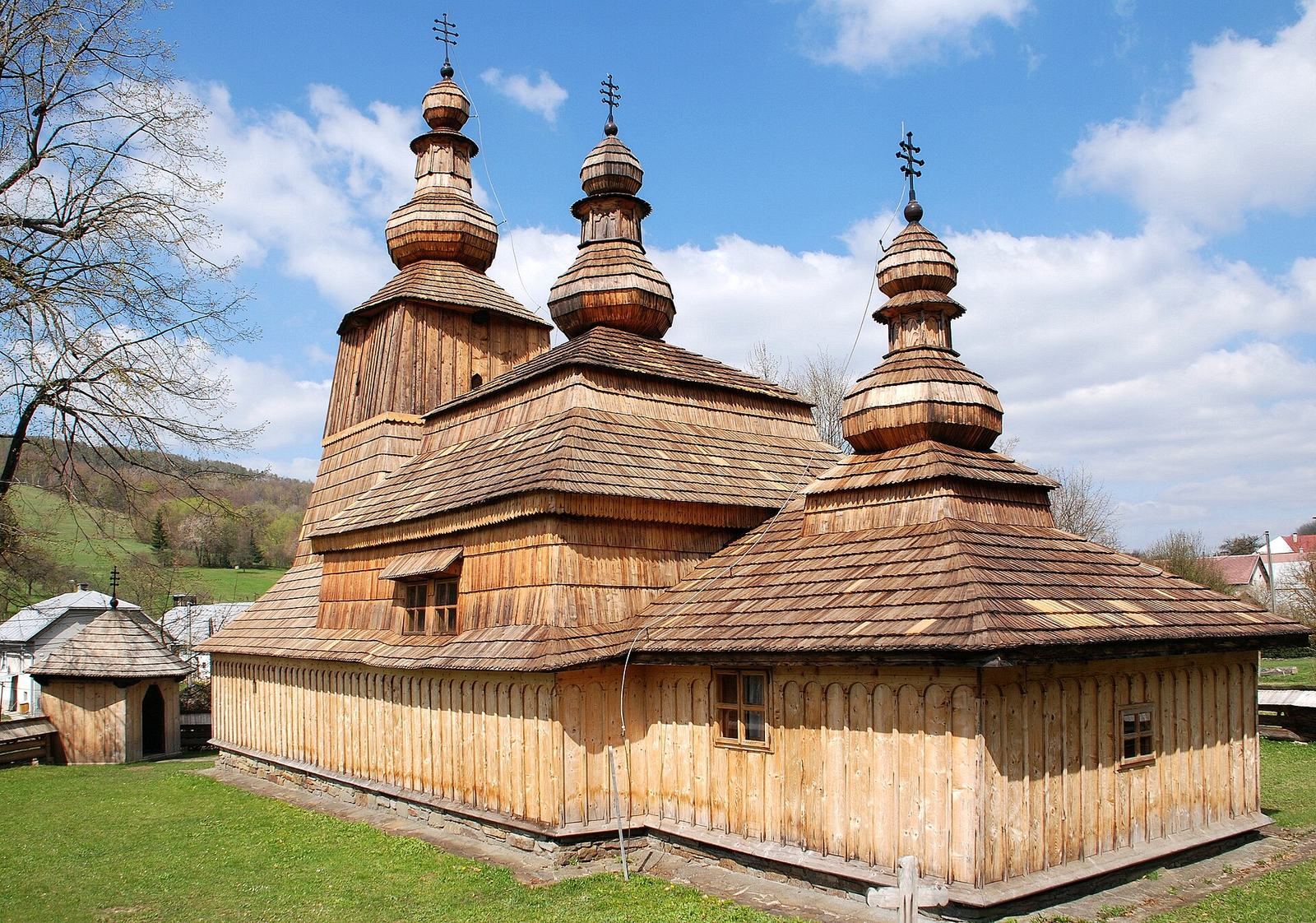
The church has a three-part plan, with a nave, a smaller sanctuary ending in a rectangle, and a narthex, the entrance vestibule. The principal sections are square in plan. Its southwestern form of Lemko-style architecture draws on traditions associated with the Lemkos, an East Slavic people of the Carpathian region. Rounded logs form parts of the walls, which are clad on the outside with boards. A later tower was added to the original nave and sanctuary. Built with a timber frame and sloping walls, it has shingles below and boards above, and its helmet-shaped roof carries an onion dome and iron cross. The church has one tower and three domes. Shingles cover the nave and sanctuary roofs; the nave roof has two tiers, while the sanctuary’s roof slopes on all sides and joins the nave roof. Bulbous roof forms, blind lanterns (roof lanterns without openings), and forged metal crosses crown the roofs. Octagonal roof ornaments with cylindrical upper sections and pear-shaped turrets line the ridges.
Fence and entrance
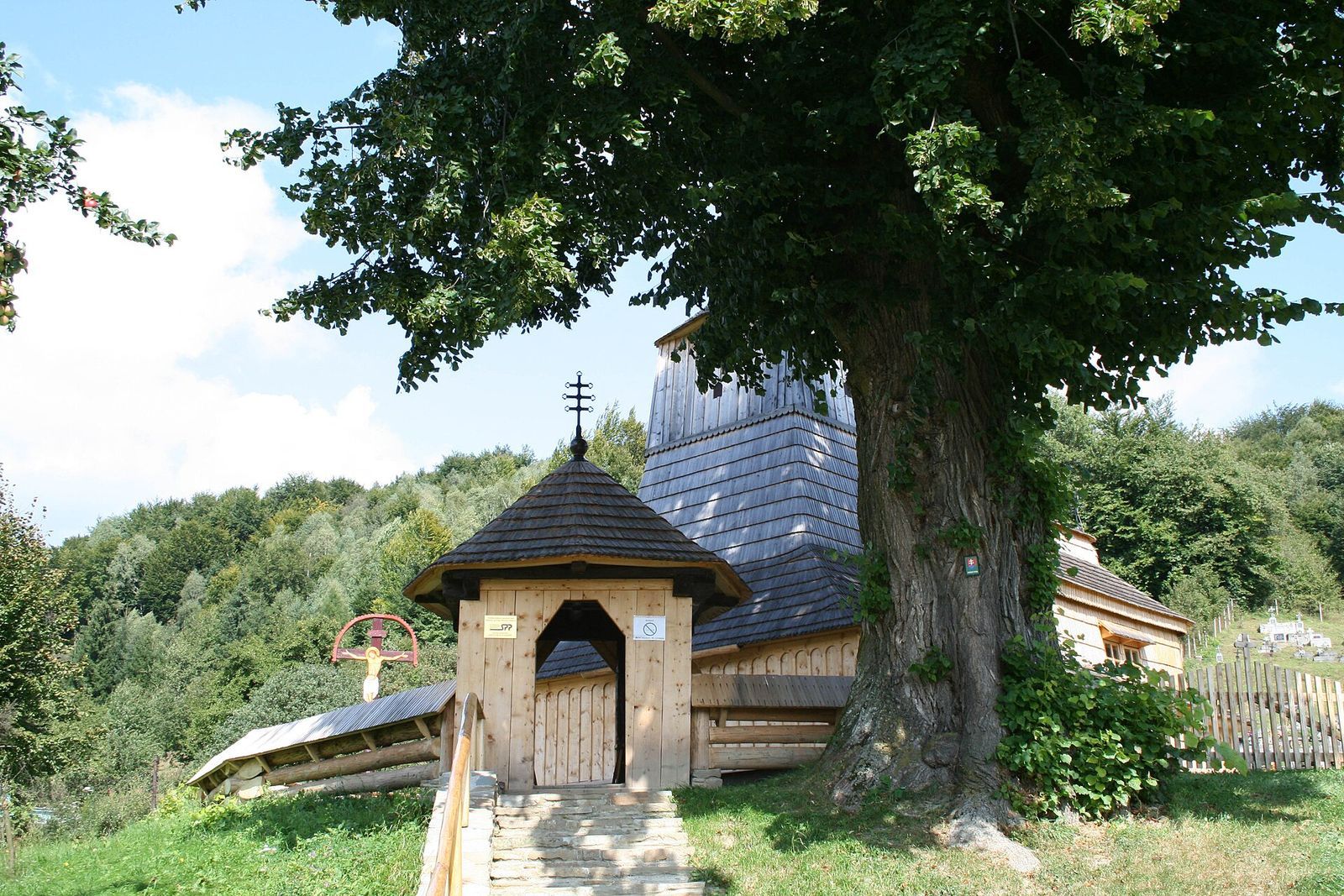
A wooden fence surrounds the church. Its entrance gate has a square plan and a low, octagonal tent roof covered with shingles.
Interior and furnishings
Iconostasis
The late-Baroque iconostasis, an icon-bearing screen separating the sanctuary from the nave, dates to the church’s construction period. Its four richly colored rows include the royal doors at the center and deacon doors at the sides. The first row contains images of Saint Nicholas, the Hodegetria (Mary pointing to Christ), Christ Pantokrator (Christ as Ruler of All), and the Protection of the Mother of God. In the first-row image, Christ appears half-length, holding an open Gospel in his left hand and blessing with his right. The second row shows principal church feasts, with the Last Supper at its center.
The third row depicts the apostles and has a central, full-length image of Christ Pantokrator. Christ wears a purple robe and a blue shoulder band marked with three brown, equal-armed crosses. The band represents the Good Shepherd carrying a lost sheep back to the flock. Christ blesses with his right hand and holds a blue orb in his left; an almond-shaped halo, called a mandorla, frames his head. Above, twelve prophet medallions occupy six panels. A Crucifixion panel crowns the screen, with the Mother of God and Saint John the Evangelist beside the cross. The royal doors bear medallions of the four Gospel writers and two scenes of the Annunciation.
Altars
The main altar in the sanctuary has a nineteenth-century painting of Christ falling beneath the cross, set in a carved frame described as rustic Rococo. A side altar holds a Baroque relief of the Crucifixion.
Icons and other objects
Several portable seventeenth-century icons in the nave came from the earlier church. They include the Dormition of the Mother of God, an Eastern Christian feast commemorating Mary’s death and glorification, as well as the Exaltation of the Holy Cross, the Mother of God with the Christ Child in the Hodegetria type, and the Nativity of the Mother of God. Other images include an eighteenth-century Archangel Michael, Saint Paraskeva, and the Mandylion, a traditional image of Christ’s face on a cloth. A processional cross is painted on the nave’s south wall.
The narthex also contains books bearing historical Cyrillic inscriptions and hand-forged nails made by local craftspeople. A processional canvas depicting Christ in the tomb was found during restoration of the altar.
Windows and ceilings
A twin window on the south wall of the nave has a wooden frame carved with rosette designs. Tent-shaped vaulted ceilings cover both the nave and the sanctuary.