Lanyon Quoit: A Neolithic Dolmen near Penzance
Site at a Glance
- Popularity
- High
- Country
- United Kingdom
- Primary era
- Stone Age
- Eras represented
- Stone Age, Modern
- Civilizations
- Unclassified
- Site type
- Burial
- Remains
- Tomb
On this page7 sections
History
Neolithic origin and possible purpose
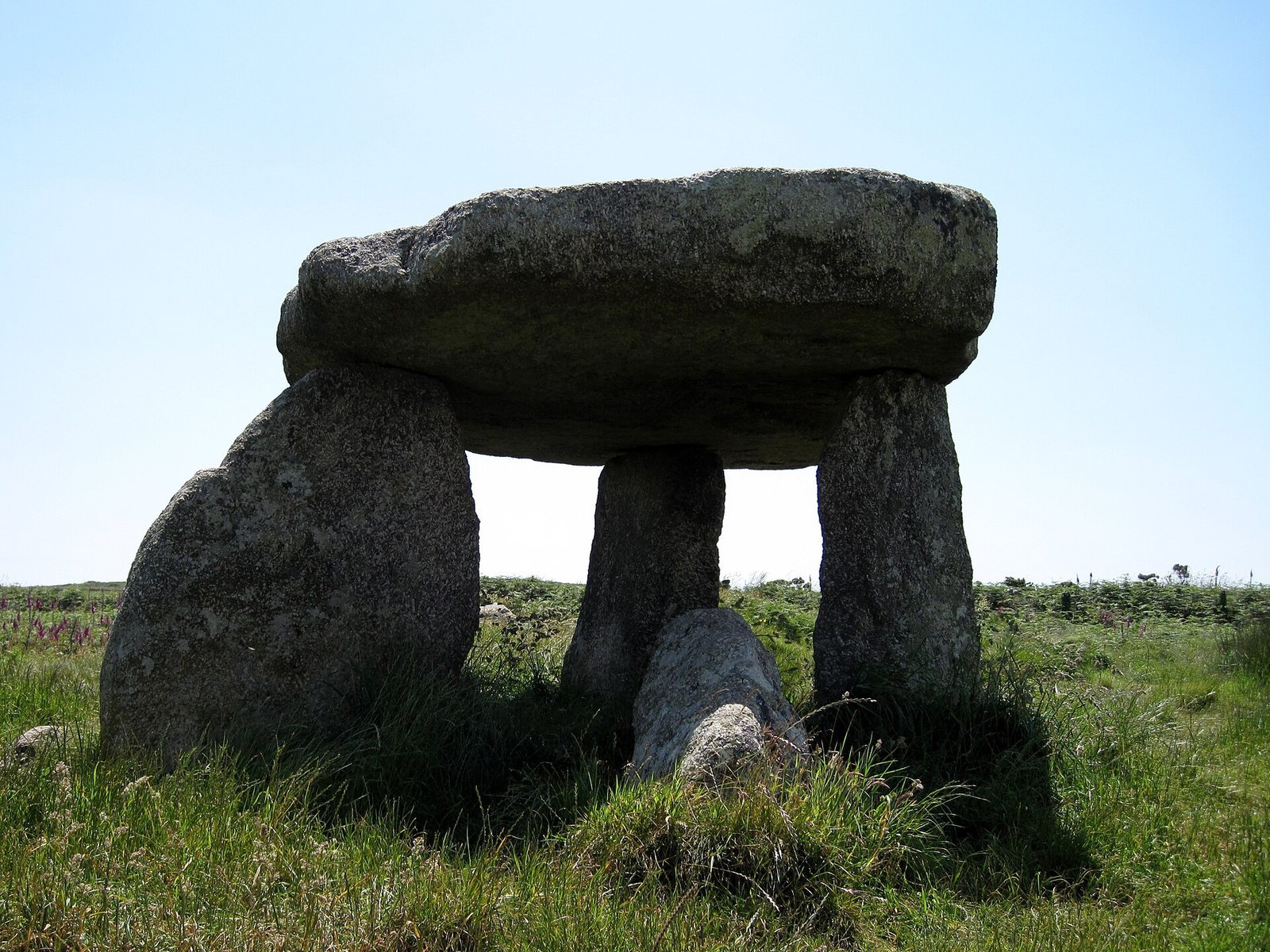
Lanyon Quoit is a Neolithic dolmen, a prehistoric stone structure with a horizontal capstone resting on upright stones, in Madron near Penzance, United Kingdom. It dates to about 3500 BC. Its original purpose is uncertain. It may have formed the chamber of a portal tomb, a burial structure with an entrance framed by upright stones and a capstone, or served as a cenotaph, a memorial that contains no remains of those commemorated. One proposal is that it commemorated respected priest-shamans, religious specialists associated with priestly and shamanic practices.
It is unclear whether earth once covered the chamber or whether its entrance and capstone remained exposed. Ritual activity in front of, within, or on the stone structure has also been proposed. The method used to raise the capstone is unknown; suggested approaches include pulling it up a long artificial ramp or lifting it in stages with a wooden structure. A local legend about giant bones found underground is associated with names for the monument including Giant’s Quoit, Giant’s Table, and Giant’s Tomb.
Collapse and rebuilding
A storm brought the monument down on 19 October 1815. It was re-erected in 1824 under Captain Giddy, an officer in the Royal Navy, the United Kingdom’s naval service. Local residents raised the money for the work. The rebuilding changed the monument’s arrangement.
Antiquarian study and later protection
William Borlase, a Cornish antiquarian, or scholar of historical remains, published the first description in 1769 with engravings showing an earlier arrangement. A depiction by Scott from 1813 also shows the monument before its collapse. Later images by R. T. Pentreath in 1857 and John Thomas Blight in 1864 show its altered form. In 1872, William Copeland Borlase investigated and excavated the site. He reproduced the earlier engravings made by his ancestor William Borlase, regarding them as especially useful records of the monument before its substantial changes.
Lanyon Quoit became a scheduled monument in 1923, a site protected under UK law. In 1952, its then-owner, Edward Bolitho of Trengwainton, transferred the land and monument to the National Trust, a British conservation organization. A specialist assessment in 1982 judged the damaged monument too compromised for classification.
Remains
The dolmen
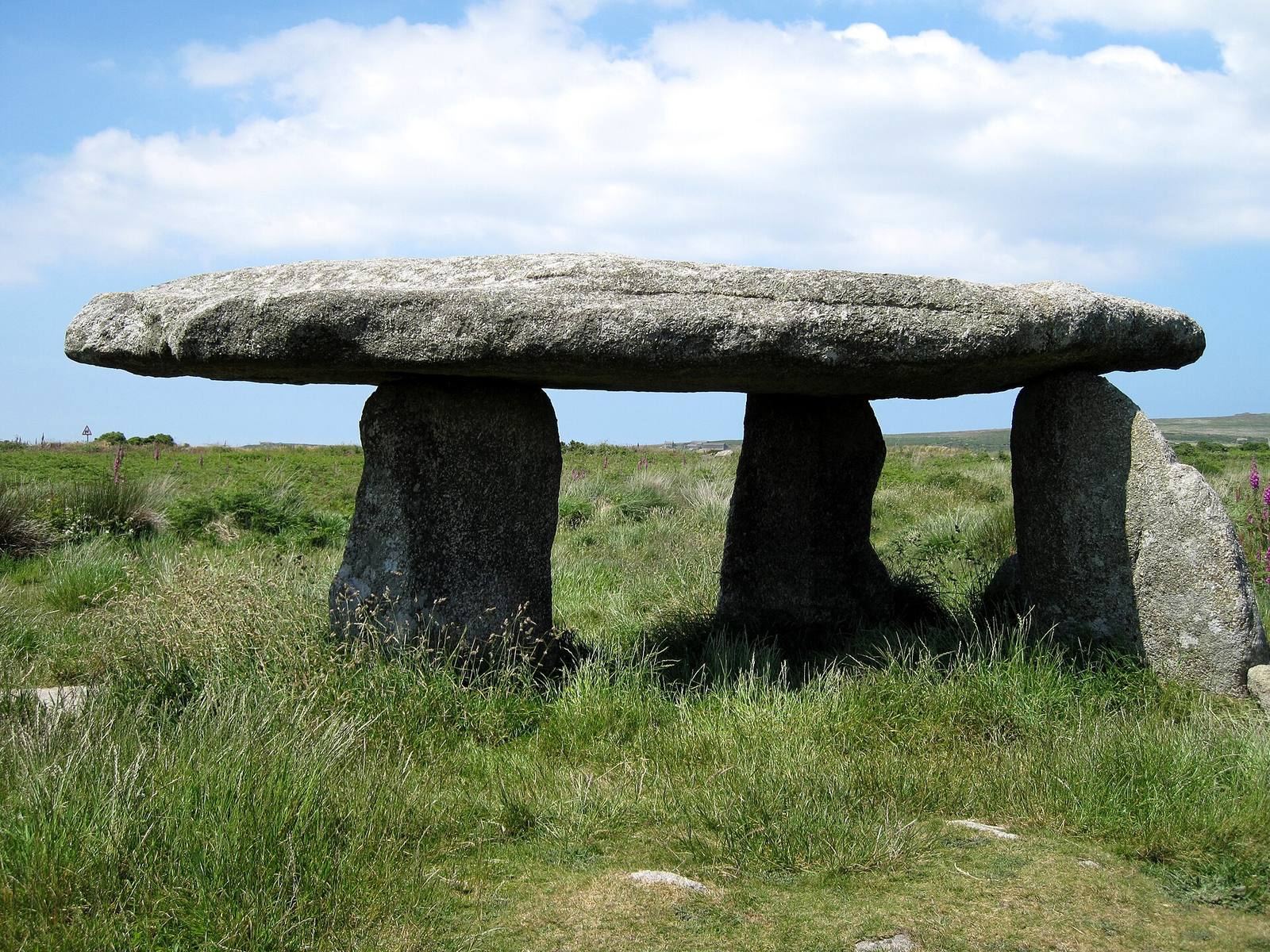
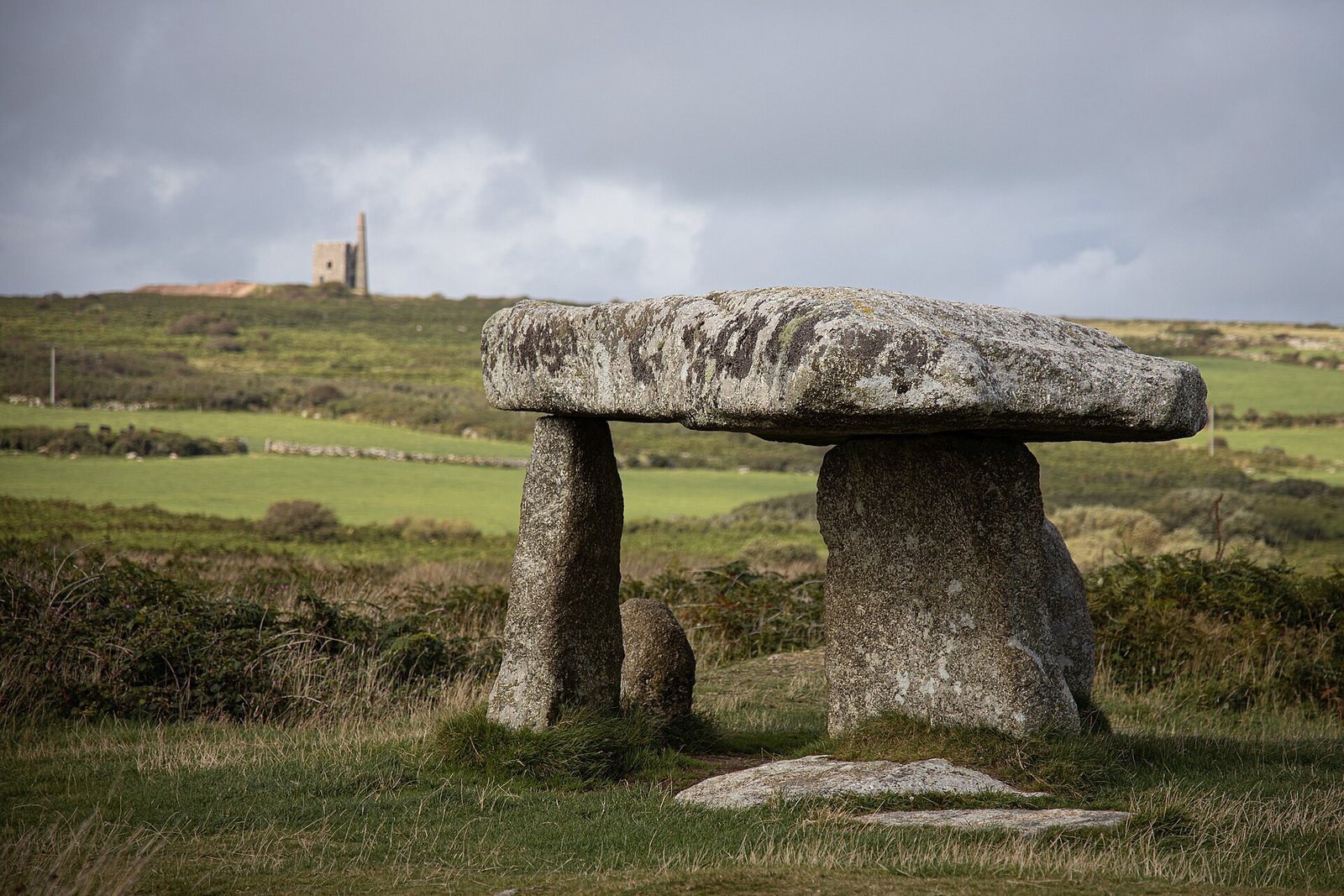
The present layout centers on the dolmen at the northern end of a long barrow. The monument lies northwest of Penzance, between Madron and Morvah, about 50 metres east of the road; the remains of West Lanyon Quoit are roughly 700 metres to the west. Three support stones, each about 1.5 to 2 metres high, carry an oval capstone measuring approximately 5.3 metres long and 2.7 metres wide, with an estimated weight of 13 tonnes. One support lies almost beneath the capstone’s center, while the other two bear its edge. The supports are neither symmetrically placed nor aligned with the capstone’s length, so the appearance of symmetry depends on the viewing angle.
Before the collapse, four supports held the capstone high enough for a person on horseback to pass beneath it. Earlier engravings show the supports standing parallel and include a substantially wider stone. One support and part of the capstone broke when the monument fell; the damaged support was not replaced during the rebuilding. The reconstructed dolmen is consequently lower than its earlier form.
Long barrow and surrounding stones
The barrow is an elongated prehistoric burial mound about 26 to 27 metres long and 12 metres wide. Grass and bracken cover its damaged surface, whose outline is indistinct. Large stones at its southern end may be the remains of one or more cists, small graves lined with stone. Standing stones also occur around the rebuilt dolmen, but their original arrangement and purpose are uncertain.