Cave aux Fées Covered Passage Tomb: A Neolithic Burial Monument in France
Site at a Glance
- Popularity
- Low
- Country
- France
- Primary era
- Stone Age
- Eras represented
- Stone Age
- Civilizations
- Unclassified
- Site type
- Burial
- Remains
- Tomb
On this page11 sections
History
The Cave aux Fées covered passage tomb at Brueil-en-Vexin, France, is a Neolithic burial monument dated to about 2200 BCE. The Neolithic was the later part of the Stone Age, when settled farming communities used polished stone tools. The tomb belongs to megalithism, a tradition of building monuments with large stones, and was used for burials.
The French anthropologist Manouvrier estimated that at least 150 people were buried in the chamber. The archaeologist Adrien de Mortillet proposed that the total might have reached several hundred. Local tradition associated the place with fairies: one tale said they lived there, while another described a white cow emerging at midnight on dark nights. The alternative name Autel des Druides, meaning “Druids’ Altar,” refers to religious specialists among ancient Celtic peoples, many centuries after the tomb’s Neolithic use.
Early investigations
The monument was first recorded in 1768. It may have been excavated in 1824 or 1825, and limited test excavations, known as soundings, were made at both ends between 1864 and 1867. Prussian officers investigated the tomb during the Franco-Prussian War, the 1870–1871 conflict between France and Prussia and its German allies. French officers carried out further work around 1876.
Adrien de Mortillet led the first official excavations in 1889, working for about fifteen days under the French Association for the Advancement of Science. The investigation followed earlier disturbance at the entrance and rear of the chamber.
Neglect and preservation
The tomb later fell into neglect and was used to dump military equipment during the Second World War. In 1957, abandoned ammunition was removed during a clearance of the site. On 8 March that year, the monument received French historic-monument status, a legal designation intended to protect historic property. The regional archaeological service restored the tomb in 1970.
Remains
Physical layout and construction
Setting and plan
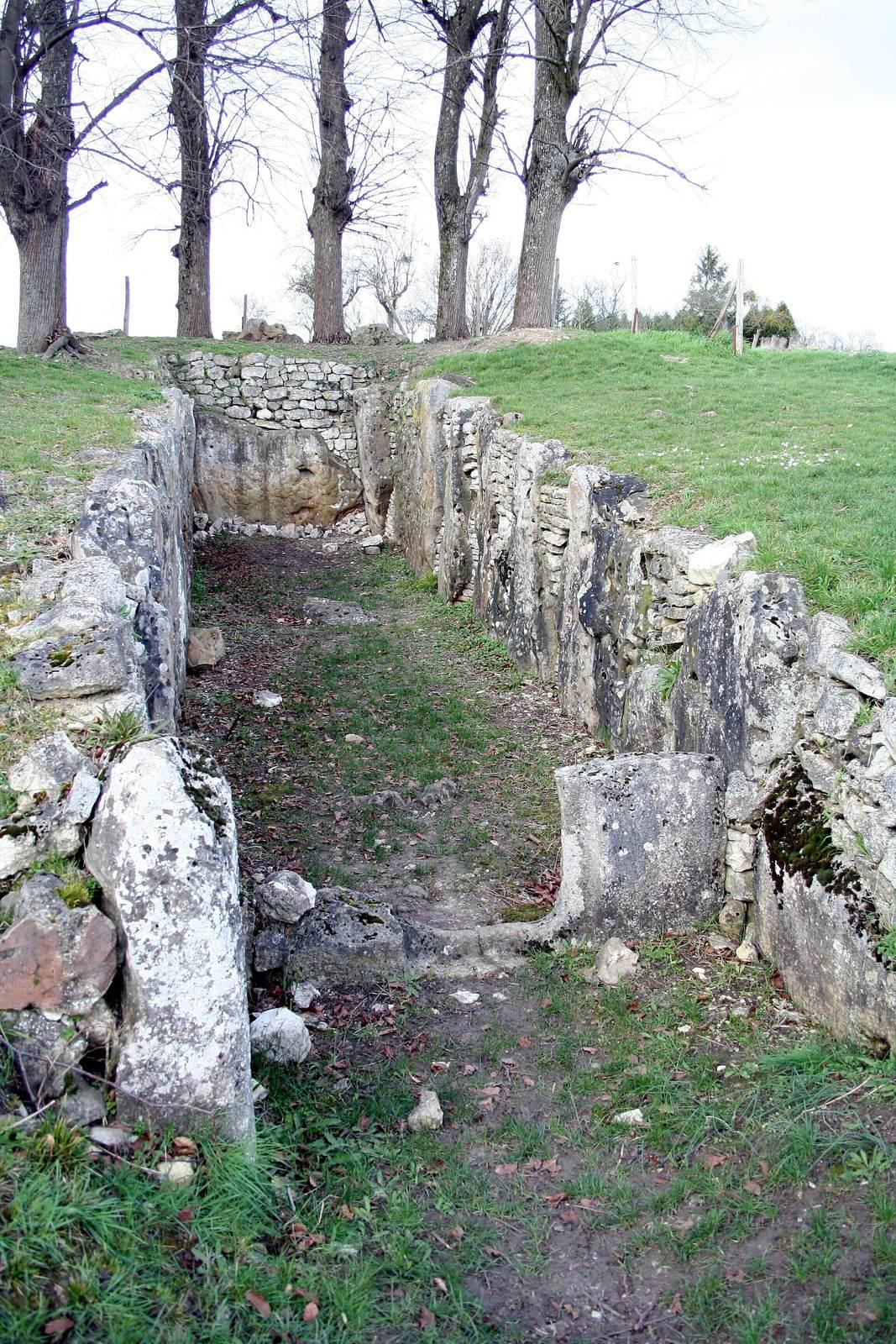
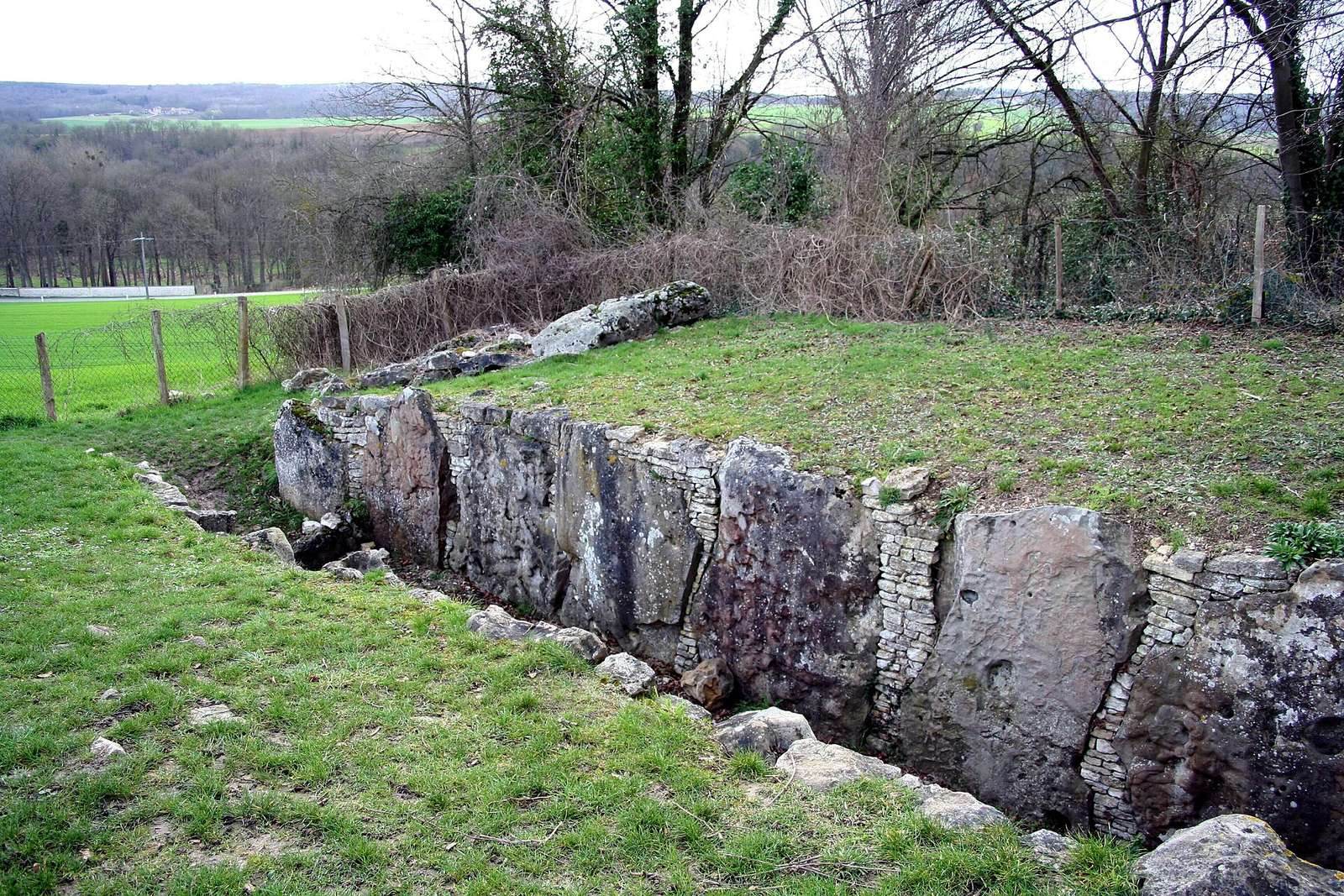
The tomb lies about 115 metres above sea level on the northern slope of the Montcient valley. Cut into the ground as a pit, it measures about 14 metres overall. Its axis runs from north-north-east to south-south-east, with the entrance at the downhill, south-south-east end. The main chamber is about 11.8 metres long and slightly trapezoidal. It measures 2.25 metres wide and high at the rear, narrowing to about two metres in both dimensions near the entrance.
Chamber and stone supports
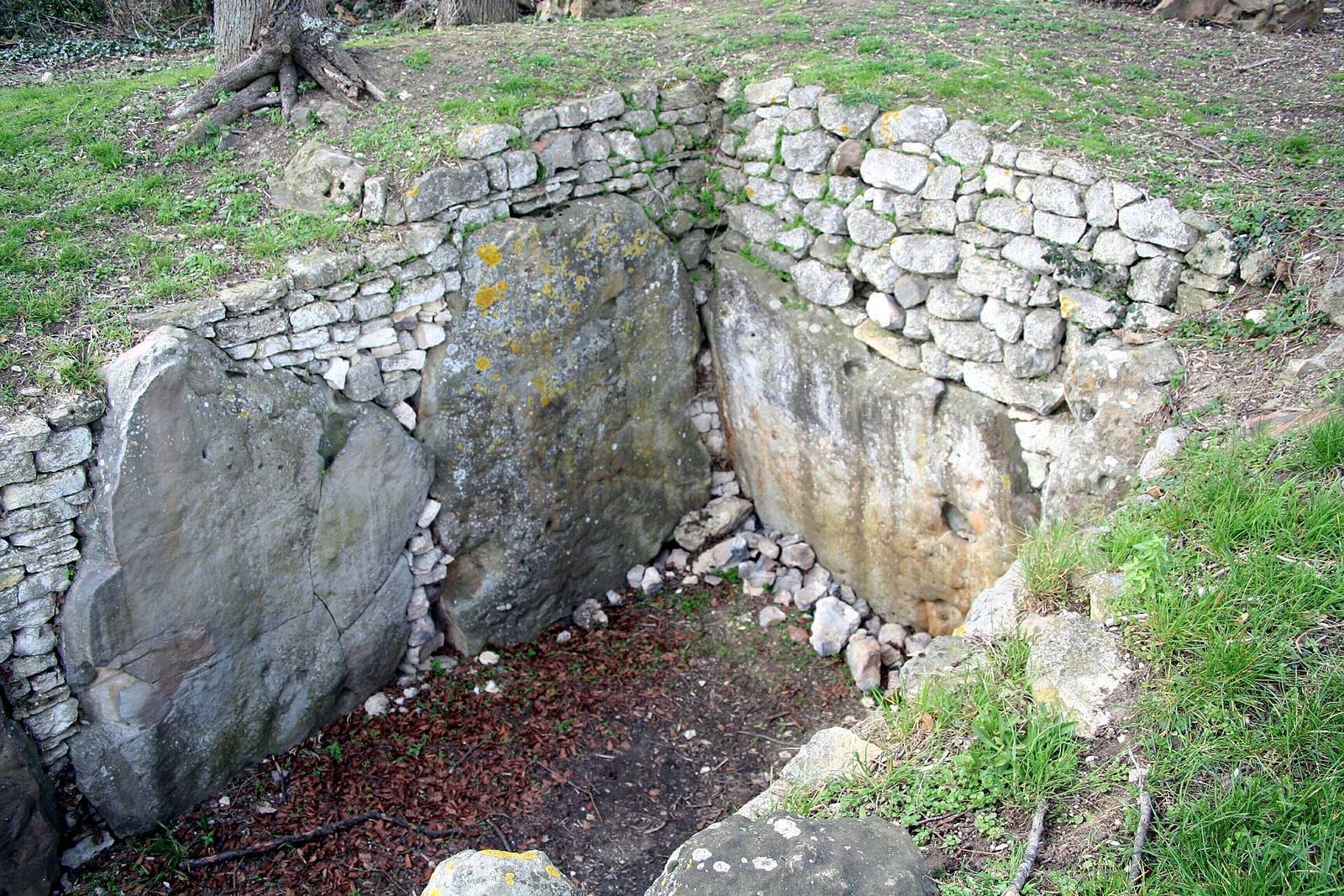
A single slab forms the rear wall, measuring 2.8 metres across and rising 1.7 metres above the paved floor. The side walls consist of large sandstone slabs set upright, called orthostats, with limestone filling the gaps. Nine slabs are described along the west side and seven along the east, with a possible eighth near the rear. Across the forechamber and main chamber, seventeen wall-supporting stones are recorded, with extensive dry-laid limestone masonry between them. A radially positioned slab survives with traces of an angular opening known as a soul hole, traditionally understood as a passage for the deceased’s spirit.
Roof and floor
The underlying ground is limestone, and paving survives across most of the monument. The roof slabs were still present in the eighteenth century, but were reused as building materials during the nineteenth century. In 1889, Mortillet noted one slab still in place and another, measuring 2.4 by 2 metres, overturned inside the chamber. The slabs were probably originally level with the ground; excavated soil has since raised the surface. A nearby source of Bartonian sandstone, a type of sandstone from the Eocene geological period, lies about 250 metres away at Remise des Grès.
Burial deposits and finds
Burial layers and hearths
The central archaeological deposit remained intact for about ten metres, while earlier soundings had disturbed the rear and entrance areas. The deposit included two bone layers, each about 0.2 to 0.3 metres thick, separated by limestone flakes and sandy soil. Limestone flakes also covered the upper layer. Two hearths, one above the other, were found about four metres from the rear end, at depths of 0.85 and 1.25 metres. Associated finds included fragments of coarse wheel-made pottery and Gallic and Roman coins.
Burial goods and human remains
Mortillet’s inventories of grave goods vary, but include an axe preform, flint blades, bone tools, beads made of bone and mother-of-pearl, pierced small-animal teeth, shells reused as pendants, and pieces of black pottery. Estimates based on recovered long bones place the average height of the buried men at 1.61 metres and that of the women at 1.52 metres.