Winterfeld Megalithic Tomb: A Neolithic Passage Grave in Germany
Site at a Glance
- Popularity
- Very Low
- Country
- Germany
- Primary era
- Stone Age
- Eras represented
- Stone Age
- Civilizations
- Unclassified
- Site type
- Burial
- Remains
- Tomb
On this page8 sections
History
The Winterfeld Megalithic Tomb is a passage grave in Germany, meaning a burial chamber reached through a narrow passage. It dates to 3700–3350 BCE and belongs to the Neolithic, the later part of the Stone Age associated with farming and settled communities. The monument is associated with the Deeply Incised Pottery culture, named for the deep-cut decoration on its pottery.
Nineteenth-century records and changes
Johann Friedrich Danneil excavated a burial mound at Lindenberg, north of Winterfeld near the boundary with Sallenthin, around 1835. He probably destroyed the mound not long afterward. A second megalithic tomb may have stood near Winterfeld and been destroyed during the nineteenth century, but whether the Lindenberg mound was that tomb is uncertain. It may instead have been a Bronze Age burial mound.
Danneil first described the surviving Winterfeld tomb in 1843. In a 1962 account, local historian Hermann Künne related that around 1840 about one-third of its stones were used for building as small fields were consolidated into larger ones. Künne also recounted that between 1863 and 1873 ten enclosure stones, including one of the two original guardian stones, were taken for farm buildings. His account tells of a prosperous farmer’s son who promised a pastor help with building farm structures in exchange for persuading his father to approve the son’s marriage to a farmer’s daughter from nearby Cheinitz. After the pastor won the father’s agreement, the son kept his promise.
Investigation and recording
The State Museum of Prehistory in Halle investigated and restored the tomb in 1977 under Johannes Schneider, and the work was repeated in 2001. In 2003–04, the State Office for Heritage Management and Archaeology of Saxony-Anhalt, the Johann Friedrich Danneil Museum in Salzwedel, and the Young Archaeologists of the Altmark association jointly measured and documented all surviving megalithic tombs in the Altmark.
Local traditions
A regional tale links the tomb’s origin to the church towers at Winterfeld and Jeggeleben. In the story, journeymen built the Winterfeld tower, which proved more beautiful than the tower made by master builders at Jeggeleben. Angered by this, the masters hurled fieldstones at the Winterfeld tower, but the stones landed beside the church and formed the tomb.
Remains
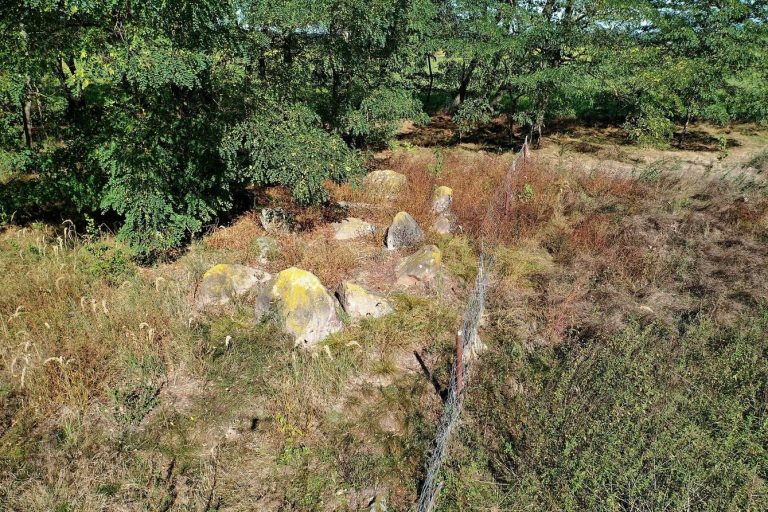
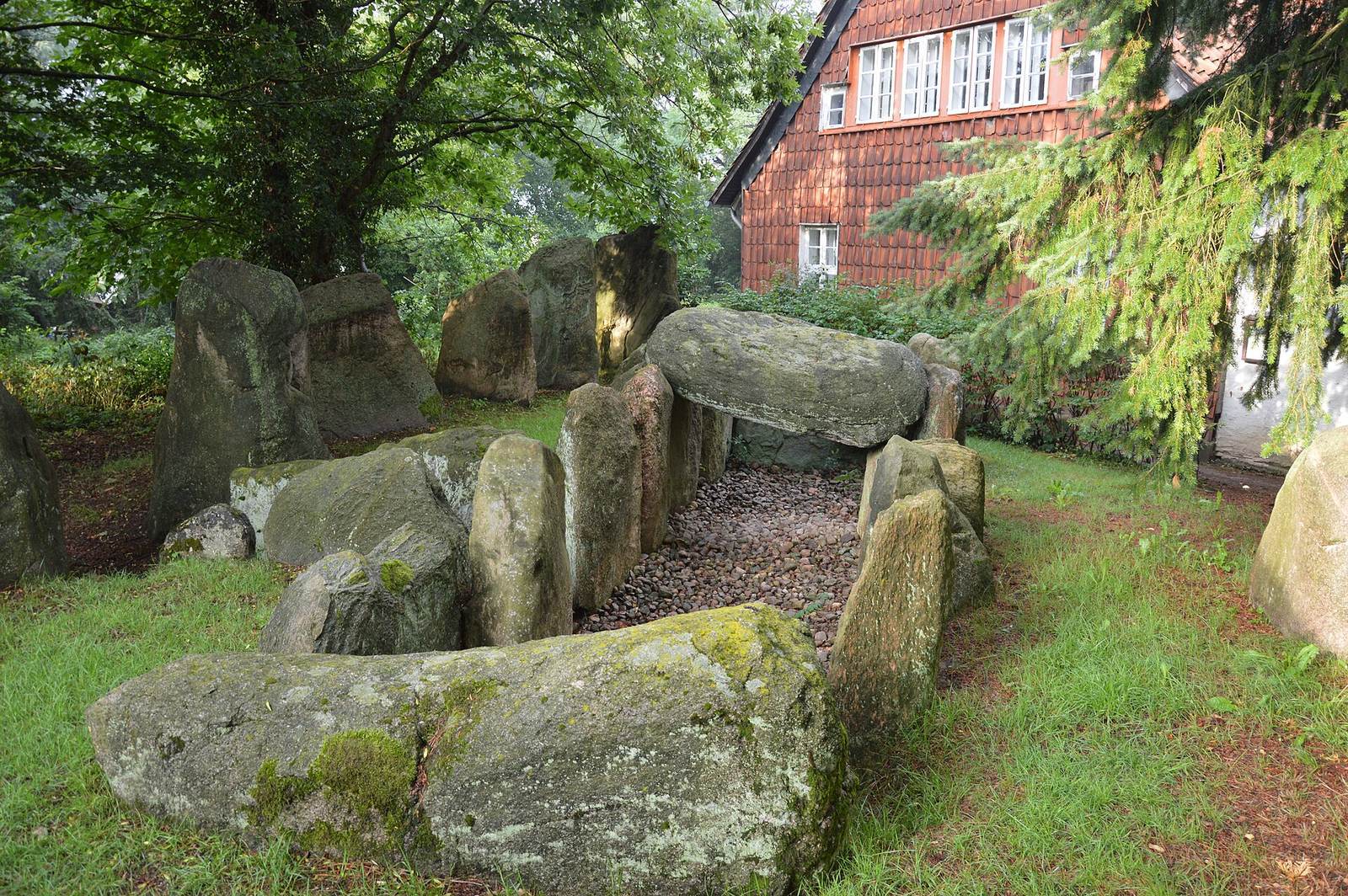
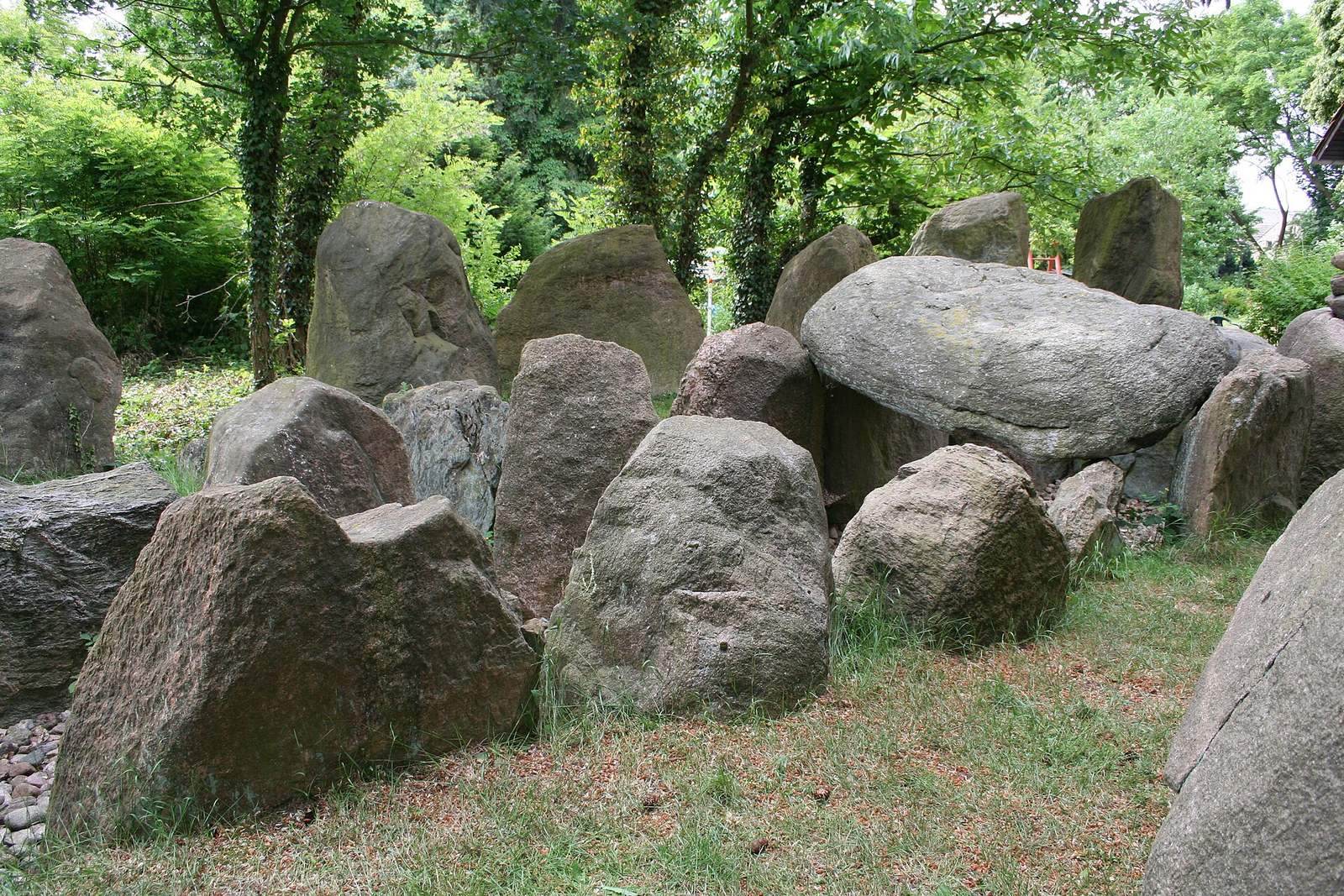
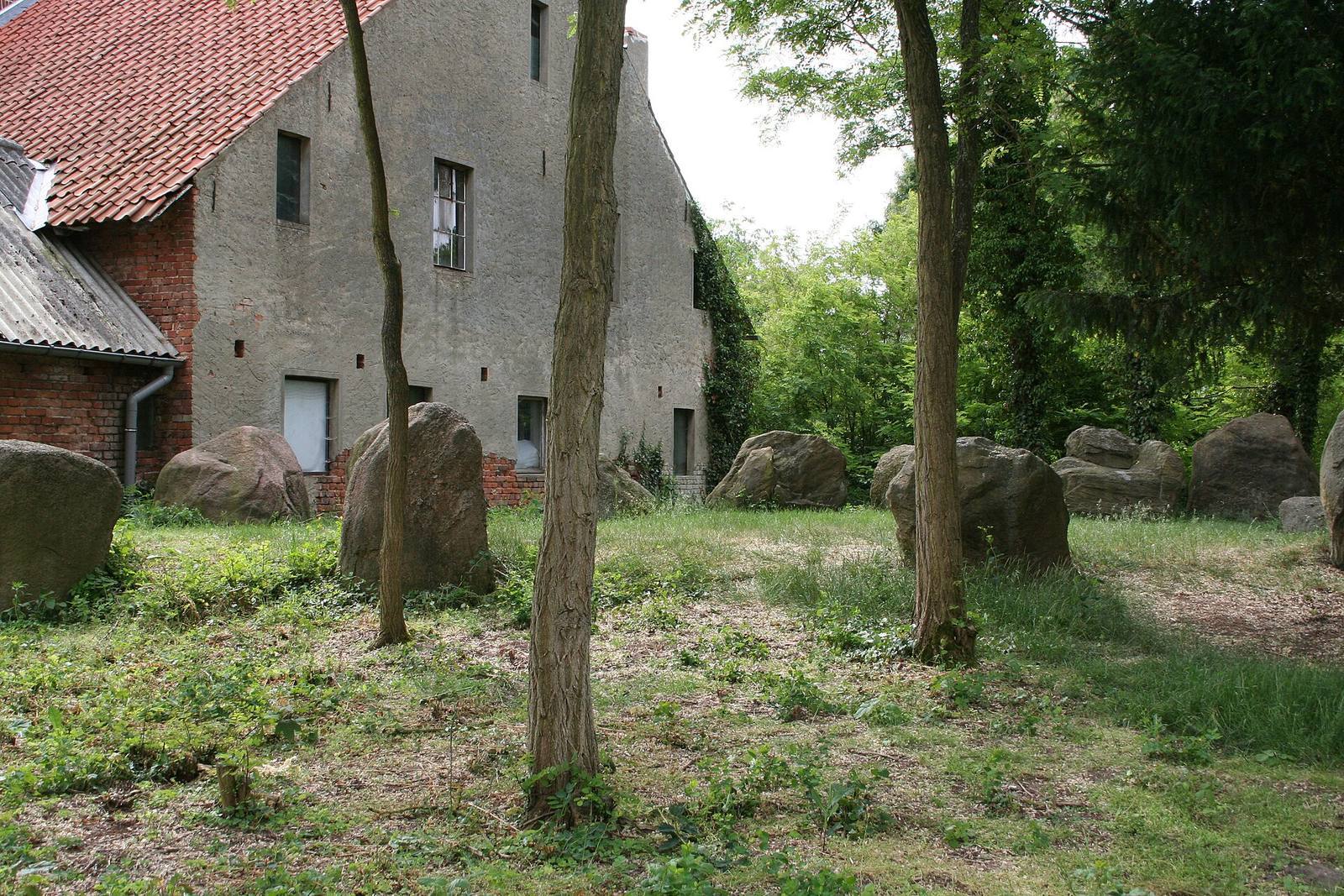
The tomb lies in the center of Winterfeld, east of the village church in the adjoining rectory garden. It is aligned northeast to southwest and originally stood on a mound, which now rises no more than 50 cm. The surviving layout includes a rectangular chamber and entrance passage within a partly preserved trapezoidal stone enclosure.
Burial chamber and passage
Fourteen wall stones and several capstones formed the rectangular chamber, which measures 7.4 m long, 1.6–1.7 m wide, and about 1.6 m high. Its surviving capstone measures 2.2 by 1.4 by 0.4 m. A passage enters from the northern end of the chamber’s southeast side. Four small wall stones define it; it is 2.3 m long, 0.6–0.8 m wide, and 1.0 m high. Three threshold stones form its floor, with gaps of 1.3 m and 1.0 m between them. A gable stone closes the chamber at the southwest end. Its upper surface bears about 30 cup marks, small cup-shaped hollows carved into the stone.
Stone enclosure
The trapezoidal enclosure survives as 19 stones and extends for more than 26 m. Its original length is estimated at 54 m, and its former width ranged from 5.5 m to at least 7.3 m. At the southwest end, one of the original guardian stones rises distinctly above the other enclosure stones. It measures 2.1 by 1.6 by 0.8 m.
Lindenberg mound
The round mound at Lindenberg had inner and outer stone enclosures. Its excavation yielded five human skeletons and several pottery vessels.