Church of Saint Ladislaus: A Roman Catholic Parish and Minorite Church in Spišský Štvrtok, Slovakia
Site at a Glance
- Popularity
- Low
- Country
- Slovakia
- Primary era
- Medieval
- Eras represented
- Medieval, Early Modern, Modern
- Civilizations
- Austria-Hungary, Habsburg, Hungarian
- Site type
- Religious
- Remains
- Church
On this page11 sections
History
The Church of Saint Ladislaus in Spišský Štvrtok, Slovakia, is a Roman Catholic parish and Minorite monastic church built in the 13th century. Dedicated to Ladislaus I of Hungary, an 11th-century king later venerated as a saint, it combines Gothic design with Romanesque elements. Gothic architecture is associated with pointed arches and ribbed vaults, while the earlier Romanesque style is characterized by rounded arches and massive masonry. The Minorites belong to the Order of Friars Minor, a Franciscan religious order.
Medieval origins and additions
A wooden parish church may have stood in a nearby village named for Saint Ladislaus in 1215. It may have been destroyed during the Mongol invasion of 1241–1242. The present church was built in the 13th century, incorporating Romanesque features into its Gothic design.
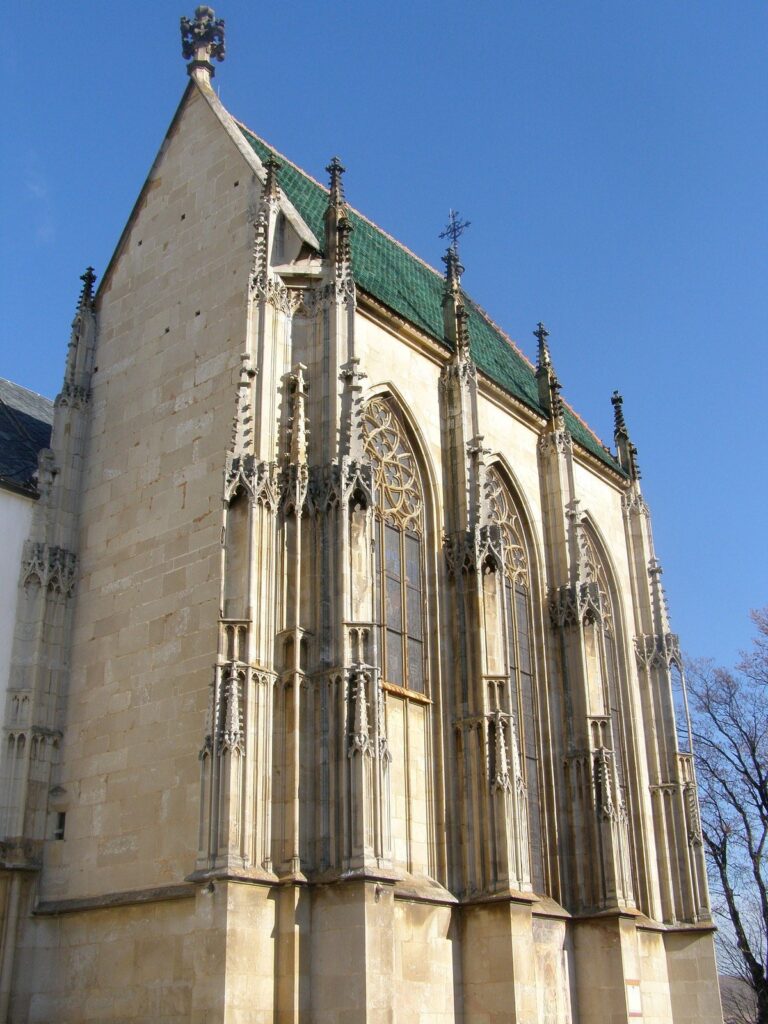
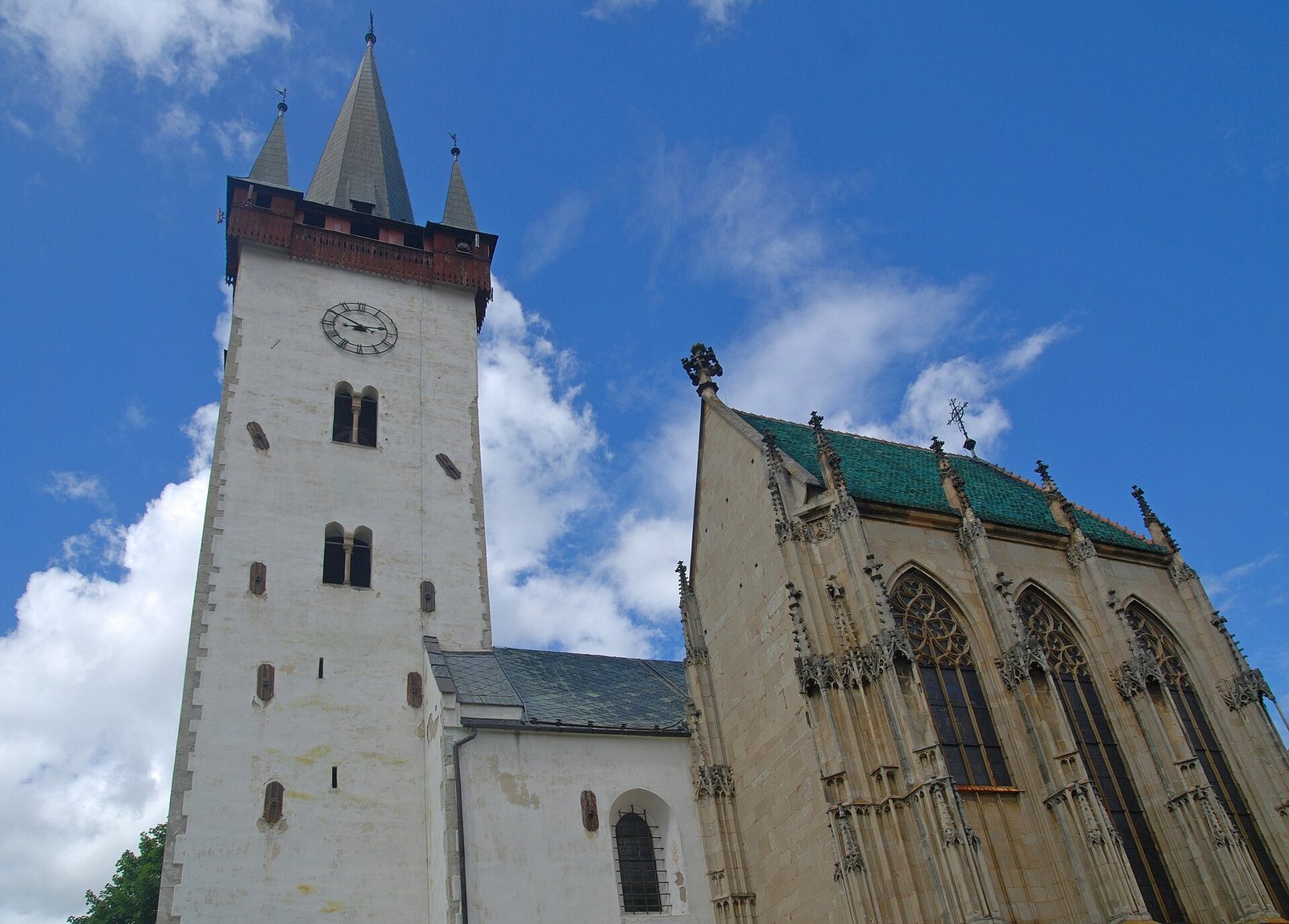
Around 1402, the church was judged to be in serious disrepair and underwent extensive repairs. A square tower was added on its southwest side. In 1473, Emmerich Zápolya, a Hungarian magnate and palatine, a senior royal official, funded a chapel on the south side. The former main entrance was incorporated into the chapel, prompting the creation of a new entrance and a narrow passage leading toward the presbytery.
Warfare and confessional change
Warfare and raids repeatedly affected the church between the 15th and 17th centuries. In 1447, troops led by John Hunyadi, a Hungarian commander and statesman, attacked it. After 1500, robbers based at Muráň Castle raided the church repeatedly. In 1530, Hieronymus Łaski requisitioned all its bells for Zápolya’s troops.
During the Reformation, a 16th-century movement that brought about Protestant churches and major changes in Western Christianity, the church became an evangelical place of worship. The strong presence of the German-speaking Spiš Saxons contributed to this change. Roman Catholics continued to hold services in the Zápolya Chapel until 1672, when the church returned to Catholic hands. Insurgent forces led by Stephen Bocskai, a Transylvanian prince heading an anti-Habsburg uprising, attacked it in 1605. In 1680, Kuruc insurgents, associated particularly with uprisings against Habsburg rule, plundered the church and the nearby Minorite monastery, which had been founded only a few years earlier.
Baroque refitting and restoration
The interior was redecorated in the Baroque style, an ornate European style of the 17th and 18th centuries, in 1693 and again in 1747. Much of the Gothic furnishing was lost, including the original main altar dedicated to Saint Ladislaus. A Gothic winged altar made around 1490 for Saint Catherine of Alexandria, traditionally venerated as an early Christian martyr, was transferred in 1806 to the Catholic church in Turany.
A fire in 1869 badly damaged the roofs of the church, its tower and chapel, and the nearby monastery. Restoration followed in 1899–1901 after local fundraising. The church is a National Cultural Monument of Slovakia and was entered on the country’s Central List of Monuments on 15 October 1963.
Remains
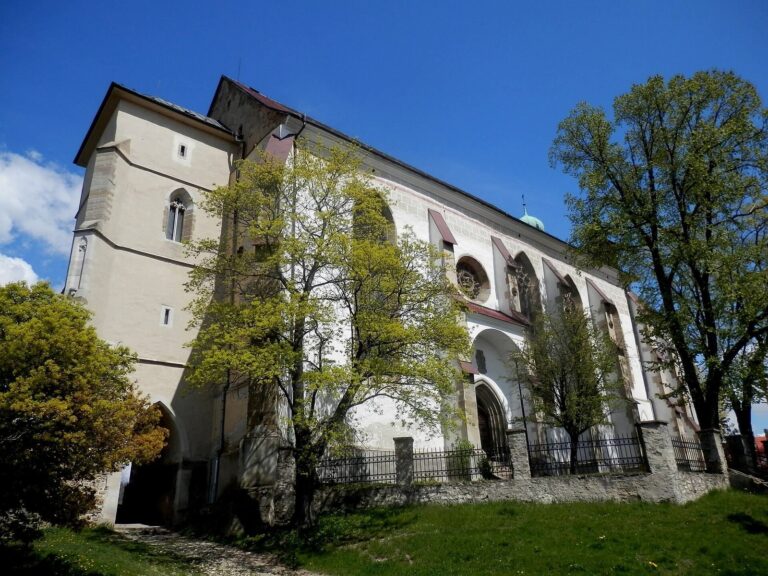
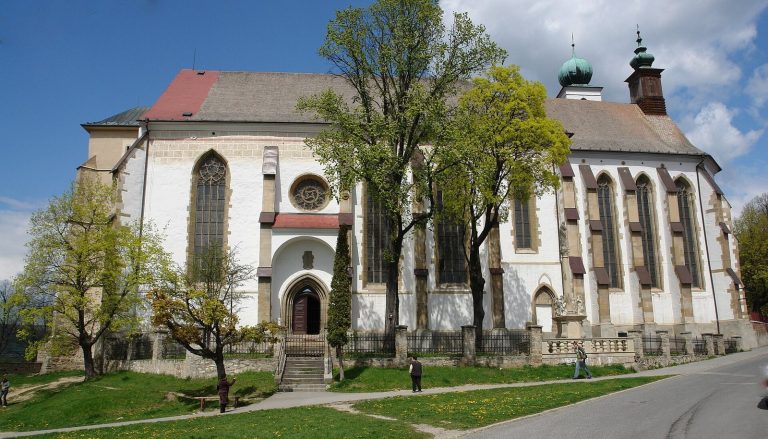
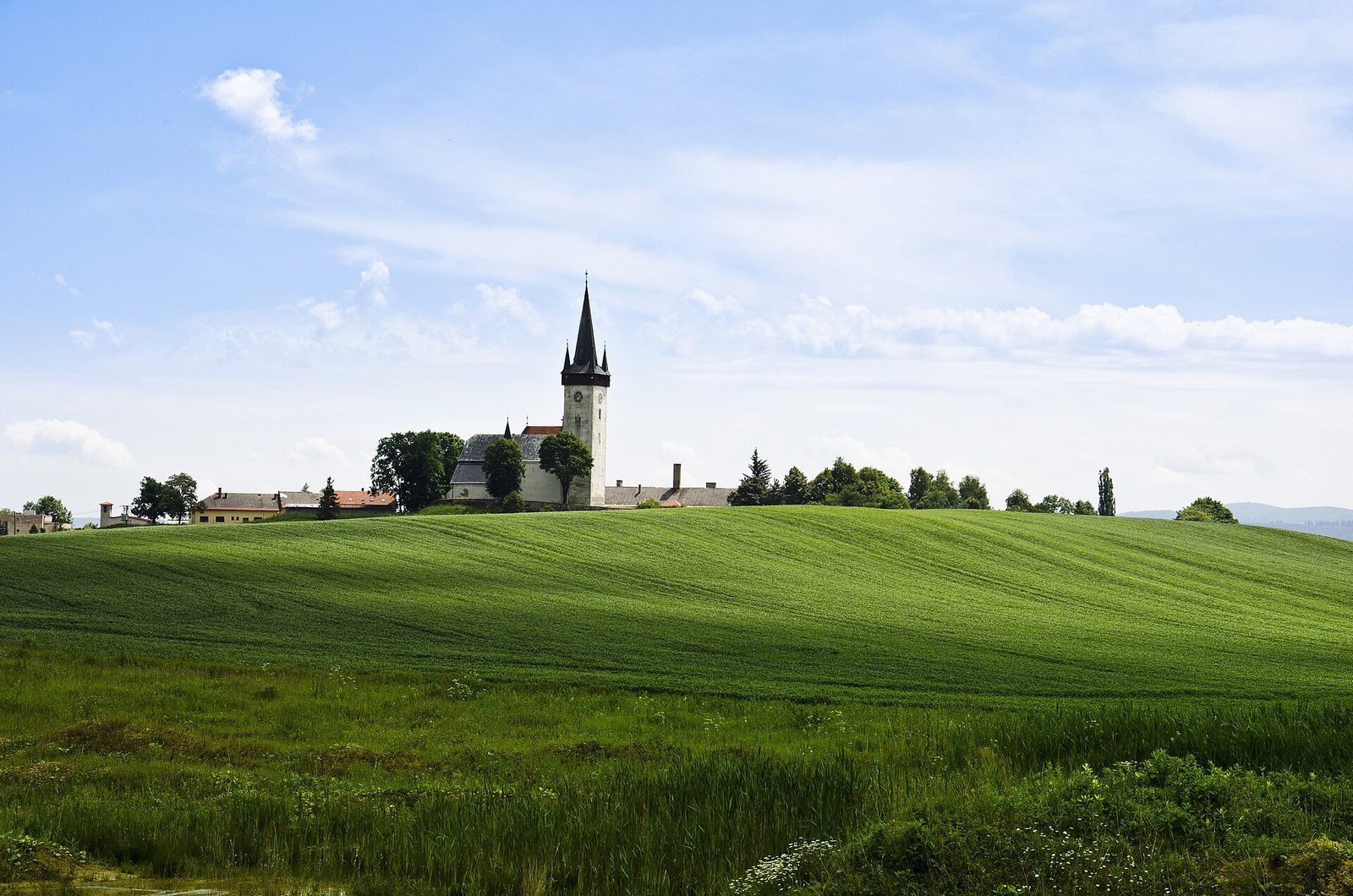
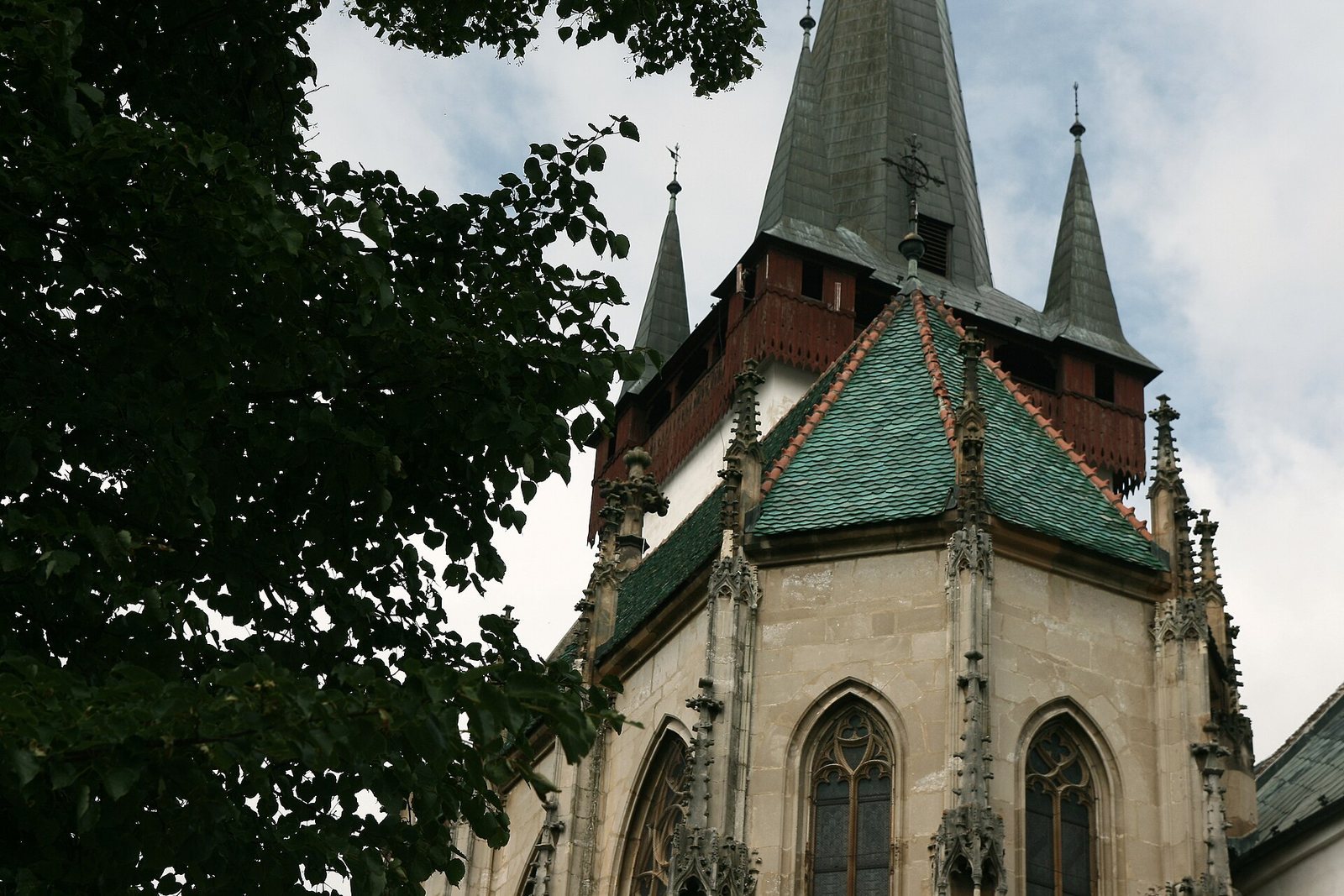
The church stands at the end of a ridge that slopes down on three sides, making it a local landmark. Its plan has a single nave, the main body of the church, a square presbytery, the area around the main altar, with a straight end, a sacristy on the north side, and one tower. The Zápolya Chapel is attached to the south side of the nave. Plain facades and the combination of Gothic and Romanesque features characterize the building.
Structure and vaulting
The square tower rises on the church’s southwest side. Its upper level has paired Romanesque windows and ends in a Neo-Gothic pyramidal spire with four slender turrets. These Gothic Revival additions date to late-19th-century work; Neo-Gothic refers to the 19th-century revival of Gothic forms. The presbytery and north sacristy have cross-rib vaults, formed by intersecting structural ribs. The nave has a barrel vault, a continuous tunnel-shaped ceiling, with lunettes, curved recesses where the vault meets the walls. The entrance arrangement includes the chapel entrance and a narrow passage leading toward the presbytery.
Altars
The main Baroque altar of Saint Ladislaus dates to 1704. Columns and pilasters, shallow vertical projections from the wall, create its cloister-like frame, which has a smaller upper section, sculptures, a painting, and acanthus ornament. A statue of Saint Ladislaus occupies the center; later paintings of the four Evangelists were added to the side doors. Matching side altars from the first half of the 18th century are dedicated to Saint Francis of Assisi, a preacher who founded the Franciscan movement, and Saint Anthony of Padua, a 13th-century Franciscan preacher. Their columned upper sections frame vertically arranged central paintings, with Baroque sculptures beside the main images. A Baroque Crucifixion altar in the Rococo style, a lighter ornamental style that developed from Baroque, dates to the second half of the 18th century. Once beneath the choir, it is now in the sacristy.
Other interior furnishings
Pulpit
The mid-18th-century Baroque pulpit rests on a caryatid, a sculpted figure serving as a support, and incorporates a statue of an angel. Spiral columns and statues of the four Evangelists surround the preaching platform. The canopy is decorated with spiral scrolls and angel figures, while panels of acanthus ornament decorate the stair railing.
Baptismal font, statues, and pews
A stone baptismal font in the early Gothic style dates to the 13th century. Above the arch separating the nave from the presbytery stands an early-18th-century Baroque statue of Mary as the Immaculate Virgin, a title referring to the Catholic belief that she was conceived without original sin. Rays form a radiant glory around the figure. The church also contains a rustic Baroque statue of the Virgin Mary from the late 18th century. Its Rococo pews date to the 18th century and have side panels decorated with rocaille, irregular shell-like ornament.
Sacristy objects
The sacristy holds a mid-18th-century Baroque reliquary, a container for religious relics, made of gilded silver and decorated with rosettes. Its other furnishings include an early-18th-century Baroque crucifix carved from polychromed wood; a mid-18th-century Baroque relief of Jesus, Christianity’s central figure, beneath the Cross; and a mid-18th-century carved, polychromed wooden statue of Saint John the Evangelist, traditionally identified as an apostle and author of the Fourth Gospel. The statue came from a Calvary group depicting the Crucifixion.