La Custodia: A Protohistoric Settlement in Navarre, Spain
Site at a Glance
- Rating
- 4.5
- Popularity
- Very Low
- Country
- Spain
- Primary era
- Iron Age
- Eras represented
- Stone Age, Bronze Age, Iron Age, Classical
- Civilizations
- Unclassified
- Site type
- City
On this page10 sections
History
La Custodia is a large protohistoric settlement near Viana in Navarre, Spain. Possible traces reach back to the Paleolithic, while remains securely extend from the Neolithic through the Bronze Age and successive Iron Age phases, into the beginnings of Romanization, the adoption of Roman political, social, and cultural practices, in the first half of the first century CE. Its ancient identity and relationship to nearby sites remain debated.
Ancient names and identity
The Greek geographer Strabo refers to a Beronian city called Varia, while the Roman historian Livy gives the name Vareia. La Custodia is widely associated with that city, and the coin legend Uarakos may preserve its indigenous name. It has also been proposed as the capital of the Berones, a people of pre-Roman Iberia, but the identification is not certain.
La Custodia should be distinguished from the Roman settlement beneath the Varea district of Logroño, where no pre-Roman archaeological layer has been identified. One debated explanation proposes that an earlier city was destroyed and its inhabitants founded a new settlement elsewhere, retaining the old name. The location of Roman Vareia has also been associated with Monte Cantabria. Some interpretations instead treat La Custodia as the main settlement and Monte Cantabria as its fortress, or consider the latter a defensive stronghold and river port within a wider complex. The Ebro was navigable from Tortosa to Varia at least into the eleventh century.
Ancient territorial boundaries add to the uncertainty. The upper Ega has been associated with the Varduli, another pre-Roman people, while the Ebro’s right bank as far as Calahorra has been linked to the Berones. The Ega valley was traditionally placed at the eastern edge of Beronian territory north of the Ebro. A later proposal locating Vasconian Curnonium at Los Arcos shifts that boundary to the Linares River. Such frontiers are difficult to locate and need not have been fixed lines. The location of the Barskunes mint, a place where coins were made, is also disputed: some researchers place it at La Custodia, while others identify the site with Uarakos and propose Pamplona or Rocaforte/Sangüesa for Barskunes.
Sertorius and Vareia
La Custodia has been proposed as the city attacked by Sertorius during his campaign of about 77 BCE. Sertorius was a Roman commander in the late Republic who opposed Pompey, a Roman general and politician. Livy describes Vareia as the region’s most powerful city. If La Custodia was Vareia, it may have supported Pompey, giving Sertorius a reason to attack.
Livy places Sertorius’s advance from Calagurris toward Beronian territory after a river crossing, possibly the Ebro or the Cidacos. A nighttime clash at Vareia between Roman forces and Beronian and Autrigon cavalry is considered possible, and a Roman victory probable. The episode has also informed proposals placing the Beron-Vascon boundary near Alcanadre, though its precise course remains uncertain.
Archaeology and protection
Juan Cruz Labeaga identified archaeological material at La Custodia in 1971. In July 1973, archaeologists led by Amparo Castiella conducted two test excavations to establish the date of ceramics brought to the surface by farming. Magnetic surveys and ground-penetrating radar in late 2017 and early 2018 revealed evidence of a buried city and its urban plan. Spain’s National University of Distance Education published the work as a research and protection project. A small excavation in 2018 and later campaigns extended investigation of the site.
Deep agricultural work, especially soil preparation for vineyards, brought up much of the recovered material and separated it from its original layers. Metal-detector looting may also have removed coins, particularly during the final two decades of the twentieth century. A nineteenth-century road between Viana and Logroño cut through the settlement before its archaeological importance was recognized. Viana added archaeological protections to its planning rules in 1991, including limits on construction, deep soil disturbance, gravel extraction, and use of woody resources, alongside provisions for municipal land acquisition or exchange. A regional order protected La Custodia in 1994. In November 2023, the Government of Navarre announced plans to designate it an Asset of Cultural Interest, a formal Spanish heritage-protection category.
Remains
Setting and buried settlement
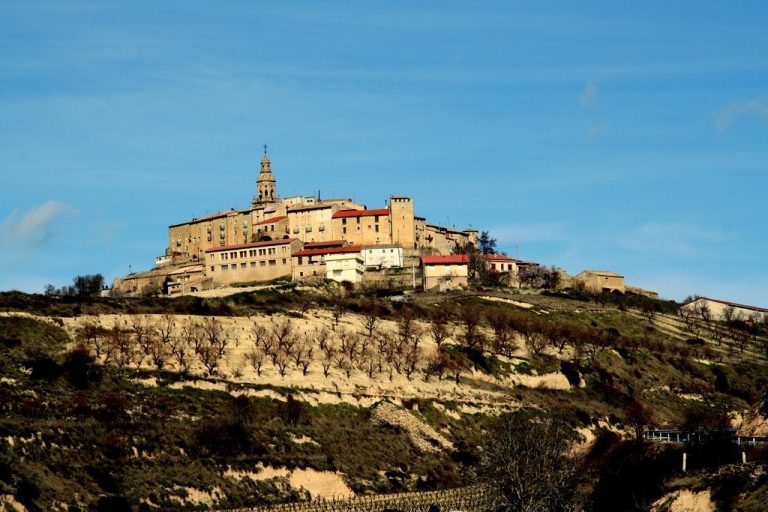
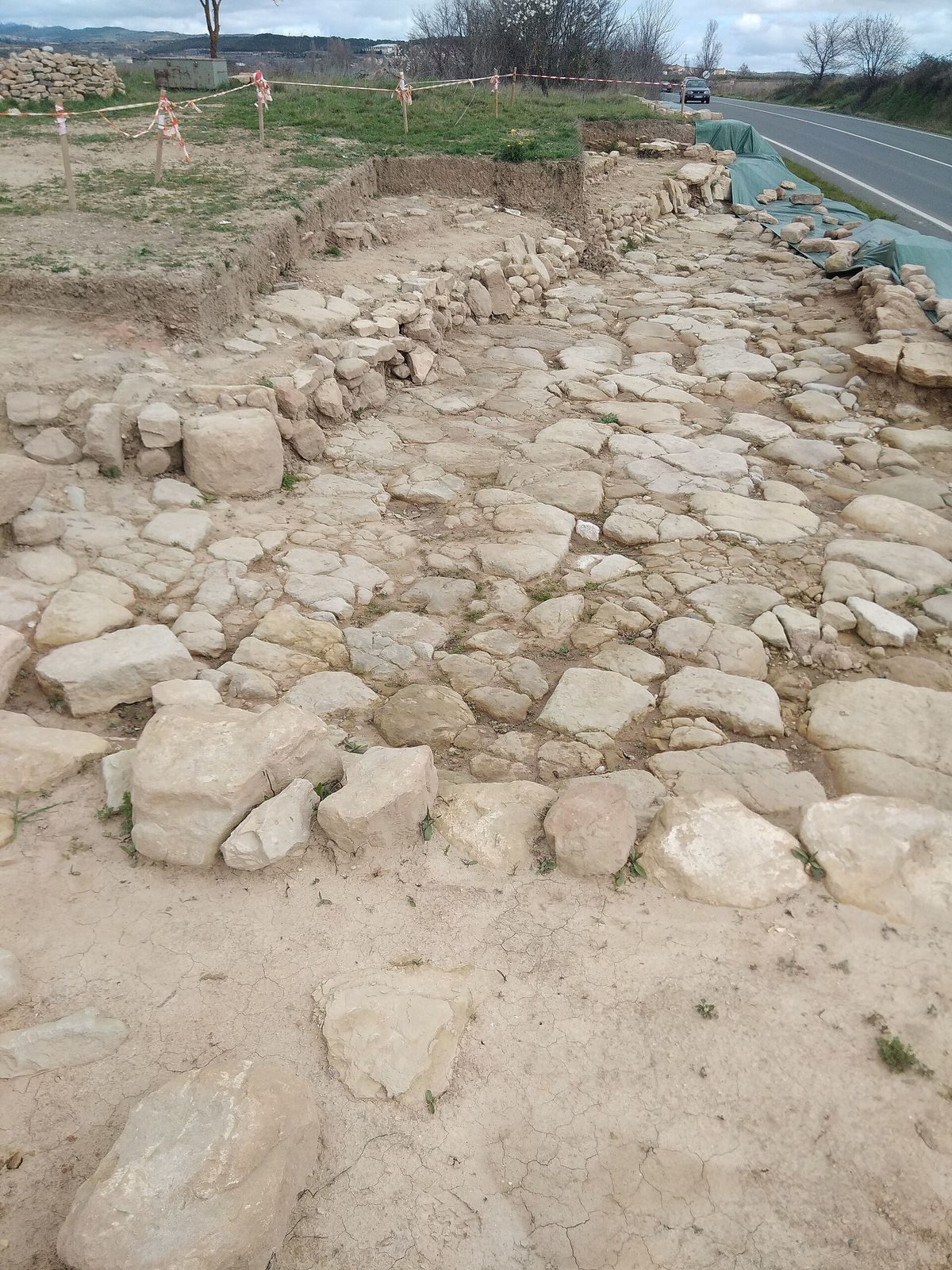
The settlement covers about 12.5 hectares on a flat-topped rise roughly 1.5 km from Viana. It stands at around 400 m above sea level, with listed elevations ranging from 405 to 415 m. Two streams meet along its southern side. The rise slopes 10 to 15 m down toward their edges, while the ground becomes more gradual to the north. The buried urban structure lies at shallow depth. A 2018 excavation in a road trench exposed a street surface and building remains.
At the 1973 test areas, ash lay beneath a layer of adobe and ceramics, a sequence indicating that fire destroyed the settlement. Further fire deposits were exposed during the 2018 excavation.
Portable finds
Hospitality tokens
Six hospitality tesserae, small tokens associated with formal agreements of hospitality, have been found at La Custodia. Four appear to carry personal names in Iberian characters, in a language considered close to Celtiberian, a language associated with peoples of inland Iberia. Inscriptions tentatively dated to the second century BCE refer to Sakas of the Zerkuakotars, the son of Loukio, Bunton, and Sakarokas. Two further tokens, found in 2021, refer to Memon of the Telkaskotars and to Tirtakon and Bursao, now Borja. The latter inscription is dated between the second century BCE and 76 BCE.
Coins
By 2000, 139 coins bearing Iberian inscriptions and four with Latin characters had been collected at the site. Six are from the Uarakos mint, out of 22 examples of that mint known overall. A group of 52 coins attributed to Barskunes comprises 36 asses, plural of as, and 16 denarii, both ancient coin denominations. Other finds include three asses of Areikoratikos, attributed to Ágreda; 16 of Bolskan, attributed to Huesca; four of Sekaisa, linked to the area near Calatayud; and 12 asses and 17 denarii of Sekobirikes, attributed to Pinilla de Trasmonte. Smaller groups represent as many as 12 additional Iberian-character mints. Four Roman coins are also known, two from the Republic and two from the Calahorra mint.
Brooches and other objects
The site has yielded 46 Hispanic ring-shaped brooches, including 25 boat-shaped examples. Because they were collected from the surface, their dates are uncertain; comparisons with finds elsewhere suggest a range from the late third century BCE to about 75 BCE. Roughly 360 similar brooches are known from around 50 sites. Other finds include abundant ceramics, bronze brooches, amulets, neck rings, and pendants, as well as belt plaques decorated with silver niello, a dark inlay used on engraved metal. Some excavated materials and objects can be viewed at the Navarre Museum.